Anna Pingel
June 9, 2026
Improving Voter List Maintenance Through Amending the National Change of Address Form
Key Takeaways
« Removing outdated registrations from the voter rolls is a difficult task under federal law, as state officials must wait several years to remove voters who fail to respond to notices confirming their address.
« Americans move frequently, and coupled with low response rates to these notices, this creates a significant number of outdated registrations.
« Adding a checkbox to the USPS Change of Address form allowing voters to request removal from voter registration lists in previous states of residence will help keep voter rolls accurate and up to date.
Introduction
Maintaining accurate voter rolls, which is the list of registered voters, is a vital responsibility for state and local election officials across the country. It helps ensure that both state and federal elections are fair and trustworthy, as the voter rolls are supposed to dictate who is eligible to cast a ballot. This task of voter roll maintenance is both absolutely essential and immensely difficult. Voters move frequently across state lines, and often there is a significant lag in updating the voter rolls in the old state of residence to reflect that the individual no longer resides there. To reconcile how voters so frequently move with the vast scale of outdated registrations this creates, this report proposes adding a checkbox to the United States Postal Service (USPS) Change of Address (COA) form allowing voters to manually request immediate removal from the voter rolls in the jurisdiction from which they are moving, as well as a new section for proof of identity if requesting removal.
The Voter Roll Maintenance Problem
There are several factors that make voter roll maintenance extremely difficult in modern-day America, primarily a combination of mobility rates, certain federal laws, and state laws. Accurate elections depend on accurate voter rolls, and the current list maintenance protocols do not ensure this standard is met.
Americans Relocate Frequently, Which Complicates Voter Roll Maintenance
Mobility rates are the first factor complicating voter rolls. The sheer volume of Americans relocating each year creates a persistent challenge for election officials tasked with maintaining accurate voter rolls. According to the most recent U.S. Census Bureau data, almost 12% of the U.S. population relocated in 2024 (U.S. Census Bureau, 2025). This represents millions of address changes that voter rolls must somehow track and reconcile; each one of these moves creates a discrepancy between a voter's previous voter registration address and their actual residence, generating outdated records that linger on the rolls and create serious vulnerabilities High-turnover populations are precisely those where voter roll maintenance is most critical and yet are the most difficult to properly track for voter roll maintenance.
Federal law attempts to address this problem. Three specific federal provisions under the National Voter Registration Act (NVRA) outline the authority granted to states for managing voter registration when it comes to Americans relocating.
- Section (a)(3)(A) allows a voter's name to be removed from the voter rolls at their request.
- Section (d)(1) specifies that removal on the basis of a change in residency is not permitted unless that individual confirms in writing that they have moved outside of their original jurisdiction.
- Section (c)(1)(A) establishes that states may create a program identifying voters whose addresses may have changed, using information provided by USPS (National Voter Registration Act, 1993).
States typically identify voters who may have moved through change of address information provided by USPS, but this information alone cannot fully verify changes in residency for removal. Instead, it simply initiates a notification process with the voter to correct the address on record (U.S. Department of Justice, 2024; United States Postal Service, n.d.). When change of address information suggests that a voter may have moved, election officials must send a forwardable notice having that individual confirm in writing that their voter registration address has been changed before voter rolls can be updated. If the voter does not respond, they cannot be removed until they have failed to vote in two consecutive federal general elections. What this means is that in the most common scenario—in which a voter silently moves and neither responds to the voter roll maintenance mailer nor votes—the formal removal process can span up to four years, during which time he or she remains on the voter rolls in any state in which he has resided. This scenario is due to the fact that a change in address alone does not confirm a move out of state (and thus removal from that state’s voter roll). Most moves occur within the same state, which does not necessitate their removal from the state voter roll but may affect eligibility to vote in the jurisdiction in which they are registered (U.S. Census Bureau, 2025).
Data from the Election Administration and Voting Survey (EAVS) reveal that the largest share of registration removals (33.5%) is attributed to voter non-response—specifically, when notices are unreturned, and individuals have not voted for two consecutive federal general elections. Even with millions of Americans moving each year, only a tiny fraction of voters (2.6%) were removed from registration rolls between 2022 and 2024 by their own request (U.S. Election Assistance Commission, 2025, p. 153, Figure 7).
The vast majority of mailings sent to voters to confirm their address (69.7%) are neither returned by the voter nor returned by USPS as undeliverable, and just 4.4% of these are returned by the voter confirming invalid registration (U.S. Election Assistance Commission, 2025, p. 151). For whatever reason, these notices are ignored. It is not an effective process for the goal pursued. The unreturned notices result in moving the voters associated with the addresses to the inactive registration list, which is then subject to the two consecutive federal election cycle wait period. Under this process, a voter who moves once a year could be technically eligible to vote in three to four different jurisdictions states. This presents a serious vulnerability to elections administration, as states do not reconcile lists of who voted after an election, and violates the principle of one vote, by one voter, cast at one time.
The scale of the inactive voter records is massive. In just the swing states that report EAVS data, there are over 4.7 million inactive voters (Election Administration and Voting Survey Comprehensive Report, 2024).
- Georgia - 1,059,374
- Arizona - 708,551
- North Carolina - 853,624
- Michigan - 1,172,570
- Pennsylvania - 767,259
- Nevada - 202,810
When some elections are decided by a mere handful of votes, the presence of inactive voters for so long on the voter rolls poses a serious vulnerability that demands attention.
The NVRA Blackout Period
In addition to the problem of high mobility, the NVRA imposes another structural constraint that limits when states can clean their voter rolls: the 90-day blackout period for voter roll maintenance, significantly shortening the window available to election officials for ensuring accuracy. Under Section (8)(C)(2) of the NVRA, states must complete any program that systematically removes the names of eligible voters from the official list no later than 90 days before a primary election or general election for federal office (National Voter Registration Act, 1993). Once that window closes, election officials enter a blackout period and cannot engage in systematic voter roll maintenance; instead, they are limited to individualized updates. Practically, this works out very poorly: under the NVRA, about half of any election year is off-limits for systematic voter roll maintenance (i.e., two periods of 90 days).
If a state's federal primary election occurs less than 90 days before the federal general election, the state must complete any systematic removal program for the entire election cycle no later than 90 days prior to the federal primary, meaning no further systematic activity may take place between the primary and general elections. Given that millions of Americans move each year, this compressed timeline means that a significant number of address changes occurring in the months immediately before an election will not be reflected in voter rolls until well after ballots have been cast.
These laws can leave voter rolls bloated with phantom registrations susceptible to error or fraud; under the current framework, layering the blackout periods and a multi-year two-cycle removal mandate on top of a high-mobility population produces voter rolls that are perpetually playing catch-up with the reality of where voters actually live.
State Laws Compound the Problem
Several state laws are worth noting due to their compounding of these federal constraints.
- Automatic Voter Registration
The first policy is automatic voter registration (AVR), in which individuals obtaining a driver's license are simultaneously added to the voter rolls. This policy is a major contributor to bloated and inaccurate voter rolls. Non-citizens and otherwise ineligible individuals can be added to voter rolls under this policy and are very difficult to remove. The greatest concerns with AVR stem from the proven inconsistencies and errors in the voter registration process, as well as the difficulty of administering AVR. Government databases are not perfect and sometimes result in ineligible individuals being registered or errors being made on an eligible voter’s information.
California serves as a stark example of how AVR can disenfranchise voters due to errors and inconsistencies. Upon implementation in 2018, the new system was exposed to foreign hacking, glitching upon use, and even instances of complete failures. There were over 105,000 errors in registration in just the first year, with thousands of duplicate voter profiles and registering people to the wrong party. Over 4,000 people opted out of registering but were placed on the voter roll anyway, against their wishes. Some of these errors were due to sloppy data entry by state employees (Vasologambros, 2019). While AVR may seem like a shortcut through bureaucracy, it can be the exact opposite by creating more bureaucratic mess for the state and local governments to clean up.
- Same-Day Voter Registration
The second policy is same-day voter registration (SDR), in which a person can walk into a polling location, register to vote, and cast a ballot immediately after. This also poses a serious vulnerability for voter roll accuracy (Pingel, 2024). The primary issue with SDR is the complete lack of voter identification verification. Because SDR does not afford election officials enough time to check voter eligibility, the risk of accepting votes from ineligible voters drastically increases. Ballots could easily be accepted from voters who do not live in the district or are otherwise ineligible, especially in states without robust identification checks. Once elections are certified, which typically happens only weeks after the election, votes cannot be discarded or marked as fraudulent.
In North Carolina, for example, after the 2008 election in which same-day registration commenced, several North Carolina counties voiced concerns about their experiences and perspectives on same-day voter registration. They reported “numerous undeliverable voter registration cards returned after the canvass timeframe, which allowed the voter’s vote to count and it should not have” (Civitas Institute, n.d.). The counties could not verify the voter’s address prior to that person casting a ballot, but these votes were counted. Ultimately, it is much easier to get on a voter roll, even if eligibility is in question, than it is to be removed from one.
The National Change of Address Solution
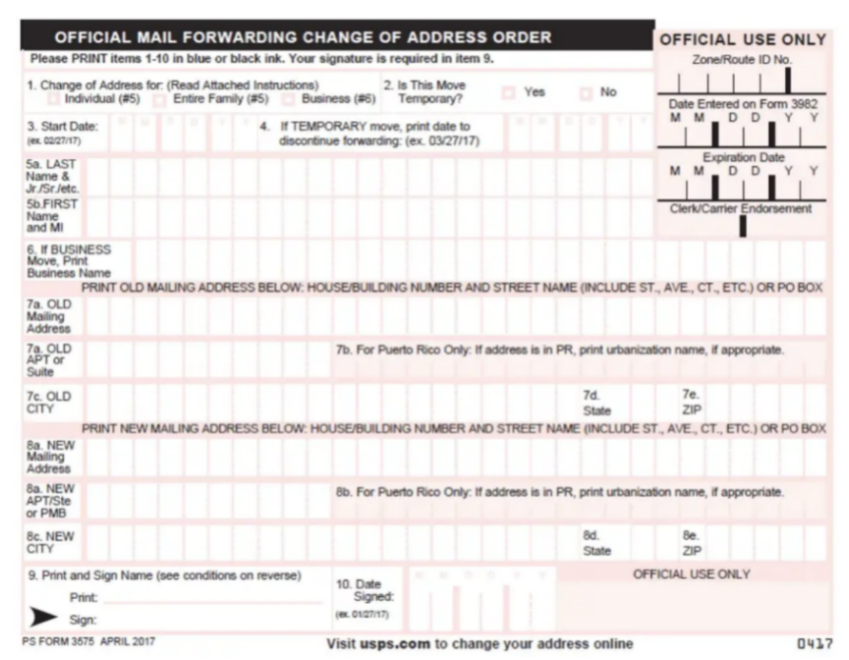
To improve the effectiveness of voter roll maintenance, USPS should consider implementing a change to the existing National Change of Address (NCOA) system. The NCOA system is a database maintained by USPS storing COA request records, utilized to identify people who have moved (United States Postal Service, n.d.). If USPS adds a checkbox to the COA form allowing the individual filling it out to request removal from the jurisdiction they have left, election administrators will be able to better align voter rolls with America’s high mobility population. This checkbox would constitute a request for removal from a voter roll under the language of the NVRA and would explicitly say as much in the description next to it.
Currently, when a person submits a COA form to USPS, that information is compiled into the NCOA database, which election officials can then cross-reference against their voter rolls. By matching voter registration records against NCOA data, election officials flag registrations where a reported address change suggests a voter may have moved. Once a voter's record is flagged through an NCOA match, however, they are still subject to the waiting period of two federal cycles with mailers not returned.
Individuals typically submit the COA form to USPS either online or in-person at a local Post Office to have their forwardable mail directed to their new address. Within this system is the NCOALink, a dataset containing approximately 160 million permanent change of address records covering the previous 48 months, used by organizations licensed by USPS, state election officials, and other partners to update mailing lists and address records (United States Postal Service, n.d.). This entire process results in voters languishing on voter rolls when they have in fact relocated somewhere else. Fortunately, amending the COA form can solve this problem.
Reform the Form: One Simple COA Form Change Will Vastly Improve Voter Roll Maintenance
Noting how USPS already collects the most current addresses through its NCOA program, linking this mechanism to the voter removal process would help streamline voter roll maintenance. Specifically, a checkbox could be added to the USPS COA form to allow voters who relocate to another state to acknowledge their move and request removal from the voter rolls in their original jurisdiction. USPS would then forward the NCOA record with the voter’s request to election officials in the voter’s previous jurisdiction to be removed.
Not only would these procedures be highly effective in ensuring that voter rolls are current, but would also qualify as a written request for removal of that voter from the voter rolls under the current language of the NVRA, satisfying the requirements of federal law. This proposed change to the form would still ensure voter consent prior to removal from voter rolls. The NVRA is clear about non-consensual modifications to voter rolls; the voter must initiate their own removal if they move from one jurisdiction to another, or be subject to the process of two federal election cycles and mailers. Under the DOJ's own guidance on what constitutes valid written confirmation under the NVRA, a “removal at the request of the registrant” requires first-hand action by a registrant, which can originate in at least three ways: 1) asking to remove their name from the voter roll; 2) completing and returning a notice card indicating an address change outside the jurisdiction; or 3) submitting a new application registering to vote in a new jurisdiction, which the state can treat as a request to cancel the prior registration (U.S. Department of Justice, n.d.). A checkbox on a USPS COA form fits squarely within the first of these, as it is a direct, first-hand, affirmative request by the registrant to be removed. It is not third-party information; it is the voter's own signed declaration.
The NVRA also does not prescribe a specific form or format for written confirmation; rather, it simply requires that confirmation be in writing and come from the registrant. A state may remove the name of a person from the voter roll due to a change of residence upon the person's written confirmation of a change of residence to a different state. The DOJ has interpreted this broadly. For example, confirmation in writing means confirmation by the voter, such as a notice card completed and returned by the voter. A completed and signed USPS COA form with a checkbox requesting removal would appear to meet this standard on its face.
There is also precedent for using government form transactions as dual-purpose vehicles for voter roll purposes. Section 5 of the NVRA specifies that a driver's license change of address can simultaneously serve as the applicant's notification of change of address for voter registration (National Voter Registration Act, 1993). The principle that a single government form transaction can carry voter registration consequences is already embedded in federal law; the checkbox proposal extends this same logic (i.e., using the COA form to initiate a voter roll change) at the voter's explicit request.
It is necessary that the checkbox be carefully designed to satisfy the NVRA's specificity requirement. The written confirmation must confirm a change of residence outside the state—not simply a move generally. A checkbox that merely says “remove me from the voter rolls” without specifying that the voter is moving out of state could be legally insufficient, or could inadvertently cause removal for voters who are simply moving within the same state and remain fully eligible. The form language would need to clearly establish that the voter is affirming they are leaving their current state. The language that would best fit the COA is as follows (with a checkbox next to this):
By checking this box, I am requesting that my name be removed from the voter registration rolls at my prior address, as I am moving from my prior state to a new state. This request will be transmitted to the chief election official of the state of my prior address. Checking this box is optional and will not affect my mail forwarding request.
This form language is clear that the voter is moving out of state and explicitly requests removal from their previous state of residence. The form should also include additional lines that indicate if there are multiple voters living at the same address and all participating in the same relocation, with the same language as above and identity verification requirements as below.
Anticipating Roadblocks
This policy could face several objections that pre-emptively need clarification. First, the argument of federalism could be brought up, inferring that states ought to run elections, not the federal government. However, nothing in this proposal invokes federal takeover of elections or nationalization of elections; rather, it utilizes existing federal processes to support state elections administration. Second, concerns could be raised over building the USPS-state information pipeline. If these processes are properly streamlined through technology maximization, the cost and administrative burden would be minimal.
But the primary concern around this policy is the fact that fraudulent COA forms have historically been an issue. The USPS Inspector General recorded more than 23,000 cases in 2021 where someone had fraudulently filed a COA request (Office of Inspector General, 2022). In order to combat this real threat, if the COA form includes a voter registration change, USPS would have to include a proof-of-identity requirement as well when a COA form checkbox is selected. This would be either the last four of a Social Security number, a driver’s license number, or a state-issued voter number. This section could be added to the form beneath the other information. Alternatively, USPS could implement a system similar to the ID.me system, applying a process used for other government databases to reliably verify identity prior to submitting online COAs. As is, in-person COA applicants submit photo ID, which satisfies identity verification standards.
Pathways to Implementation
There are several different mechanisms by which the COA form could be adjusted. First, the United States Board of Postal Governors could promulgate a regulation requiring that the COA form information, whether filed in person or electronically, be delivered every 14 days to the chief election official in each state from which the voter is moving. While it is the responsibility of the chief election official to actually conduct the voter roll maintenance and remove outdated entries, USPS can proactively provide the COA information to assist in this effort. When a voter completes a COA form and checks the box requesting removal from their previous state's voter rolls, USPS would flag that transaction and transmit the confirmed address change, along with the removal request, to the chief election official within 14 days of the change of address.
The USPS already sends a move validation postcard to a voter's new address whenever a COA form is processed, as a standard fraud-prevention measure. This existing postcard could be modified to include a notice that a voter roll removal request was also submitted and has been forwarded to the relevant state election authority, giving the voter a tangible record of their request and an opportunity to contest the removal if it was submitted in error. This way, there is full transparency: the voter receives an affirmative notice, retains the right to correct a mistake, and the state receives a legally sufficient written confirmation that satisfies the NVRA without having to send its own forwardable notice, wait for a response, and then monitor two additional election cycles before acting.
The second option, although it poses a more complicated path, is that Congress could act by amending the NVRA to designate USPS with the explicit authority to issue COA forms with a checkbox for voter registrant removal, which would then initiate the process above. The NVRA amendment would need to address three specific provisions.
- Section 20507(a)(3)(A): This section, which currently allows removal only "at the request of the registrant," would need to be amended to specify a checkbox selection on a federally administered COA form as a legally sufficient written request for removal. This is the most important amendment, as it is the provision that defines exactly what constitutes a valid voter-initiated removal request. Without this change, states potentially could still argue that a checkbox on a USPS form does not meet the statutory standard, even if the DOJ's existing guidance suggests otherwise.
- Section 20507(d)(1): This section, which governs removal on the basis of change of residence, would need to be amended to create an expedited removal pathway for voters who have affirmatively checked the removal box, bypassing the existing notification and two-cycle waiting period that currently applies when a move is identified. The amendment would need to make it crystal clear that a voter's own affirmative checkbox selection is categorically different from a state-initiated removal based on NCOA data, and that the waiting period does not apply when the voter themselves has requested removal.
- Section 20507: A new provision would likely need to be added as a new subsection of Section 20507, establishing the federal framework for the checkbox mechanism itself: directing USPS to include the checkbox on the COA form, specifying the data transmission requirements, and mandating the confirmation notice to the voter. This would simply codify what the above MOU states.
Congress could allocate additional funds under the Help America Vote Act (HAVA) grants that fund election administration, with the grant distribution dependent on a state’s opting in to using the COA form data from USPS to conduct meaningful voter list maintenance. This would incentivize states to participate in better list maintenance and cover any costs associated with additional processing of voter roll data.
Conclusion
Accurate voter rolls are the cornerstone of accurate election administration, helping ensure that only those eligible and lawfully registered to vote are participating in American elections. For election officials, it is a crucial responsibility to maintain these records correctly and keep them up to date to prevent outdated or even fraudulent registrations. This task has become increasingly challenging as Americans move more frequently than ever before. With this in mind, it is imperative to amend the USPS COA form, enabling voters to request their removal from registration through a simple checkbox. If enacted, officials in states all over the country could more easily and efficiently reduce the hundreds of thousands of outdated registrations remaining on the rolls, and American elections would be made more secure, transparent, and accurate.
references
52 U.S.C. §§ 20501–20511. National Voter Registration Act of 1993. https://uscode.house.gov/view.xhtml?req=(title:52%20section:20507%20edition:prelim)
Civitas Institute. (n.d.). Civitas Probe Shows Late Voter Registration Weakens NC’s Already Shaky Election System. Retrieved April 27, 2026, from https://www.nccivitas.org/sdrprobe/
Election Assistance Commission. (2025). Election Administration and Voting Survey 2024 Comprehensive Report. https://www.eac.gov/sites/default/files/2025-06/2024_EAVS_Report_508c.pdf?_hsenc=p2ANqtz-_c5nYMMOfisTIMqTlXkf6YJiHps9NpdQMijzTK3G61munEeEAZog62e1Az60tPuzPi4FZd
Office of Inspector General. (2022, April 12). Issues Identified with Internet Change of Address. https://www.uspsoig.gov/sites/default/files/reports/2023-01/22-058-22.pdf
Pingel, A. (2024, February 26). The Pitfalls of Same-Day Registration. America First Policy Institute. https://www.americafirstpolicy.com/issues/the-pitfalls-of-same-day-registration
United States Postal Service. (n.d.). NCOALink®. PostalPro. Retrieved April 27, 2026, fromhttps://postalpro.usps.com/mailing-and-shipping-services/NCOALink
U.S. Census Bureau. (2025, September 16). United States Migration/Geographic Mobility At A Glance: American Community Survey 1-Year Estimates. https://www.census.gov/topics/population/migration/guidance/acs-1yr.html
U.S. Department of Justice. (2015, August 6). The National Voter Registration Act Of 1993 (NVRA). https://www.justice.gov/crt/national-voter-registration-act-1993-nvra
U.S. Department of Justice. (2024, September 18). Voter registration list maintenance: Guidance under Section 8 of the National Voter Registration Act, 52 U.S.C. § 20507. https://www.justice.gov/crt/nvra-list-maintenance-guidance
Vasliambros, M. (2019, October 21). Glitches in California Embolden Automatic Voter Registration Foes. https://www.governing.com/news/headlines/Glitches-in-California-Embolden-Automatic-Voter-Registration-Foe.html
Author biography
Anna Pingel serves as the Senior Policy Analyst for Election Integrity and the Secure Elections Campaign Director at the America First Policy Institute.
Resources