Removal Roadmap: How States Can Fuel Immigration Enforcement
Overview
With the border largely secure under President Trump’s leadership, elected officials at all levels of government must now turn their legislative and executive priorities towards the removal of illegal aliens, especially those with criminal records, final orders of removal, or affiliations with criminal organizations. While the administration has realized remarkable progress on removals, with nearly 550,000 deportations at the time of writing, the historic achievement of a genuine mass deportation remains a challenge that requires meaningful action at all levels of government.
Some states, particularly Florida and Texas, have led the country in their policies to support federal law enforcement in this mission. Others, such as California and Illinois, have put up legislative and executive roadblocks to prevent state and federal law enforcement partnerships, discourage expanding detention capacity, and prevent the lawful removal of illegal aliens.
While Americans traditionally think of border states as the epicenter for the flood of illegal migration under President Biden, the truth is that every state in our union has felt the negative effects of illegal migration. During Biden’s term, an estimated 11 million illegal aliens – including 2 million “known gotaways” – entered our country. To put that in perspective, Ohio, North Carolina, and Georgia each have a population around 11 million.
Under President Biden, America effectively added a 51st state to the union comprised of illegal border crossers. This “51st state” includes cartel members, Chinese Communist Party members, Iranian regime-backed terrorists, and other illegal aliens.
According to recent Pew Research data, many non-border states have sizable illegal alien populations, totaling over an estimated three million. Ten months into the Trump Administration, estimated illegal alien populations are likely lower due to increased enforcement measures.
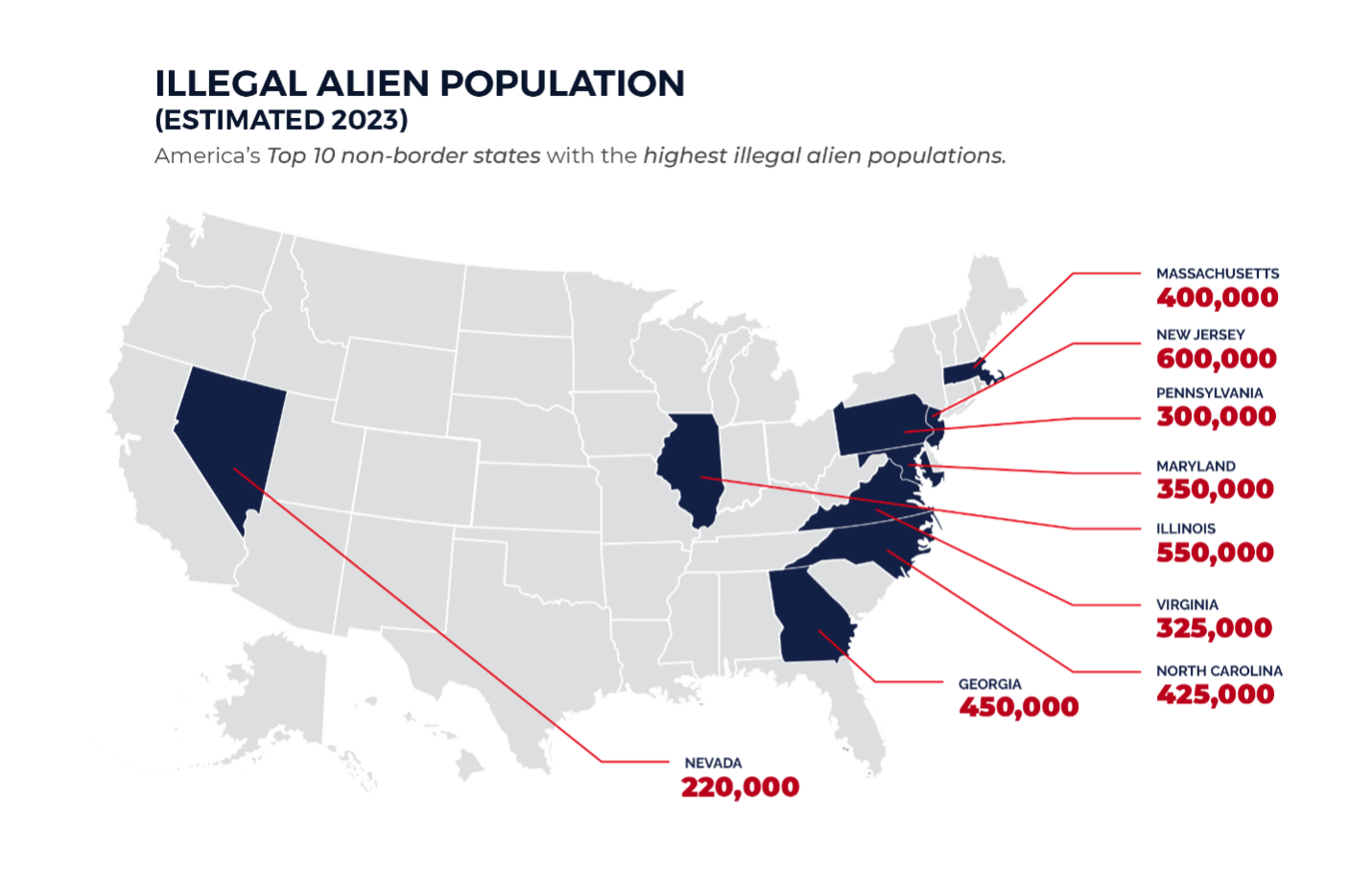
Source: Passel, J. S., & Krogstad, Jens M. (2025, August 21). U.S. unauthorized immigrant population reached a record 14 million in 2023. Pew Research Center. https://www.pewresearch.org/ra...,*%20New%20Jersey%20(600%2C000)%20*%20Illinois%20(550%2C000)
States must step up their efforts to target, detain, and remove illegal aliens from our communities in partnership with the federal government. What follows is a list of policy recommendations, organized under executive and legislative authority, that every state could pursue to achieve this goal. Under each policy recommendation is a list of states that have taken similar actions. With this Removal Roadmap, state governors and legislators will have the available tools to best assist the federal government in their mission to rid our streets of criminal aliens for good.
Policy List
State Executive Actions
Policy #1: Deploy the National Guard
Policy #2: Implement Task Force Model 287(g) Agreements
Policy #3: Organize Large-Scale Joint Federal, State, and Local Operations
Policy #4: Declare a State of Emergency
Policy #5: Open Detention Facilities to Increase ICE’s Capacity
Policy #6: Protect ICE Agents
State Legislative Action
Policy #7: Mandate State Court Cooperation with ICE
Policy #8: Make Illegal Entry or Re-entry into the U.S. a State Crime
Policy #9: Increase Penalties for Illegal Aliens
Policy #10: Require Fingerprinting and DNA Collection from Non-citizens in Custody
Policy #11: Require Cooperation Between State, Local, and Federal Law Enforcement on Detainer Requests and Information Sharing
Policy #12: Invalidate Driver’s Licenses Obtained by Illegal Aliens and Prohibit the Issuance of Driver’s Licenses to Illegal Aliens
Policy #13: Require Law Enforcement Agencies to Collect and Regularly Publish Immigration Information on Individuals Arrested
Policy #14: Provide Locals with the Ability to Sue for Noncompliance with Federal Laws
State Executive Actions
Policy #1: Deploy the National Guard
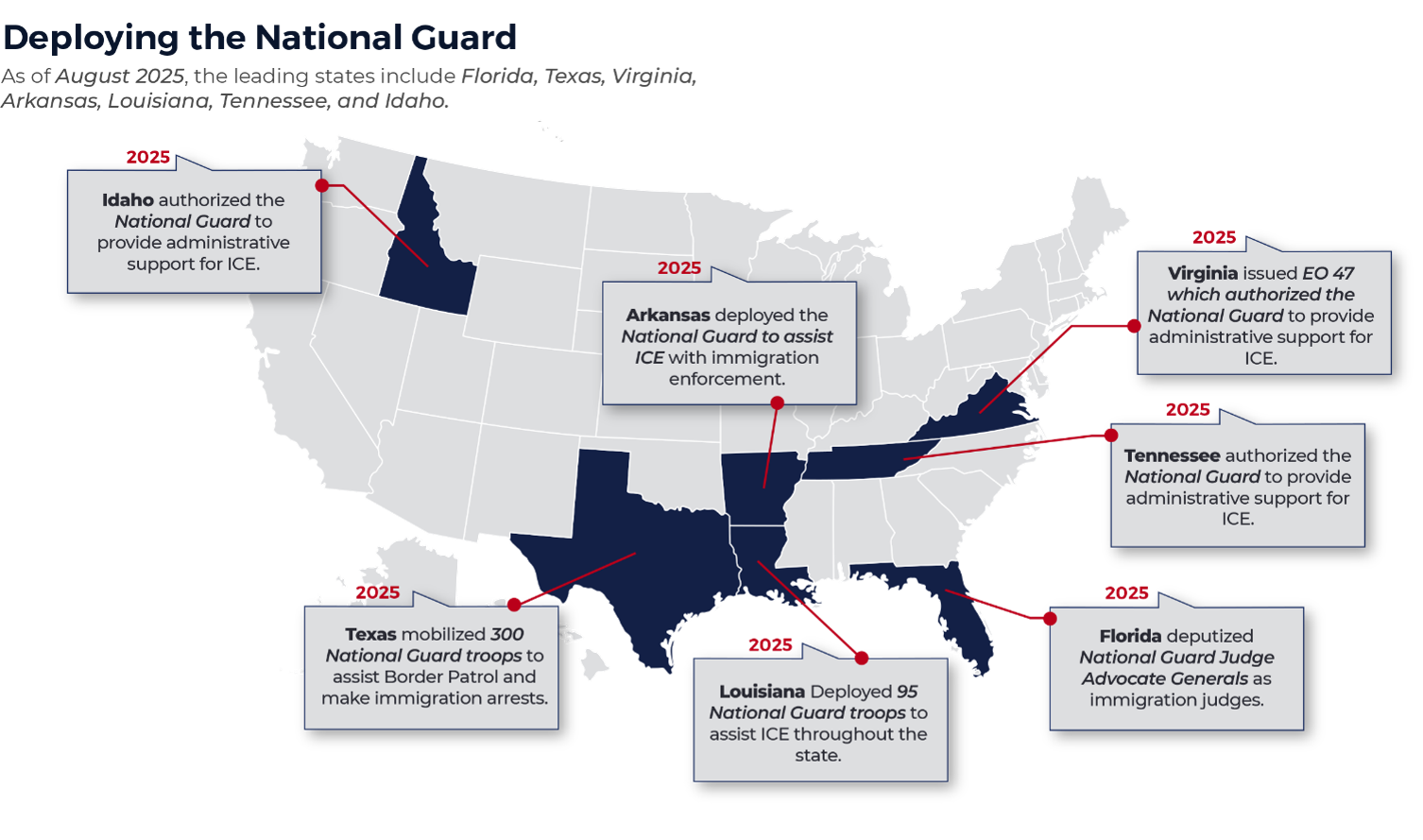
Since the Biden Administration’s border crisis began, numerous states have deployed National Guard members in support of broader border security missions, including for administrative support, legal support, transportation, or to build physical infrastructure. During President Trump’s second term, other states have supported National Guard deployments to support immigration enforcement measures. National Guard organizations can enter into 287(g) agreements (agreements between state and local law enforcement and Immigration and Customs Enforcement (ICE)) to further support immigration operations. In recent months, states like Arkansas deployed their National Guard to assist ICE with enforcement, and numerous states sent National Guard troops to Washington, D.C., for assistance on public safety, including immigration enforcement.
States should work with their federal counterparts to surge National Guard resources and personnel in advancement of border security and immigration enforcement missions.
| STATE | ACTION |
|---|---|
| Arkansas | Deployed the National Guard to assist ICE with immigration enforcement. |
| Florida | Deputized National Guard Judge Advocate Generals as immigration judges. |
| Texas | Mobilized 300 National Guard troops to assist Border Patrol and make immigration arrests. |
| Virginia | Issued EO 47 authorizing National Guard administrative support for ICE. |
| Tennessee | Authorized the National Guard to provide administrative support for ICE. |
| Idaho | Authorized the National Guard to assist ICE. |
| Louisiana | Deployed 95 National Guard troops to assist ICE throughout the state. |
Policy #2: Implement Task Force Model 287(g) Agreements
The 287(g) program empowers state and local law enforcement to perform federal immigration enforcement duties, dramatically force multiplying ICE’s reach and improving public safety. Under President Trump, the program has seen rapid and historic growth with over 1,000 agreements now active across 40 states and multiple operational models tailored to local needs. Now, due to One Big Beautiful Bill (OBBB) funding, ICE is able to reimburse local governments for salaries, benefits, and other costs to incentivize participation. State and local jurisdictions and law enforcement agencies (LEAs) should prioritize public safety and force multiply the federal government’s efforts by joining the 287(g) program, bolstered by OBBB funding to cover reimbursement costs.
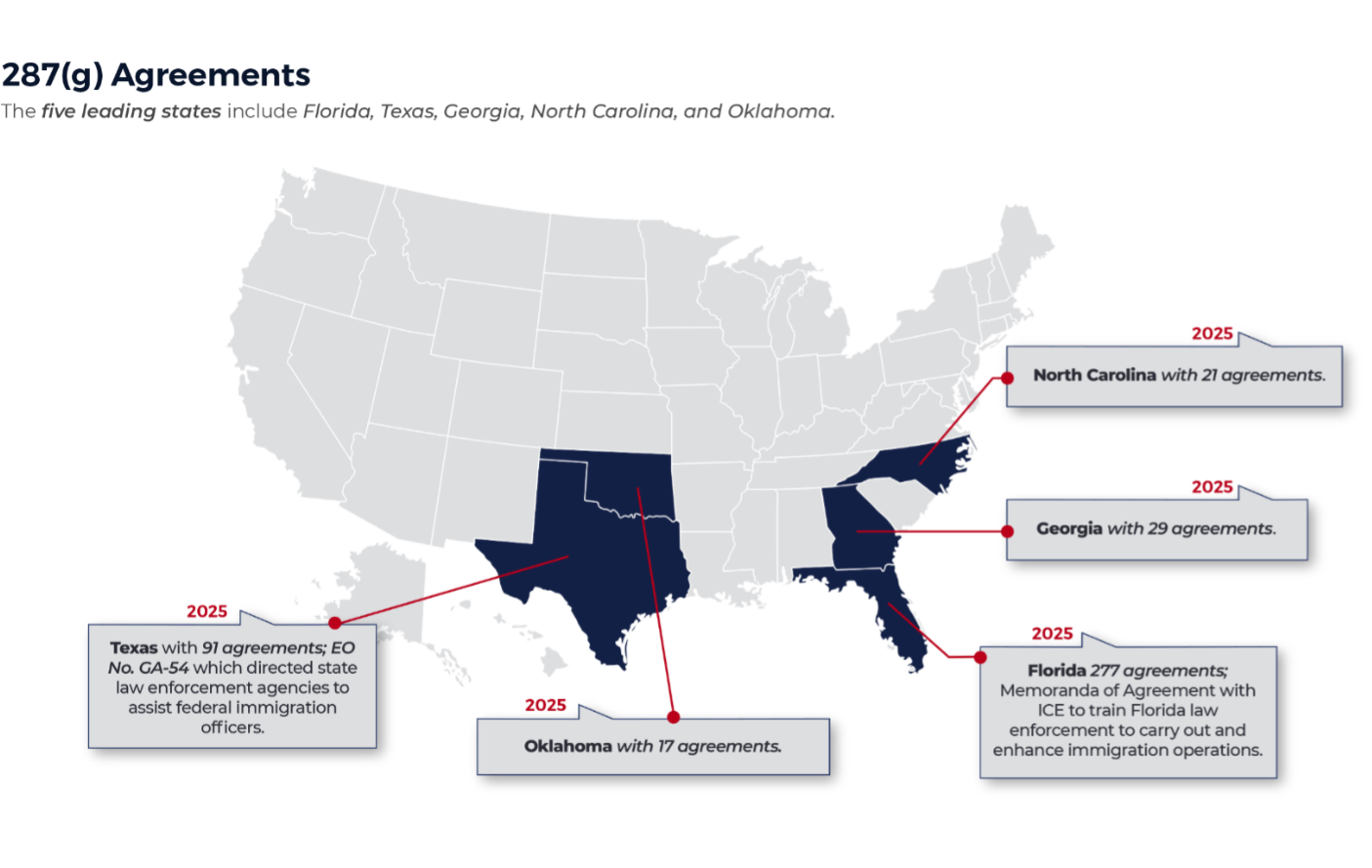
Note: Data above is as of June 2025.
The table below provides some examples of actions taken by governors across the 40 states with jurisdictions to facilitate state and local participation in 287(g) programs.
| STATE | ACTION |
|---|---|
| Florida | Governor DeSantis announced a Memoranda of Agreement with ICE and multiple Florida law enforcement agencies to train Florida law enforcement to carry out and enhance immigration operations. |
| Texas | Governor Abbott issued EO No. GA-54, directing state law enforcement agencies to assist federal immigration officers. |
| Virginia | Governor Youngkin issued EO 47, mandating the Virginia State Police to enter into the Task Force Model and the Virginia Department of Corrections to enter into the Jail Enforcement Model with ICE under 287(g). The order further sought certification from local sheriffs and regional jails of their commitment to cooperate with ICE under the 287(g) VSP Task Force. |
| Idaho | Governor Little issued EO 2025-03, mandating all state departments and agencies to review their rules, policies, and practices to ensure compliance with federal immigration laws; directing the Idaho State Police to cooperate with DHS and DOJ immigration investigations; mandating communication with DHS and DOJ; and directing officials in the Idaho Department of Corrections to identify prisoners who may be subject to deportation. |
| Missouri | Governor Kehoe issued EO 25-04, which established a 287(g) designation to designate specific MSHP troopers to undergo immigration enforcement training. |
Policy #3: Organize Large-Scale Joint Federal, State, and Local Operations
Partnerships between federal immigration authorities and state and local law enforcement should be initiated to target, detain, and ultimately deport illegal aliens. A number of these operations have occurred in recent months to great success, leading to hundreds or thousands of criminal illegal aliens being removed from American neighborhoods. These highly publicized events also have the benefit of sending a clear message to would-be criminals that the jurisdiction is no longer a haven for illegal behavior.
DHS and DOJ maintain numerous taskforces and intergovernmental groups that are designed to target perpetrators of human trafficking. For example, Homeland Security Investigations (HSI) Counter-Human Trafficking Task Force and DHS’s Center for Countering Human Trafficking represent excellent opportunities for partnerships on the coordination and execution of immigration enforcement operations.
State and local jurisdictions should proactively initiate law enforcement operations, using local knowledge and intelligence, to both detain and remove dangerous criminals whilst sending a clear signal that their presence is no longer welcome.
| STATE | ACTION |
|---|---|
| Florida | Governor DeSantis announced a Memoranda of Agreement with ICE and multiple Florida law enforcement agencies to train Florida law enforcement to carry out and enhance immigration operations. |
| Texas | Governor Abbott issued EO No. GA-54 which directed state law enforcement agencies to assist federal immigration officers. |
| Virginia | Governor Youngkin issuedEO 47 which mandated the Virginia State Police to enter into the Task Force Model and the Virginia Department of Corrections to enter into the Jail Enforcement Model with ICE under 287(g). The order further sought certification from local sheriffs and regional jails of their commitment to cooperate with ICE under the 287(g) VSP Task Force. |
| Idaho | Governor Little issued EO 2025-03, which mandated all state departments and agencies to review their rules, policies, and practices to ensure compliance with federal immigration laws; directed the Idaho State Police to cooperate with DHS and DOJ immigration investigations; mandated communication with DHS and DOJ; and directed officials in the Idaho Department of Corrections to identify prisoners who may be subject to deportation. Governor Little issued EO 2025-03, which mandated all state departments and agencies to review their rules, policies, and practices to ensure compliance with federal immigration laws; directed the Idaho State Police to cooperate with DHS and DOJ immigration investigations; mandated communication with DHS and DOJ; and directed officials in the Idaho Department of Corrections to identify prisoners who may be subject to deportation. |
| Missouri | Governor Kehoe issued EO 25-04, which established a 287(g) designation to designate specific MSHP troopers to undergo immigration enforcement training. |
Policy #4: Declare a State of Emergency
In response to the border crisis, millions of illegal aliens are roaming the streets, many of whom are known terrorists, violent gang members, and criminals. In many jurisdictions, this meets the statutory requirements to declare a state of emergency.
By declaring a state of emergency, state and local governments may be able to allocate additional resources, deploy more personnel, and unlock new legal authorities. While all states have some legal mechanism to declare a state of emergency, they differ in their emergency declaration authorities, oversight, and legal processes to activate emergency powers. State legislatures should examine their statutes to ensure that they include immigration enforcement and modify them, as necessary, to include it. They should also encourage executive leadership to take action.
| YEAR | STATE | ACTION |
|---|---|---|
| 2021 | Texas | Issued a disaster declaration to provide resources and strategies in response due to the surge in illegal crossings. |
| 2025 | Florida | Issued Executive Order 23-03 for additional support and resources in wake of the border crisis. |
Policy #5: Open Detention Facilities to Increase ICE’s Capacity
To support the goal of mass deportation across the nation, detention capacity is a key factor in this process. Across the United States, the federal government has partnered with numerous states to both create new facilities and expand capacity in existing facilities to support ICE enforcement activities. Examples include the Lonestar Lockup in Texas (1,000 new beds), the Alligator Alcatraz (3,000) and Deportation Depot (1,300) in Florida, the Speedway Slammer (1,000) in Indiana and the Cornhusker Clink (280) in Nebraska. Most were pre-existing facilities repurposed for detainment, although some represent new construction. State governments have taken the lead in identifying potential sites, ideally strategically co-located with airstrips and other infrastructure to keep costs low. The federal government works with the states by funding the new capacity through grants.
These facilities have expanded the capacity that ICE has to hold illegal aliens between detainment and deportation, furthering the ability and reach of immigration enforcement operations and, therefore, deportations.
| YEAR | STATE | ACTION |
|---|---|---|
| 2025 | Texas |
Opened Lone Star Lockup expanding ICE detention space by 1,000 and a goal of 5,000. |
| 2025 | Florida |
Opened Alligator Alcatraz and Deportation Depot expanding ICE detention space. |
| 2025 | Indiana |
Opened Speedway Slammer expanding ICE detention space by 1,000. |
| 2025 | Nebraska |
Announced Cornhusker Clink to expand ICE detention space. |
Policy #6: Protect ICE Agents
DHS has reported a 1,153% increase (as of November 2025) in assaults on ICE agents to include doxxing, attacks on agents, and even shootings at ICE facilities to include the shooting on September 24th in Dallas, TX. ICE officers have resorted to wearing facial coverings during operations to protect themselves, as well as their families, from this violence. They need full support and backing of state and local law enforcement to ensure they can carry out their duties safely and humanely.
States should follow Florida’s lead by creating programs to protect and support ICE agents. In June of 2025 they rolled out a new program to prevent doxxing of ICE officers. If doxxing is suspected, they can report it to the team who investigates the claim and carries out routine checkups on the officers, their homes, and their families. By implementing programs to provide increased security for ICE agents and their families, ICE will be better prepared to carry out their duties effectively and efficiently. States must hold individuals and groups accountable for this dangerous and threatening behavior to protect our agents and their loved ones.
State Legislative Action
Policy #7: Mandate State Court Cooperation with ICE
State courts serve as vital sources of information that should be shared with ICE to strengthen their operations and the safety of every American citizen.
Accordingly, states must pass legislation to require courts and court personnel to honor ICE detainers, and, in accordance with federal law, all government officials should provide immigration information on persons to federal law enforcement officers as well as other information regarding official proceedings.
Additionally, state courts must be required to notify ICE of every illegal alien represented by a defense counsel in a criminal case, and when such representation is funded by the taxpayer.
Policy #8: Make Illegal Entry or Re-entry into the U.S. a State Crime
It is a violation of federal law to enter or re-enter the United States illegally, and it should be a crime in states as well. By classifying this as a state crime, state and local officials have greater authority to act against such criminals. In addition, it enhances deterrents for illegal aliens entering the country illegally and remaining in states that have this in statute.
While there are ongoing legal issues surrounding specific types of legislation (such as Texas’ SB 4 bill), various states have passed legislation into law, therefore increasing punishments for illegal aliens and ultimately creating deterrents for entering illegally.
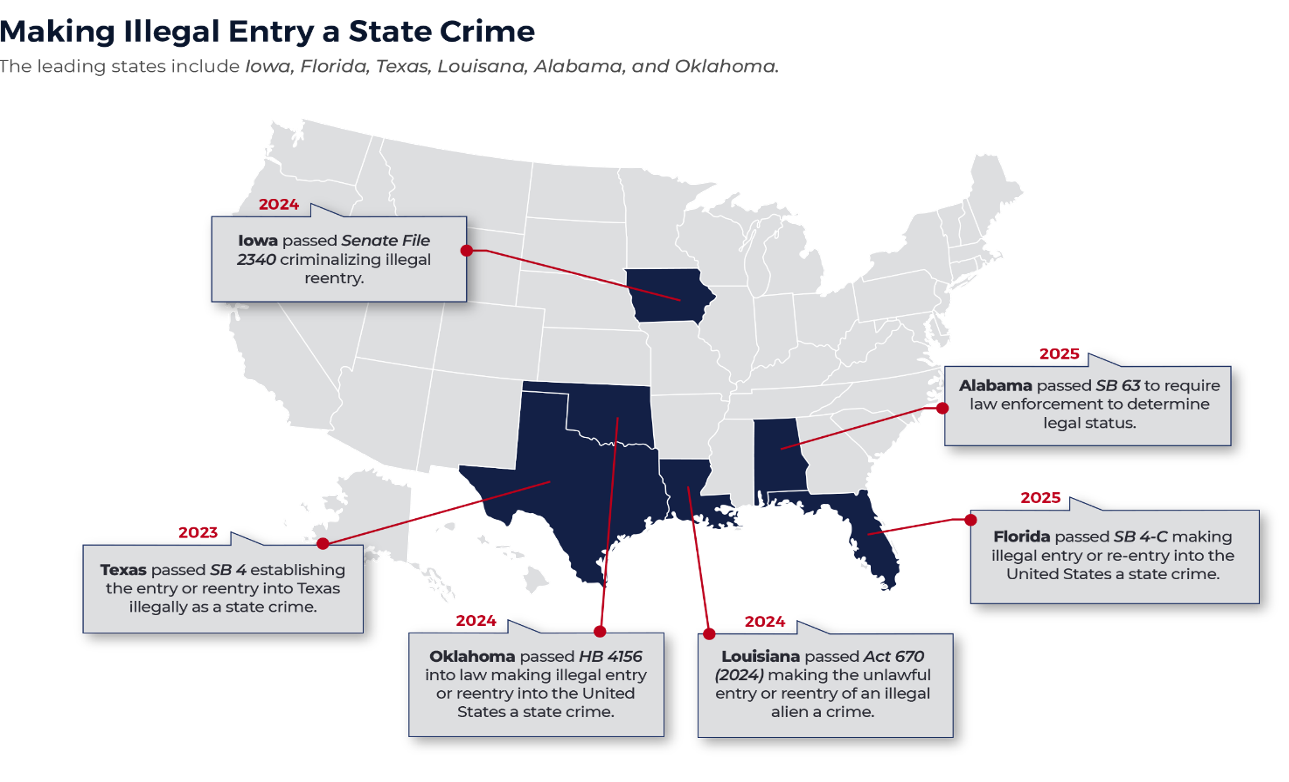
| YEAR | STATE | ACTION |
|---|---|---|
| 2025 | Florida | Passed SB 4-C making illegal entry or re-entry into the United States a state crime. |
| 2025 | Idaho | Passed HB 83 to make illegal entry or re-entry to the United States a state crime |
| 2025 | Alabama | Passed SB 63 to require law enforcement to determine legal status. |
| 2024 | Oklahoma | Passed HB 4156 into law making illegal entry or reentry into the United States a state crime. |
| 2024 | Iowa | Passed Senate File 2340 criminalizing illegal reentry. |
| 2024 | Louisiana | Passed Act 670 (2024) making the unlawful entry or reentry of an illegal alien a crime. |
| 2023 | Texas | Passed SB 4 establishing the entry or reentry into Texas illegally as a state crime. |
Note: SB 4-C is enjoined, Florida is appealing; enforcement remains paused.
HB 83’s core criminal provisions are blocked; litigation is ongoing.
HB 4156 is blocked from enforcement; litigation is ongoing
SF 2340 remains blocked; no appeal noted
Act 670 (2024) is not yet effective and remains contingent on Future U.S. Supreme Court decision on Texas SB 4
SB 4 remains blocked; the full Fifth Circuit is taking up the case
Policy #9: Increase Penalties for Illegal Aliens
Crimes must not go unaddressed, and consequences must be served. While the initial crime of entering the United States illegally has already occurred, any additional crimes committed should incur enhanced punishment. By establishing harsher penalties, a strong deterrent is created. Various states have incorporated this into their efforts to enhance immigration enforcement operations. This includes increased penalties for violent crime and employment of aliens without proper work authorization.
| YEAR | STATE | ACTION |
|---|---|---|
| 2025 | Arkansas | Passed SB 426: Defense Against Criminal Illegals Act, which increased penalties for criminal illegal aliens. |
| 2025 | Florida | Passed SB 4-C, which makes it a misdemeanor for illegal aliens over the age of 18 to knowingly enter Florida and impose the death penalty for illegal aliens who are convicted of capital crimes. |
| 2025 | Virginia | Through Code Section 40.1-11.1, made it a state crime to employ an illegal alien. |
| 2024 | Tennessee | Passed HB 1872, which authorized courts to enhance penalties, up to imprisonment for life without the possibility of parole, for certain crimes committed by illegal aliens. |
Policy #10: Require Fingerprinting and DNA Collection from Non-citizens in Custody
Mandating fingerprinting and DNA collection from all individuals in custody, including non-citizens, ensures a record of everyone being held in detention. This enforcement allows for increased and accurate identification of known terrorists, rapists, gang members, and violent criminals, as well as collaboration with federal immigration officials.
Various states, including Alabama, Virginia, Florida, and Georgia, have already implemented this practice allowing for cooperation and enhancement of immigration operations.
| YEAR | STATE | ACTION |
|---|---|---|
| 2024 | Georgia | Passed HB 1105, requiring DNA collection for those convicted of a felony who are subject to an ICE detainer. |
| 2025 | Alabama | Passed SB 63, requiring law enforcement to collect DNA and fingerprints of illegal aliens in custody. |
| 2025 | Virginia | Code Section §53.1-23 and §19.2-390, required the fingerprinting of all arrested and inmates committed to custody including illegal aliens. |
| 2025 | Florida | Statute 943.325 required a “qualifying offender” to provide a DNA sample following the detainer being received. |
Policy #11: Require Cooperation Between State, Local, and Federal Law Enforcement on Detainer Requests and Information Sharing
In addition to executive action mandating 287(g) agreements and joint operations, legislation enforcing cooperation between state, local, and federal immigration officers will ensure the continuation of collaboration for years to come.
Cooperation, including information sharing, compliance with detainers, 287(g) agreements, and funding programs for enhancement, will play a key role in keeping both states and the nation safe.
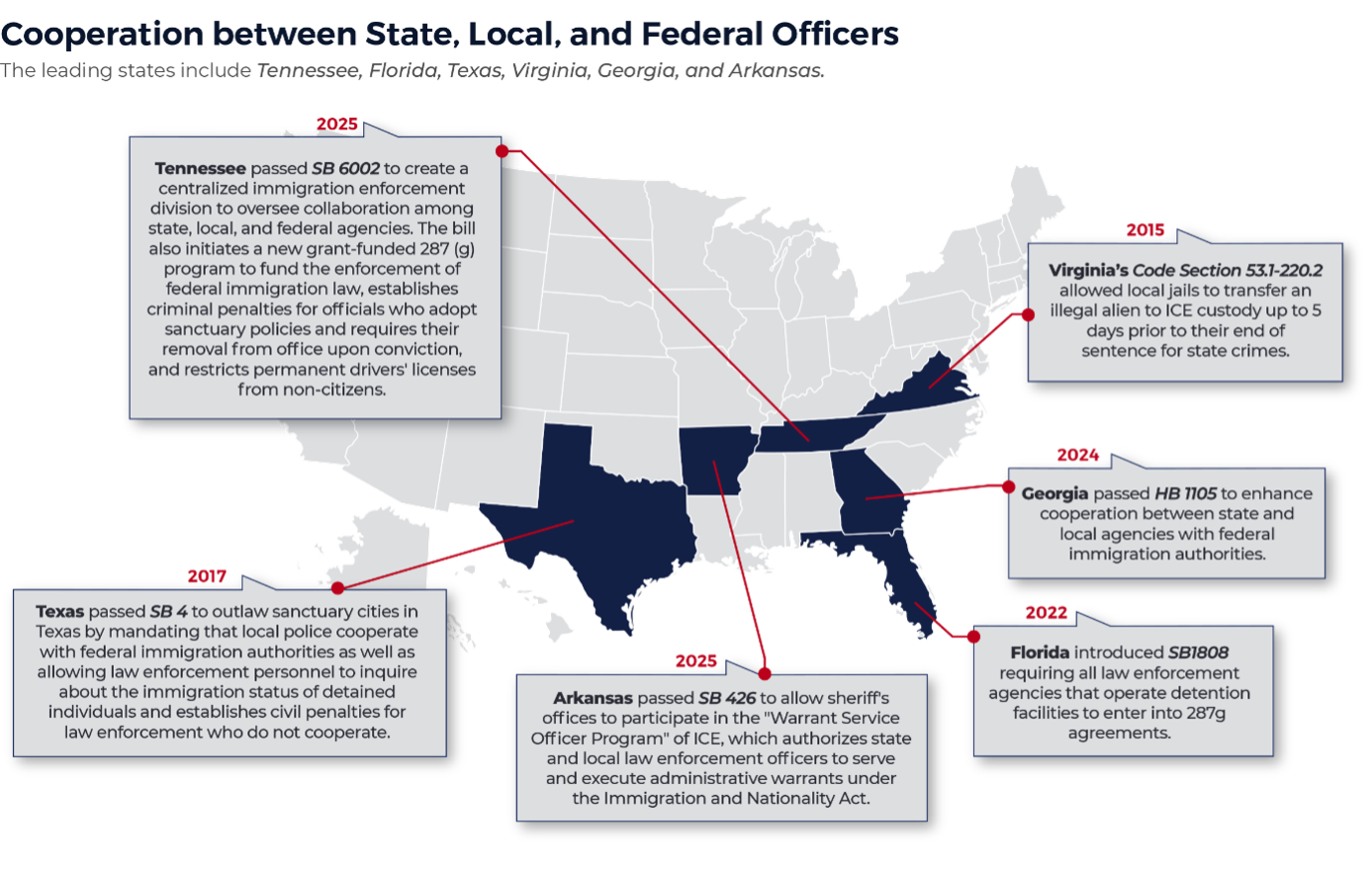
| YEAR | STATE | ACTION |
|---|---|---|
| 2025 | Arkansas | Passed SB 426 to allow sheriff's offices to participate in the "Warrant Service Officer Program" of ICE, which authorizes state and local law enforcement officers to serve and execute administrative warrants under the Immigration and Nationality Act. |
| 2025 | Tennessee | Passed SB 6002, creating a centralized immigration enforcement division to oversee collaboration among state, local, and federal agencies, initiating a new grant-funded 287 (g) program to fund the enforcement of federal immigration law, established criminal penalties for officials who adopt sanctuary policies and requiring their removal from office upon conviction, and restricting permanent drivers' licenses from non-citizens. |
| 2024 | Georgia | Passed HB 1105, enhancing cooperation between state and local agencies with federal immigration authorities. |
| 2022 | Florida | Introduced SB 1808, requiring all law enforcement agencies that operate detention facilities to enter into 287g agreements. |
| 2017 | Texas | Passed SB 4, outlawing sanctuary cities in Texas by mandating that local police cooperate with federal immigration authorities as well as allowing law enforcement personnel to inquire about the immigration status of detained individuals and establishes civil penalties for law enforcement who do not cooperate. |
| 2015 | Virginia | Under Code §53.1-220.2, allows local jails and the state Department of Corrections to transfer an illegal alien to ICE custody up to 5 days prior to their end of sentence for state crimes. |
Policy #12: Invalidate Driver’s Licenses Obtained by Illegal Aliens and Prohibit the Issuance of Driver’s Licenses to Illegal Aliens
Recent tragedies caused by illegal aliens driving with driver’s licenses obtained due to sanctuary policies highlight the necessity to eliminate the issuance of driver’s licenses in states where applicable. States must eliminate any government ID eligibility for illegal immigrants, refuse to accept Federal Employment Authorization Document as a form of ID, refuse Commercial Drivers Licenses for non-English speaking aliens, and proactively share State Driver’s license data if available with ICE and CBP.
Multiple states have already introduced and passed legislation to counteract the radical legislation of sanctuary states by invalidating out-of-state driver’s licenses obtained by illegal aliens.
States can also review their pre-existing DMV databases for potential use for immigration enforcement.
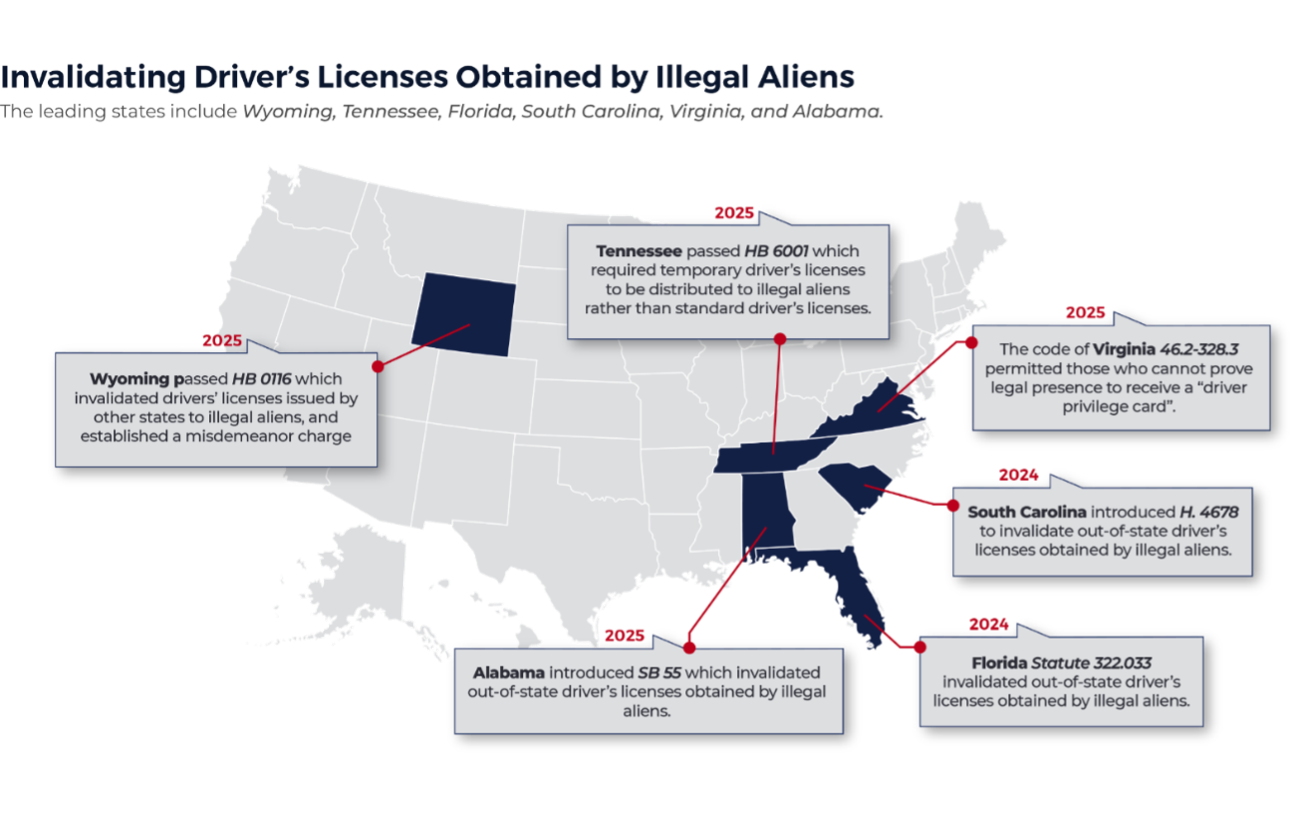
| YEAR | STATE | ACTION |
|---|---|---|
| 2025 | Virginia | Code §46.2-328.3, permitted those who cannot prove legal presence to receive a “driver privilege card”. |
| 2025 | Tennessee | Passed HB 6001, which required temporary driver’s licenses to be distributed to illegal aliens rather than standard driver’s licenses. |
| 2025 | Alabama | Introduced SB 55, which invalidated out-of-state driver’s licenses obtained by illegal aliens |
| 2025 | Wyoming | Passed HB 0116, which invalidated drivers’ licenses issued by other states to illegal aliens, and established a misdemeanor charge and fine for possession of a license by an illegal alien. |
| 2024 | Florida | Statute 322.033 invalidated out-of-state driver’s licenses obtained by illegal aliens. |
| 2024 | South Carolina | Introduced H. 4678 to invalidate out-of-state driver’s licenses obtained by illegal aliens. |
Policy #13: Require Law Enforcement Agencies to Collect and Regularly Publish Immigration Information on Individuals Arrested
Local law enforcement agencies should cooperate efficiently and consistently with their federal counterparts. Agreements between local agencies and ICE, as well as state legislation, can compel law enforcement authorities to collect immigration information during routine investigations. Immigration data obtained by law enforcement should then be shared with federal immigration authorities, ensuring that illegal immigrants are identified and reported to the appropriate agencies. This can be done through either legislative (e.g. Texas and Alabama) or executive (e.g. Florida) action.
| YEAR | STATE | ACTION |
|---|---|---|
| 2017 | Texas | Passed SB 4, which prohibits sanctuary policies that often prohibit information collection and sharing. |
| 2025 | Alabama | Passed SB 63, which required law enforcement to collect and submit an illegal alien’s fingerprints and DNA samples in custody. |
| 2025 | Florida | Announced memoranda of agreement between state law enforcement and ICE to include the interrogation of any suspected alien as well as fingerprinting, photographing, and interviewing. |
Policy #14: Provide Locals with the Ability to Sue for Noncompliance with Federal Laws
States should prohibit sanctuary policies throughout the entirety of their jurisdiction to prevent rogue cities and towns from offering safe harbor to illegal immigrants and jeopardizing local communities. One mechanism to enforce state and local compliance with federal law is through the creation of pathways to use litigation for enforcement.
States have passed anti-sanctuary state legislation to mandate that local authorities cooperate with federal immigration authorities while establishing penalties for non-compliance. Should county or city personnel be deemed to be in non-compliance, the state may sue the municipalities.
| YEAR | STATE | ACTION |
|---|---|---|
| 2023 | Texas | Passed SB-4, to require local government entities and law enforcement officials to comply with federal immigration laws and detainer requests and created criminal penalties for entities that do not enforce the law which effectively bans sanctuary policies and establishes penalties for noncompliance. |
| 2024 | Indiana | Passed SB 0181, allowing the State of Indiana's Attorney General to sue municipalities with sanctuary policies as these policies violate the state's ban on sanctuary cities. |