Iran as China’s “Counter-Pivot”: The Strategic Implications of Operation Epic Fury for America’s Competition with China
Key Takeaways
« For two decades, Iran served as China's "counter-pivot" — the mechanism by which Beijing kept the United States strategically mired in the Middle East while modernizing the People’s Liberation Army, and advancing Taiwan contingency planning.
« China's relationship with Iran was a deliberate extraction arrangement: $140 billion in discounted oil purchases, dual-use weapons technology transfers, and a shadow banking system that kept Tehran solvent and its proxy network funded.
« Operation Epic Fury has materially disrupted China's Middle East architecture — degrading Iran's proxy network, disrupting Beijing's sanctions evasion model, and exposing China's inability to protect its own strategic partners.
« The costs to the United States are real in weapons stockpiles depleted, and Indo-Pacific assets diverted to the Middle East in a pattern that has the potential to become structural and long-term.
« China must now reevaluate its posture, including in the Taiwan Strait, knowing that its counter-pivot architecture has been demonstrated to be vulnerable to American hard power.
Overview
Certain commentators have raised the eye-catching question of whether Operation Epic Fury—the American prong of the joint U.S.-Israeli campaign against the Islamic Republic of Iran—is "All About China" (Riboua, 2026). It is an arresting contention that overstates the case that Epic Fury principally aims to end the half-century of threats to the American people from the Iranian regime: from hostage-taking to IEDs maiming American soldiers in Iraq, from the sponsorship of terrorist movements across the Middle East to its arsenal of ballistic missiles and its pursuit of nuclear weapons capable of threatening the region and beyond.
Yet the Islamic Republic did not operate in a vacuum. For two decades, Iran functioned as the People's Republic of China's (PRC) most cost-effective instrument for keeping the United States strategically distracted, and actions directed at Tehran therefore carry consequential implications for Beijing's long-term ambitions and for how American power is perceived globally. In this sense, Operation Epic Fury inherently bears upon our strategic relationship with China.
While the progress of Epic Fury has thus far tilted the strategic equation in favor of the United States and has achieved concrete and vital objectives in meeting its stated aims, real concerns persist over weapons stockpile depletion, diverted U.S. assets, and implications for any extended confrontation with the PRC. This brief assesses both dimensions.
The PRC’s Hegemonic Objectives in the Context of its Strategic Relationship with Iran
The PRC as an Emerging Systemic Rival to the United States
Xi Jinping’s rise to General Secretary of the Chinese Communist Party (CCP) was accompanied by a significant rhetorical shift, announcing the PRC’s ambitions to supplant the United States as the world’s dominant power by 2049—a “hundred-year marathon,” starting from 1949, the founding year of the PRC (Pillsbury, 2015, Ch. 1; Pillsbury, 2021). This goal is well-known and often referenced in both open and coded language throughout Chinese government and party pronouncements; most often, the PRC uses the phrase “changes unseen/not seen in a hundred years/century”—first elevated by party leadership in 2017—as a subtle way to address the dilemma of “the United States [choosing] to be an adversary or partner,” implying that the U.S. is in decline, which will enable the PRC’s rise (Council on Foreign Relations, n.d.; Mattis, 2023).
China's challenge to the American-led world order is not merely rhetorical, but structural: building parallel institutions where it can, and corrupting existing ones. This is best seen in China’s promotion of the Brazil-Russia-India-China-South Africa (BRICS) organization, its associated New Development Bank, the Shanghai Cooperation Organization, and other adjacent organizations and institutions (Southerland et al., 2020; Popov, 2023; Chin, 2024). The PRC aspires to drastically reform or replace existing global institutions, such as the International Monetary Fund (IMF), the World Health Organization (WHO) and the World Bank, because it realizes that simply removing the United States will not accomplish its goals. When useful, the PRC coopts institutions like the United Nations, using its various agencies and offices to delegitimize criticisms of the PRC’s behavior (Piccone, 2018; Lee-Smith & Cosic, 2025; Mao, 2026; Morgan, 2026). Iran also played a role in establishing several of Beijing’s new multilateral organizations intended to replace existing pillars of global commerce and governance, though the extent of its involvement was heavily constrained by U.S. sanctions (Shokri, 2024).
These revisionist ambitions underscore that it is best to think of the PRC as a “systemic” challenger, and not simply an economic or strategic rival, though it is that as well (Smith, 2025). Beijing's revisionist ambitions extend well beyond soft power and institutional competition into hard military force, structured explicitly around denying the United States access to the Western Pacific and creating the conditions for a successful invasion of Taiwan. To that end, the PRC has sought to build a military with extensive naval, missile, and air capabilities to deny the United States the ability to defend the First Island Chain, the geographic choke-line stretching from Japan through Taiwan and the Philippines, constricting China’s naval access to the Pacific Ocean. This is accompanied by extensive territorial revisionism by the PRC, which asserts claims to islands in the South China Sea[1]—or “South Sea,” as it is called in Chinese. as well as islands in the Pacific Ocean based on flimsy or outright fabricated historical claims (Campbell & Salidjanova, 2016, pp. 3-5; Department of Defense, 2025, pp. 45-49).
China recognizes that neither its institutional architecture nor its military buildup is sufficient on its own, which is precisely why Beijing has spent two decades cultivating a coalition of pariah and revisionist states to multiply its leverage against the American-led order, and why Operations Southern Spear (the police action that removed Venezuelan strongman Nicolás Maduro) and Epic Fury strike at the heart of that strategy. These include anti-American foreign adversaries such as the Democratic People’s Republic of Korea (DPRK, or North Korea), the Russian Federation, the Islamic Republic of Iran, the Bolivarian Republic of Venezuela (pre-January 2026), and Cuba, and other nations like the Republic of Belarus that participate in its parallel international organizations. In this light, it is reasonable to assert that Operation Southern Spear and Operation Epic Fury are to some degree “about China.”
Iran’s Role in the CCP’s Alternative World Order
Iran has been Beijing’s most powerful instrument to prevent America’s “Pivot to Asia.” For two decades, the China-Iran relationship served as Beijing's cost-effective means of keeping the United States strategically distracted—funding, arming, and diplomatically shielding the one regional power capable of consuming American attention at scale.
However, the modern China-Iran relationship rests on a foundation that transcends transactional convenience: two totalitarian revisionist states, one communist and one theocratic, each defining its legitimacy in opposition to the American-led international order, each finding in the other a partner to bypass Western-dominated institutions. Both regimes have staked their political identity on resistance to American global leadership, and that convergence has proven more durable than any formal alliance.
The United States-China Economic and Security Review Commission (USCC) 2025 Annual Report characterized the broader informal alliance of China, Iran, Russia, and North Korea as an “Axis of Autocracy,” brought together by a shared desire to challenge U.S. global leadership and reshape the international system toward norms more compatible with authoritarianism (USCC, 2025, pp. 143-198). Within that framework, Iran was the indispensable Middle Eastern node.
To understand why Iran has mattered so deeply to Beijing's revisionist project—i.e., supplanting America’s global leadership, from ensuring freedom of navigation to maintaining the dollar as the world’s reserve currency—it helps to look at a map (pictured below). Iran, successor to the once-dominant Persian Empire,[2] sits at the intersection of the Middle East, Central Asia, and South Asia—a 636,000-square-mile landmass that functions as both a corridor and a chokepoint for Eurasian commerce and military logistics. For the Belt and Road Initiative, Iran was not merely a participant but a structural necessity: overland routes connecting China to Europe and the Persian Gulf run through Iranian territory. The Five Nations Railway, China's primary overland bypass of maritime chokepoints, runs through Iran and is now indefinitely on hold (Ministry of Foreign Affairs of the Islamic Emirate of Afghanistan, n.d.).
Figure 1
1996 CIA Map of Southwest Asia
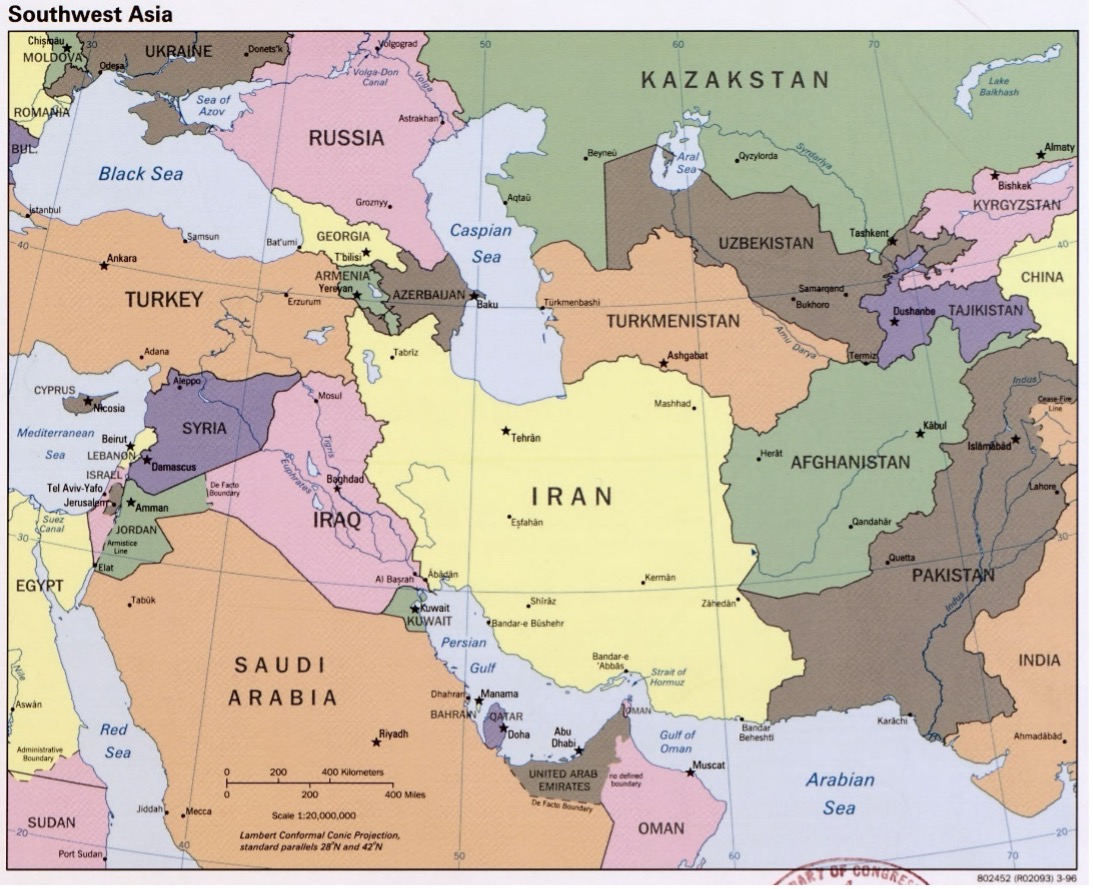
Note: Accessed and reproduced via the Library of Congress.
Beyond land corridors, Iran's geography gives it something more valuable: the ability to threaten corridors it does not formally control. The Islamic Republic sits astride the Strait of Hormuz, through which roughly one-fifth of the world's oil supply transits. For China, which relies on seaborne imports for over 63% of its oil needs and routes approximately half of those imports through the Strait, a friendly Iran was a form of insurance (Webster et al., 2026; Ayres et al., 2026). An Iran not aligned with Beijing means that in any confrontation between China and the United States, including one triggered by a move on Taiwan, the Strait of Hormuz would be tremendously vulnerable to American pressure. Iranian control of the waterway was a structural hedge against the kind of maritime stranglehold the U.S. Navy could otherwise impose.
Iran has also brought a geostrategic deterrent to the table that extends beyond its own military capabilities. Tehran's most consequential contribution was the network of armed proxies it built, funded, and directed across the Middle East. This included both direct and indirect support for these proxies from the PRC (Lailari, 2024; Gering & Brodsky, 2025). These organizations served Chinese strategic interests by imposing costs on American attention and resources without Beijing’s direct involvement. Iran provided the threat architecture: a sustained ballistic missile program encompassing short- and medium-range systems that required permanent U.S. and Israeli surveillance and military presence across the region (Gharaei, 2025; Office of the Director of National Intelligence, 2026, pp. 29-31). Meanwhile, Hezbollah in Lebanon, Hamas in Gaza, Houthis in Yemen—the counter-pivot's 3 Hs—and various Shia militia groups in Iraq engaged in the kinds of low-grade insurgencies and political destabilization that Iran's own military and IRGC could not conduct directly without triggering a conventional response.
The Houthis' campaign that began in late 2023 against Red Sea and Gulf of Aden shipping (with a notable exemption for Chinese ships) is the clearest illustration of this logic in action. A militia financed by Tehran and armed with Iranian-designed weapons built with Chinese components—including sensors and semiconductors identified in recovered drone wreckage—managed to disrupt a significant fraction of global maritime commerce, raise insurance costs across European-Asian shipping lanes, and force the U.S. Navy into a sustained and expensive counter-operation (Foundation for Defense of Democracies, 2024; Office of the Director of National Intelligence, 2026, p. 10; Pedrozo, 2025; Ayres et al., 2026). It also came at minimal direct cost to Beijing. The financial chain connecting Beijing to this disruption runs through the oil trade: China's purchases of Iranian crude — roughly $31 billion in 2025 alone, and accounting for approximately 45 percent of Iran's government budget that year — provided the financial oxygen sustaining the entire proxy network (Ayres et al., 2026). This also had the residual benefit of pushing an increasing volume of general trade between China and Europe overland via the Southern corridor rail route through Kazakhstan, thereby pulling Kazakhstan away from the orbit of a Ukraine-distracted Russia back into China’s orbit and subsidizing China’s overland BRI investment.
Simultaneously, Iran explored similar mechanisms in other regions, thereby serving the PRC’s geopolitical interests. For example, in the Western Hemisphere, Iran’s support for and operations in Venezuela served as another means to undermine American hemispheric dominance. Iran’s presence, along with the expansion of its proxy groups into several Latin American nations as part of a broader destabilizing effort, undermined the continent's stability and provided a jumping-off point for operations in the region (Tan & Woolsey, 2026).
A nuclear-armed Iran, or even an Iran persistently on the threshold of nuclear capability, functions for Beijing similarly to the way North Korea does: as a second, erratic nuclear pole that forces the United States to maintain substantial military and diplomatic infrastructure in a region far from the Pacific. Every diplomatic cycle spent on Iranian nuclear negotiations is attention and resources not focused on Taiwan and the South China Sea. Beijing did not need Iran to go nuclear to extract this benefit; the ambiguity itself was sufficient.
Iran did not merely serve China's interests. Iran was China's counter-pivot — the mechanism by which Beijing prevented Washington's reorientation toward Asia, buying time and strategic space while the People’s Liberation Army (PLA) modernized, the South China Sea was fortified, and Taiwan contingency planning advanced. That infrastructure is now degrading. What replaces it is the central strategic question that Operation Epic Fury presents to China.
Epic Fury’s Implications for the Projection of Chinese Power
The Extent and Nature of the PRC’s Support for the Islamic Republic
The nature of the strategic relationship between Iran and the People's Republic of China has significantly evolved over the past decade since Xi Jinping's initial visit to Tehran in January 2016, generally understood as part of an alignment between these countries against the United States (Ministry of Foreign Affairs of the PRC, 2016). The PRC's own Ministry of Foreign Affairs still boasts of its "comprehensive strategic partnership" that has emerged in the years since, in addition to extensive investment pledges, oil purchase contracts, and additional collaborative agreements that were signed in 2021 (Ministry of Foreign Affairs of the PRC, n.d.; Motamedi, 2022). What the Iran–China partnership actually delivered was less a genuine strategic commitment than a mechanism for extracting value—a reality that Beijing's muted response to Operation Epic Fury merely confirmed (Wagner, 2026).
China and Iran formalized their arrangement in the 2021 Comprehensive Strategic Partnership, under which Beijing pledged up to $400 billion in investment over 25 years (Ayres et al., 2026), but the headline figure was always more aspirational than concrete. Analysis by the American Enterprise Institute (AEI) suggests only approximately $25 billion was ever concretely invested between 2005 and 2018, with AEI researchers calling the 2021 pledge "unfeasible," noting that large projects Chinese companies had promised Iran before 2021 "failed because of financial disagreements, project delays, and U.S. sanctions" (Zhang, 2021; American Enterprise Institute, 2025). Documented investment in the aftermath of the 2021 agreement is limited, scattered across railways and petroleum infrastructure, and amounts to only the low billions (Chen & Wang, 2025). If any nation stands to face significant capital losses from Iran's current crisis, it is not China but Russia, which, over the previous two to three years, was Iran's largest actual investor, particularly in oil and gas extraction and refining (Smagin, 2026), though even those figures may be exaggerated by Tehran to manufacture positive economic optics (Khatinoglu, 2024).
This gap between pledge and performance was not an accident. Rather, Beijing structured the relationship to extract maximum strategic benefit at minimum financial and political cost. The $31 billion in annual oil purchases at steep discounts and the dual-use technology transfers that sustained Iran's missile and drone programs did not require Beijing to build railways or honor investment pledges. China got discounted energy, a deferential regional partner, and a mechanism for keeping American attention fixed on the Middle East, while Iran got enough financial benefits to survive. As Ryan Hass and Allie Matthias of the Brookings Institution wrote in late January 2026, Chinese analysts have long described this arrangement accurately as "strategic opportunism":
"[...] China's relationship with Iran falls below China's 'all-weather strategic partnerships' with Russia, Pakistan, and others. [...] China's pledges of major investments in Iran have not materialized at the expected pace. [...] Iran does not stand out as a major recipient of Chinese development financing. It falls within the middle tier of Beijing's overseas lending recipients. [...] Reflecting China's relatively narrow interests and competing priorities, Chinese analysts have long described China's relationship with Iran as 'strategic opportunism'" (Hass & Matthias, 2026).
The terminology Beijing deploys to classify its partnerships reinforces this hierarchy. The PRC describes its relationship with Iran as a "comprehensive strategic partnership," the same language it used for Venezuela, which it also failed to defend when U.S. forces moved against Maduro while a Chinese delegation was present in Caracas (Council on Foreign Relations, 2024; Ministry of Foreign Affairs of the PRC, 2025; Federici et al., 2026). The relationship with Pakistan, by contrast, is an "all-weather strategic cooperative partnership." Relations with Russia rise to the level of a "comprehensive strategic partnership of coordination for a new era [...that] has no limits." Iran was never in the top tier, and the absence of a Chinese military response to Epic Fury is consistent with Tehran's place in Beijing’s hierarchy of relationships.
That said, the absence of a Chinese military response reflects more than hierarchy of relationships; it reflects hard capability limits that even a higher-priority commitment could not overcome. The People's Liberation Army Navy is not designed for power projection in the Middle East (USCC, 2025). It is designed for a single primary purpose: an assault on Taiwan and the denial of U.S. naval access within the First Island Chain. (Department of Defense, 2025). Deploying meaningful kinetic force to the Persian Gulf would not merely be politically inconvenient for Beijing; it would require capabilities the PLA does not possess. China maintains its first and only acknowledged overseas military base in Djibouti, compared with the United States' network of roughly 750 facilities across more than 80 countries (TIPP Insights, 2026). Beijing could not have intervened even if it had wanted to, and it structured its Iran relationship from the beginning with that limitation in mind.
The divergence within Chinese academic commentary captures this tension precisely. Zheng Ge, Oriental Chair at Shanghai Jiao Tong University, argues that China's growing power will require it to "go beyond traditional 'non-interference' principles and find a new balance between upholding sovereign equality and assuming great power responsibilities" (Zheng, 2026), an implicit acknowledgment that Beijing's current posture is unsustainable if it wishes to be taken seriously as a global power. Offering a slightly different perspective, Zhu Zhaoyi, director of Peking University's Middle East Institute, argues that "[t]he U.S.'s deep involvement in Middle East military conflicts objectively constrains its ability to continue pressuring China in the Indo-Pacific region" (Zhu, 2026).
Weapons Purchases and Arms Trade
The most significant dimension of the PRC-Iran arms relationship is not the contested question of finished weapons deliveries but the enabling architecture that China constructed around Iran's military programs. The USCC's March 2026 fact sheet documents Chinese components, including sensors, voltage converters, and semiconductors, recovered from Iranian drones used by both Iranian forces and their proxies (Ayres et al., 2026). In 2021, China provided Iran full military access to its BeiDou satellite navigation system, the same system likely guiding Iranian drone and missile attacks throughout the current conflict (Ayres et al., 2026). Most strikingly, in the week of March 2, 2026, while Epic Fury was already underway, two state-owned Iranian vessels departed China's Gaolan Port carrying sodium perchlorate, a key precursor for solid rocket fuel, in an incident that followed a near-identical transfer in January 2025 (Lee & Kelly, 2026). China was an active supplier in Iran's military buildup.
The most conclusive evidence of PRC components in Iranian attack drones came in a 2026 Treasury sanctions order targeting Hong Kong-based companies, following the recovery of such components from drones used by Iran and its proxies (Sayeh, 2025; Department of the Treasury, 2026). This is corroborated by off-the-record reporting alleging PRC involvement in providing components or other assistance for Iran's Shahed drone series (Matthews, 2026).
There are limits to the finished-weapons dimension of this relationship. The PRC did not deliver its own HQ-9B or similar air defense systems in any significant quantity before Epic Fury, and most Iranian air defense systems prior to 2025 were either Russian-purchased or Russian-derived S-200s and S-300s (Military Watch, 2025). While some analysts contend that Iran's illegal oil trade, beginning in October 2025, was intended to purchase HQ-9 systems with oil revenues, no quantities or actual deliveries were confirmed (Norman & Areddy, 2025; Hoang-Wilkes, 2026). The more significant Chinese air defense contribution was navigational rather than hardware-based: BeiDou access granted in 2021 is assessed as likely to have guided Iranian drone and missile attacks throughout the conflict, a capability that required no physical delivery (Ayres et al., 2026).
International monitoring prior to Operation Midnight Hammer repeatedly noted that the PRC-Iran arms relationship was vastly overshadowed by Iran's purchase of Russian systems and its reverse-engineering of components for domestic production (George et al., 2025; Lair, 2026). International arms monitoring organizations such as the Stockholm International Peace Research Institute (SIPRI) noted that from "2015–19, Russia supplied 98 per cent [sic] of Iran's arms imports, and in 2020–24 it was Iran's sole supplier" (George et al., 2025). The SIPRI figures on finished arms sales, while accurate, capture only the most visible layer of the relationship. China's contribution to Iran's military capability was never primarily about exporting complete weapons systems—it was about providing the components, navigation infrastructure, financial architecture, and fuel chemistry that allowed Iran to build and sustain its own. As John Spencer observed, the conflict has exposed China to a reputational risk analogous to the Soviet Union's after Israeli forces destroyed over 60 Soviet-supplied Syrian aircraft in 1982 without losing a single plane: if Iranian air defenses influenced by Chinese technology prove ineffective against U.S. and Israeli forces, countries currently considering Chinese weapons exports will take note (Spencer, 2026).
Energy Trade Between the PRC and Iran
China's purchase of Iranian crude oil is the financial foundation upon which the entire strategic relationship rests. The true country of origin is obfuscated to evade scrutiny for sanctions non-compliance. As extensive investigative reporting has unearthed, many major shipments of crude oil do not go directly to the PRC for domestic use; shipments are usually either received by "teapot refineries" for re-export to other nations, or alternatively the crude is laundered via "falsified origin documents that claim, for instance, the oil is Malaysian crude" (Ayres & Tsering, 2025, pp. 10-13). The scale of this is significant: some estimates calculate that approximately 1.6 million barrels per day are imported from Iran, “[comprising] roughly 13.5 percent of China's total oil imports, rivaling imports from Saudi Arabia and Russia” (Ayres & Tsering, 2025, p. 10), while the EIA places the figure closer to 11%, with Saudi Arabia at 14% and Russia at 20% (Energy Information Administration, 2025, p. 16). Whatever the precise percentage, the cumulative value of Chinese purchases since 2021 has exceeded $140 billion—making China the primary reason the Islamic Republic has not gone bankrupt despite decades of Western sanctions (Jungman & Roth, 2025).
The strategic consequences of disrupting this flow extend well beyond the bilateral relationship. Approximately 45% of China's total oil imports transit the Strait of Hormuz, meaning that Iran's closure of the waterway imposes costs on Beijing that go far beyond the loss of Iranian barrels specifically (Ayres et al., 2026). The immediate price shocks are less attributable to Iran's supply reduction than to the broader inability of Gulf state exports to continue normally—Brent crude rose more than 40% in the first two weeks of the conflict (New York Times, 2026). These price increases benefit Russia’s exports, whose extensive energy partnerships with the PRC provide Moscow with a revenue windfall precisely when it is needed most (Kalwasinski & Rudnik, 2026; Hartog, 2026). Export increases were already slated to begin in February and are likely higher now that Iranian exports are disrupted (Reuters, 2026; Interfax, 2026; Liu, 2026).
However, the strategic cost to Beijing is not primarily the loss of Iranian barrels, but the destruction of the sanctions evasion architecture that made Iranian oil so valuable in the first place. China paid $8-14 per barrel below market rate for Iranian crude precisely because of the shadow fleet (a covert, global network of oil tankers used to secretly export sanctioned Iranian oil), the teapot refineries, and the falsified origin documents (Ayres et al., 2026). A destabilized Iran forces China to buy equivalent volumes at market rate. China's GDP growth target was downgraded to 4.5-5% at the Two Sessions in March 2026, with the impact of the war in Iran on energy explicitly acknowledged as a contributing factor (Bao, 2026).
One corollary benefit for the United States has been the accelerating shift by American allies toward U.S. LNG and non-Hormuz energy sources; a commercial expression of Epic Fury that it is likely politically irreversible (Tan & Lu, 2026). Trump's comment about keeping oil flowing through the Strait of Hormuz as "a gift from the United States of America to China" is not evidence that the strikes were benign toward Beijing, but rather that the U.S. controls access to that gift (Casiano, 2026). That Beijing has responded to the Hormuz disruption by accelerating domestic coal consumption, reversing its supposed progress on a green energy transition, illustrates the gap between China's strategic preparation and the actual resilience of its energy economy when subjected to stress (Delgado & Ghosal, 2026).
Technological Collaboration and Vulnerabilities
Part of the extensive developmental and economic agreements between the PRC and Iran involved Iran adopting many intrusive surveillance technologies, largely to better suppress dissent in its urban centers. Though reported on at varying levels over the past several years, recent events in Iran—from the protests in January to the Ayatollah’s death in March—have confirmed the regime’s extensive use of facial recognition, device monitoring, and other mass surveillance tools made popular by the PRC and Russia (Filter Watch, 2023; Reynaud & Untersinger, 2026). This collaboration involves many familiar firms, including Huawei, ZTE, and Hikvision, all known tools of the PRC’s surveillance apparatus, providing software and hardware to intensify surveillance in Iran (Article19, 2026).
The same architecture China designed to monitor and suppress Iranian citizens became, in Israeli hands, the architecture that monitored and ultimately killed the Iranian leadership. Israel’s brilliant reversal, the latest in a series of strategic compromises achieved by Israel’s security apparatus, should sow insecurity within every authoritarian government that has purchased Chinese surveillance infrastructure as a tool of domestic control (Iran International, 2025; Kang & Mednick, 2026; Greenberg, 2025). Iran's implementation of further digital surveillance by the PRC, even as its own digital defenses are often found to be lacking, created a tremendous vulnerability amid increasing pressure.
This capability was reportedly used during the initial strikes of Epic Fury and the associated Israeli operation Roaring Lion, which resulted in the killing of the Ayatollah. Israel had reportedly spent years analyzing the vulnerabilities of systems purchased by Iran and the extent of their adoption, enabling it to track Khamenei’s movements block by block in Tehran (Srivastava et al., 2026). The hacking of surveillance cameras and other nominally civilian infrastructure is now “part of war’s playbook,” especially when vulnerabilities like those known to exist with surveillance systems can be so easily documented and exploited (Greenberg, 2026; Jones, 2026).
The broader lesson for Beijing is uncomfortable: China's "smart city" surveillance exports, marketed across the developing world as instruments of stability and control, have now been demonstrated in the most consequential possible setting to function simultaneously as intelligence-collection platforms for their adversaries, such as Israel, who can exploit them. Every government that has purchased Huawei infrastructure must now consider that demonstration. While there are reports from Chinese-language sources online that this has prompted the PRC to examine its own vulnerabilities in this regard, leading to arrests of employees at companies such as Hikvision, these reports remain unverified and highly speculative (Bryen, 2026).
Reactions to Operation Epic Fury in the People’s Republic of China
The actions taken by the U.S. have provoked a variety of reactions in the PRC. In the immediate aftermath of Operation Midnight Hammer, the most pressing takeaway was the perception that American actions were sudden, coming on the back of the nuclear negotiations underway in the summer of 2025 (Van Oudenaren, 2026, p. 2). This analysis also noted the sophistication of the systems and munitions involved, particularly the deep-penetration “bunker buster” bombs that struck the Fordow facility. Their use also sent the message that underground PLA facilities that the PRC has built would similarly be vulnerable in any conflict between China and the U.S. (Van Oudenaren, 2026, p. 4; Honrada, 2026).
Operation Epic Fury has elicited a different reaction, largely because the operation itself was much more anticipated given the large amounts of material redeployed to the region, which indicated an imminent operation (Aboudouh, 2026). The conflict’s complex effects on world commerce and interactions with Gulf states have also led to speculation among the PRC’s commentariat that the United States may be liable to become bogged down in the conflict, causing an opportunity-cost dilemma: achieve objectives in the Middle East or remain prepared for a conflict in the Indo-Pacific (Kaylan, 2026).
However, the domestic situation in the PRC remains unsettled as well in the aftermath of multiple military purges, a process ongoing since 2022—though the most recent round has devastated the most senior leadership in the PLA, leaving it apparently rudderless (Lin et al., 2026; Indo Pacific Defense Forum, 2026). These purges reflect an ongoing lack of confidence in the PLA’s leadership, not necessarily unique to the years of the Trump Administration, though the recent removals “leave a void” as “there’s no one right now at the highest level [who] is in charge of training and exercises” (Indo Pacific Defense Forum, 2026).
In the context of these successive military purges and intra-Party turbulence, recent events may have dealt reputational damage to Xi personally as a leader ostensibly capable of "managing the barbarians."[3] Such managing includes hosting Western leaders in Beijing with hierarchical visual optics portraying Xi’s superior status—an image implicitly understood metaphorically by a domestic audience as supplicants kowtowing to the emperor—securing concessions, and projecting the image of a China that the world must approach on favorable terms. The capture of Maduro in January occurred while a delegation of the Chinese People's Political Consultative Conference was in Caracas, creating what analysts described as an acutely "awkward moment" that left Xi visibly "embarrassed" (Yuan, 2026). Epic Fury compounded the embarrassment of seeing a second Chinese strategic partner destroyed within two months, with Beijing offering nothing beyond a statement. This failure to protect two partners in succession raised the stakes for Xi’s summit with President Trump, whom Xi could not manage the way he managed Biden,[4] or recent “middle power” visitors like Keir Starmer[5], Mark Carney[6], and Friedrich Merz[7] (Margolis, 2024; Cheng, 2026; Williams, 2026; Merz, 2026, 14:25; Duell, 2026; Lum, 2026; George, 2026).
The "managing the barbarians" image that Xi has so carefully constructed is difficult to sustain when the barbarian in question has just demonstrated that he will act decisively against Chinese partners without asking Beijing's permission and without apparent consequence.
Reactions from Allies and Partners
Taiwan
Perceptions in Taiwan of the recent strikes – from Operations Midnight Hammer through Epic Fury – have been positive, particularly in contrast to the military failures of the Biden Administration and its withdrawal from Afghanistan (Yi & Hou, 2021), which had fed “American skepticism” narratives amplified by pro-Beijing mouthpieces such as Global Times (Global Times, 2021; Li et al., 2023). The operational and strategic failure of the Afghanistan withdrawal not only raised concerns about the decision-making ability of the Biden Administration but also about the capabilities of the United States military relative to the PRC at the time (Lee, 2021). Operations Midnight Hammer and Southern Spear heightened perceptions of America’s military capabilities in the first year of the Trump Administration, a trend further corroborated by Epic Fury (Lin, 2026).
Taiwanese government responses to Epic Fury have been markedly positive, if tight-lipped, from President Lai’s administration and Taiwan's Ministry of Foreign Affairs. The Taiwanese Ministry of Foreign Affairs has condemned Iran’s attacks and stated that it “hopes the Iranian people can enjoy freedom, democracy, and human rights” (Everington, 2026a).
Taiwanese independent press commentary has been notably sober in its assessment of what American operational success in Iran does and does not prove. Analysts have cautioned that Iran's defenses were structurally destined to fail, given U.S. "absolute advantages in intelligence" and the absence of key Iranian defensive equipment that had not yet been fielded (Yu, 2026). This caveat matters enormously for Taiwan's own strategic calculus, since the PRC's air defense architecture is more sophisticated than anything the Islamic Republic could field on its own. Any war over the Taiwan Strait would likely involve air and missile strikes on the Chinese homeland by the U.S. and its allies.
Other reactions are positive, albeit with caveats. Democratic Progressive Party (DPP) legislator Chen Kuan-ting, member of the legislature’s foreign relations and defense committees, noted on February 28 that Taiwan needed to prepare for possible escalation of coercion from the mainland, and that a prolonged war could undermine “stability and peace in the Indo-Pacific” (Everington, 2026b). Some Kuomintang legislators have noted that the war in Iran may actually heighten global awareness of Taiwan's strategic and economic leverage, rooted in its indispensable role in global semiconductor and critical supply chains MSN, 2026).
The March 18 release of the 2026 Annual Threat Assessment added an official American dimension to Taiwan's calculus, with the Intelligence Community explicitly assessing that Chinese leaders do not currently plan to invade Taiwan in 2027 and have no fixed timeline for unification—attributing the reassessment in part to PLA purges that have created structural gaps in joint combat capability, and to the gap between Chinese military equipment and real-world performance that recent conflicts have exposed (Office of the Director of National Intelligence, 2026). Taiwan's government welcomed the assessment while cautioning that China has "never abandoned the use of force" (Reuters, 2026).
The more immediate concern in Taipei is energy: with only 11 days of natural gas reserves—the lowest in East Asia—and over a third of its LNG supply routed through Hormuz, Taiwan is absorbing direct economic costs from a conflict it broadly supports strategically, accelerating its pivot toward long-term U.S. LNG contracts and underscoring that for Taipei, the stakes of Hormuz stability are not merely geopolitical (Atlantic Council, 2026; Liu, 2026). This re-sourcing of Taiwanese LNG imports would give the U.S. Navy greater justification to ensure safe passage, “even under blockade conditions.”
Japan
Japanese reactions to Operations Midnight Hammer and Epic Fury have been broadly supportive in strategic terms, while remaining carefully hedged in public. Japan has constitutional constraints, a dependence on Middle East energy, and an acute awareness that some American military assets being expended over Iran are the same ones it relies on for its defense. Prime Minister Takaichi, whose November comments declaring a Chinese move on Taiwan a potential "survival-threatening situation" for Japan have already placed her at the center of focus in the region. She has attempted to voice support for U.S. actions enough to satisfy President Trump, while avoiding provoking Beijing into economic retaliation (Miki, 2026).
Epic Fury bolsters Takaichi's worldview, casting the China-Russia-Iran-DPRK axis as an existential threat to Japanese security, which requires alignment with American military power. This view has only been strengthened by Beijing and Moscow’s failure to come to Tehran's defense (Riboua, 2026b). Japan has long worried about a coordinated scenario combining Chinese pressure on Taiwan with Russian encroachment from the north. That threat matrix has become less plausible.
However, the immediate practical consequences are more complicated. The redeployment of American forces from Japan toward the Gulf, including elements of THAAD from South Korea, and over 2,000 marines, has reopened long-standing questions about Japanese independence in foreign affairs. Okinawa, which hosts roughly half of all U.S. forces in Japan, in practice serves as a regional platform within America's global deterrence network rather than a shield for Japan specifically.
On munitions, Japan's concerns are immediate and specific. Japan ordered 400 Tomahawk missiles from Washington in 2024, the same systems being expended over Iran at a rate estimated to have consumed at least 200-400 in the first days of Epic Fury alone, against an American production capacity of roughly 60-90 per year (Yamaguchi, 2024; Kass, 2026). Delivery of Japan's order will be delayed well beyond this year, pushing Tokyo toward faster development of indigenous counterstrike capabilities, for example, the Type 12 anti-ship missile tested at ranges exceeding 1,000 kilometers, and serious consideration of nuclear-powered submarines (Takahashi, 2025).
At the White House on March 19, 2026, Trump pressed Takaichi directly on Hormuz security, telling her that Japan gets over 90% of its oil through the Strait while noting Japan was performing "unlike NATO" (Miki, 2026). Takaichi acknowledged Hormuz stability as a shared priority while explaining Japan's legal constraints on Self-Defense Force escort missions. The two sides signed three documents on energy and critical minerals cooperation, including a joint project for U.S.-produced crude oil storage in Japan (Miki, 2026).
The energy dimension may prove the most consequential long-term consequence of Epic Fury for the U.S.-Japan relationship. Japan maintains roughly 254 days of oil supply in reserve, but its LNG position is more exposed (Webster et al., 2026). Qatar halted LNG production following Iranian drone strikes, tightening global markets at the precise moment Japan, South Korea, and Taiwan are all competing for alternative supplies (Jeyaretnam, 2026). The lesson is the same for all three: dependence on Middle Eastern energy routed through a chokepoint that a hostile power can close is no longer theoretical. The accelerating shift toward U.S. LNG is a strategic reorientation that Epic Fury has made possible (Cahill & Nakano, 2026).
Other Regional Allies and Partners
In the Indo-Pacific, South Korea has taken a similar line to Japan, drawing parallels to North Korean proliferation, which signals that Seoul views the strikes through the lens of its own threat environment (Ministry of Foreign Affairs of the ROK, 2026). In Australia, Iranian strikes on a UAE facility housing Australian military personnel transformed what might have been a distant geopolitical event into a direct national security concern (Jervis-Bardy, 2026). The net picture across the coalition is one of widening support for the U.S., a diplomatic outcome that stands in sharp contrast to the fractured allied response that accompanied American military action in the Middle East in prior decades.
Potential Risks to America’s Strategic Posture
Munitions Depletion and Base Damages
Precise munitions expenditure figures for an ongoing conflict are necessarily incomplete, drawing on open-source estimates by think tanks and press outlets rather than official Pentagon data. With that caveat, the broad contours are clear. Analysis by the Payne Institute for Public Policy, updated through late March (when operations slowed significantly), estimates over 850 Tomahawk missiles expended through the first four weeks of conflict, alongside substantial defensive munitions: approximately 400+ Patriot, 430+ Aegis, and 198 Terminal High Altitude Area Defense (THAAD) interceptors (Amoah et al., 2026a; Amoah et al., 2026b; Amoah et al., 2026c; Reuters, 2026).
A separate analysis from the Center for Strategic and International Studies (CSIS) paints a starker picture, estimating 1,000+ Tomahawks, 1,060-1,430 Patriot, 320-620 Aegis, and 190-290 THAAD munitions used through April 21, 2026 (Cancian & Park, 2026). The Trump administration has announced plans to scale Tomahawk production from roughly 60 to 1,000 annually, a meaningful change to the medium-term replenishment picture, with THAAD and Patriot munitions seeing similar expansion efforts announced in January of 2026 by Lockheed Martin (Lockheed Martin, 2026; Stone, 2026).
The most supply-constrained category is THAAD munitions. The DoD's FY2026 weapons supplemental funds 25 THAAD interceptors at $546.7 million; at that pace, replenishing the estimated 198 expended in the first three weeks of Epic Fury alone would take years (Department of Defense Comptroller, 2025, p. 4-3). Applying CSIS's stockpile estimates, the United States has expended at least 45% of its THAAD inventory against Iran across the Twelve Day War and the first three weeks of Epic Fury (Mezzofiore et al., 2025; Amoah et al., 2026b; Amoah et al., 2026c; Rumbaugh, 2025). Patriot PAC-3/MSE munitions are in comparably better shape, which the DoD has been procuring at least 200 annually for three consecutive years. Epic Fury usage has likely constituted less than 25% of total stockpiles (DoD Comptroller, 2025; Amoah et al., 2026b; Amoah et al., 2026c).
Beyond munitions, several U.S. facilities sustained retaliatory strikes. An AN/TPY-2 THAAD radar at Muwaffaq Salti Air Base in Jordan was reportedly destroyed at an estimated replacement cost of $300 million. An AN/FPS-132 radar in Qatar, a system that Foreign Policy estimates would take five to eight years to replace at a cost of $1.1 billion, was also alleged to have been hit (Amoah et al., 2026a; Capaccio & Doyle, 2026). The total operational cost for the first two weeks of Epic Fury was estimated at $16.5 billion (Cancian & Park, 2026). Additionally, friendly fire incidents from Kuwaiti air defenses destroyed three U.S. F-15E Strike Eagles (CENTCOM, 2026).
The munitions costs are real and impose genuine replenishment demands, but they are not paralyzing. As Hudson Institute's John Lee has noted, deterrence is "an inexact guessing game." China does not know the precise state of U.S. stockpiles, and uncertainty about American resolve and remaining capacity cuts in both directions (Lee, 2026).
Opportunity Cost and Redeployment
In addition to the repositioning of Patriot and THAAD batteries noted above, carrier strike groups have been drawn into Epic Fury, raising questions about Indo-Pacific coverage that the administration maintains are manageable. The USS Gerald R. Ford has been deployed for nearly eleven months, extending its maintenance cycle and potentially delaying its return to readiness (Stancy, 2026; Oakley et al., 2025). The USS Abraham Lincoln, initially assigned to the Indo-Pacific, was subsequently redirected to the Middle East, leaving only the USS George Washington Carrier Strike Group and the USS Tripoli Expeditionary Strike Group in the Pacific theater (Burchett, 2026; USNI, 2026). The redeployment also brought THAAD and Patriot components from the Korean Peninsula, drawing pushback from Seoul (Kim, 2026; Lim, 2026).
The conflict has also highlighted a structural gap in U.S. naval composition, specifically the lower-end vessels needed for escort duties, minesweeping, and littoral operations in a contested chokepoint like Hormuz. The retirement of the Oliver Hazard Perry-class frigates in 2015 and the subsequent struggles with replacement programs have left the fleet optimized for blue-water combat and long-range strikes, but with a limited number of vessels suited to sustained presence in contested littorals (Jun, 2026). Defense planners have identified this gap for years, but Epic Fury has given it fresh urgency.
The People’s Liberation Army is Watching
As with any major U.S. military operation, Epic Fury is providing intelligence value to the PLA — though American planners are equally studying how China observes, what it prioritizes, and where its own capabilities fall short.
The PRC's extensive technological presence in Iran has given Beijing an unusually close vantage point. Epic Fury has prompted PLA analysts to call for re-evaluation of China's electronic warfare and intelligence methods (Choi & Dang, 2026), while PLA journal Binggong Keji discussed the need to develop Chinese equivalents of the MOAB and bunker-busting munitions used in Midnight Hammer (Goldstein, 2026). Civilian Mandarin-language commentary has called on the PLA to "seriously study" the integration of AI, precision munitions, and operational boldness demonstrated in Epic Fury (Mardell, 2026). PLA-affiliated social media accounts claimed to draw "five lessons" from the strikes: that the "deadliest enemy is the threat within"; that "blind faith in peace" is the costliest miscalculation; that "superior firepower" is the operative logic; that the "illusion of victory" is a trap; and that "ultimate reliance is self-reliance" (China Military Bugle, 2026).
That last lesson is perhaps the most consequential. A China that concludes that diplomacy does not work outside of its circle of pariah state partners, will invest more heavily in hard power—the one currency Epic Fury has demonstrated to matter.
Conclusion
For two decades, the People's Republic of China structured its relationship with the Islamic Republic of Iran not as a genuine alliance but as a cost-effective instrument of strategic distraction—funding, arming, and diplomatically shielding the one regional power capable of effectively consuming American attention. The $140 billion in cumulative oil purchases—secured at discounts of $8-14 per barrel below market rate through the shadow fleet, teapot refineries, and falsified origin documents—represented both an enormous ongoing subsidy to Chinese industry and the financial lifeline sustaining Iran's proxy network. Add dual-use technology transfers, BeiDou navigation access, shadow banking, and the proxy network those revenues funded, and a clear architecture emerges: China's counter-pivot, designed to keep the United States mired in the Middle East while Beijing modernized the PLA, fortified the South China Sea, and advanced its Taiwan contingency planning. Iran was not merely a Chinese partner. Iran was China's most cost-effective tool for preventing the reorientation of American power toward the Pacific.
Operation Epic Fury has struck directly at that architecture with important and favorable strategic implications for the United States. The costs are real and should not be minimized, but the question is not whether Epic Fury was expensive; it is what the United States received in exchange. Iran's proxy network no longer functions as the cost-imposing mechanism it once was. The Five Nations Railway corridor is indefinitely on hold. The sanctions-evasion model that provided Beijing with deeply discounted oil has been disrupted, forcing China to purchase equivalent volumes at market rates—a meaningful additional cost imposed on an economy already under strain inter alia from deflationary pressures, a property crisis, and a trade war with the United States. China has been seen as unable to protect a second strategic partner within two months while offering nothing beyond statements, damaging its credibility across the developing world. And the munitions costs are recoverable in ways that China's strategic losses are not.
The Trump-Xi summit, which took place against this backdrop, illustrated the changed strategic context with unusual clarity. Xi arrived having failed to defend both Venezuela and Iran, presiding over a purge-ridden military and an economy absorbing the oil price shock from a war he could neither prevent nor shape. The narrative of American decline that Beijing has so carefully cultivated is materially harder to sustain when the head barbarian has just dismantled your counter-pivot architecture. That shift in context is the durable strategic consequence of Operation Epic Fury for the competition that will define the decades ahead.
The United States must seize this moment to make two sustained policy thrusts towards the PRC.
First, use the post-Epic Fury moment to consolidate the energy realignment already underway. This is illustrated by the accelerating shift by American allies, including Japan, South Korea, Taiwan, and European partners, toward U.S. LNG and away from Hormuz-dependent Middle Eastern supply. This is not merely a commercial development. It is a strategic reorientation that reduces Beijing's leverage and increases Washington's. Every long-term U.S. LNG contract signed by an Indo-Pacific ally is a quiet diminishment of the energy chokepoint China spent two decades cultivating through Iran.
Second, the United States should press its informational and psychological advantage against the CCP and PLA leadership directly. Epic Fury has demonstrated capabilities—precision targeting of hardened facilities, penetration of surveillance infrastructure, leadership decapitation—that Beijing's military planners cannot dismiss. Washington should ensure those lessons land with maximum force through deliberate cognitive warfare: messaging that emphasizes the costs any Taiwan contingency would impose on the Chinese people, the demonstrated vulnerability of Chinese-supplied systems, the reach of American intelligence against adversary leadership, and the superiority of American arms in sustained high-intensity conflict. The goal is to counter Beijing's own cognitive warfare campaign—which has spent years cultivating "American skepticism" narratives in Taiwan and across the Indo-Pacific—by making the PLA's lesson from Epic Fury unmistakable: the cost of action against Taiwan is higher, and the probability of success lower, than any wargame scenario Beijing previously practiced.
Third, the United States must urgently accelerate domestic production and processing of critical minerals and rare earth magnets. Epic Fury has exposed the compounding danger of munitions depletion combined with Chinese dominance of the supply chains needed to replenish those munitions—gallium, germanium, tungsten, and five of the USGS's top ten supply-disruption-risk commodities are all subject to Chinese export controls that Beijing could tighten at any moment of its choosing. Scaling up domestic mining, processing, and allied supply chain development—in partnership with Australia, Canada, and Japan—is not merely an economic imperative. It is a prerequisite for the munitions production ramp-up the Trump administration has already announced, and for ensuring that the next extended air campaign is not constrained by Chinese control of the inputs required to fight it.
The deeper implication of Epic Fury for the U.S.-China relationship is that the rules of the competition have changed. For two decades, China's counter-pivot strategy successfully exploited American commitments in the Middle East to buy time and strategic space in the Pacific. That strategy has now been demonstrated to be vulnerable. A China that must reevaluate its assumptions about American resolve, its ability to protect partners, and the reliability of its proxy architecture is a China operating from a weaker position than it occupied eighteen months ago. The United States has a strong opportunity to convert a tactical success into a lasting strategic advantage.
[1] This body of water might be labelled more precisely the “West Philippines Sea” when discussing contested areas such as the Scarborough Shoal and Second Thomas Shoal, per Philippines government nomenclature.
[2] Iran's regional ambitions draw on both the legacy of the Persian Empire, which at its height stretched from the Aegean to the Indus, and the Shia narrative of resistance rooted in the Battle of Karbala (680 AD), in which the Prophet Muhammad's grandson was killed by forces loyal to the Sunni Umayyad Caliph — an event that crystallized the Sunni-Shia schism, with Iran seeing itself as the guardian of Shi’ism.
[3] Sinocentric chauvinism historically saw the civilized world as radiating outward from “the Middle Kingdom”—what China calls itself in Chinese (zhongguo). The degree to which nations within the broader sinosphere were sinicized reflected their level of civilizational development, with Korea, Japan and Vietnam being of higher status than nations on the periphery. Thus, in 1793, when the Earl of Macartney arrived in China as an envoy of King George III seeking trade privileges with the (sinicized Manchu) Qing dynasty, Chinese chroniclers referred to the delegation as “South Sea Barbarians,” as the British arrived on China’s shores from the south (Toynbee, 1948; cf. Nordholt, 2018).
[4]At the 2024 APEC summit in Lima, Peru, President Biden was relegated to the back of the photo while Xi occupied the foreground—a choreographed image of Chinese dominance that Xi's handlers engineered and Biden's allowed.
[5] Prime Minister Keir Starmer of the United Kingdom was perceived to have been slighted by being escorted around Tiananmen Square by a tour guide rather than government officials, compared with previous visits, such as President Trump’s first and second term state visits.
[6] Prime Minister Mark Carney’s visit to the PRC did result in a trade deal, but it was widely perceived as unfavorable to Canada and as carrying potential ramifications for its participation in the USMCA.
[7] Chancellor Friedrich Merz was quoted after his visit to the PRC as saying at a CDU party rally, “When you come from China […] you see things more clearly […] work-life balance and a four-day work week [cannot maintain] long-term prosperity […] we will simply have to do more.”
Resources