Christopher Schorr, Ph.D.
September 8, 2026
Make Colleges Pay their “Fair Share”: Congress Should Close the Endowment Tax Loophole
Key Takeaways
« University endowments are large pools of invested assets owned by nonprofit institutions. At the wealthiest institutions, decades of donations and investment returns have produced endowments worth tens of billions of dollars, generating substantial investment income on an annual basis.
« Under current law, endowments are taxed at 1.4%, 4%, or 8%, depending on their student-adjusted endowment tier. These rates are modest when compared to the corporate tax rate (21%), raising fairness concerns, particularly when considered alongside the other substantial tax preferences these institutions enjoy and the healthy growth of university endowments (7.7% per year, on average).
« Closing this “endowment tax loophole” would generate substantial federal revenues while also improving tax fairness.
Introduction
Most traditional U.S. colleges and universities, including nearly all public and most private institutions, operate under “nonprofit” or tax-exempt structures.[1] This designation does not mean that these institutions generate no revenue—colleges and universities receive substantial income from tuition, fees, research grants, philanthropy, and investment earnings. Nonprofit status instead refers primarily to the absence of private shareholders who receive distributions from institutional operations.
Yet, a subset of these institutions have accumulated financial assets on a scale that gives them characteristics more commonly associated with large institutional investors. Most are private nonprofits that invest donations in professionally managed investment portfolios known as “endowments.” These tax-advantaged institutional investment portfolios support institutions’ educational missions by subsidizing tuition, funding faculty positions and research, supporting facilities, and stabilizing institutions’ finances during periods of economic or enrollment uncertainty. However, this same wealth allows institutions to acquire and develop assets and to pursue a wide range of initiatives and activities with little direct connection to their educational missions. Some universities even operate businesses and commercial enterprises, including real estate, restaurants, theaters, and sports and entertainment facilities.
This substantial accumulation of wealth is difficult to reconcile with the public purposes that justify these institutions’ preferential tax treatment. Indeed, these vast stores of wealth can themselves generate substantial income indefinitely. Currently, endowments are taxed modestly in comparison to other institutions (e.g., C-corporations and insurance companies) and especially in comparison to individual taxpayers. This disparity raises tax fairness and fiscal policy concerns, particularly given persistent federal deficits and underfunded national priorities. As described in this paper, taxing endowment investment income at the 21% corporate rate could generate more than $1 billion in additional annual revenue, or about $10.2 billion over 10 years.
“Hedge Funds with Schools Attached”
Due to their associated institutions’ nonprofit designations, endowments benefit from several tax advantages. These include eligibility for tax-deductible charitable contributions, exemption from most federal and state income taxes; and, in many jurisdictions, exemption from state and local property taxes. Along with broader market trends that have lifted investment returns generally, these advantages help endowments generate solid investment returns. For example, from 2015 to 2025, 10-year nominal endowment returns averaged 7.7%, according to a study by the National Association of College and University Business Officers (NACUBO) and Commonfund. The same study estimated the total value of the endowments participating in the study at nearly $1 trillion ($944.3 billion) in 2025.
The distribution of endowment wealth is also highly concentrated. Although the median endowment in the NACUBO-Commonfund survey was $253.6 million, the 10 largest endowments averaged $26.9 billion—more than 100 times the median.
Endowments also vary in terms of growth rates due to differences in investment strategies. Comparing the same institutions in 2011 and 2021—a different period and metric than the NACUBO-Commonfund return data cited above—and using data provided by the National Center for Education Statistics (NCES), average 10-year nominal growth in total endowment value was slightly higher for public institutions (116.3%) than for private institutions (100.7%), including those in the “Ivy League” (107%, see Figure 1). At the same time, median Ivy League endowment values continue to dwarf other private and public institutions due, in part, to the exceptional earnings of institutions like Harvard University ($57 billion in 2025).
In response to this massive accumulation of wealth, critics deride wealthy universities as “hedge funds with schools attached.” Large endowments even bear some functional similarity to government-controlled sovereign wealth funds. Both:
- Amass enormous pools of permanent capital that are professionally managed with a long-term, intergenerational investment horizon.
- Deploy capital across a wide range of alternative assets, including private equity, venture capital, hedge funds, real estate, infrastructure, and other illiquid investments.[2]
- Provide substantial financial autonomy to their institutions, reducing reliance on ordinary operating revenues and raising questions about transparency, accountability, and the public purposes served by such concentrated pools of wealth.
Indeed, endowment distributions can even cover a large share of university operating costs. For example, Harvard University’s $57 billion endowment provides $2.5 billion in annual distributions, covering roughly 40% of the university’s operating costs. Such concentrated institutional wealth is difficult to reconcile with the charitable and educational purposes that justify these institutions’ preferential tax treatment.
Figure 1
Average Value of Largest 120 Institution Endowments, by Institution Type: FY 2011 and FY 2021 (Billions of Current Dollars)
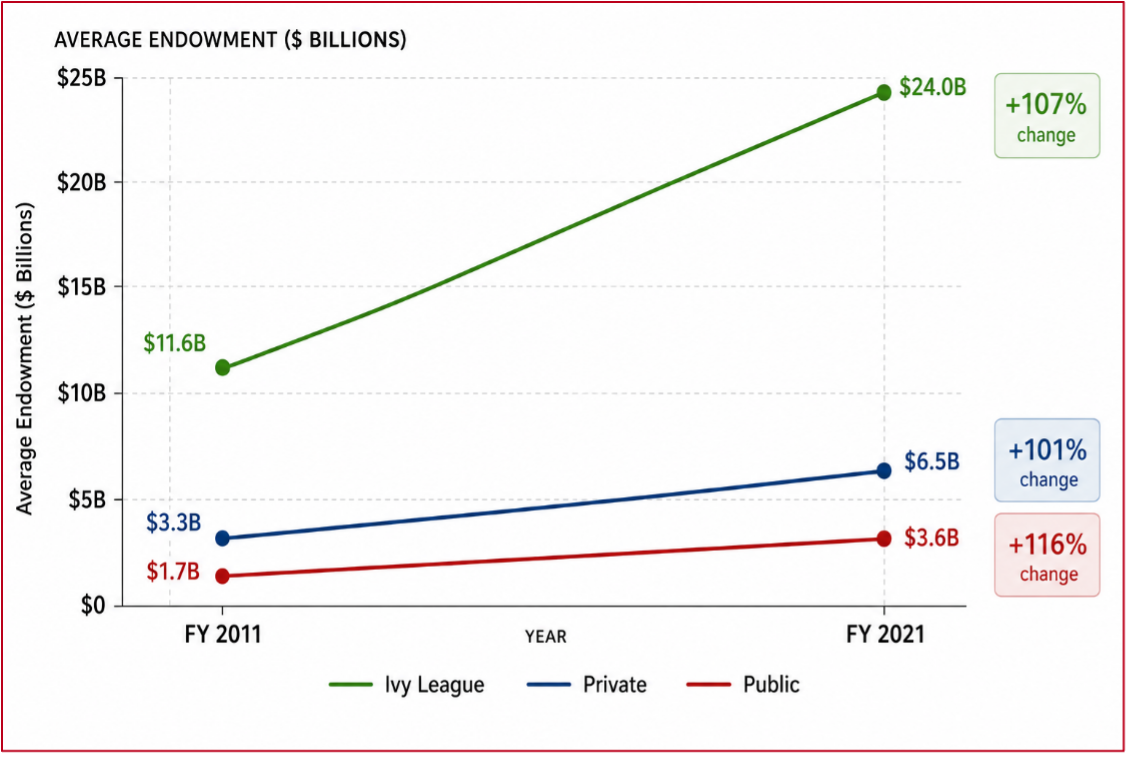
Note. Dollar amounts are reported in current (nominal) dollars using data from NCES, Digest of Education Statistics, Table 411 (2012 edition) and Table 333.90 (2022 edition) and author’s calculations. Ivy League institutions are included in totals for private institutions. The University of Texas System Office ($14.6 billion in 2011 and $40.4 billion in 2021) and the University of California System Administration Central Office ($5.2 billion in 2011 and $16.5 billion in 2021) endowments are included in totals for public institutions.
Defenders of wealthy endowments counter that these funds enable universities to advance various public goods, including expanded access to elite institutions through tuition subsidies and funding for scientific and medical research. True enough, access to vast sums of tax-shielded, interest-compounding wealth affords many opportunities, including socially beneficial ones.
But this same observation would seem to apply as well to other institutions, including those taxed at much higher rates. Advancing technology surely benefits the public—should technology companies be exempt from ordinary taxation? Equipping the armed forces is unquestionably beneficial—should the defense sector be exempt from ordinary taxation? What about agriculture, health care, and pharmaceuticals? What about the millions of Americans whose wages are subject to ordinary taxation? Their wages, too, fund consumption and savings that benefit society—should those wages be exempt from taxation as well? The pursuit of the good life is a certainly a worthy public good.
Continued preferential tax treatment for large endowments raises obvious fairness concerns, notwithstanding the positive uses this wealth accumulation affords. These concerns take on increasing importance as federal deficits mount. These concerns may extend beyond the largest endowments, since nonprofit institutions of all sizes can generate substantial investment income while benefiting from tax-preferred status.
Taxing Endowments: Fairness and Practical Considerations
The first tax on university endowments was included in the 2017 Tax Cuts and Jobs Act (TCJA). The initial rate was set to 1.4% on private colleges and universities with 500 or more tuition-paying students and more than half of their students located in the U.S. The 2025 Working Families Tax Cuts (WFTC) replaced this flat rate with a 3-tier rate structure—1.4%, 4%, and 8%—on a narrower base of institutions (3,000 or more students) with rates set to endowment assets per student (see Appendix A). Under the new structure, endowment taxation is likely to affect fewer than 30 institutions and raise approximately $6.7 billion over a 10-year window.[3]
The same 2017 TCJA set the corporate tax rate to 21% to better align U.S. business taxation with global standards. The corporate tax rate is far from the only tax U.S. businesses pay, and many businesses—such as those incorporated as sole proprietorships, partnerships, S corps, and most limited liability companies—pay taxes through individual tax rates ranging from 10%–37%. Add to this the many other taxes colleges and universities are generally excluded from: state corporate taxes, property taxes, sales taxes, franchise taxes, and gross receipts and business license taxes.[4]
The complexity of the U.S. tax system derives, in part, from competing priorities and disagreements over whether fairness concerns support proportional (equal treatment) or progressive (redistributive) rate structures. Yet few in this conversation would defend, as a matter of principle, special tax breaks enabling wealthy individuals or organizations to pay lower effective rates than their less wealthy peers. The effective tax burden imposed on large endowment investment income is substantially below the 21% federal corporate income tax rate and can also be far below the marginal rates faced by individual taxpayers on ordinary income.
To the basic fairness concerns, it must be added that the U.S. government’s finances—current deficits and debt, and looming costs—are daunting. Identifying new, under-utilized revenue sources could help to offset these challenges without requiring broader (growth-compromising) increases in tax rates. Alternatively, Congress could use additional revenues generated by raising the endowment tax to expand apprenticeships linked to high-earning jobs—a critical Trump Administration priority.
With these observations in mind, the America First Policy Institute’s Office for Fiscal and Regulatory Analysis has published a revenue analysis of several options for taxing endowments at the corporate rate of 21%. This analysis anticipates potential institutional responses to the higher rate, including increases in financial aid, reduced endowment investment, and other changes to the tax base. AFPI estimates taxing endowment investment income at the corporate rate would likely generate over $1 billion in additional annual revenue on top of existing endowment revenues for a total of $10.2 billion in additional revenue over 10 years. Model revenue estimates are presented below, in Figure 2. Revenue estimates for the top 10 university endowments are presented in Table 1.
Figure 2
AFPI OFRA 21% Endowment Tax Revenue Estimates: Budget Window FY 2027–2036
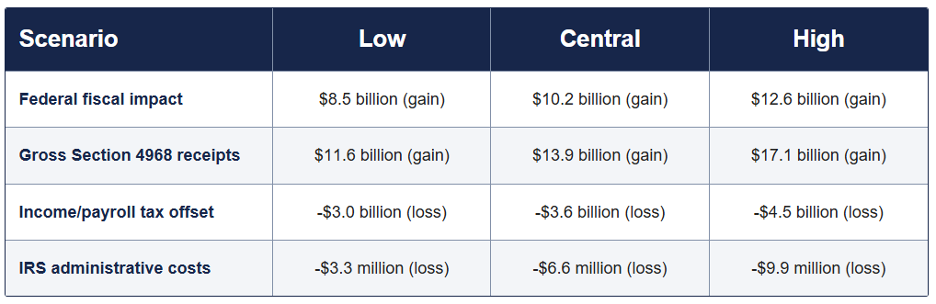
Source: AFPI Office for Fiscal and Regulatory Analysis, endowment tax model v.0.1.0.
Note. Components may not sum to totals due to rounding. OFRA AI tools assisted in generating this estimate.
Tax Endowments at the Corporate Rate
University endowments have accumulated substantial wealth, in part due to the favorable tax treatment federal law confers on their affiliated institutions. Yet current endowment taxation does little to address the fairness concerns created by this preferential treatment. At a time when some universities hold tens of billions of dollars in invested assets, Congress should reconsider whether institutions with such enormous stores of tax-advantaged wealth should continue to receive substantially more favorable treatment than other taxpayers and investment institutions.
Taxing endowment investment income at the 21% corporate rate would meaningfully address these concerns while also generating more than $1 billion in additional federal revenue annually, or approximately $10.2 billion over 10 years. These revenues could be used for deficit reduction or to fund critical investments, such as expanding apprenticeships linked to high-earning jobs. This proposal would not eliminate universities' nonprofit status, nor would it tax their tuition, charitable contributions, or core educational activities. It would simply require the wealthiest institutions to pay a tax rate on investment income more comparable to rates paid by many corporations.
Congress should no longer subsidize the accumulation of institutional fortunes through preferential tax treatment. Universities that maintain endowments worth tens of billions of dollars can afford to contribute more toward the public purposes that justify their tax-exempt status. At a time of persistent federal deficits and competing national priorities, Congress should close this loophole and put these billions of dollars to work for the American people.
Table 3
Top 10 Covered University Endowments: FY 2024 Values and Estimated Annual Tax Revenue at Current Rates and at the Corporate Tax Rate (FY 2027, Central Case)
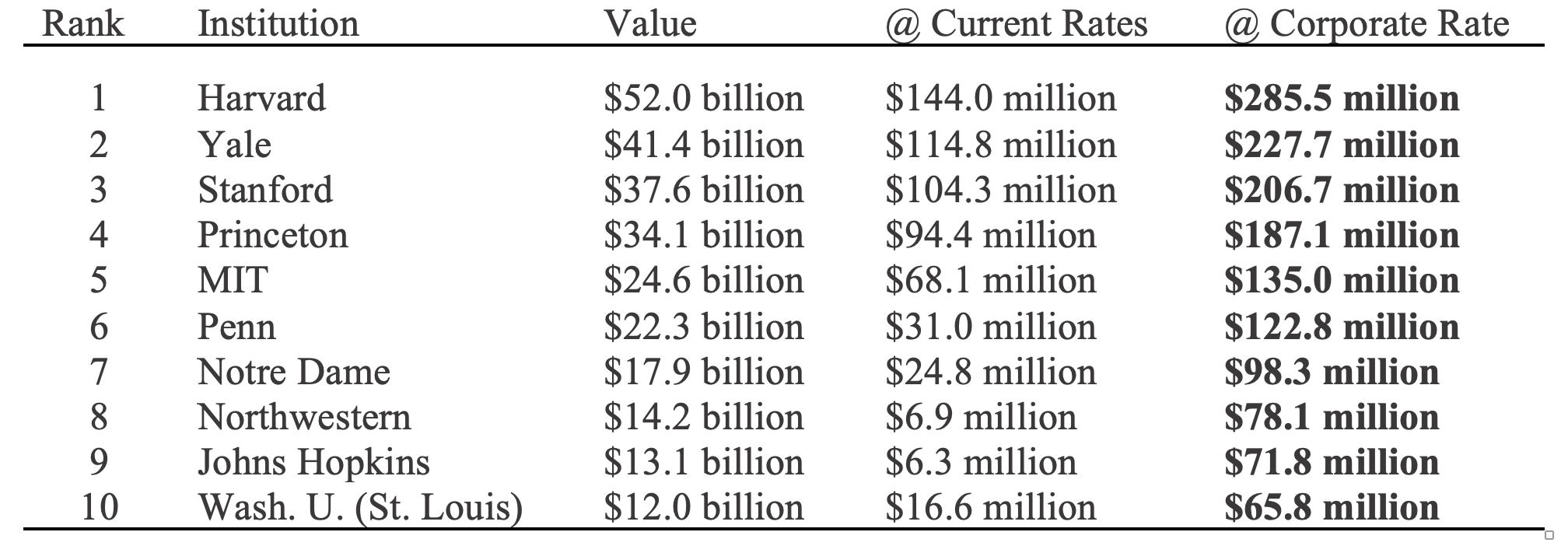
Source: AFPI Office for Fiscal and Regulatory Analysis, endowment tax model v.0.1.0 (central scenario). Endowment values are FY 2024 NACUBO-Commonfund market values; tax amounts are modeled for FY 2027 liabilities at FY 2024 rate tiers.
APPENDIX A. Changes to University Endowment Taxation: 2017–2025
Provision |
Tax Cuts and Jobs Act (2017) |
Working Families Tax Cuts (2025) |
Tax on net investment income |
Flat 1.4% tax rate |
Progressive rates: 1.4%, 4%, & 8% |
Applicable institutions |
Private colleges and universities |
Private colleges and universities |
500 tuition-paying students |
3,000 tuition-paying students |
|
More than 50% of students located in the U.S. |
More than 50% of students located in the U.S. |
|
Assets per student |
$500k in assets per eligible student (1.4% tax) |
$500k to < $750k in assets per eligible student (1.4% tax) |
$750k to < 2 million in assets per eligible student (4% tax) |
||
$2 million or more in assets per eligible student (8% tax) |
||
Estimated revenue |
$1.8 billion over 10 years |
$6.7 billion (additional revenue) over 10 years |
Note. Endowment tax rates obtained from the TCJA (2017) and the WFTC (2025). Revenue estimates obtained from the Congressional Research Service (2018) and the Joint Committee on Taxation, 2025.
[1] See §501(c)(3) of the Internal Revenue Code.
[2] I.e., assets other than publicly traded stocks, bonds, and cash.
[3] See Join Committee on Taxation, JCX 26-25R, p.5, line 21.
[4] State and local tax exemptions vary.