Northern Lights Flashing: The Case for U.S. Security Governance of Greenland
Key Takeaways
« The narrow conversation about who defends Greenland misses the urgent issue of the role Greenland plays in U.S. national defense.
« Greenland is critical to U.S. missile defense and space posture, the security of supply chains for critical resources, and, as the gateway to the Western hemisphere, blocking our adversaries' ambitions in our neighborhood.
« Securing U.S.-directed governance of Greenland's defenses is crucial for homeland security and empowers European partners to shift resources to immediate threats to the European continent. Security governance of Greenland is vital not only for the defense of the homeland but also to enable our European allies to focus together on other priorities in and beyond the continent.
Overview
The U.S. is in desperate need of an Arctic security strategy, and the media noise over the details of a Greenland “annexation” is disingenuous to the real security concerns facing not only the U.S. but also the wider Western Hemisphere and the transatlantic relationship. Greenland is more than an island of ice, polar winds, and rocks; it is a vital link in Arctic security for friends and foes alike. Security governance for Greenland—particularly that which is planned, overseen, and implemented by the U.S.—is integral to American missile radar awareness, the defense of the North Atlantic, and the holding of the line for the Western Hemisphere. Securing Greenland, in other words, is the first step toward blocking our adversaries’ ambitions in our northern neighborhood, parallel to the U.S. focus to the south.
Since President Franklin Roosevelt moved U.S. forces to deny the Axis occupation of Greenland after the fall of Denmark in 1940, the U.S. has been free to place as many troops and air and naval assets on the island as we deemed necessary for mutual defense. At the height of our commitment and with the cooperation of Denmark and the North Atlantic Treaty Organization (NATO), 15,000 Americans manned Greenland’s defenses. We can do this again and will have the support of the Western alliance hopefully awake to the threat China and Russia pose in the Arctic.
A scenario in which the U.S. prioritizes Greenland would further integrate, develop, and enhance existing defense systems, create economic opportunities, diminish emerging threats to the transatlantic alliance, and counter adversarial activities that compromise U.S. national defense more broadly. A forward-leaning posture in the Arctic positions the U.S. to develop assets and resources that have long been neglected and are increasingly necessary for the wider geopolitical competition. Rising threats in our hemisphere, such as those posed by Russia and China, necessitate direction and action that only the U.S. can orchestrate with European assistance.
The narrow rhetoric that focuses solely on who defends Greenland misses the urgent geopolitical question of Greenland’s role in defending the U.S. and the transatlantic alliance. Regardless of the outcome, the fact remains that Greenland is an essential part of Arctic security and will be strategic for the U.S. to expand its presence and assume greater responsibility for the security governance of Greenland. The consequences of Greenland’s security will have global implications as more adversaries view the Arctic as a new and vital aspect of global shipping, military projection, and diplomacy.
American Missile Defense and Space Posture Depends on Greenland
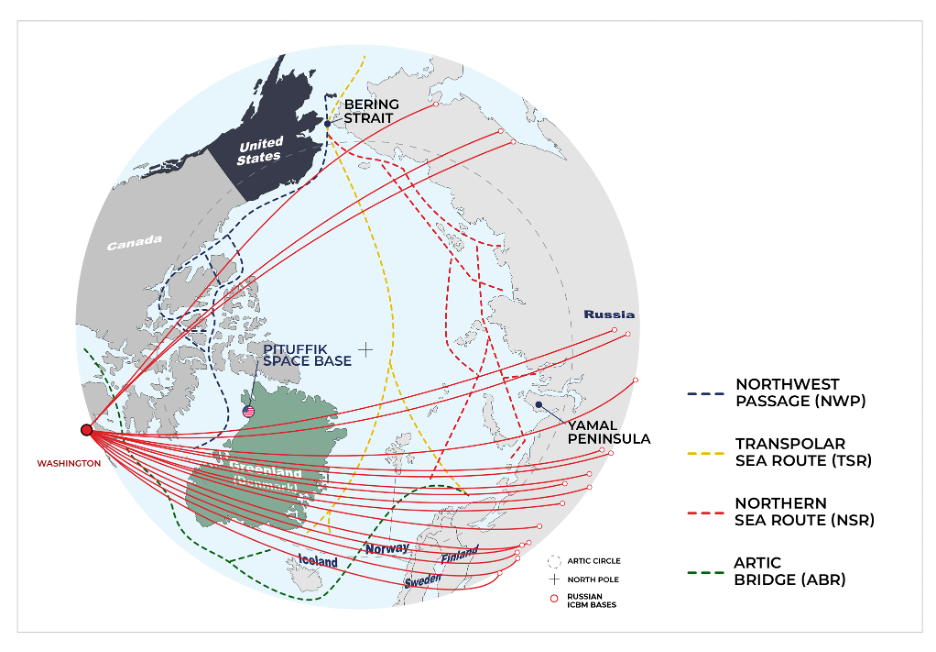
Greenland’s strategic location at the edge of the Western Hemisphere places it directly along the most likely polar flight paths for long-range missiles aimed at North America. In U.S. defense planning, “the homeland” refers to the continental U.S., its territories, and its air and maritime approaches that must be monitored for strategic surprises. Because threats to the homeland often travel over the Arctic, defending the homeland therefore begins not at the shoreline, but at the earliest point where threats can be detected, tracked, and assessed before they reach North America.
The geographic position of Greenland provides crucial early-detection and tracking capabilities that extend the sensor horizon of U.S. and allied missile-warning systems in the Arctic region. The importance of this vantage point is not new. U.S. presence in the region dates to the end of World War II, when Arctic basing became part of North America’s defensive perimeter. During the Cold War, Thule Air Base (now Pituffik Space Base) became pivotal to the Ballistic Missile Early Warning System, crafted specifically to detect Soviet missiles traversing the polar route toward the U.S. That mission has endured and is recognized in our current defense posture. The base’s integration into today’s North American Aerospace Defense Command (NORAD) and modern space domain awareness capabilities reflects a continuous recognition across decades that the Arctic—and Greenland in particular—is inseparable from the defense of the Western Hemisphere.
Greenland remains a core national security priority. As Russia modernizes its Arctic missile, air, and submarine forces, its role within NORAD is increasingly central to any NORAD modernization efforts and to the U.S. defense relationship with northern counterparts, ensuring credible early warning and hemispheric defense. As it currently stands, Greenland’s defense value lies in its existing capabilities and geography. Pituffik Space Base is the northernmost U.S. military installation that is operated by the United States Space Force. Its mission is not combat or power projection. Rather, it exists to support ballistic missile early warning, missile tracking and trajectory assessment, and space domain awareness, particularly for polar-orbiting objects. Missiles aimed at North America often travel over the Arctic, and Pituffik’s location uniquely provides what missile defense values most: time to detect, assess, and respond.
Note: Data sourced from Easy Financial Markets and Statista
Data from Pituffik feeds directly into NORAD’s missile warning and aerospace surveillance architecture, functioning as a critical Arctic sensor node along the polar route—the most direct trajectory for long-range threats to the homeland. This role becomes increasingly important as NORAD modernization is underway. Pituffik’s location and space domain awareness capabilities also support NATO’s collective security and alliance by enhancing early warning and situational awareness along the Arctic and transatlantic approaches. As a founding and current member of NATO, the U.S. has the obligation to contribute concrete capabilities and provide protection as an active contributor to the alliance’s collective defense. While NATO does not command the base, the information and awareness enabled by Pituffik strengthen NATO’s northern flank. The site enhances visibility over transatlantic reinforcement routes and adversarial approaches without requiring new basing or force deployments.
Pituffik anchors NORAD’s homeland warning mission while simultaneously reinforcing NATO’s defense posture. The Executive Order establishing Golden Dome, signed in January 2025 by President Trump, directed the U.S. to take a whole-of-government approach to provide for the “common defense of its citizens and the Nation by deploying and maintaining a next-generation missile defense shield.” All of these are valid arguments, given the capabilities that the existing Space Base already provides. Including Greenland within an integrated missile warning and tracking architecture is a logical extension of capabilities that have already proven relevant for both homeland defense and alliance security.
Greenland’s Importance for America’s Economic Security
Just as Greenland’s geography anchors homeland defense and alliance security through early warning and sensing, it also shapes the long-term economic conditions that determine who holds influence across the Arctic. Economic security refers to the ability of a nation to shape the conditions of trade, infrastructure, investment, and resource access in ways that preserve strategic choice, political autonomy, and long-term prosperity. In the Arctic, where access is difficult but resources are rich, economic activity is inseparable from geopolitical influence. The actors who finance, build, and control critical infrastructure in this region will shape the balance of power for decades.
Greenland also plays a critical role in shaping economic security outcomes in the Arctic, including as a response to China’s Polar Silk Road ambitions. Economic security is national security, and Greenland directly contributes to hemispheric defense, supply-chain resilience, and long-term energy and resource optionality, thus reinforcing U.S. leadership in the Arctic. By establishing an American presence in Greenland, the U.S. will shape access, influence, and infrastructure. Further, Greenland helps ensure that economic activity in the region supports prosperity and transparency to promote free and fair trade, an articulated theme in the 2025 National Security Strategy of the United States of America.
In the Arctic, economic engagement is uniquely strategic because infrastructure, investment, and access tend to establish influence for decades rather than mere years. The region’s extreme conditions demand highly capital-intensive developments (e.g., ports, airports, mining facilities, energy systems, and communications networks), which, once built, become deeply entrenched and extraordinarily difficult and costly to reverse or displace. This dynamic makes a deliberate, long-term, strategic approach to Greenland particularly essential. Greenland’s investments in critical infrastructure create enduring geopolitical and economic footholds, thereby shaping regional power balances for years to come.
Access, however, is the prerequisite for any such engagement. As it currently stands, the U.S. has three operational United States Coast Guard polar-capable icebreakers, with plans underway to expand the fleet through the acquisition of new cutters in the coming years. Icebreakers are access-enabling platforms that make Arctic sea lanes navigable, escort commercial and military vessels, enable port operations, resupply remote infrastructure, and support year-round activity in waters otherwise blocked by ice. In practical terms, they determine who can sustain a presence long enough for economic activity to take root. Control of sea lanes is inseparable from control of trade, logistics, and resource development. This limited icebreaking capacity constrains the ability to sustain economic presence and shape long-term outcomes across the Arctic. But this also provides businesses with the opportunity to invest in the much-needed capability in a critical region, further justifying the economic argument. In this context, Greenland’s geography and existing U.S. presence help mitigate access limitations, making it a critical enabler of economic engagement, infrastructure development, and continued influence while broader Arctic capacity is built out.
China’s gray-zone warfare tactics reflect a long-term economic strategy focused on access, infrastructure, and influence rather than militarization. Through its Polar Silk Road concept, China has framed its Arctic interests around control of emerging shipping routes, investment in port and airport infrastructure, mining and rare earth extraction rights, telecommunications networks, and long-term financing of energy and logistics patterns already observed through the Belt and Road Initiative. Though presented as commercial and cooperative, these projects establish durable footholds in the physical and financial systems that enable trade and resource development. In a region where access and infrastructure are difficult to reverse once established, such economic positioning carries clear strategic implications for Greenland, the U.S., and its partners.
The primary risk, then, is not necessarily competition, but rather economic entrenchment that narrows future strategic choices. When a single external actor finances ports, builds logistics hubs, funds mining operations, and underwrites communications networks, that actor gains influence over how trade flows, which partners are preferred, and what standards govern commercial activity. Infrastructure is both an opportunity and a chokepoint, depending on who controls the capital behind it. Ownership of infrastructure, control of financing mechanisms, and dominance in crucial industrial sectors can gradually reduce transparency and constrain policy autonomy. If not addressed, Greenland would, by virtue of economic alignment, absorb governance and investment practices in which commercial activity serves its financing entity.
Over time, economic dependence can harden into strategic leverage. In practical terms, this dependence can manifest as reliance on foreign financing for mining and energy projects or integration into shipping trade routes that favor one external partner over others. Greenland plays an important role as a case study of economic security leverage, with ongoing negotiations rooted in promoting reciprocal prosperity among allies and in defending the Western Hemisphere. The concept of reciprocal prosperity is the foundation of any fair trade as it promotes mutual benefits, not dependency; fair exchange, not extraction; long-term stability, not short-term gain; and, most importantly, balanced growth, not a zero-sum outcome. These principles stand in stark contrast to the predatory and extractive economic models employed by U.S. adversaries, in which benefits accrue disproportionately to one side. For example, China’s Belt and Road Initiative has resulted in debt-driven dependence and asymmetric relationships that constrain long-term autonomy, while often serving only as shells for the concept of development. Such arrangements can create the appearance of economic prosperity while limiting genuine economic freedom and strategic choice for participating partners.
Burden Shifting with Our European Allies
The U.S. and Europe both share interests in Arctic security. NATO member countries own just shy of 50% of the Arctic coastline, while Russia owns the remaining. Given the geographic context, the Arctic cannot be treated as a standalone region, but rather as a focal point of the alliance itself
Within President Trump’s conception of international alliances and partnerships, he emphasizes both “burden-sharing” and “burden-shifting” as key foreign policy approaches aimed at strengthening the global security architecture and U.S. national security, as outlined in the National Security Strategy. U.S. and European diplomatic efforts over Greenland do not escape this reality. The diplomacy playing out over Greenland reflects ambitious goals of configuring the transatlantic relationship along the lines of competitive strengths, mutual interests, and long-term stability. The transatlantic alliance ought to conform to the geopolitical reality it finds itself in, adapt, and overcome the obstacles ahead. An increased American presence and responsibility in Greenland not only advances Arctic security goals but also strengthens NATO’s hand in Europe; NATO, as an institution and member states, must be proactive rather than reactive and understand itself within the geopolitical reality it faces, not the one it wishes it had.
In the context of transatlantic security, the core American interests in obtaining a greater presence and responsibility over Greenland are threefold: the lives of American citizens must be prioritized and protected; American national defense must be proactive, not reactive; and the U.S. must understand its position and act accordingly in its Arctic interests.
1. Americans Must Be Protected
No matter the diplomatic effort, whether it is dialogue with Europe, Russia, or China, the interests and protection of Americans at home and abroad is the utmost policy priority. Greenland is a critical part of this goal. Greenland has historically served as a forward-operating and reconnaissance base for the U.S. in support of early warning systems for national defense. Undoubtedly, as President Trump has noted, Greenland will be a critical piece in the Golden Dome for the protection of the homeland, and, most importantly, of American citizens.
2. American National Defense Must Be Proactive, Not Reactive
Transatlantic defense policies and strategies—particularly those concerning long-term investment in the defense industrial base, innovation, acquisition processes, and strategic foresight—have remained largely dormant for far too long. Despite its efforts, NATO typically does not act with foresight and initiative; instead, it tends to move at a glacial pace, reacting to events around it, thereby fostering complacency, allowing responsibilities to be neglected, and ultimately concentrating the defense burden on one or a few allies—most notably the U.S. For years, the U.S. has shouldered a disproportionate share of the burden of defending the transatlantic alliance. Under President Trump’s leadership, this imbalance has begun to shift decisively. President Trump secured NATO members’ commitment to increase defense spending to 5% of gross domestic product (GDP) by 2035 through the Hague Commitment. However, increased spending and material contributions must be matched by a clear strategic direction and purpose. Fundamental questions (i.e., what to defend, who will defend it, and where) must be addressed transparently, taking into account each member’s comparative advantages and limitations.
Shifting the burden of Greenlandic defense to the U.S. underscores the need to develop a strategy based on comparable advantages. The U.S. should be responsible for NATO’s northern flank, while Europe should handle the eastern flank; U.S. negotiations regarding an enhanced presence and access in Greenland are not intended to antagonize Europe or portray it as an adversary. Rather, they reflect a proactive response to the strategic threat posed by Russia (and, to a lesser extent, China) in the Arctic and along the Northern Flank. President Trump’s approach prioritizes proactivity over reaction: by securing an increased American footprint and responsibility in Greenland through negotiated frameworks that build on existing agreements (such as the 1951 U.S.-Denmark Defense Agreement), he seeks to preempt and contain emerging threats rather than wait for them to materialize. This forward-leaning posture strengthens deterrence, protects critical transatlantic vulnerabilities (such as missile early warning, air defense, and control of key Arctic corridors), and ensures the alliance remains resilient in an era of great-power competition.
3. Geopolitical Chess
Russia and China have strategic interests in the Arctic. For the past two decades, Russia has increasingly invested in the Northern Sea Route (NSR), an emerging Arctic trade route that hugs the Russian Arctic coastline. In 2018, President Vladimir Putin’s May Decrees elevated the NSR as a core interest for Russia, and in each annual Eastern Economic Forum panel discussion, he sets goals for greater investment and increased trade volume through the route. Additionally, Russian military installations—including the modernization of the Northern Fleet, the construction of Trefoil Arctic bases, and the addition of more ports or railroads with Russian Federal Security Service officers present—have been scattered throughout the Russian Arctic. An increased presence of Russian assets, both civilian and military, has enabled Russia not only to entrench its existing presence but also to expand it. Recently, Russia, through the United Nations (UN) Convention on the Law of the Sea and the arbitration process, has sought to include the Lomonosov Ridge, the Mendeleev Ridge, the Gakkel Ridge, and the Canadian Basin within its Exclusive Economic Zone (EEZ), and has received partial approval.[1] Allowing Russia and China to expand their influence unimpeded in the Arctic endangers the Northwest Passage, NATO’s northern flank, and American commercial and naval dominance. Greenland, as a strategic link between the North Atlantic Gap and the Northwest Passage, must be reinforced with an increased American presence to protect our parallel emerging commercial interests in the Arctic. As American Admiral Alfred Mahan wrote in his naval history and strategy, The Influence of Sea Power Upon History, “The tendency to trade, involving of necessity the production of something to trade with, is the national characteristic most important to the development of sea power.” In other words, commercial dominance is only as good as the nation’s naval dominance. If a nation wants to maintain economic security, both in peace and at war, it must be able to protect and enable that trade. Greenland’s natural geographic features make it advantageous for both commercial activities and naval strategy.
President Trump even highlighted this fact in his 2026 speech at Davos:
Greenland is a vast, almost entirely uninhabited and undeveloped territory that’s sitting undefended in a key strategic location between the United States, Russia and China. That’s exactly where it is. Right smack in the middle…And to get to this rare earth, you got to go through hundreds of feet of ice. That’s not the reason we need it. We need it for strategic national security and international security.
President Trump’s negotiations over Greenland are not a one-off event, but one piece in a larger geopolitical competition among great powers to pursue and secure interests before others can take control. A stronger American presence in the Arctic is detrimental to our adversaries’ interests, especially those of Russia and China, with repercussions globally, including diminishing avenues for China’s Belt and Road Initiative and for Russia’s Shadow Fleet Operations. Ultimately, President Trump’s approach reflects an assessment of the strategic role of the transatlantic alliance and the objectives of its adversaries, with policies shaped accordingly.
Greenland as a Gateway to the Western Hemisphere
From an “America First” perspective, leadership in the Western Hemisphere is not optional; it is foundational. American security begins in the Western Hemisphere, which is the closest to the homeland. Greenland fits squarely within that logic. Its location, its historical ties to North America, and its growing importance in Arctic security make it a critical part of the immediate strategic environment of the U.S.
American leadership in Greenland strengthens stability across the hemisphere. When the U.S. clearly takes responsibility, it reduces uncertainty, deters outside interference, and signals that the hemisphere’s security is under U.S. leadership. Just as the U.S. safeguards the Caribbean and continental airspace, the Nation is uniquely positioned to assume responsibility for Arctic defense anchored in Greenland.
Greenland is a strategic asset that affects the safety and security of the U.S. Greenland sits at the intersection of North America, Europe, and the Arctic, providing a vantage point over northern maritime traffic and trade routes. An “America First” approach means prioritizing control and influence in areas where threats could reach the homeland. Greenland sits at the crossroads of Arctic competition and hemispheric security, and U.S. policy should reflect that.
The Arctic is more than just Europe’s northern edge—it is the northern extension of North America. Greenland’s proximity to the U.S., its integration into NORAD, and its role in early warning and missile defense make it impossible to separate it from U.S. continental security. Greenland increasingly controls the eastern outlet of the Northwest Passage, the northern equivalent of the Panama Canal. Its position gives the U.S. direct influence over emerging Arctic sea lanes connecting the hemisphere to Europe and Asia, underscoring its strategic value. Efforts to defend the homeland and the American people must therefore treat Greenland as part of the broader Western Hemisphere, not as a distant diplomatic issue.
From this perspective, a greater U.S. role in Greenland is not a departure from American tradition, but it reflects continuity with long-standing strategic principles. Just as the Monroe Doctrine aimed to prevent European powers from gaining influence in the Americas, the U.S. today must ensure that extra-hemispheric powers like China and Russia do not gain a stronger foothold in the Arctic. Greenland underscores the reality that threats to the hemisphere no longer develop at a distance, and adversaries move quickly to exploit unguarded spaces near North America. Taking a stronger U.S. role in Greenland is about keeping the hemisphere secure and preventing adversaries from gaining a foothold before it becomes a problem. China and Russia are increasingly active in the Arctic, and preventing our adversaries from penetrating the hemisphere applies there just as much as it does in the Caribbean or South America.
Conclusion
The Trump Administration is advancing a new, refreshing America First strategy not only in the Western Hemisphere but also in the Arctic. Over the past year, the Trump Administration has reshaped geopolitical dynamics, placing our adversaries on the defensive and undermining their ability to coordinate. Our adversaries’ strategic setbacks undoubtedly compel a new calculus, ushering in a far more complex threat environment in which dominance in key areas of technology, geographic presence, and resources will be determinative of broader strategic advantages. Investments made today in Arctic defense equities, shipping, and infrastructure will yield significant returns by challenging Russian and Chinese intentions and securing American dominance over an emerging region. Greenland’s security arrangement is key to how these events unfold and to the ability of the U.S. to defend against and deter them. The present discussions between the U.S. and its European allies toward a negotiated framework for Greenland are the foundation for our cooperation in building a world of greater peace and prosperity.
[1] The UN Commission on the Limits of the Continental Shelf (CLCS) is established under the UN Convention on the Law of the Sea and evaluates the scientific claims of coastal states that extend beyond the arbitrated and agreed-upon 200-nautical-mile EEZ. “Approval” from the CLCS is not final; it is a recommendation at the end of an evaluation. In Russia’s case, the scientific evidence presented to the CLCS was found partially credible for expanding Russia’s claim beyond the agreed-upon EEZ. For an EEZ change to occur, a bilateral or multilateral agreement between the parties with similar claims, such as Canada and Denmark, who have not yet received “approval,” must be reached.