Reforming America’s Legal Immigration to a Merit-Based System
Key Takeaways
America's legal immigration system is outdated and dysfunctional, privileging familial ties and chance over skills, merit, and the national interest.
During the last decade, 84% of immigrants to the U.S. were selected regardless of their skills, their ability to contribute to America’s economy, or willingness to culturally assimilate.
The failure to take merit into account has led to an influx of immigrants who are less educated, lower wage earners, less likely to be self-sufficient, and more likely to use public resources.
Congress should reform our legal immigration system by eliminating low-skilled immigration perpetuated by chain migration and the Diversity Visa Lottery and creating a merit-based system that prioritizes immigrants with skills and the desire to assimilate.
Introduction: Why Merit Matters
The U.S. has one of the most generous immigration systems in the world, admitting approximately 1.1 million legal immigrants annually (DHS Statistical Yearbooks, Table 6). However, under our current system, most legal immigrants are selected based on family connections, or even random chance, rather than merit. This is because the current system, created by the Immigration and Nationality Act of 1965, contains far more opportunities for immediate-family and extended-family immigration than immigration based on skills or merit.
From the moment it was created, America’s family immigration system sparked a wave of mass migration to the United States. In the 1950s, the U.S. admitted 250,000 immigrants (also called legal permanent residents or green card holders) on average per year. In the 1960s, the U.S. admitted 330,000 immigrants on average per year; in the 1970s, 450,000 immigrants on average per year; in the 1980s, 735,000 immigrants on average per year; in the 1990s, nearly 1 million immigrants on average per year; and since 2000, over 1 million immigrants on average have been admitted to the U.S. per year (DHS Statistical Yearbook FY 2023, Table 1; PRB, 2014).
This dramatic increase in legal immigration has been driven by family immigration, which allows immigrants to sponsor a never-ending flow of immediate relatives and extended-family members (the latter called family-based immigrants). Combined, these family members now comprise nearly two-thirds of all legal immigration to the United States.
Figure
1
Aliens Granted Legal Permanent Residence 1960-2023
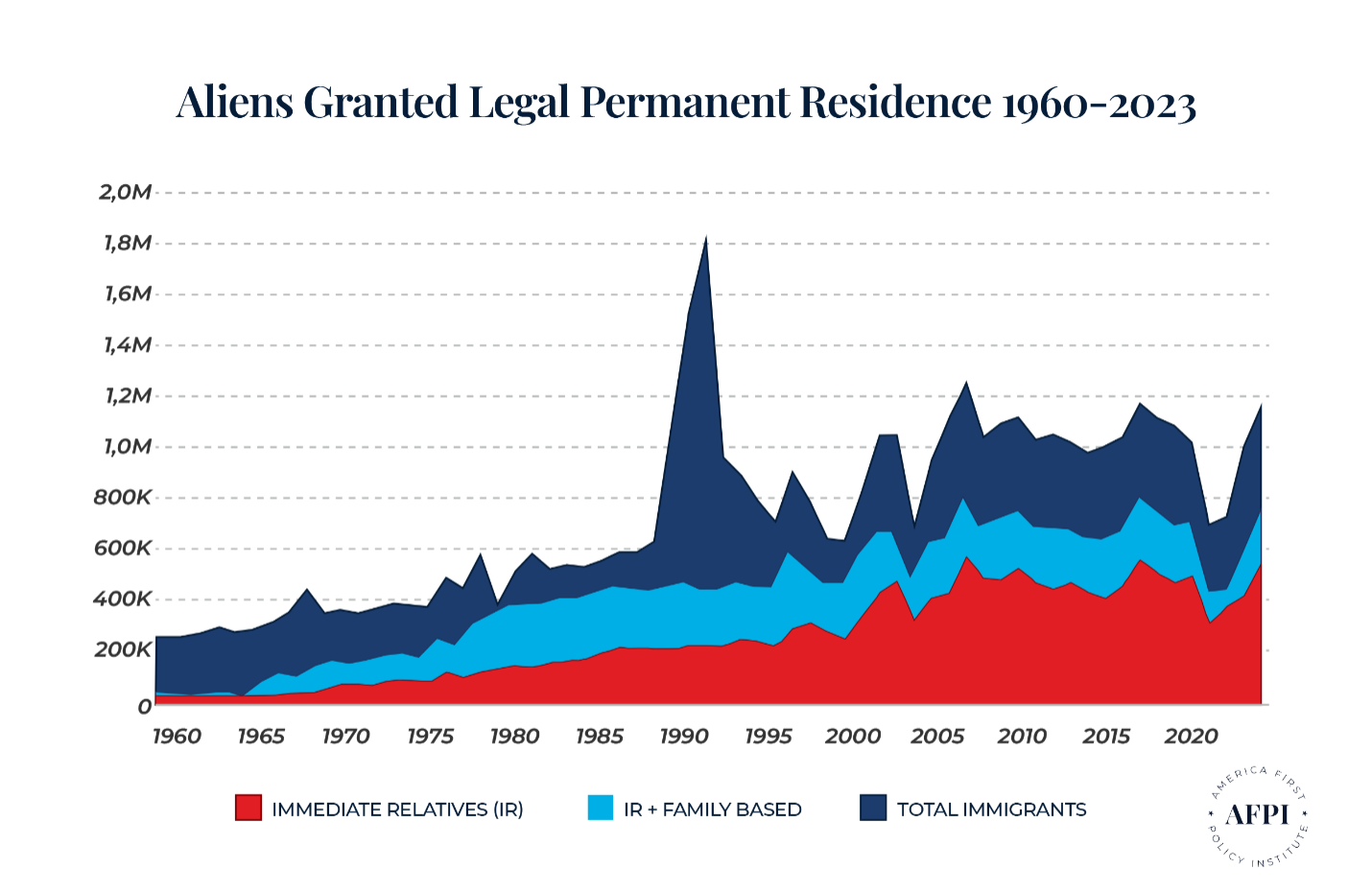
Note: Annual data obtained from Immigration and Naturalization Service Annual Reports and Homeland Security Yearbooks of Statistics. Data from 1960-1965 were categorized based on current statutory definitions.
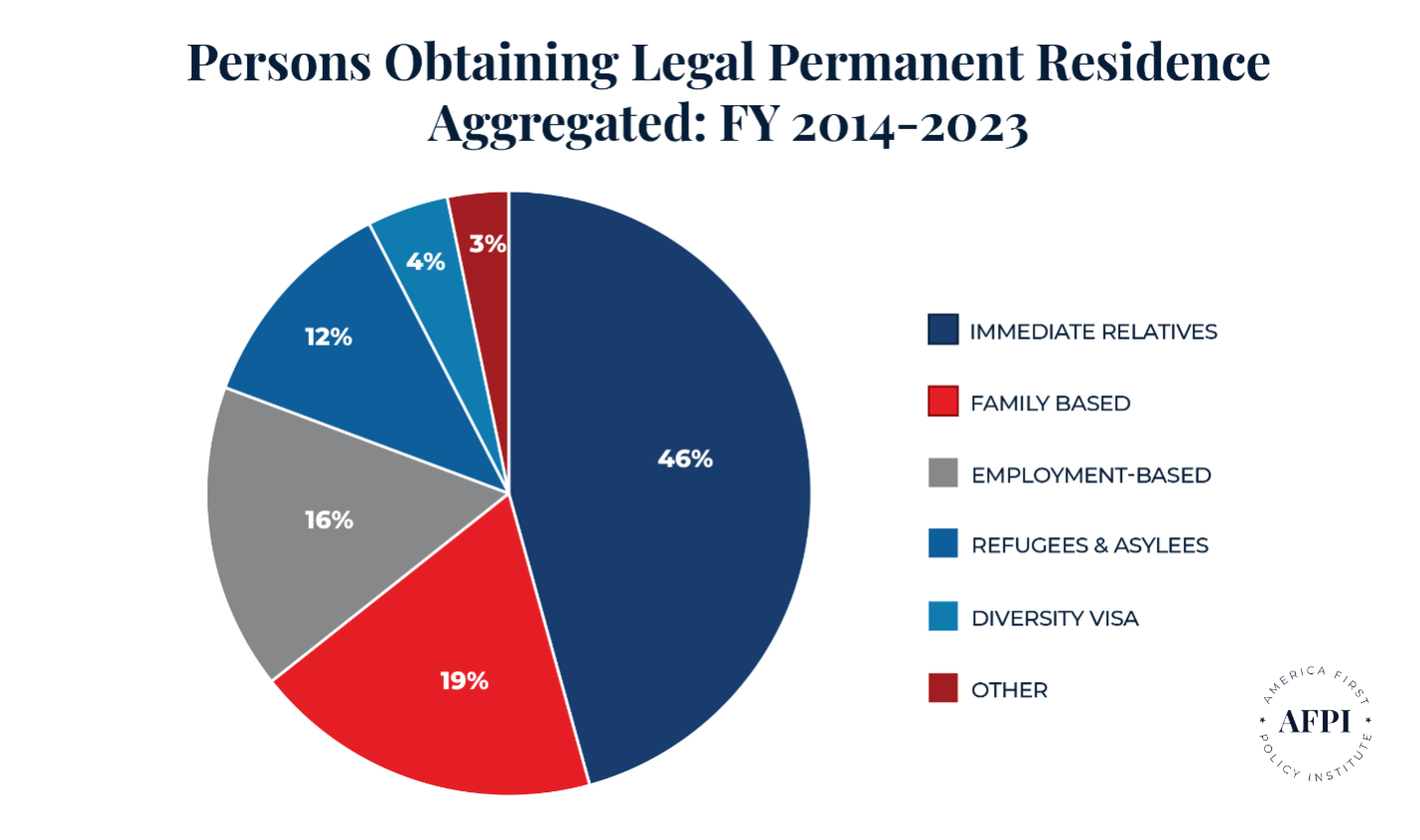
Through these family categories, enshrined in the 1965 Act, most immigrants to the U.S. were admitted regardless of skill, education, ability to contribute to America’s economy, or likelihood of assimilating into American society. Similarly, other large groups of immigrants were admitted through non-merit categories, such as the Diversity Visa Program (also called the Visa Lottery) and the refugee/asylum program. Indeed, as demonstrated by Figure 2 below, over the last decade, a staggering 84% of new immigrants to the United States were admitted regardless of skill or merit.
Admitting millions of immigrants regardless of merit does not serve America’s national interest. Americans have long believed that immigrants should be self-sufficient, contribute to the economy, and not impose fiscal burdens on taxpayers. This is why, for over a century, federal law has barred the admission of immigrants who are likely to become a public charge. Americans also believe newcomers should contribute to society, rather than undermine it, which is why federal law bars the admission of criminals, terrorists, and others who seek to undermine our government (INA Section 212(a)(2),(a)(3); INA 212(a)(4)). Americans also believe that immigrants should assimilate and speak English, which is why immigrants must demonstrate a basic understanding of civics and the ability to speak, read, and write basic English to naturalize (INA Section 312). Finally, Americans believe in measured immigration, not mass migration, which is why most immigration categories are numerically capped.
Unfortunately, these principles are undermined when the sole requirement for obtaining an immigrant visa is, as in most cases, a family relationship. And the overwhelming predominance of family immigration in our system has led to the influx of less-skilled, lower-earning immigrants who not only compete with American workers but impose significant burdens on American taxpayers. More emphasis should be placed on merit.
To address this problem, in 2017, Senator Tom Cotton introduced the Reforming American Immigration for a Strong Economy Act (RAISE Act). That legislation proposed reforming America’s immigration system by curbing the runaway growth of family immigration and replacing our current employment-based system with a points-based system that prioritizes merit. The RAISE Act rewarded factors like education, English proficiency, and job offers, while eliminating non-merit immigration categories, such as the extended family preference categories and the Diversity Visa Program, a program that annually allows up to 55,000 foreign nationals from certain countries to obtain immigrant visas by entering a lottery (S.1720, 2017).
Early in his first term, President Trump endorsed the merit-based system in the RAISE Act because he recognized the current immigration system encourages low-skilled immigration. At a White House ceremony to highlight the bill, President Trump said, “This legislation demonstrates our passion for struggling American families who deserve an immigration system that puts their needs first and that puts America first” (The Washington Times, 2017). In 2019, President Trump unveiled his own robust immigration plan that would have, in addition to securing the border and reforming our asylum system, created a merit-based immigration system while maintaining a priority for nuclear families of U.S. citizens and legal permanent residents (White House, 2019). Unfortunately, Congress did not act on either of these proposals.
With the start of President Trump’s second term and the return to America First immigration policies, now is the time for Congress to reform America’s immigration system so that it serves Americans first. While President Trump’s executive orders have been tremendously effective in securing the border and enforcing our immigration laws in the interior, Congress must lead the way to secure the long-term, structural reform of America’s immigration system. Codifying a merit-based system would ensure the immigration and economic vision of America First lasts beyond President Trump’s second term, and, in particular, that future immigration flows serve America’s national interest, protect wage earners, and support the upward mobility of working- and middle-class Americans for generations to come.
America’s Current Immigration System Prioritizes Family Connections Over Merit
A review of the legal immigration categories helps explain why America’s system largely ignores merit. The Immigration and Nationality Act (INA) authorizes the admission of new immigrants through the following broad categories:
(1) Immediate Relatives
(2) Family-Based Immigrants
(3) Employment-Based Immigrants
(4) Diversity Visa Immigrants
(5) Refugees and Asylees
(6) Other
Notably, only one category – employment-based immigrants – admits legal immigrants based on merit.
Immediate Relatives
“Immediate relatives” is the largest immigration category, encompassing the spouses, minor children (under 21), and parents of U.S. citizens. It is also one of the few immigration categories that is not subject to an annual cap. Thus, aliens who qualify as immediate relatives of citizens can immigrate to the U.S. on a rolling basis, only waiting a relatively short period of time while their paperwork is processed and security checks are conducted. Notably, the number of parents sponsored through the immediate relatives category has become substantial over time. Between Fiscal Year 2014 and Fiscal Year 2023, it accounted for 29% of all immediate relatives. In FY 2023 alone, parents accounted for 38% of immediate relatives (208,000) and 18% of the annual total of immigrant visas (DHS Statistical Yearbook, FY 2014-2023, Table 6).
Family-Based Immigrants
Separate and distinct from the immediate relatives category, the U.S. immigration system has another category for “family-based” immigrants. The “family-based” category, capped at 226,000 annually, allows citizens and legal permanent residents to sponsor extended family members to immigrate to America. U.S. citizens may sponsor adult children and adult siblings living back in their home countries. Legal permanent residents may sponsor spouses, minor children, and adult children who are unmarried.
Through this pipeline, hundreds of thousands of extended family members have immigrated to the U.S. each year, regardless of skill or ability to contribute to American society. In turn, once these newcomers arrive, they may sponsor other extended family members, regardless of their skill or potential to contribute to society. This cycle is called “chain migration.”
Employment-Based Immigrants
The “employment-based” category is the only immigrant visa category based on skill, and even within this category, some employment-based visas require only minimal skills. Employment-based visas allow foreign nationals to immigrate if they fall into one of five subcategories:
(1) Aliens with extraordinary abilities; outstanding professors or researchers; and certain multinational executives;
(2) Professionals holding advanced degrees or aliens of exceptional ability;
(3) Other skilled and unskilled workers;
(4) Special immigrants; and
(5) Investors (INA Section 203(b)).
The employment-based category is capped at 140,000 visas per year, although by statute, unused family-based visas will roll into this category, occasionally increasing the number of employment-based visas available.
Diversity Immigrants
Each year, the Diversity Visa Program (also called the Visa Lottery) grants up to 55,000 immigrant visas through a random lottery to the nationals of “low admission” countries across six geographic regions. Low-admission countries are countries from which fewer than 50,000 nationals have emigrated to the U.S. within the previous five years. In 2025, this permitted nationals from all but 18 countries to enter the lottery (U.S. Department of State, 2023). However, no country may receive more than 7% of the total diversity visas (INA, Section 203(e)).
The criteria for entering the visa lottery are minimal. Aliens need only have a high-school education or two years of qualifying work experience. Thus, the visa lottery is specifically designed to ignore the education and skills of selected immigrants and the impact they will have on American workers.
Refugees and Asylees
Refugees and asylees make up the majority of America’s humanitarian immigration program. The refugee and asylum programs allow aliens to seek legal permanent residence in the United States if they establish that they have been persecuted, or fear persecution, in their home countries based on race, religion, nationality, political opinion, or membership in a particular social group (Section 101(a)(42)).
The number of refugees allowed into the U.S. is set annually by presidential decree, and the number of refugees authorized has varied significantly in recent years (INA Section 207). In 2024, the number of refugees was capped at 125,000; in 2025, it was capped at 7,500. Meanwhile, there is no limit on the number of aliens who may obtain legal permanent residence through asylum (USCIS Policy Manual, Chapter 1).
Other Immigrants
Per the Department of Homeland Security’s reporting system, the “other” immigrant category includes children born abroad to legal permanent residents, certain Iraqis and Afghans employed by the U.S. government (plus spouses and children), aliens who receive cancellation of removal, victims of human trafficking (through “T visas”), and crime victims plus their immediate relatives (through “U visas”) (Office of Homeland Security Statistics, Immigrant Classes of Admission).
America Needs Merit-Based Immigration Reform
Since 1965, non-merit-based categories have dominated our immigration system, crowding out opportunities for merit-based immigration. Between FY 2014 and FY 2023 (except during COVID-19), the U.S. consistently admitted more than one million new immigrants each year, peaking at 1.173 million in FY 2023. The top two categories of immigration during that decade were immediate relatives, making up 46% of the total, and family-based immigration (i.e., extended family members), making up 19% of the total.
The third- and fourth-largest categories of immigration over the past decade, refugees/asylees and diversity visas, were also non-merit categories. Between FY 2014 and FY 2023, refugees and asylees made up 12% of total immigration, and diversity immigrants made up 4%. Thus, during the last decade, 84% of new immigrants to the United States were admitted regardless of merit (. 
Figure 2
Persons Obtaining Legal Permanent Residence: FY 2014-2023
Persons Obtaining Legal Permanent Residence: FY 2014-2023 |
|||||||
Fiscal Year |
Total |
Immediate Relatives |
Family-Based |
Employment-Based |
Diversity Visa |
Refugees & Asylees |
Other |
2023 |
1,172,910 |
551,590 |
204,240 |
196,760 |
67,350 |
99,360 |
53,610 |
2022 |
1,018,349 |
428,268 |
166,041 |
270,284 |
43,233 |
83,082 |
27,441 |
2021 |
740,002 |
385,396 |
65,690 |
193,338 |
15,145 |
56,397 |
24,036 |
2020 |
707,362 |
321,148 |
121,560 |
148,959 |
25,028 |
63,875 |
26,792 |
2019 |
1,031,765 |
505,765 |
204,139 |
139,458 |
43,463 |
106,911 |
32,029 |
2018 |
1,096,611 |
478,961 |
216,563 |
138,171 |
45,350 |
185,909 |
31,657 |
2017 |
1,127,167 |
516,508 |
232,238 |
137,855 |
51,592 |
146,003 |
42,971 |
2016 |
1,183,505 |
566,706 |
238,087 |
137,893 |
49,865 |
157,425 |
33,529 |
2015 |
1,051,031 |
465,068 |
213,910 |
144,047 |
47,934 |
151,995 |
28,077 |
2014 |
1,016,518 |
416,456 |
229,104 |
151,596 |
53,490 |
134,242 |
31,630 |
Note: Data from DHS Statistical Yearbook FY 2014-2023, Table 6 (https://ohss.dhs.gov/topics/immigration/yearbook/2023/table6).
Figure 3
Persons Obtaining Legal Permanent Residence Aggregated: FY 2014-2023
Note: Data from DHS Statistical Yearbook FY 2014-2023, Table 6 (https://ohss.dhs.gov/topics/immigration/yearbook/2023/table6).
This lopsided distribution of immigrant visas has not advanced America’s national interest. Instead, it has led to the mass migration of people who are less educated, lower wage earners, less likely to be self-sufficient, and more likely to use public resources. This is because granting visas solely based on family relationships ignores education, skill, earning capacity, English proficiency and other important factors that determine whether an immigrant will be successful in America.
Available research supports this conclusion. Consider education, for example. In 2023, 64% of all immigrant visas (755,830) were given to immediate relatives and family-based immigrants. Of this number, nearly half (340,470) came from Mexico, Central America, and the Caribbean. Meanwhile, the educational level of aliens arriving from Mexico, Central America, and the Caribbean is significantly below that of Americans. While only 34% of Americans have a high school diploma or less, approximately 76% of the foreign-born from Mexico have a high school diploma or less; 73% of the foreign-born from Central America have a high school diploma or less; and 51% of the foreign-born from the Caribbean have a high school diploma or less (Pew Research, 2025).
Although the educational data reflect the education level of all foreign-born persons, legal and illegal, the pattern is consistent across the board, even with respect to college degrees. While 36% of native-born Americans have a college degree, only 10% of the foreign-born from Mexico have a college degree, 11% from Central America have a college degree, and 25% from the Caribbean have a college degree (Pew Research, 2025).
With lower educational attainment, immigrants are likely to earn less money and pay less in taxes. According to the Migration Policy Institute (MPI), Latin America and the Caribbean are “by far” the most common regions of origin for “low-income immigrants” in the United States, defined as foreign-born persons (legal and illegal) whose income is less than 200% of the federal poverty level. In 2019, 63% (or 9,256,000) of low-income immigrants living in the U.S. were from Latin America and the Caribbean; one-third of low-income immigrants (or 4,887,000) were born in Mexico. Importantly, MPI estimates that 64% of low-income immigrants are legal immigrants (MPI, 2022).
Less-educated, low-income immigrants are also more likely to use social and welfare benefits. For example, a recent study from the Center for Immigration Studies shows that of the foreign-born households with young children where the head of household has less than a college degree, 66% participate in one of two major welfare programs, Women Infants and Children (WIC) or food stamps (SNAP); 28% of those same households participate in both programs (Center for Immigration Studies, 2025). Not surprisingly, this study showed that the participation rate of households from the Western Hemisphere is almost the same, with 65% participating in either WIC or SNAP, and 28% participating in both programs.
Low-income immigrants are also less likely to have health insurance and more likely to need taxpayer-subsidized health care. According to MPI, 32% of low-income immigrants had no health insurance at all. Another third of low-income immigrants had public health insurance through Medicaid or SCHIP.
Lower education and income levels also correlate to lower proficiency in English, which is critical for assimilation and economic advancement (Census Bureau, 2014; Pew Research, 2015; MPI, 2022). Overall, only 52% of the foreign-born living in the U.S. are proficient in English, and only 31% of the foreign-born from Central America are proficient in English (Pew Research, 2025).
The problem with our current immigration system is that, due to the disproportionate emphasis on family immigration, the U.S. is not bringing in the most skilled people from countries across the globe. And, while education is an important driver of income and self-sufficiency, it is not the only one. Some immigrants with modest education levels may achieve success through valuable trade skills or other entrepreneurial abilities. But wherever they come from or however they obtain their skills, creating an immigration system that prioritizes immigrants who are the most likely to succeed is the key to creating an immigration system that serves America first.
Merit plays a central role in an America First immigration system, but it is not the only one. An America First immigration system – one that ensures that immigration benefits Americans and places their interests above those of immigrants – will accomplish the following:
- Prioritize immigration based on merit. As described herein, America’s immigration system should prioritize immigrants with education, skills, and well-paying jobs waiting for them in the U.S. because these individuals are most likely to contribute to America’s society and economy, benefitting all Americans.
- Reduce low-skilled immigration. In tandem with increasing merit-based immigration, low-skilled immigration should be minimized to reduce unfair competition to American workers and to reduce the number of immigrants who will drain America’s resources.
- Prioritize individuals most likely to assimilate. America should not only prioritize individuals who will contribute to America economically, but also those who want to be Americans. Thus, an America First immigration system will prioritize immigrants who respect the rule of law, share American values, and are proficient in English.
- Protect American workers. An America First immigration system should not disadvantage any group of Americans, particularly American workers. Thus, in addition to eliminating unfair competition created by the mass importation of low-skilled workers, an America First immigration system will prevent corporations from abusing guest worker visas and replacing workers with cheap foreign labor.
- Protect American taxpayers. Immigration should not come at the expense of the American taxpayer. Thus, in addition to reducing the flow of low-skilled immigrants who often impose fiscal burdens on Americans, America’s immigration system should generally limit most social and welfare benefits to legal permanent residents and citizens.
- Reserve humanitarian programs for those truly in need. America’s refugee and asylum programs serve an important purpose of helping individuals who truly face persecution. However, these programs should not be abused for political purposes or used as a form of foreign aid. Nor is it fair to allow economic migrants to abuse these or other humanitarian programs to gain entry to the U.S. and stay indefinitely. Thus, an America First immigration system will place sensible limits on eligibility for asylum, strictly limit the eligibility for parole, and repeal programs that have been perennially abused for political purposes, such as Temporary Protected Status.
- Maintain moderation in numbers. As Americans learned first-hand during the Biden administration, immigration must be measured in nature and moderate in numbers so that America can economically absorb and culturally assimilate newly arriving immigrants. An America First immigration system, therefore, must reduce immigration that does not serve the national interest, such as eliminating chain migration, and resist future political pressure to expand the system to the detriment of the American people.
Instituting reforms like these will restore common sense to America’s immigration system. Eliminating the extended family-based categories and the Diversity Visa Program will reduce the perpetual arrival of low-skilled workers who create unfair competition for American workers. Similarly, prioritizing merit-based immigration will increase the arrival of immigrants with valuable skills who contribute to the U.S. economy. Harvard University Professor George Borjas (Borjas, 2017) described the simple but effective strategy behind merit-based immigration:
Despite all the disagreement that economists have over the details of the economic impact of immigration, there is little, if any, disagreement about the fact that high-skill immigration benefits the United States far more than low-skill immigration. High-skill immigrants are more complementary to America’s existing productive infrastructure. High-skill immigrants pay more in taxes and receive fewer services. Exceptional high-skill immigrants will introduce knowledge and abilities that we will learn from, making us more productive, and expanding the frontier of what is economically possible in our country. And high-skill immigration, unlike low-skill immigration, will reduce, rather than increase, income inequality.
America deserves an immigration system that cultivates greatness. Now is the time. Congress should seize this moment and pass legislation that prioritizes merit to ensure a more selective, competitive immigration system. The American people are ready for bold, decisive action to rein in legal immigration and ensure they are put first in their own country, exactly as President Trump promised.
Conclusion
America’s immigration system is outdated and does not serve the national interest. Since the passage of the Immigration Act of 1965, immigration to the U.S. has been heavily dominated by family categories that ignore whether immigrants will contribute to American society or the economy. The result has been mass migration that perpetuates the influx of low-skilled workers who tap more of America’s resources than they contribute. The Diversity Visa Lottery and other non-merit immigration programs have compounded this problem.
While President Trump is in office, Congress has a rare opportunity to deliver a permanent legislative solution that advances the America First vision. By prioritizing skills, education, earning potential, well-paying jobs, and language proficiency, an America First immigration system will prioritize the interests of Americans, protect American workers and taxpayers, and restore common sense to our immigration system. The American people deserve a system that rewards excellence and secures prosperity for future generations.
Resources