Kassidy Scott
June 16, 2026
The Department of Labor is Combatting H-1b Abuse, Illegal Labor at Record Levels
Key Takeaways
« President Trump’s Department of Labor is targeting illegal labor employers, illegal child labor employer, and work visa abusers at vastly higher rates than the Biden Administration.
« The Department of Labor has sharply increased monetary penalties issued to employers who employ illegal aliens and violate federal labor laws compared with the previous four years.
« Low-wage industries, where illegal labor violations are common, saw some of the biggest jumps. Penalties in these sectors have risen 65 percent.
« Illegal child labor fines have also increased significantly. The total amount collected in FY2025 was nearly four times higher than the average of the prior four years, making it the largest amount recorded in at least 13 years.
« Penalties for violations of the H‑1B and H‑2B visa programs, which are rife with abuse, increased 356 percent and 1,373 percent respectively in FY2025, representing a remarkable surge compared to the prior four fiscal years under President Biden.
« More can be done to combat illegal labor violations, including expanded interagency action, increase penalties, and surged prosecutorial resources.
Overview
The Department of Labor (DOL)’s mission is to “foster, promote, and develop the welfare of the wage earners, job seekers, and retirees of the United States” (U.S. Department of Labor, n.d.). In the first year of the second Trump Administration, DOL has returned to this core mission as it increases its efforts to penalize employers who utilize illegal alien labor, exploit guest workers, undermine the American worker, and subsequently create a critical incentive for illegal immigration.
During President Biden’s term, the DOL—one of the primary federal agencies outside of the Department of Homeland Security (DHS) charged with preventing the illegal employment and exploitation of foreign labor—should have actively worked to protect American laborers and the integrity of our economic system. As millions of individuals illegally entered the country during this period (many of whom ultimately joined the workforce), the Biden Administration should have ensured strict enforcement of labor laws. Instead, the DOL routinely failed to address violations involving unauthorized employment and allowed practices that undercut wages and displaced American workers.
Since President Trump’s inauguration in January of 2025, the DOL has embarked on numerous agency-wide and interagency efforts to enforce the law and protect American workers from illegal alien labor. These efforts include Project Firewall (which is an initiative to investigate H-1B abuse), the launch of DOL’s Office of Immigration Policy, and the collection of $259 million in back wages for workers (U.S. Department of Labor, 2025, 2025, 2026) Together, these efforts have bolstered the DOL’s enforcement posture, resulting in significant rises in penalties against employers who have abused the American workforce to their own benefit. These increased enforcement measures will likely serve as a key deterrent to future illegal immigration, and they must be continued and expanded according to the key policy recommendations made in the final section.
Civil Monetary Penalties: Low Wage, High Violation
The Department of Labor imposes Civil Monetary Penalties (CMP) on employers who violate federal labor laws, such as hiring illegal workers, violating guest worker programs, and illegally employing child labor (U.S. Department of Labor, Wage and Hour Division, n.d). These civil monetary penalties, which are inflation-adjusted, are an important financial tool to deter illegal activity within the American workforce. During President Trump’s first full year in office, CMPs have increased significantly.
The DOL maintains a database of “Low Wage, High Violation” industries (U.S. Department of Labor, Wage and Hour Division, n.d.), which includes agriculture (Castillo, 2025), construction (National Association of Home Builders, n.d.), and hospitality (Amador & Heiliczer, 2025). The DOL targets these low-wage industries for investigations because of the high concentration of violations or incidence of egregious violations (U.S. Department of Labor, Wage and Hour Division, 2015). These industries are also traditionally characterized by high proportions of foreign and illegal labor. According to the Center for Migration Studies, the U.S. workforce includes approximately 8.5 million illegal aliens[1]—with construction comprising approximately 20% of the illegal workforce, and hospitality/accommodation roles comprising approximately 12% (Lisiecki, 2025). Thus, by targeting low-wage industries, the DOL is attacking some of the core industries that employ illegal aliens and likely contribute to weakened American wages and increased illegal immigration.
Here is the data we uncovered from the DOL:
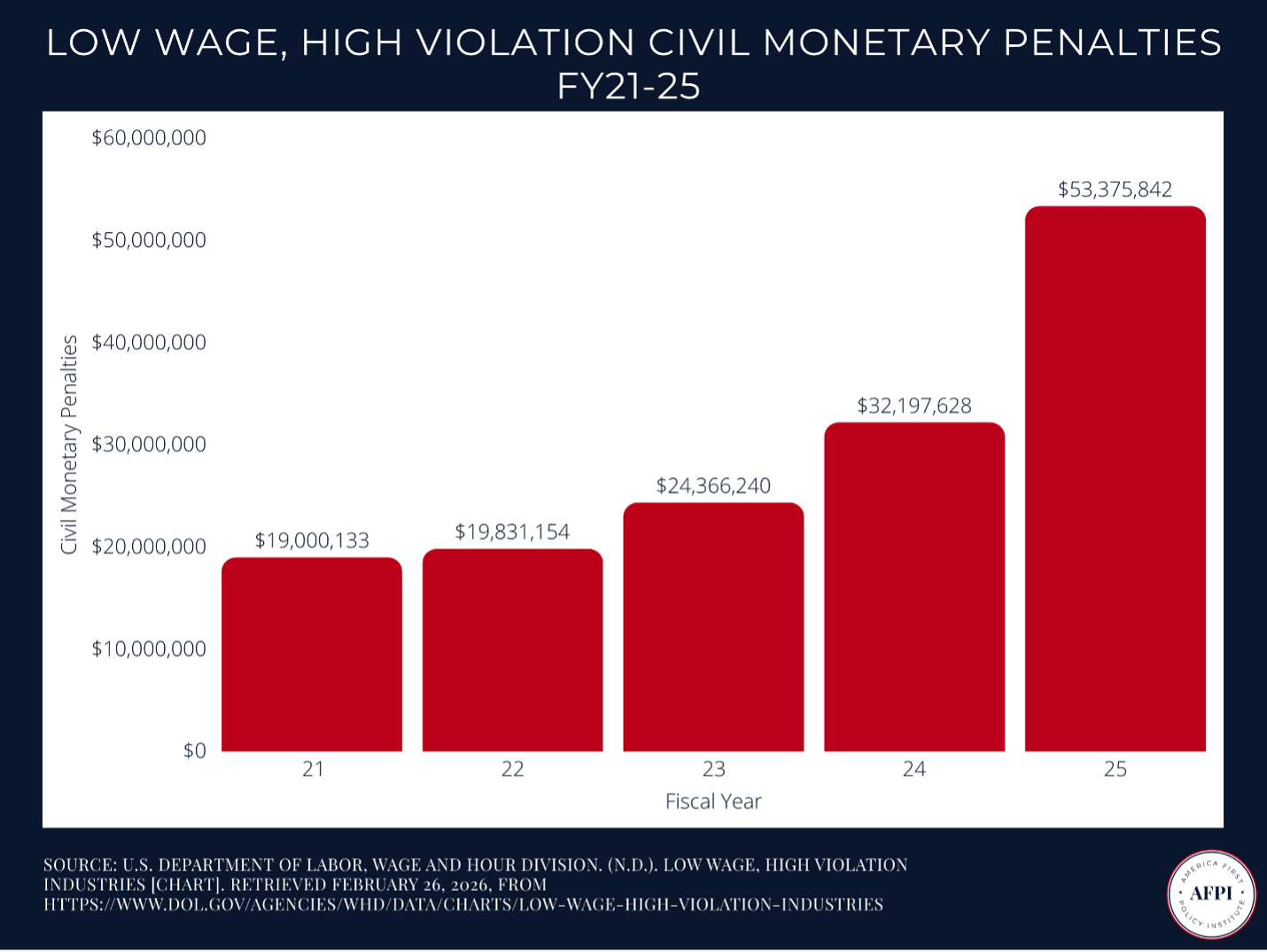
- In Fiscal Year (FY) 2024, at the end of President Biden’s term, the DOL assessed approximately $32 million in CMPs for violations across the Low Wage, High Violation industries.
- In FY 2025, as President Trump took office, the total assessed CMPs jumped to over $53 million, approximately 65% higher than FY 2024.[2]
- The highest annual amount assessed under the Biden Administration, assessed in FY 2024, was still 40% lower than the Trump Administration’s first year. In FY 2023, only around $24 million in CMP was assessed, and in FY 2022, it was even lower, at approximately $19 million.
- The FY 2025 total is roughly equal to three years of the Biden Administration combined.
These numbers, as shown in the graph below, show that President Trump’s DOL is aggressively pursuing employers in industries rife with illegal alien labor. This enforcement will ultimately benefit the American worker, as illegal immigration tends to harm low-wage American workers the most, especially in terms of reduced wages (Camarota, 2023).
Graph 1
Low Wage, High Violation Civil Monetary Penalties, Fiscal Years 2021-2025
Child Labor Penalties
While child labor is a prominent issue the DOL works to counter each year, the Biden Administration’s record concerning unaccompanied alien children (UAC) was catastrophic and likely led to an increase in illegal child labor.
In 1938, the Fair Labor Standards Act (FLSA) was enacted, helping to combat the dangerous conditions which children were subjected to in the workplace (U.S. Department of Labor, Child Labor). In part, the FLSA set a minimum age to work, a maximum number of hours a minor could work, and prohibited certain jobs for children. Child labor CMP fines are set by statute at 29 U.S.C. 216(e) and are inflation-adjusted annually. Currently, a child labor violation has a maximum fine per employee of $16,035 (U.S. Department of Labor, Wage and Hour Division, 2026). If the violation results in death or serious injury, the maximum fine is $72,876.
The DOL is responsible for enforcing elements of the FLSA, and President Trump’s first fiscal year has proven to be a historic year for financial penalties against employers engaging in illegal child labor—representing the single largest year of penalties in over 13 years.
By the end of the Biden Administration, nearly 300,000 unaccompanied alien children (UAC) were unaccounted for, and therefore missing. The New York Times reported that many of these children were working dangerous jobs, with some fatalities, while the Biden Administration punished whistleblowers and inadvertently funneled children to traffickers (Dreier, 2023a, 2023b). In 2023, a Florida Grand Jury investigation found that 20,000 UAC were lost in Florida in a 10-month span (Florida Office of the Attorney General, 2023). Following these reports, a nationwide Child Exploitation Taskforce was created with the DOL as the lead (U.S. Department of Labor, 2023). As of December 2025, DHS announced the government had located 129,143 of the lost UACs (U.S. Department of Homeland Security, 2025).
This is not the only way in which the Biden Administration failed vulnerable children. Enforcement data from the DOL demonstrates that the Biden Administration also failed to protect children who were being illegally employed (U.S. Department of Labor, Wage and Hour Division, n.d.). Though no formal data exists to calculate the extent to which child labor violations include UACs and other illegal aliens, anecdotal data from recent worksite enforcement actions suggest that UACs or illegal alien minors do enter the workforce—including 14 migrant children who were discovered working at marijuana grow sites in California in 2025 (U.S. Department of Homeland Security, 2025).
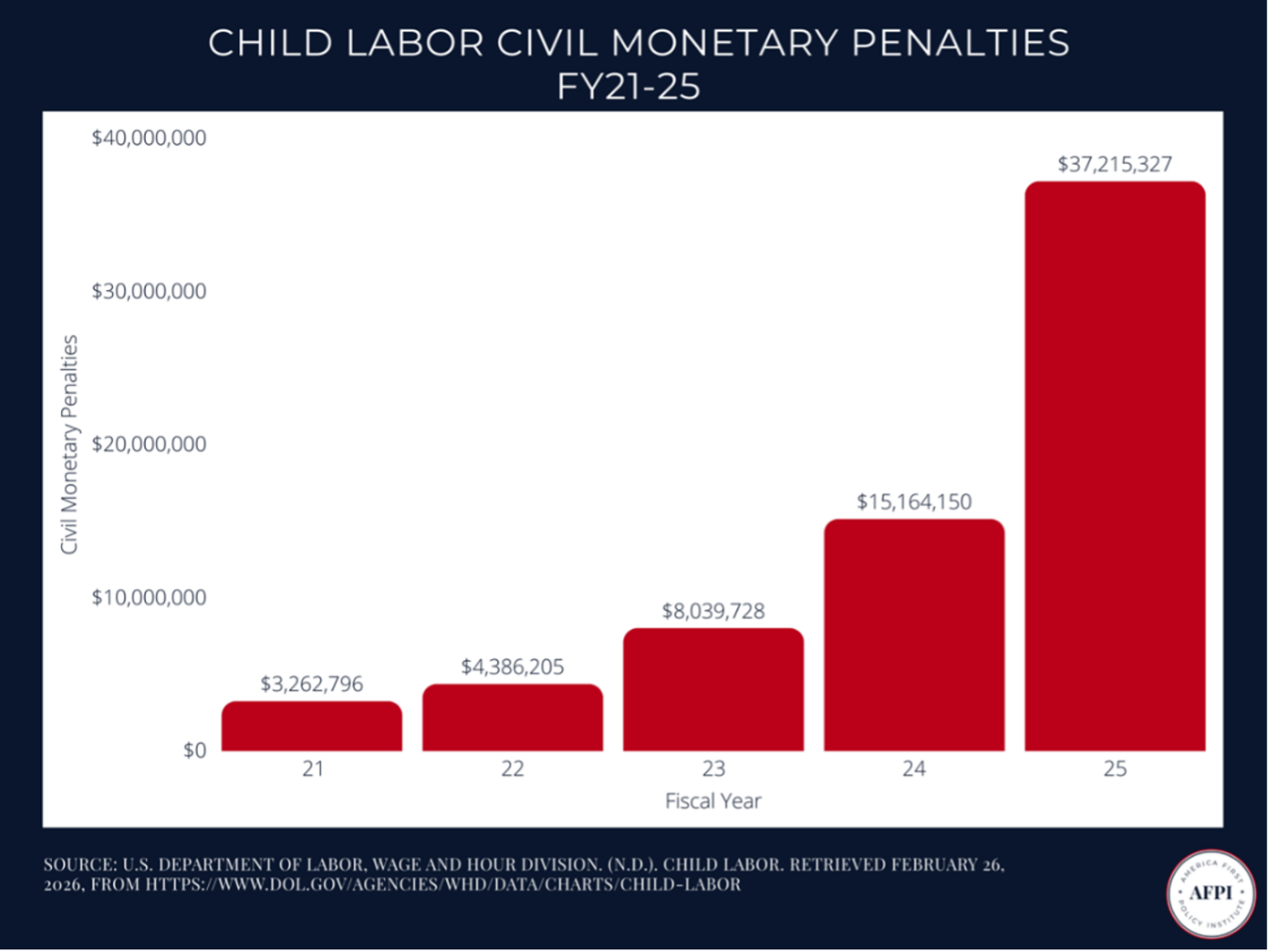
Fiscal Year 2025 saw the largest amount of CMP assessed for child labor since at least FY 13 by a wide margin. Additionally, FY 25’s fines were higher than all four years under President Biden combined (FY 21-24).
From FY 21 to FY 24, the DOL assessed a total of $30,852,879 in child labor CMP. In FY 25, the DOL assessed $37,215,327 in child labor-related CMP—a 20% increase over the prior four years combined. The FY 21-24 average for child labor CMP assessed is $7,713,219, meaning the FY 25 number represents a 382.5% increase over the prior four-year average (see Graph 2 below).
Graph 2
Child Labor Civil Monetary Penalties, Fiscal Years 2021-2025
With hundreds of thousands of children going missing by FY22 and FY23, the Biden Administration was slow to move against exploitative child labor employers. The vast expansion in child labor CMP in such a short amount of time demonstrates that the low CMP was a policy choice.
H-1B Violations
The H-1B visa is highly popular among large employers and is sought after to import foreign workers. The foreign workforce in various industries with high volumes of H-1B visas (especially the STEM field) doubled from 2000 to 2019 (The White House, 2025). This phenomenon is particularly prevalent in the information technology (IT) industry. The share of IT workers in the H-1B program ballooned from 32% in FY 2003 to an average of more than 65% since FY 2021 (The White House, 2025).
While the original purpose of H-1B visas was to bring in high-skilled labor (The White House, 2025), this has quickly been undermined through the rampant abuse of the program. Due to this, the DOL has applied stricter scrutiny to the use of H-1B and other non-immigrant (i.e., temporary) employment visas in order to protect and prioritize American workers. The DOL has statutory authority to assess fines for H-1B violations under 8 U.S.C. 1182(n)(2)(c), with inflation-adjusted maximum fines ranging from $2,364 to $67,367 per violation. These violations include wage theft, paying aliens lower wages than they reported on the petition, improperly applying lower wage levels to a job than the experience and skill required, and imposing illegal fees, among other violations.
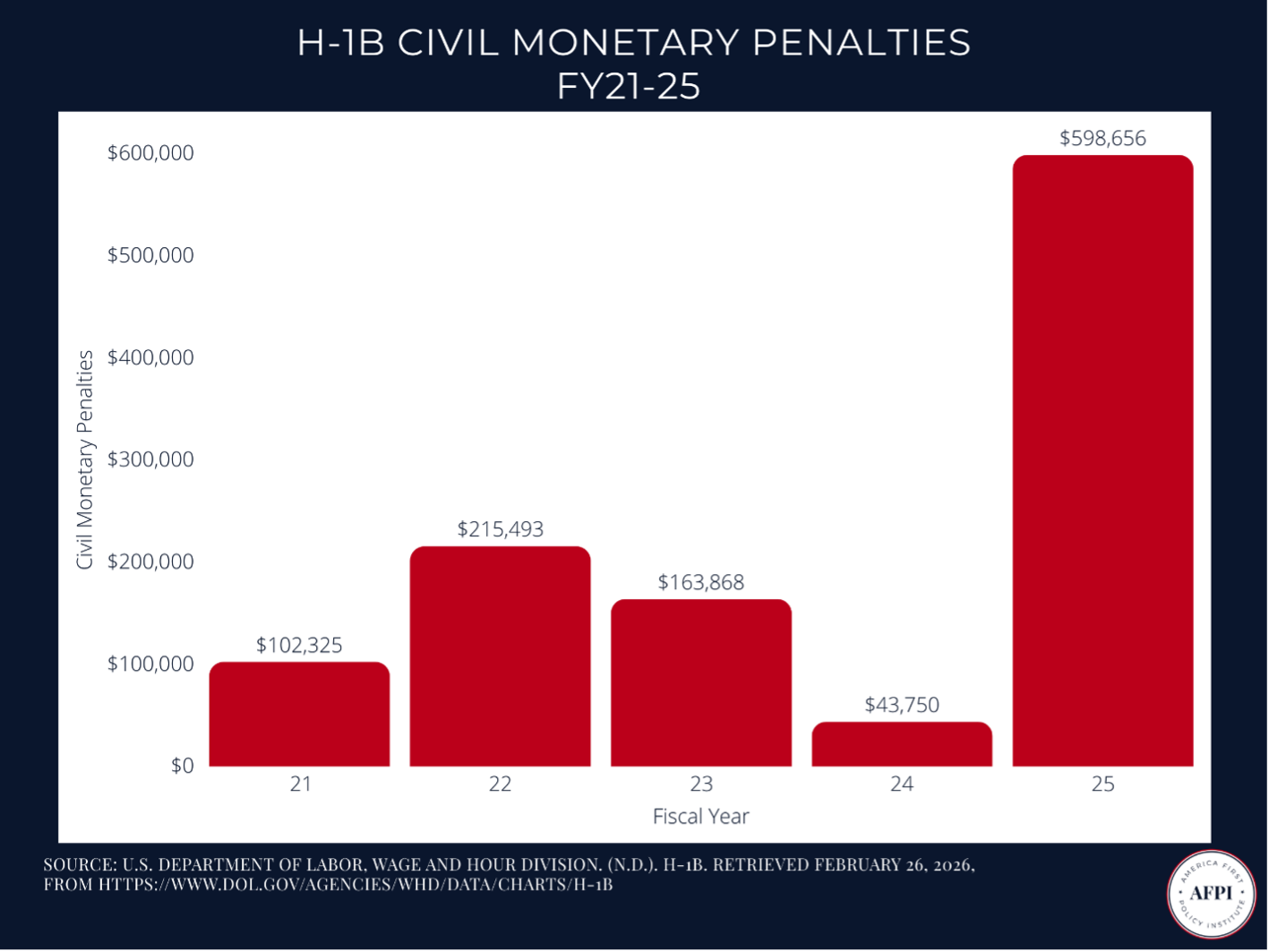
Even before DOL launched Operation Firewall to target H-1B abuse, the DOL was closely scrutinizing the program. As a result, CMP against H-1B employers surged by more than 1,260% — from $43,750 in FY 24 to $598,656 in FY 25. As with child labor, the DOL assessed more CMPs in FY 25 than in the prior four fiscal years combined. Fiscal Year 2025’s CMP assessed 356% more than the four-year average in the Biden Administration.
Graph 3
H-1B Civil Monetary Penalties, Fiscal Years 2021-2025
H-2B Violations
Another popular visa for importing foreign workers is the H-2B visa (U.S. Citizenship and Immigration Services, n.d.). Employers use H-2B workers in lower-wage jobs that are temporary or seasonal in nature, such as landscaping, groundskeeping, hospitality, tourism, construction, and food service. The statutory authority for assessing fines for H-2B violations is found under 8 U.S.C. 1184(c)(14).
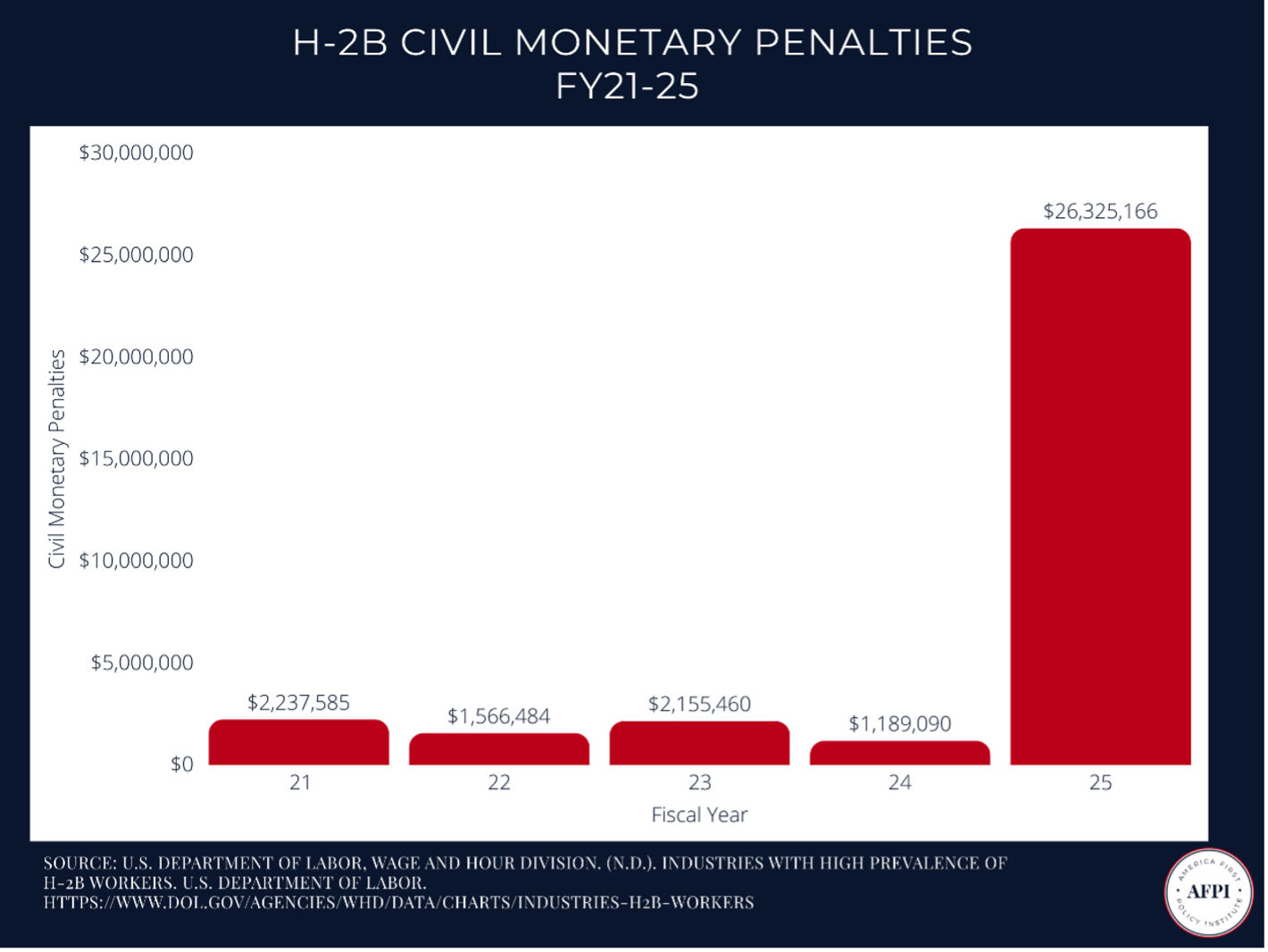
The DOL has been especially aggressive in targeting employer violations of the H-2B program during the first year of President Trump’s second term. See Graph 4 below for details.
For this visa category, the difference in CMP assessments during President Biden’s term and FY 25 under President Trump is even more pronounced when comparing H-2B employer enforcement data (U.S. Department of Labor, Wage and Hour Division, n.d.). In FY 25, the DOL assessed $26,325,166 in CMPs for H-2B violations, compared to $1,189,090 in FY 24. Over the prior four fiscal years, the average H-2B CMP was $1,787,155—meaning that the FY 25 H-2B CMP constitutes a remarkable 1,373% increase over the FY 21-24 average. This represents the largest year of CMP assessment for H-2B employers since at least FY 2013.
Graph 4
H-2B Civil Monetary Penalties, Fiscal Years 2021-2025
Policy Recommendations
The recharged efforts of the DOL to fine employers who use illegal labor reflect a return to America First principles under the Trump Administration. The dramatic increase in CMPs imposed on employers who break the law is a particularly encouraging sign for American workers. However, even more can be done to effectively end a large pull-factor of illegal immigration and abuse of labor laws. The DOL should strive not only to match but surpass previous efforts through partnerships with federal agencies, harsher penalties, and increased resources from Congress.
- Expand Interagency Enforcement Agreements and Strengthen Project Firewall. The Trump Administration should escalate inter-agency efforts to combat illegal immigration and immigration fraud, including DOL efforts to punish violating employers. This should include expanding the interagency effort of Project Firewall to all non-immigrant employment categories, especially H-2B given the FY25 CMP assessment. To address the black market in labor, DOL and ICE should fundamentally revise their Memorandum of Understanding (MOU) to closely coordinate worksite enforcement operations and share investigative information.
- Increase Penalties for Illegal Alien Employers. Congress should increase civil and criminal penalties for violators by amending statutes such as 29 U.S.C. 216(e), 8 U.S.C. 1184(c)(14), and 8 U.S.C. 1182(n)(2)(c) to drastically increase the maximum fines allowed per violation to establish deterrence. Unless these changes are made, companies will continue to exploit their labor forces and treat fines as an acceptable cost of doing illegal business.
- Expand Investigatory and Prosecutorial Resources. Congress should surge more resources for the investigation and prosecution of labor-related offenses within the annual appropriations process. Particularly, appropriations line items for the Wage and Hour Division and Employment and Training Administration should be significantly raised beyond historical baseline funding, with a focus on funding new hires and building out system integrity and enforcement capacity.
Conclusion
Compared to the Biden Administration, the DOL during President Trump’s second term is significantly more aggressive in punishing employers who violate labor laws. America’s labor black market is fueled by illegal immigration, but the DOL is often best situated to deter the employers exploiting them. More resources must be surged to expand DOL investigations even further to eliminate the jobs magnet provided by unscrupulous employers. With these actions, the Trump Administration is cutting off a key “pull factor” that encourages illegal immigration: the ability to obtain employment (U.S. Citizenship and Immigration Services, 2020).
[1] This figure is likely lower in 2026 due to increased enforcement and deportations since President Trump took office in 2025.
[2] Editor’s Note: Throughout this research report, we describe Fiscal Years 2021-2024 as equivalent to President Biden’s term in office. President Biden took office on January 20, 2021, and left office January 20, 2025. However, the Fiscal Year 2021 started at the end of President Trump’s first term (October 2020), and Fiscal Year 2024 ended before President Biden left office (September of 2024). The same applies to Fiscal Year 2025, which we describe as being President Trump’s first year in office during his second term, though technically it began in October 2025—four months before President Biden left office.
Resources