April 24, 2026
The Hidden Tax: Waste, Fraud, and Abuse in Los Angeles City Government
Key Takeaways
« Los Angeles taxpayers fund one of the most expensive city governments in the United States and have received in return a culture of pervasive public corruption, a homelessness crisis that billions of dollars have not solved, infrastructure that costs multiples of what peer cities pay, and a public utility that has systematically overcharged the residents it exists to serve.
« In the years since 2022, four senior city and county officials have been federally convicted or face trial on public corruption charges—bribery, RICO conspiracy, and systemic self-dealing. No structural accountability reforms have followed.
« Los Angeles has spent more than $1.2 billion in voter-approved funds on homeless housing and delivered fewer than one in eight promised units. The city’s signature homeless intervention program now costs more than $204,000 per person per year. A federal court-ordered audit, meanwhile, found $2.3 billion in homelessness spending was essentially untrackable.
« This is not a crisis of resources—it is a crisis of accountability. The reforms needed to change these outcomes require no new spending and no expansion of government: only transparency, competition, and consequences for failure.
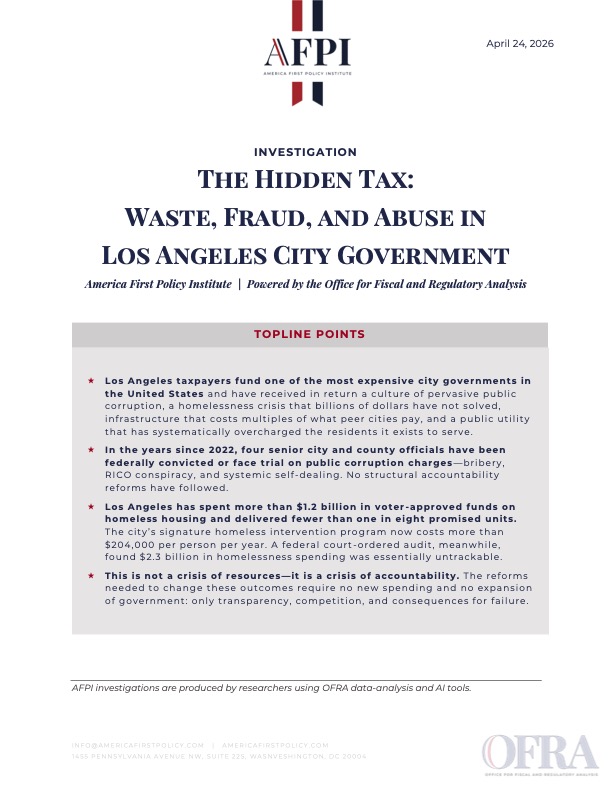
AFPI investigations are produced by researchers using OFRA data-analysis and AI tools.
Introduction: A Tax NO ONE Voted For
Los Angeles is one of the most expensive cities in the United States. The explanations most often offered—land scarcity, coastal geography, population density—are real but incomplete. Embedded in the cost of living in Los Angeles is a governance premium: the invisible surcharge that residents, ratepayers, and businesses pay because their city government has systematically chosen insiders over accountability.
This investigation documents four interconnected patterns of governance failure that have compounded into a crisis for working Angelenos. Each is documented not by partisan allegation, but by federal court records, findings of city and state auditors, independent court-ordered audits, and investigative reporting from sources across the ideological spectrum. Together, they describe a city government that functions efficiently—for the people inside it.
The four failures are distinct in their mechanics but unified in their effect. A culture of public corruption, documented in multiple federal prosecutions since 2022, has established that public office in Los Angeles can be rented by developers, contractors, and utility lawyers for the right price. That corruption culture is not incidental to the failures in homelessness spending, infrastructure delivery, and utility governance—it is their root cause. It explains why homelessness bonds disappear without producing housing, why infrastructure projects cost three times what comparable cities pay, and why ratepayers absorb the losses from every LADWP misadventure.
None of this dysfunction is new, and none of it is inevitable. It is the accumulated product of specific choices: to tolerate pay-to-play, to approve bond measures without performance requirements, to fund programs without competition, and to look away when insiders extracted value from a system that belongs to the public. Different choices—enforcing transparency, requiring competition, imposing consequences for failure—can produce different outcomes. They have in other American cities. They can in Los Angeles.
CITY HALL FOR SALE
A functioning government depends on a foundational premise: that public officials act in the public interest. In Los Angeles, that premise has been repeatedly and systematically violated. Between 2022 and 2024, four senior city and county officials were federally convicted on corruption charges—not for minor transgressions, but for bribery schemes, RICO enterprises, and systemic self-dealing that diverted public resources to personal gain. No structural reforms followed.
A PATTERN OF FEDERAL PROSECUTION
In March 2023, former Los Angeles County Supervisor and City Councilmember Mark Ridley-Thomas was convicted on federal charges of conspiracy, bribery, mail fraud, and wire fraud. Prosecutors proved that while serving as County Supervisor, Ridley-Thomas steered lucrative county contracts to USC’s School of Social Work in exchange for personal benefits for his son—graduate school admission, a full-tuition scholarship, and a paid professorship. He was sentenced to three and a half years in federal prison.1
In July 2024, former Deputy Mayor Raymond Chan was convicted on all twelve felony counts against him, including RICO conspiracy, bribery, wire fraud, and making false statements to federal agents. Chan, who had served nearly 36 years in city government and oversaw the Department of Building and Safety, accepted hundreds of thousands of dollars in bribes while facilitating developer payoff schemes. He was sentenced to 12 years in federal prison.2
In April 2022, former LADWP General Manager David H. Wright was sentenced to six years in federal prison for accepting bribes from attorney Paul Paradis in exchange for steering a $30 million no-bid contract to Paradis’s firm. Wright had secretly agreed to receive $1 million per year and a luxury vehicle—compensation arranged while he managed a department with more than 10,000 employees and an annual budget exceeding $4 billion.3
Los Angeles City Councilmember Curren Price faces trial on twelve felony counts including embezzlement of public funds, conflict of interest, and perjury. Prosecutors allege he voted to approve projects that paid his wife more than $950,000 while failing to disclose the relationship, and separately embezzled approximately $33,800 in city medical benefits by falsely claiming a partner as his legal spouse. A preliminary hearing in January 2026 resulted in Price being held to answer on all counts. He remains on the City Council.4
A SYSTEM WITHOUT CONSEQUENCES
What is striking about these cases is not merely their number, but what followed them: nothing. The current administration has not proposed, and the City Council has not enacted, any structural accountability reform in response to four federal corruption convictions of senior officials. The former U.S. Attorney who prosecuted the foundational Huizar RICO enterprise warned publicly in 2021 that despite multiple federal indictments, Los Angeles City Hall had taken no meaningful steps to reform the conditions that produced them.5 The subsequent convictions of Chan, Ridley-Thomas, and Wright—and the ongoing prosecution of Price—confirm his assessment.
The corruption documented in these cases is not a rounding error in an otherwise well-functioning system. LADBS building inspectors were convicted on federal bribery charges for accepting cash from property owners and contractors in exchange for approving building permits and passing inspections for work not actually completed.6 Federal prosecutors described the Huizar enterprise—whose resolution fell within the current administration—as one of the most extensive RICO cases in the history of the Central District of California.
The Corruption Tax on Ordinary Angelenos
The costs of this corruption are not abstract. When a deputy mayor is on a developer’s payroll, building approvals reflect private arrangement rather than public interest. When a utility general manager is negotiating personal compensation while awarding contracts, ratepayers absorb the cost of deals made on someone else’s behalf. When a councilmember votes on contracts that enrich his household, residents’ interests are subordinated to his personal finances.
The City of Los Angeles has paid nearly $1 billion in liability claim settlements since 2020—a figure that reflects, in part, the downstream costs of misconduct, policy violations, and accountability failures in a system where official wrongdoing carries rare and slow consequences.7
Critically, the corruption culture identified in this pillar is not separate from the failures that follow. It is their enabling condition. Homelessness contractors who are never audited, infrastructure projects awarded without competitive bidding, a utility whose general manager is on a private attorney’s payroll—these are not coincidental failures. They are the predictable output of a system in which accountability mechanisms have been chronically weakened.
The Housing Tax: LA Needs More Housing, and Its Own Rules Are the Problem
Los Angeles needs more housing. Most of that housing will need to be multifamily. And new multifamily housing in Los Angeles has at least $500 per month in extra cost baked into every unit—not because of land prices or construction labor, but because of the city’s own broken regulatory apparatus. That cost doesn’t stay on the developer’s spreadsheet. It moves directly into the rent check of whoever signs the lease.
The National Association of Home Builders puts government-imposed regulatory costs at more than 40% of the total development cost of a new multifamily unit nationally. In California—where a single Environmental Impact Report under CEQA can take more than a year and cost more than $1 million, where permitting timelines stretch across multiple mayoral terms, and where every new project faces overlapping fees for schools, affordable housing linkage, transportation impact, and discretionary review—that share is higher. The city permitted fewer than 14,000 new housing units in 2024, a 23% drop from the prior year, against a documented shortfall of roughly 400,000 units. The city simultaneously declared a housing emergency, a declaration that does not, by itself, waive a single fee or shorten a single review timeline.
The corruption connection is direct. Former Deputy Mayor Raymond Chan ran the Department of Building and Safety for 36 years before his 2024 federal conviction for RICO conspiracy and bribery. Federal prosecutors documented a system in which developers who paid moved through approvals; those who didn’t, didn’t. Building inspectors were separately convicted for passing uninspected work. When the permitting process itself can be purchased, it prices out the honest developer—who absorbs the cost of compliance, delay, and legal risk into a rent that the tenant ultimately pays.
The city is sitting on the answer. More than one thousand city-owned parcels sit vacant across Los Angeles, most already zoned for residential use, many under half an acre. The city’s “Small Lots, Big Impacts” program proposes to sell some at fair market value for owner-occupied housing development. Housing is the defining issue of the 2026 mayoral race—fourteen candidates, a June primary, and a debate held the week this paper was published—in part because voters understand that a city sitting on vacant land while residents pay $2,200 a month for a one-bedroom apartment is making a choice.
The state cleared the runway—now the city needs to use the controls it already has. In June 2025, California exempted most infill housing under 85 feet from CEQA review—a reform the mayor and City Council had no part in passing, because CEQA is state law and beyond their reach. But Sacramento cannot sell city-owned land, eliminate locally imposed fees, or speed up the city’s own discretionary review process. Those are levers the mayor and City Council hold today. The agenda is short and requires no ballot measure: sell surplus city-owned parcels for housing at scale; adopt ministerial (by-right) approval for all projects meeting objective development standards, as state law already permits; and eliminate locally imposed fees that add cost per unit without producing a demonstrable public benefit. None of this requires Sacramento’s permission. It requires only a city government that prioritizes the people paying the rent over the interests that profit from keeping supply scarce.
The Homelessness Industrial Complex
No issue more visibly defines the Los Angeles governance crisis than homelessness. The city and county have spent billions of dollars addressing it, erected a substantial institutional infrastructure to manage it, and watched the homeless population grow. The failure is not a shortage of resources. It is a failure of accountability—the same systemic failure that characterizes Los Angeles governance broadly.
The Bond That Built Almost Nothing
In 2016, Los Angeles voters approved Proposition HHH, a $1.2 billion bond measure to build housing for homeless Angelenos. The promise was explicit: 10,000 units of permanent supportive housing.
A 2022 audit by the Los Angeles City Controller—the third in a series of annual performance reviews—found that average per-unit costs had risen from the projected $350,000 to nearly $600,000, with individual projects approaching $837,000 per door.8 After five years, only 1,142 of the promised 10,000 units were complete—an 11% delivery rate. The audit identified $5.2 million in excess interest payments from premature bond sales. The program had no credible trajectory to fulfill its voter-approved mandate.
The per-unit cost comparison is instructive. At median Prop HHH costs, housing all of Los Angeles’s estimated 59,000 homeless residents would require approximately $31 billion.9 The approved bond covered $1.2 billion of that figure. The math was never going to work. The City Controller identified this in the first annual review in 2019.10 The program continued unchanged.
Inside Safe: $204,000 Per Person Per Year
Mayor Bass launched Inside Safe in December 2022 as the centerpiece of her homelessness strategy, deploying teams to clear encampments and place residents in hotels and interim housing. The fiscal year 2023–24 budget for the program totaled $250 million. Within that allocation: $92 million for hotel rentals; $18 million for hotel damage caused by program participants; $16 million for overhead; and $13 million for food at an estimated $21 per person per day.11
The all-in cost: approximately $17,009 per individual per month—more than $204,000 per person per year.12 For context, the median rent for a one-bedroom apartment in Los Angeles is approximately $2,200 per month. The city is spending nearly eight times the prevailing rental rate on each Inside Safe participant, in hotel rooms, with no demonstrated pathway to permanent housing.
Billions Spent, Nothing Tracked
In 2023, a federal court-ordered audit conducted by the independent firm Alvarez & Marsal examined four years of homelessness spending across the City of Los Angeles, Los Angeles County, and the Los Angeles Homeless Services Authority (LAHSA). The auditors reviewed $2.3 billion in combined expenditures.13
Their finding was categorical: the spending was essentially untrackable. Fragmented data systems prevented auditors from following dollars to outcomes. LAHSA had routinely approved payments to contractors before verifying that services had actually been provided. The auditors found that nearly half—47.8%—of individuals who exited supportive housing subsequently returned to homelessness. Billions had been spent with no reliable means of measuring whether any of it worked.
In fiscal year 2024, the City budgeted approximately $1.3 billion for homelessness programs. The City Controller found that at least $513 million—nearly 40% of the total—went unspent, with inadequate staffing and outdated technology identified as contributing factors.14 While hundreds of millions sat undeployed, encampments persisted on city streets.
A 2023 California State Auditor report found that the state had spent $24 billion on homelessness programs between 2018 and 2023, although the oversight agency responsible for tracking outcomes had analyzed no data beyond 2021. Three major state programs totaling $9.4 billion in combined funding could not be evaluated at all due to missing records. During this same period, California’s homeless population grew by approximately 30,000 people.15
What Works Elsewhere
Houston, Texas offers a direct contrast. Over twelve years, Houston reduced its homeless population by approximately 63%, reaching roughly 3,325 unhoused individuals as of its 2025 Point-in-Time count.16 The city’s homelessness rate—approximately 16 per 10,000 residents—compares to Los Angeles’s approximately 42 per 10,000.17 Houston accomplished this without deploying city general fund dollars beyond its share of federal homeless funding, relying instead on coordinated case management, direct housing placement, and rigorous outcome measurement tied to continued provider funding.
The difference is not climate, geography, or funding levels. It is governance: the discipline to measure results, require performance from service providers, and reallocate resources away from programs that do not produce outcomes.
The INFRASTRUCTURE SWINDLE
When Los Angeles voters approve a transportation bond, they are making a promise to themselves: that the infrastructure funded will be built, at the cost advertised, in a timeframe that can reasonably be anticipated. That promise has been broken, repeatedly and at enormous scale, in project after project. The pattern is not isolated incompetence. It reflects the absence of competitive discipline and independent oversight in the allocation of public capital.
The $9.5 Billion Subway That Covers Nine Miles
The Los Angeles Metro D Line (Purple Line) extension—a subway expansion from Koreatown to Westwood—is now estimated to cost $9.5 billion for nine miles of underground rail, translating to more than $1 billion per mile.18
The comparison to peer cities is stark. Research by the NYU Marron Institute and the Transit Costs Project finds that Madrid builds comparable underground subway at approximately $320 million per mile; Paris at approximately $160 million per mile.19 The median cost across the developed world is roughly $350 million per mile. Los Angeles is spending approximately three times that figure—and has been since construction began in 2014. The first of three sections is scheduled to open in spring 2026; the remaining two sections extending to Westwood have no finalized completion date after years of delays and rolling cost overruns.
The D Line is not an anomaly. Los Angeles Metro Rail ranks among the highest-cost rail systems in the United States to operate on a per-car-mile basis, approximately twice as costly as the largest European networks. Voters have been asked to approve bond measure after bond measure to fund this system. The cost trajectory has not changed.
High-Speed Rail: The Promise That Keeps Growing
In 2008, California voters approved Proposition 1A, authorizing $9.95 billion in bonds for a high-speed rail system connecting Los Angeles and San Francisco at a total projected cost of $33 billion. The California High-Speed Rail Authority’s 2026 Business Plan now estimates Phase 1 costs at $126.2 billion—nearly four times the figure voters were shown.20 After fifteen years and approximately $6.9 billion in federal funds, not a single mile of high-speed track has been laid.
The Federal Railroad Administration declared the Authority in default of its federal grant terms following a comprehensive compliance review, citing missed deadlines, budget shortfalls, and overstated ridership projections.21 In 2025, the Trump Administration cancelled $4 billion in federal high-speed rail funding.22 Gov. Newsom acknowledged in 2019 that the full LA-to-SF connection could not be delivered as promised, scaling the project back to a Central Valley segment connecting no major city to any other.23 The Los Angeles-to-San Francisco rail service that voters approved in 2008 has no completion date and no funded pathway to construction.
LAX: $880 Million in Overruns, $550 Million Paid by Angelenos
The Los Angeles World Airports Automated People Mover—a connector between parking facilities, Metro stations, and airport terminals—suffered $880 million in cost overruns, according to a 2024 Los Angeles County Grand Jury report.24 The City of Los Angeles paid $550 million in settlement costs associated with the overruns. Inadequate contract oversight and the absence of fixed-price protections meant that taxpayers, not contractors, absorbed the cost of the project’s mismanagement.
The Human Cost: LAFD and the Palisades Fire
Infrastructure failure is not only fiscal. In January 2025, the Palisades Fire became one of the most destructive wildfires in California history, burning more than 23,000 acres across Pacific Palisades and surrounding communities. The LAFD’s fire chief had warned, in written communications preceding the fire, that budget constraints would hamper emergency response capacity. Those warnings were not acted upon.
What followed was an institutional failure compounding the physical one. The LAFD battalion chief who authored the original after-action report declined to endorse the final published version, stating publicly that substantive findings had been removed from the document before release.25 In March 2026, four of the five civilian members of the Los Angeles Board of Fire Commissioners resigned—effectively collapsing the department’s civilian oversight structure—in a public expression of the judgment that meaningful accountability had become impossible within existing institutional conditions.26
The UTILITY TRAP
The Los Angeles Department of Water and Power is the largest municipal utility in the United States, serving more than four million residents and businesses. It operates as a public entity, nominally accountable to the city it serves, and it bills ratepayers for every cost it incurs—including the costs of mismanagement, corruption, and deferred accountability. When the utility fails, the residents of Los Angeles pay for the failure. They have no alternative provider.
A GENERAL MANAGER ON A BRIBE
In April 2022, former LADWP General Manager David H. Wright was sentenced to six years in federal prison for accepting bribes from attorney Paul Paradis.27 The arrangement was straightforward: Paradis, who was simultaneously representing LADWP ratepayers in a billing class action lawsuit, secretly agreed to pay Wright $1 million per year and provide a luxury vehicle. In exchange, Wright steered a $30 million no-bid consulting contract and a separate $10 million cybersecurity contract to Paradis’s firm.
The arrangement meant that the official responsible for managing a $4-plus billion public utility—including its legal strategy and its contracting decisions—was in the employ of a private attorney who was simultaneously suing that utility on behalf of ratepayers. The conflict is almost too direct to require elaboration.
THE BILLING DISASTER AND ITS AFTERMATH
LADWP’s billing system has been a sustained source of ratepayer harm. A new billing platform—deployed against the explicit warnings of the state auditor, who found it was not ready for launch—failed on rollout, generating erroneous bills for tens of thousands of customers. The resulting litigation produced a $67.5 million settlement paid to affected ratepayers; the billing system itself ran more than $200 million over its original cost estimate.28
The institutional response to these failures deepened them. In 2019, FBI agents raided both LADWP headquarters and the City Attorney’s office, seeking evidence of bribery, kickbacks, extortion, mail fraud, and wire fraud.29 Investigators found that rather than representing the public interest in the billing litigation, officials had structured arrangements that prioritized institutional relationships over ratepayer protection. Multiple federal convictions resulted.
The Cost TO RATEPAYERS
LADWP rates have been rising steadily, and forward projections indicate significant further increases. Sewer charge rates are on track to double by 2028.30 The utility’s ratepayer base—which includes more than one million renters, more than 650,000 homeowners, and nearly half a million seniors on fixed incomes—has no competitive alternative and no independent check on the rates they are charged. Mismanagement, corruption, and deferred maintenance are embedded in the rate base, and ratepayers fund all of it.
The structural problem is governance. LADWP’s board is appointed by the mayor, making it subject to the same political dynamics that have produced the broader corruption culture documented in this investigation. There is no independent rate review authority. There is no standing mechanism to challenge rate increases that reflect management failure rather than legitimate infrastructure costs. The utility functions, in practice, as a captive revenue source—and the captives are the people of Los Angeles.
What Misgovernance Costs Los Angeles Every Year
The tables on the following page separate recurring annual losses—costs that repeat every year the underlying failures go unaddressed—from major one-time documented losses. All figures are drawn from independent audits, court records, or government reporting cited in this paper. This is a partial accounting; it excludes infrastructure cost overruns on the D Line and California High-Speed Rail, which would add billions but involve multi-jurisdictional funding.
RECURRING ANNUAL LOSSES
Category |
Estimated Annual Cost |
Basis |
Source |
City liability claim payouts (misconduct, negligence, policy failure) |
~$188 million/year |
$940M paid FY2020–FY2025 |
KTLA; LA City Controller |
Inside Safe: annual spending in excess of local market-rate rent equivalent |
~$180 million/year |
$204K/person/year vs. $26,400 market rent; ~1,200–1,500 avg. participants |
NBC Los Angeles; city budget |
Proposition HHH: ongoing cost overruns above original per-unit projection |
~$57 million/year |
$285M in excess costs over 5 active program years |
LA City Controller, 3rd Annual Audit |
Annual recurring subtotal |
~$425 million/year |
||
Per Los Angeles household (~1.5M) |
~$283/household/year |
MAJOR ONE-TIME DOCUMENTED LOSSES
| Category | Amount | Source |
LAX Automated People Mover: city settlement for contractor overruns |
$550 million |
LA County Grand Jury, 2024 |
LADWP billing collapse: system overrun + ratepayer class-action settlement |
~$268 million |
CA State Auditor; court records |
LAHSA: contractor cash advances unrecovered after up to eight years |
$51 million |
LA County Auditor, 2024 |
Not included: the regulatory cost embedded in every new multifamily unit built in Los Angeles. At $500 or more per month per unit—the conservative end of what research on government-imposed development costs supports—and with the city issuing roughly 14,000 new units per year, Los Angeles’s broken permitting and approval apparatus is adding at least $84 million in excess annual housing costs to units coming online right now. That number compounds every year new supply is suppressed.
The question is not whether Los Angeles can afford accountability. The question is how much longer it can afford the alternative.
Conclusion: Governing for Residents, Not Insiders
Los Angeles does not suffer from a shortage of resources. It is home to extraordinary economic dynamism, some of the most talented people in the world, and a civic tradition that has produced nationally significant institutions in culture, commerce, and public life. What it lacks is the institutional architecture to translate those assets into results for the people who live and work here.
The patterns documented in this investigation—serial public corruption, homelessness spending that produces neither housing nor accountability, infrastructure costs that dwarf those in peer cities, and a utility that treats ratepayers as captive revenue—did not emerge from natural disaster or geographic necessity. They emerged from choices: to tolerate pay-to-play arrangements, to approve bonds without outcomes requirements, to fund contractors without competition, to manage a public utility as a political asset. Those choices were made by identifiable people in identifiable institutions. They can be unmade.
The residents of Los Angeles—working families paying among the highest housing costs in the nation, renters watching billions spent on homelessness with no visible relief, homeowners whose utility bills rise while their utility’s former general manager serves a federal prison sentence, small business owners navigating a permitting system riddled with inspector corruption—are not asking for a perfect city. They are asking for a city that works. That is not an unreasonable demand. Meeting it requires only that those who govern Los Angeles be held to the same standard of accountability they ask of everyone else.
The dysfunction documented here was not inevitable. It will not end on its own. But it is not intractable either. It is the product of choices—and different choices remain available.
ENDNOTES
1. United States v. Mark Ridley-Thomas, conviction March 2023, sentencing August 2023, U.S. District Court, Central District of California. https://deadline.com/2023/08/m...
2. United States v. Raymond Chan, conviction and sentencing 2024, U.S. District Court, Central District of California. https://laist.com/news/crimina...
3. United States v. David H. Wright, sentencing April 2022, U.S. District Court, Central District of California. U.S. Department of Justice, U.S. Attorney’s Office, Central District of California. https://www.justice.gov/usao-c...
4. People v. Curren Price, Los Angeles County District Attorney, charges filed 2023, preliminary hearing January 2026. https://da.lacounty.gov/media/...
5. Former U.S. Attorney Nick Hanna remarks on systemic corruption risk at Los Angeles City Hall, October 2021. KCRW News. https://www.kcrw.com/news/show...
6. Federal bribery convictions of LADBS inspectors. United States v. Samuel In and related matters, U.S. District Court, Central District of California. U.S. Department of Justice press releases: https://www.justice.gov/usao-c...
7. Los Angeles has paid out nearly $1 billion in liability claims since 2020. KTLA, 2024. https://ktla.com/news/local-ne... See also interactive dashboard: https://liabilityclaims.lacont...
8. Los Angeles City Controller Ron Galperin, Proposition HHH Performance Audit, Third Annual Review, February 2022. https://controller.lacity.gov/...
9. Los Angeles City Controller data analysis: “At $531K Median Per-Unit Cost, Housing All 59,000 Homeless at HHH Prices Would Cost $31 Billion,” February 2020. https://controller.lacity.gov/...
10. Los Angeles City Controller Ron Galperin, Proposition HHH Performance Audit, First Annual Review, October 2019. https://controller.lacity.gov/...
11. City of Los Angeles FY2023–24 Budget, Inside Safe program allocations. The Center Square: “LA’s ‘Inside Safe’ hotels for homeless program costs $17K per month per person.” https://www.thecentersquare.co...
12. “LA Mayor’s ‘Inside Safe’ Effort: $67 Million Spent, Only 255 Homeless People Permanently Housed.” NBC Los Angeles Investigations, 2023. https://www.nbclosangeles.com/...
13. Alvarez & Marsal, Independent Analysis of Homeless Services and Spending in Los Angeles, submitted pursuant to order of U.S. District Judge David O. Carter in LA Alliance for Human Rights v. City of Los Angeles, 2024. See KTLA: “Scathing audit finds L.A. homeless spending lacks oversight, accountability.” https://ktla.com/news/local-ne... See also LAist: https://laist.com/news/housing...
14. Los Angeles City Controller, FY2024 Homelessness Spending Review, 2024. https://controller.lacity.gov/...
15. California State Auditor, Homelessness in California: The State Must Do More to Assess the Cost-Effectiveness of Its Homelessness Programs, Report 2023-102.1, April 2024. https://www.auditor.ca.gov/rep...
16. Coalition for the Homeless of Houston/Harris County, 2025 Point-in-Time Count. See also Governing magazine, “How Houston Cut Its Homeless Population by Nearly Two-Thirds.” https://www.governing.com/hous...
17. Smart Cities Dive, “Houston’s housing-first model is reducing homelessness,” 2024; LA County 2024 Point-in-Time Count. https://www.smartcitiesdive.co...
18. LA Metro D Line (Purple Line) Extension: $9.5 billion for 9 miles, with multiple approved cost overrun amendments totaling over $700 million. Wikipedia project overview: https://en.wikipedia.org/wiki/.... See also Streetsblog LA cost overrun reporting: https://la.streetsblog.org/202...
19. NYU Marron Institute / Transit Costs Project, “Transit Costs Data—2026 Update.” https://transitcosts.com/new-d.... See also Bloomberg, “The U.S. Gets Less Subway for Its Money Than Its Peers.”
20. California High-Speed Rail Authority, Draft 2026 Business Plan, February 2026. https://hsr.ca.gov/programs/re...
21. Federal Railroad Administration, Compliance Review of the California High-Speed Rail Authority, declaration of default, 2025. https://railroads.dot.gov/gran...
22. Trump Administration cancellation of $4 billion in federal high-speed rail funding, 2025. U.S. Department of Transportation press release: https://www.transportation.gov...
23. Governor Gavin Newsom, State of the State Address, February 12, 2019. Office of the Governor of California. https://www.gov.ca.gov/2019/02...
24. Los Angeles County Grand Jury, Report on LAX Automated People Mover / LINXS Project Cost Overruns, 2025. LAist reporting: https://laist.com/news/transpo.... Grand jury reports: https://grandjury.lacounty.gov...
25. Battalion Chief Kenneth Cook declined to endorse the final published Palisades Fire after-action report, stating substantive findings had been removed; LAFD Chief Jaime Moore subsequently acknowledged the report “was edited to soften language and reduce explicit criticism of department leadership.” Los Angeles Times (Tchekmedyian & Pringle): https://www.firerescue1.com/wi...
26. Four of five Los Angeles Board of Fire Commissioners members resigned amid scrutiny over Palisades Fire response, March 2026. Los Angeles Times (Tchekmedyian & Pringle): https://www.firerescue1.com/fi....
27. United States v. David H. Wright, DOJ press release on sentencing, 2023. U.S. Attorney’s Office, Central District of California. https://www.justice.gov/usao-c...
28. California State Auditor warning on LADWP billing system launch, Report 2014-105; $67.5 million class action settlement approved December 2016. Settlement information: https://www.ladwpbillingsettle... Consumer Watchdog timeline: https://consumerwatchdog.org/i...
29. FBI search warrants executed at LADWP headquarters and Los Angeles City Hall, July 22, 2019, seeking evidence of bribery, kickbacks, extortion, and wire fraud. LA Daily News: https://www.dailynews.com/fbi-... LA Magazine background: https://lamag.com/politics/lad...
30. LADWP rate increase projections; sewer service charges on track to double by July 2028 under City Council-approved schedule. NBC Los Angeles: https://www.nbclosangeles.com/... KNX/Audacy: https://www.audacy.com/knxnews...