Christopher Schorr, Ph.D.
July 1, 2026
“Academic Freedom” is no Excuse for Viewpoint Discrimination
Key Takeaways
Viewpoint discrimination against conservative faculty is pervasive and consequential. It undermines the mission of the university, violates the principle of equal treatment in public life, and contributes to illiberal campus climates marked by censorship, coercion, and civil rights violations.
Many well-meaning reformers nonetheless oppose government-led efforts to address viewpoint discrimination on “academic freedom” grounds. In practice, this elevates institutional autonomy over individual academic freedom, allowing one of higher education’s means to obstruct its ends.
Education reformers should instead prioritize the public interest in higher education by defending individual academic freedom and supporting all viable efforts—internal and external—to restore viewpoint diversity and equal treatment to viewpoint minority scholars and students.
Introduction
Higher education plays a vital role in supporting the discovery, improvement, and dissemination of knowledge (Kalven Committee, 1967). To this end, institutions of higher education (hereafter, “universities”) are charged with cultivating atmospheres of open inquiry and robust intellectual exchange (University of Chicago, 2015). The familiar metaphor of the university as a “marketplace of ideas” captures this aspiration: progress—scientific, moral/ethical, methodological, cultural, etc.—requires challenging orthodoxies and unsettling conventions (Mill, 1859). These processes require not only the freedom to advance ideas, but also meaningful exposure to competing perspectives. Absent such exposure, errors go unnoticed, assumptions go untested, and dominant frameworks risk becoming insulated from critique (Nemeth, 2010; Tetlock, 1994).
Today, unfortunately, competing perspectives are often suppressed in campus settings. Mounting evidence suggests conservative faculty face discrimination from their far more numerous liberal peers in hiring, promotion, grant review, and disciplinary processes (Inbar & Lammers, 2012; Honeycutt & Freberg, 2017; Kaufmann, 2021; Honeycutt, 2024). Conservative and other heterodox faculty, students, and visitors also find their expression constrained by speech codes, diversity statement requirements, and cancellation campaigns (Palmer, 2024; Academic Freedom Alliance, 2022; Schorr, 2025). In addition to limiting the range of accessible campus perspectives (viewpoint diversity), this viewpoint discrimination denies equal treatment to a class of people in public life while leaving certain dominant or ascendant perspectives insufficiently challenged—a dynamic that appears to contribute to troubling violations of civil rights and liberties (Pidluzny, 2024).[1]
Many thoughtful scholars and education reformers nonetheless resist government-led efforts to address viewpoint discrimination, including the Trump Administration’s recent higher education “compact” proposal, which offered participating institutions preferential access to grants and other federal benefits in exchange for specified reforms (Trump Administration, 2025; George et al., 2025; Tomasi & Haidt, 2025). A prominent concern among this eclectic group—which includes liberals, centrists, libertarians, and even conservatives—is that government “intrusion” of this sort into university affairs infringes on academic freedom. Traditionally, “academic freedom” describes the right of scholars, researchers, and students to “explore, research, and express ideas without fear of censorship, retaliation, or institutional pressure” (HxA, n.d.-a); however, opponents of government action (“anti-interventionists”) here invoke the term in defense of institutional discretion to deny these same freedoms to viewpoint minority scholars and students (Rosenberg, 2025).
Conflicting appeals to “academic freedom” reflect a common—though not a formally codified— understanding of the term as comprising three related elements: (1) individual academic freedom, or the freedom of faculty, researchers, and students to pursue inquiry and expression; (2) institutional autonomy, or the ability of universities to direct their own affairs without external control; and (3) professional and disciplinary norms governing scholarly practice and evaluation (AAUP, 1940/1970; Sweezy v. New Hampshire, 1957; Regents of the University of California v. Bakke, 1978). However, it is important to emphasize that the relationship between these elements is not one of equals. Focusing on the first two, the primary value conferred by institutional autonomy is the maintenance of the conditions under which individual academic freedom—and, through it, the mission of the university—can be realized (AAUP, 1940/1970; Post, 2012; Byrne, 1989).
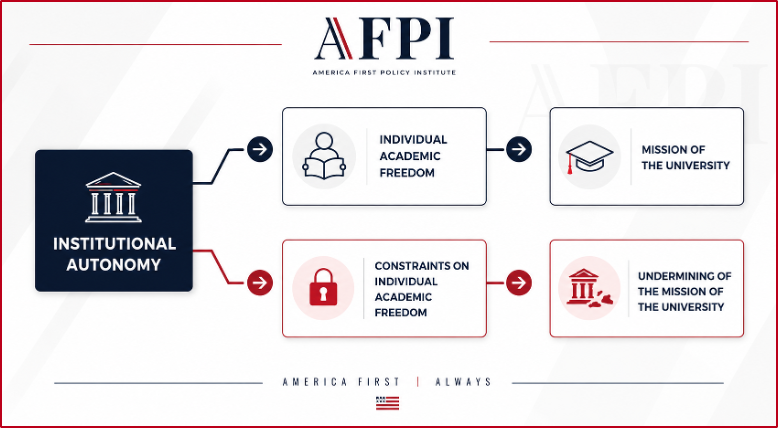
Institutional autonomy advances the mission of the university when it protects and enables the free exchange of ideas among scholars. Conversely, when institutional practices (whether formal or informal) systematically constrain the participation or advancement of disfavored viewpoints, autonomy becomes an impediment to that mission. The same authority that enables universities to foster open inquiry can be abused to stifle debate and exclude competing perspectives (see Figure 1).
Figure 1
Institutional Autonomy, Academic Freedom, and the Mission of the University
Finally, the value of both institutional autonomy and academic freedom are primarily instrumental. Institutional autonomy supports individual academic freedom and academic freedom supports the public interest in higher education: the production of knowledge, the cultivation of an informed citizenry, and the maintenance of civic equality, including by ensuring compliance with civic rights law.[2] The justification for institutional autonomy would therefore seem to depend heavily on its contribution to these ends. Education reformers should consider whether, in the absence of effective internal reforms, persistent viewpoint discrimination in higher education warrants external intervention to restore universities to their appropriate mission and purpose.
Section 1: Viewpoint Discrimination’s Magnitude and Consequences
Survey data attests to the pervasiveness of biases against conservative faculty, students, and guest speakers in campus settings. Beginning with faculty, a recent comprehensive report by the Center for the Study of Partisanship and Ideology (CSPI) estimates four-in-10 (40%) faculty would oppose hiring a Trump supporter. The same survey finds one-in-five (20%) faculty would discriminate against a conservative colleague applying for a grant[3] (Kaufmann, 2021).
Similar findings are evident across a range of faculty survey populations. For example, a survey of social and personality psychologists finds support for penalizing conservatives, including when:
- Evaluating prospective job applicants (38%).
- Inviting colleagues to present their work (14%).
- Reviewing colleagues’ work (19%).
- Reviewing colleagues’ grant applications (24%; Inbar & Lammers, 2012).
Table 1
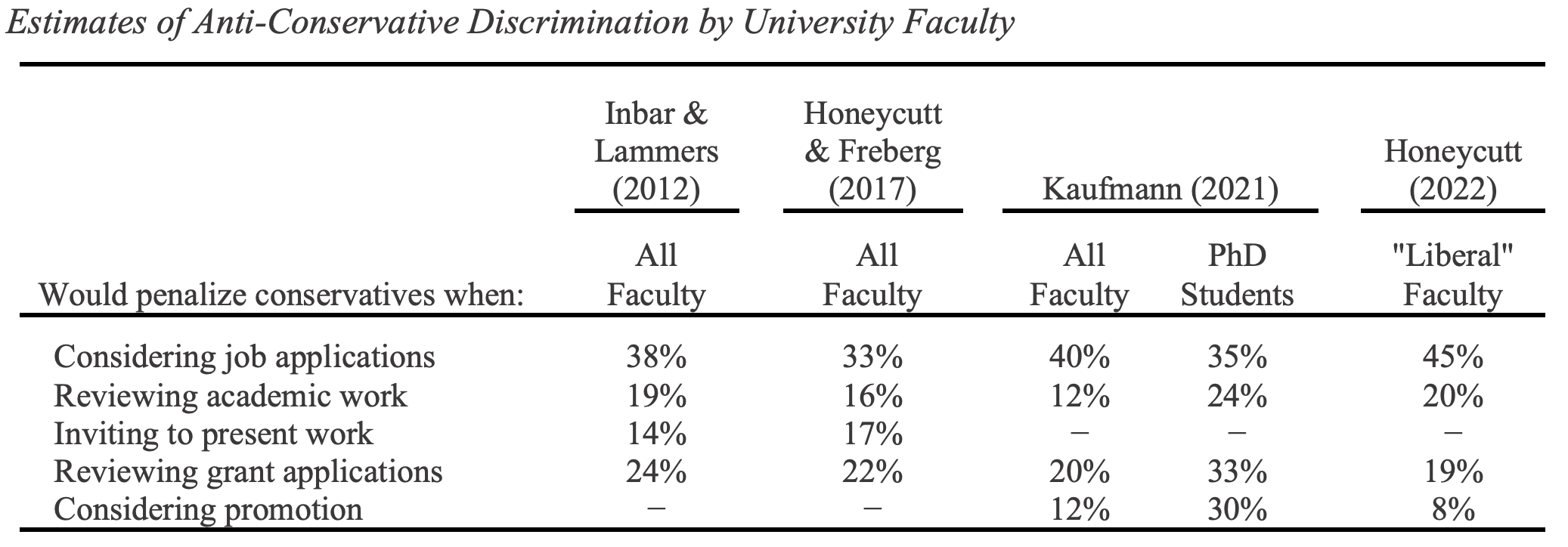
Note. Inbar & Lammers (2012) survey 800 social & personality psychologist faculty (members of the Society for Personality and Social Psychology). Respondents self-identify as "liberal" (85%), "moderate" (9%), and "conservative" (6%). Honeycutt & Freberg (2017) survey 618 California State University system faculty across 76 disciplines. Respondents self-identify as "liberal" (71%), "moderate" (15%), and "conservative" (14%). Kaufmann (2021) surveys 1,093 faculty members at top 100 US universities in social science and humanities fields and 397 American and Canadian PhD students. Honeycutt (2022) surveys 1,867 "liberal" identifying tenure-track faculty at top ranking universities in the STEM, social science, humanities, business, and education disciplines.
In part due to the high proportion of self-identified liberals in these fields (85%), this study was replicated in 2017 using a broader cross-section of academic departments. As shown in column 2 of Table 1, this broader sample, which still reflects a high proportion of self-identified liberals (71% “liberal”), expresses a similar willingness to discriminate against their conservative peers (Honeycutt & Freberg, 2017).[4] According to a 2022 survey of liberal tenure-track faculty members, nearly half (45%) would discriminate against a conservative job applicant (Honeycutt, 2022). Similarly, a survey of PhD students reveals that more than a third (35%) would discriminate against a conservative job applicant. A remarkable eight-in-10 (82%) PhD students would discriminate on at least one of four dimensions (see Table 1, column 4; Kaufmann, 2021). This finding suggests discrimination against conservatives is likely to increase as today’s PhD students become tomorrow’s professors.
It bears emphasizing that these estimates are taken from personal admissions of discriminatory intent.[5] Given social desirability bias, it is reasonable to treat these estimates as the “floor” for the true rate of discrimination against conservative faculty. What about the “ceiling?” Returning to Inbar and Lammers (2012), when asked about their colleagues’ willingness to discriminate against conservatives, faculty estimates increase in each category:
- Evaluating job applicants (38% ➔ 44%).
- Inviting colleagues to present their work (14% ➔ 30%).
- Reviewing colleagues’ work (19% ➔ 34%).
- Reviewing colleagues’ grant applications (24% ➔ 37%).
These estimates suggest faculty are aware of biases against conservatives in higher education, even if most do not admit to harboring such biases themselves.[6] These perceptions are also captured in “goodness of fit” type of questions. For example, when asked whether a comparable conservative and liberal job candidate would be a “good fit” in their department, four-in-10 faculty (39%) rate the conservative candidate as a very/somewhat “poor fit” in contrast to only three-in-100 (3%) for the liberal candidate (Honeycutt, 2024). When asked whether a Trump-supporting colleague would feel comfortable expressing his/her political views, more than eight-in-10 (86%) of faculty respond “no” or say they are unsure (Kaufmann, 2021).
Moving beyond the traditional discrimination measures, Kaufmann (2021) finds robust evidence that liberal faculty employ “hard authoritarian” tactics against their conservative peers. This includes disciplinary action in response to “teaching, research, (and) speech in private or public forums, or speech elsewhere.” Among surveyed members of the National Association of Scholars—an approximately 2/3rds conservative organization—43% report having been disciplined or threatened with discipline for their views.[7] Among American and Canadian PhD students, 38% of conservatives (three-to-six times the rate of liberals and centrists) report having been disciplined or threatened with discipline for their views.
In line with these findings, a quarter of faculty in the social sciences and humanities (25%) would support a campaign to remove a colleague for expressing conservative views in at least one of four topic areas.[8] This rises to 43% among American and Canadian PhD students, a quarter of whom (25%) would also support an effort to remove a faculty member who favored reducing immigration (Kauffman, 2021).
Some of this discrimination is embedded in formal university and departmental policies and practices. Examples of such “institutional discrimination" includes:
- “Diversity statements” that compel job and promotion candidates to affirm progressive values, including their support for diversity, equity, and inclusion (DEI) programs (Honeycutt et al., 2023; Paul & Maranto, 2021; Arnold et al., 2025a).[9]
- Codes of conduct that penalize speech and association along ideological grounds (FIRE, 2025a).
- Aggressive ideological biases in peer review, including at “flagship” journals like the American Political Science Review (Minella, 2025).
When considered alongside interpersonal prejudice—for example, nearly six-in-ten (57%) faculty report they would be “uncomfortable” or “unsure” about even sitting next to a Trump supporter—discrimination against conservatives in higher education appears to be “systemic” (Kaufmann, 2021).[10]
The resulting hostile climate relegates conservative faculty to second-class status. Half of conservatives (52%), vs. one-in-three liberals (35%), fear suffering reputation costs due to colleagues misunderstanding something they have said or done. One-in-three conservatives (32%), vs. only one-in-five liberals (18%), fear such misunderstandings could cost them their jobs. More than half of conservative faculty (55%) admit to “occasionally hid(ing) their political views in order to keep their jobs” in comparison to less than one in five liberal faculty (17%; Honeycutt, 2024).
The situation isn’t much better for students or visitors, and, as with discrimination against conservative faculty, this also appears to be getting worse.[11] A recent report by the Knight Foundation and Ipsos reveals the proportion of students who describe their free speech rights as “secure” dropped an astonishing 30 points in just eight years (2016–2024; Knight Foundation & Ipsos, 2024). That report finds two-in-three students self-censor, despite the same share recognizing that self-censorship undermines education. Similarly, a recent analysis of cancelled and disrupted campus speaking events finds progressives were responsible for nearly all (90%) ideologically motivated disruptions from 1997 to 2024. The liberal (vs. conservative) share of disruptions and cancellations are both increasing over time (Schorr, 2025).[12]
The general climate of hostility towards conservative students, speakers, organizations, events, and most importantly, ideas, appears to be downstream from discrimination against conservative faculty. Between the difficulty of obtaining university employment, and the professional risks associated with retaining it, the conservative academic is becoming something of an “endangered species.” As discussed in the following section, this results in an extreme lack of viewpoint diversity in precisely those institutions where a broad representation of perspectives is most valuable.
Negligible Viewpoint Diversity
The university’s role in facilitating the advancement of knowledge depends upon a robust exchange of ideas. This core mission is undermined when certain topics and perspectives are restricted. But this is not the only way to undermine the “marketplace of ideas.” Extending the metaphor, one could restrict the range of “approved” products, thereby denying choice to customers and removing the impetus for producers to innovate to improve their products.
The value of viewpoint diversity finds robust support in academic literature. Research suggests ideological homogeneity causes researchers to overlook important questions, misinterpret findings, and compromise the integrity of the scientific process (Haidt, 2011; Tetlock, 1994; Duarte et al., 2015). Excluding dissenting perspectives can cause less creative and more rigid and error-prone thinking (Nemeth, 2010). Unsurprisingly, both the public and elites (e.g., judges) are more likely to distrust research associated with ideologically lopsided institutions (Redding, 2011). Viewpoint diversity thus benefits not only viewpoint minorities but also majorities who desire to have their work taken seriously.
Liberals have long extolled the benefits of viewpoint diversity when arguing for policies to boost representation for members of underrepresented groups. Such arguments were key to persuading a majority of Supreme Court justices to allow affirmative action to stand as long as it did, despite the clear tension between institutionalized racial preferences and constitutional and statutory law (Grutter v. Bollinger, 2003). Similar arguments were later mobilized to defend DEI training and diversity statements across the major institutions of American society. Indeed, it seems that the case for pursuing viewpoint diversity as a byproduct of representation along other lines was so compelling that advocates were willing to overlook the argument’s implicit essentialism—i.e., the assumption that individuals from particular groups possess distinct, group-linked perspectives (Schuck, 2014).
As these examples suggest, viewpoint diversity can be understood along many dimensions; however, diversity along ideological lines seems especially relevant in university settings insofar as this dimension speaks to given competing comprehensive frameworks for understanding large swaths of social, political, and economic life. It is therefore striking—if not surprising, given the noted pervasiveness of viewpoint discrimination—that conservatives find so little (and declining) representation among university faculty. As depicted in Figure 2, today’s campus ideological “monocultures” have been decades in the making. Today, self-identified “liberal” faculty outnumber their “conservative” peers by nearly 7:1 in comparison to less than 2:1 in1969 (Honeycutt, 2025; Ladd & Lipset, 1975).
Figure 2
Faculty Ideology in the United States, 1969–2022
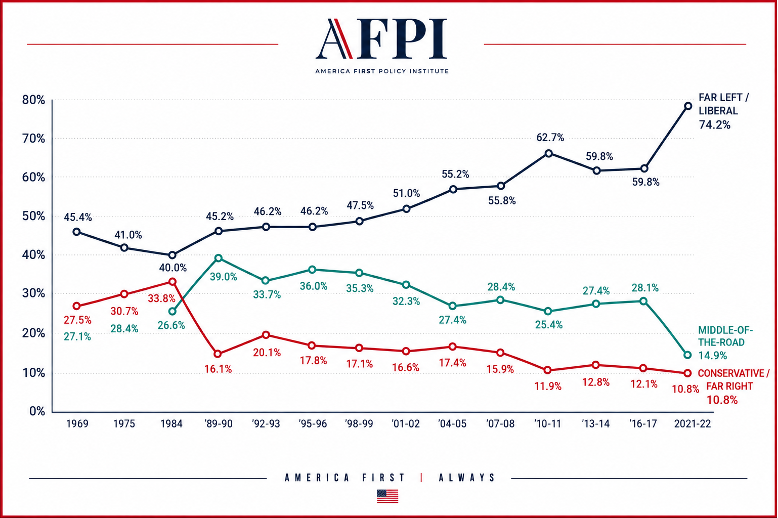
Note. Figure adapted with permission of author from The Politics of University Faculty, Working paper, 2025 (https://osf.io/preprints/psyarxiv/dnxqh_v1).
By contrast, survey data from Gallup suggests national ideological self-placement has changed much less dramatically in recent decades. From 1994–2024, the share of self-identified “conservatives” held steady (36% to 37%), while a small increase in “liberal” self-identification (17% to 24%) was counterbalanced by a similar decline in “moderate” self-identification (43% to 34%; Brenan, 2025a).
There is also cause to suspect the trends depicted in Figure 2 may understate the academy’s ideological drift from the American mainstream. This is because the proportion of far-left faculty has also increased in recent years. For example, self-described “radicals” and “Marxists” increased from 11% to 17% and 3% to 8%, respectively from 2006–2022. A quarter of faculty (26%) now describe themselves as “socialists”—more than twice the proportion describing themselves as “conservative” (11%; Honeycutt, 2025).[13]
Party registration data reveals a similar story.[14] For example, a 2018 analysis of “8,688 tenure track, Ph.D.–holding professors from 51/66 top-ranked liberal arts colleges” uncovers a mean Democrat-to-Republican (D:R) ratio of 12.7:1 (Langbert, 2018). The ratios varied substantially across 25 academic fields. At the low end, Republicans were outnumbered by only 1.6:1 in engineering; however, in communications, anthropology, and “Studies” departments (for example, “women’s” and “Africana” studies), no Republican faculty were found among surveyed faculty. Even more remarkably, there appeared to be no Republican faculty across 39% of the universities surveyed. Similarly, a 2016 study uncovers an average D:R ratio of 11.5:1 across five departments at 40 universities (Langbert et al., 2016). A 2025 report by the Buckley Institute finds Democrats comprise 83% of Yale faculty, while Republicans were nonexistent in 27 departments (Buckley Institute, 2025). The small share of self-identified “Republican” respondents to faculty surveys likewise suggests a declining presence in higher education (Quinn, 2024a; Kaufman, 2021).
As often seems to be the case, these trends appear worse at elite universities (Langbert et al., 2016; Langbert, 2018). A recent study investigates partisan representation among a sample of 12,372 faculty from 118 highly ranked universities (Langbert & Stevens, 2020).[15] As depicted in a widely circulated figure comprised from data taken from that study, the rarity of Republican faculty among some of the most “elite” universities in this survey is remarkable (see Figure 3; Rozado, 2024a).[16] The near absence of Republican faculty in such places is remarkable, given that, at the time this survey was conducted, the Republican share of the American electorate was 29%—or 42%, including Republican-leaning independents (Jones, 2020).
Using the same universities listed in Figure 3, we can delve further by comparing political and racial representation in faculty bodies. The comparison may be interesting insofar as racial discrimination (unlike viewpoint discrimination) is both widely stigmatized and unlawful under Title VII of the Civil Rights Act (1964). In part for this reason, racial minority representation at elite institutions has long been a subject of concern. Additionally, as noted, prior to Students for Fair Admissions v. Harvard (2023), university affirmative action programs were upheld, reasoning that a “critical mass” of minority students enriches campus intellectual climates by helping to encourage a diversity of perspectives.
Figure 3
Proportion of Registered Democrats/Republicans Among Faculty at Elite U.S. Universities
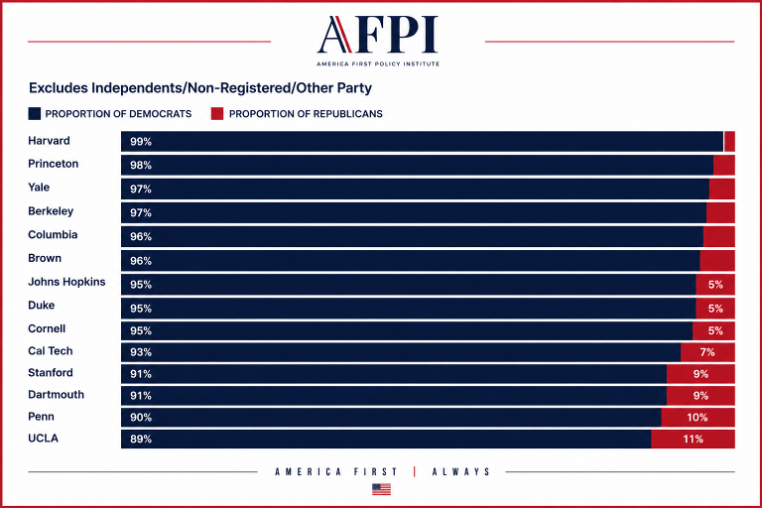
Note. Figure from Proportion of Registered Democrats/Republicans Among Faculty at Elite U.S. Universities, X.com, 2024 (https://x.com/DavidRozado/status/1857563687990735167). Data from Partisan Registration and Contributions of Faculty in Flagship Colleges, Studies in Higher Education, 2022 (https://www.nas.org/blogs /article/partisan-registration-and-contributions-of-faculty-in-flagship-colleges/?ref=quillette.com).
Figure 4 depicts representation quotients (RQs) for Republican and African American faculty at the same universities listed in Figure 3 using faculty party registration data from Langbert and Stevens (2020) and faculty demographic data from the National Center for Education Statistics (2025). RQs are a simple, widely used method for measuring the difference between a group’s share of a given institution and its share of the population (for methods, see Appendix A):
For context, where RQ=1, a group’s share of an institution (university faculty) matches their share of the reference (national) population. At RQ=0.5, a group’s share would be half that of the reference population. In all 14 cases depicted in Figure 4, Republican and African American faculty lag far behind their respective national reference populations; however, in 11 of those cases, Republican faculty are more underrepresented than African American faculty. Utilizing the full list of universities sampled by Langbert and Stevens (2020), Republican faculty underrepresentation exceeds African American faculty underrepresentation in 60.5% (69/114) of cases (see Appendix B).
Figure 4
Representation Quotients: Republican and African American Faculty at Select Elite Universities, 2019
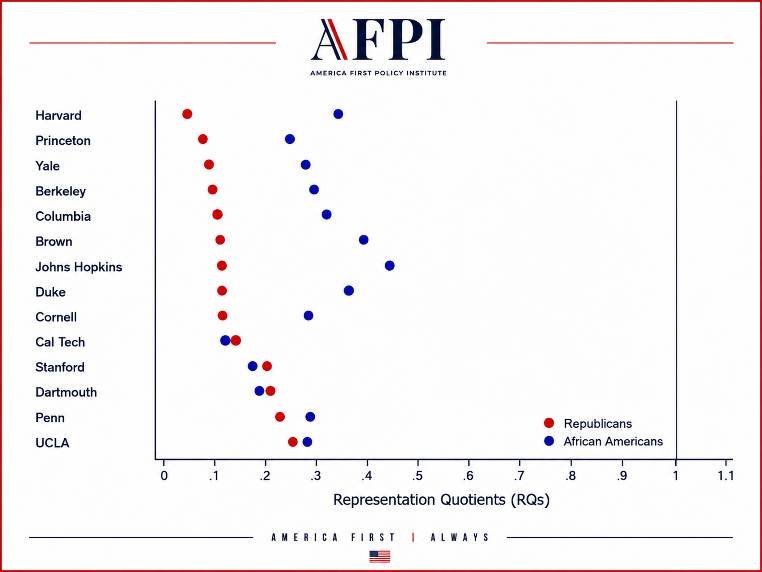
Note. Data from Homogenous: The Political Affiliations of Elite Liberal Arts College Faculty, Academic Questions, 2018 (https://prod.nas.org/academic-questions/31/2/homogenous...); National Center for Education Statistics, Integrated Postsecondary Education Data System (IPEDS) [Data set], U.S. Department of Education, 2024 (https://nces.ed.gov/ipeds/); U.S. Party Preferences Steady During Trump Era, Gallup, 2020 (https://news.gallup.com/poll/274694/party-preferences-steady-during-trump-era.aspx); Black Alone, Percent, U.S. Census, 2025 (https://www.census.gov/quickfacts/fact/table/US/RHI225222), and author’s calculations.
As discussed further in Section 2, appeals to “academic freedom” can be used to justify discrimination along any grounds. The distinction between hiring and discriminating against African Americans and conservatives is a matter of legal protections (or lack thereof)—not ethics. However, the irony should be lost on no one that these institutions and their advocates champion certain kinds of representation to the point of employing discriminatory racial preferences on viewpoint diversity grounds while simultaneously suppressing other kinds of representation through overt viewpoint discrimination.
Violations of Civil Rights and Liberties
During the Spring of 2024, elite U.S. university campuses were engulfed by a wave of protests in response to Israel’s campaign against Hamas in Gaza. As described across multiple news outlets, these protests included many documented instances of antisemitic slogans and chants, and targeted harassment and intimidation of Jewish students (Pidluzny, 2024). This spectacle, and the seeming indifference to it by university leaders, shocked much of the American public and prompted sharp condemnations from members of Congress (Christenson, 2024). While many struggled to understand how this hatred could have—it seemed, suddenly—reemerged at elite universities, several critics of cultural developments in higher education noted the striking similarity between campus rhetoric targeting Jewish students and Israel on the one hand, and rhetoric targeting whites, men, heterosexuals, and the United States on the other (Goodman, 2024; Pidluzny, 2024; Schorr, 2024; Bernstein, 2022).
The alliance between elements of the far-Left and Islamists has been termed the “red-green alliance” (Karagiannis & McCauley, 2013). Channeling neo-Marxist frames of reference, this coalition designates Jews as “oppressors” based on their proximity to “whiteness”—understood in contemporary (liberal) scholarship as referring to a resource of social power linked to European ancestry (Harris, 1993; Roediger, 1991). It often defends the October 7th massacre of Israeli civilians by Hamas as justifiable “resistance” to oppression (Anti-Defamation League, 2024). Its description of Israel as a “settler colony”—what other prominent settler colony comes to mind?—draws on postcolonial frameworks likewise shaped by neo-Marxist theories of power and domination (Said, 1978).
If there was any doubt as to the ideological foundations of this protest movement, the release during this period of the Harvard-Caps-Harris poll clarified the matter considerably. According to the national poll, among 18 to 24-year-olds (i.e., “college-aged” respondents):
- Two-thirds (67%) agreed that Jews are “a class of oppressors and should be treated as oppressors.”
- Four-in-five (79%) agreed white people are “a class of oppressors and nonwhite people and people of certain groups have been oppressed and as a result should be favored today at universities and for employment.”
- Three-fifths (60%) agreed that “the Hamas killing of 1200 Israeli civilians and the kidnapping of another 250 civilians can be justified by the grievances of Palestinians” (Harvard, Caps, Harris, 2023).
“Campus left” antisemitism is one of several manifestations of entrenched radicalism in U.S. universities—at least some of which can be measured using available data. Table 2 returns to the 14 elite universities addressed in Figures 2 and 3, to depict associations between faculty ideological homogeneity (columns 1 and 2) and measures related to civil rights and liberties. These include:
- Arrests and encampment protests (columns 3 and 4), which relate to potential prohibited ancestry-based discrimination under Title VI of the Civil Rights Act (1964; U.S. Department of Education Office for Civil Rights, 2025).
- The proportion of 2024 faculty academic job postings containing “diversity statement” prompts (column 5), which raise viewpoint discrimination and coerced speech concerns (Academic Freedom Alliance, 2022).
- Campus free speech grades by FIRE (column 6), which primarily address student perceptions of campus speech climates (see discussion below).
Table 2
Viewpoint Homogeneity and Violations of Civil Rights and Liberties at Select Elite Universities
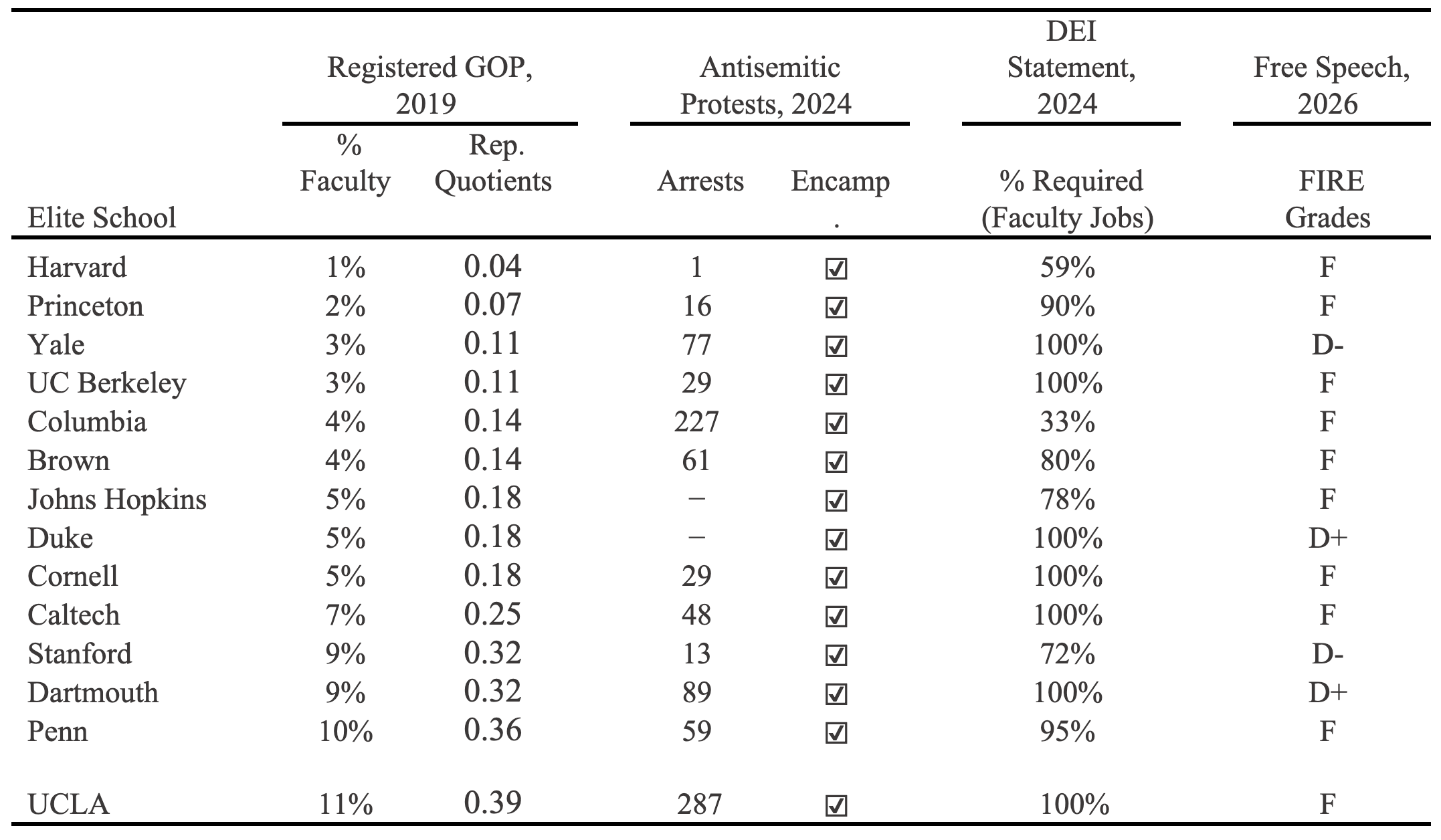
Note. Faculty registered Republican percentages are obtained from Rozado (2024a, column 1). Republican RQs are obtained from Langbert and Stevens (2020) and Jones (2020, column 2). 2024 campus arrest data is obtained from Chenoweth et al. (2025, column 3). University encampments data is obtained from Culter and Taylor (2024). and Bryant and Attridge (2024, column 4). “DEI”/“diversity” statement data is obtained from Arnold et al. (2025a, column 5). Free speech grades are obtained from FIRE (2026c, column 6).
These associations are descriptive; they do not establish causation. Nor do they appear to be linear. Nonetheless, they appear to be consistent with the hypothesis that ideologically homogeneous faculty environments contribute to illiberal campus environments that enable violations of civil rights and liberties.
Beginning with campus antisemitism, every listed university—those with the lowest representation for Republican faculty—hosted an encampment during the 2024 antisemitic protests. Nearly all such campuses (12 out of the 14) also saw arrests of protestors during this same period (column 3).[17] The association between low Republican faculty representation and university encampments may strike some as unremarkable, given that these protests were nationwide; however, from March to May 2024, encampments were present at just 5% of four-year, degree-granting private non-profit and public universities (124 out of 2,518).[18] The ubiquity of encampment protests—a proxy for campus antisemitism—and the near ubiquity of arrests at those institutions with some of the lowest rates of faculty ideological diversity is certainly noteworthy.
Turning to diversity statements (sometimes called “DEI statements”), these too may be regarded as a
manifestation of intolerance towards dissenting perspectives in higher education (see column 5). Many departments solicit these statements in applications for faculty positions, asking applicants to describe such things as their knowledge of, commitments to, and planned efforts to advance DEI (University of California, 2019). In practice, these prompts operate as ideological filters, incentivizing applicants to commit to favored (i.e., pro-DEI) views (Academic Freedom Alliance, 2022; Kennedy, 2024). This is because diversity statements scoring rubrics explicitly penalize alternative perspectives, such as support for color-blind meritocratic (i.e., equal) norms and skepticism towards segregating students and faculty into so-called “affinity groups” (Sailer, 2024). In one reported case, 679 out of 893 applicants for a single faculty position were eliminated solely based on their responses to a diversity statement prompt (Gillen, 2020).
Given the severe penalty for perceived ideological non-conformity, it seems likely that even optional (vs. mandatory) diversity statements could function as barriers to faculty employment, promotion, or tenure. Universities, grant reviewers, and others might also coax diversity statements from applicants without explicitly calling for such statements by communicating the importance of DEI themes to their institutions. For example, applicants might reasonably regard the following as an “implicit” diversity statement prompt to be addressed somewhere in their application, such as in a research or teaching statement:
Duke University and The Department of Philosophy are strongly committed to advancing inclusive excellence throughout our research, teaching, and service activities. A diverse faculty – defined broadly as representing a wide range of identities, lived experiences, and perspectives – is a prerequisite for excellence and is essential to driving innovation within our scholarly community. To achieve these goals, it is essential that all members of the community feel valued and welcome, that the contributions of all individuals are respected, and that all voices are heard. All members of our community are expected to uphold these values, and we seek to hire faculty who are passionate about working to increase the participation and success of individuals from different backgrounds and communities. (Duke University, 2024)[19]
Column 5 of Table 2 lists the proportion of new faculty jobs posted between August 12 and December 6, 2024, containing diversity statement requirements at the noted 14 elite universities (for additional details on methodology, see Appendix C). On average, more than eight-in-10 (86%) job postings over this period included an explicit or implicit diversity statement prompt (see Appendix D and E). This estimate is most comparable to the 78% of elite school job postings identified by Paul and Maranto (2021) as containing references to “diversity;” however, findings from these studies are not directly comparable due to methodological differences.[20]
A final measure by which to assess the health (or lack thereof) of our universities comes from campus speech climate surveys. Free expression is sine qua non to the mission of the university: when students and faculty are afraid to share or debate ideas, or to investigate important topics, the university fails as an institution. FIRE’s College Free Speech Rankings, which have been conducted annually since 2020, provide a useful tool with which to compare institutions and to assess change within institutions, overtime (FIRE, 2026a).[21]
FIRE’s most recent free speech grades (derived from their free speech scores) are listed in column 6 of Table 2 for the 14 elite universities. As with columns 3–5, these institutions (where Republican faculty representation is low) fare very poorly; however, it seems that nearly all of higher education also fares poorly in this regard. According to FIRE, the average score across their sample of 257 universities was 58.3—a failing grade (“F;” FIRE, 2026b). The 14 elite universities in Table 2 manage to score even lower at 56.0 (“F”), albeit only slightly so (FIRE, 2026a).
At first glance, the fact that the noted universities fare only slightly worse in terms of average speech climates is puzzling. If viewpoint homogeneity contributes to restrictive campus speech climates, why do elite universities not appear dramatically worse than other institutions, in this respect? Does this finding suggest that campus viewpoint monocultures and restrictive speech climates are unrelated?
Not necessarily. Consider that prominent leftwing academics have long advocated for censoring speech that conflicts with progressive values (Marcuse, 1969; Delgado, 1982). Further consider survey evidence demonstrating that self-identified liberal/progressive faculty and students are more likely than their peers to favor censorship, deplatforming, and speech mandates (Kaufmann, 2021; Knight Foundation & Ipsos, 2024; Honeycutt et al., 2023). Returning to Figure 2, it stands to reason that, as self-identified “liberals” grow as a share of faculty bodies (in part, due to discrimination against conservatives), the proportion of faculty bodies holding anti-speech views would also increase. Given that shared governance vests faculty deliberative bodies (“faculty senates”) with substantial influence over university policy, the trend towards increasing (left-wing) faculty viewpoint homogeneity should erode campus free speech over time. Indeed, survey data generally reveal a worsening speech climate (FIRE, 2026a; Stevens, 2024; Kaufmann, 2021).
What then could account for the apparent null finding? One possibility is that the inflection point after which faculty left-wing homogeneity drives restrictive campus speech climates occurs before conservative underrepresentation reaches the extreme proportions evident today in elite institutions. Another possibility is that higher education, as an institution, has converged on similar policies (viewpoint discrimination) with similar effects (viewpoint monocultures and associated abusive policies) due to one or more organizational pressures. For example, less elite institutions (or actors within elite institutions) may imitate policies implemented by elite institutions to elevate their own status (DiMaggio & Powell, 1983). Either explanation (or both) could account for the 14 elite institutions listed in Table 2 appearing only marginally worse than average, in terms of speech climates.
Figure 5
How Viewpoint Discrimination May Contribute to Toxic Campus Climates
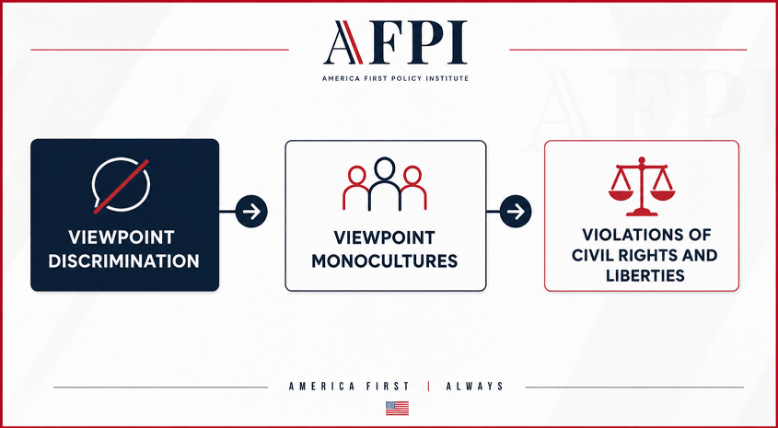
Even with this qualification, Table 2 paints a decidedly unappealing portrait of higher education. To be sure, the relationships between the policies addressed in the respective columns merit further investigation—ideally with a larger sample population and more (as well as better) measures. Table 2 does not establish a causal relationship between campus viewpoint monocultures and toxic campus climates, yet it is difficult to imagine how systematically excluding opponents of such policies wouldn’t encourage the noted abuses. Taken together, the evidence is consistent with the relationship depicted in Figure 5.
In taking full stock of viewpoint discrimination in higher education, one thus confronts issues of compromising the mission of the university (both advancing knowledge and educating students) and fundamental fairness, as well as facilitating legally and morally reprehensible behavior. Despite all of this, recent efforts by the Trump Administration to address viewpoint discrimination have been met with resistance from some (it must be said, well-meaning) education reformers (Tomasi & Haidt, 2025; George & West, 2025). The central impediment to consensus regarding the need for meaningful, external action to rein in viewpoint discrimination in universities is addressed in the following section.
Section 2: Resisting Reform on “Academic Freedom” Grounds
In higher education policy, opponents of viewpoint discrimination are divided over the issue of government intervention. Both sides agree on the desirability of universities reforming themselves. They disagree on its likelihood—that is, on the viability of persuading universities to reform themselves (Pettit, 2025).
Several prominent critics of government action (“anti-interventionists”) contend that colleges and universities are already implementing successful reforms and that government intervention is unnecessary and even counterproductive (Tomasi, 2025a; Tomasi & Haidt, 2025; Quinn, 2025).[22] It is true that some important reforms have been implemented thanks to efforts by organizations like the Heterodox Academy and its affiliated scholars, among others. For example,
- 157 universities have committed to avoiding taking public positions “on social and political issues unless those issues threaten the very mission of the university and its values of free inquiry” (HxA, n.d.–b; FIRE, 2026d). By clarifying the role of the university as the “home and sponsor of critics” rather than the critic itself, “institutional neutrality” creates needed space for vigorous engagement with contentious ideas (Kalven Committee, 1967). The rapid, recent adoption of such commitments—prior to 2023, they were present at only three institutions—represents a major accomplishment for higher education reformers (Arnold et al., 2025b). Still, fewer than one-in-10 universities make these commitments today (Apodaca, 2025).
- There are now 45 university-affiliated “civics centers”—institutions widely regarded as friendly to conservative and classical liberal thinking (Siddiqi and Regnier, 2025). Civic centers’ semi-independent status allows centrist and conservative faculty to circumvent ideological discrimination by liberal faculty (Quinn, 2024b). However, the fact that six-in-10 (59%) post-2022 civic centers were created by state governments rather than by universities seems to argue for, rather than against, government intervention (Siddiqi & Regnier, 2025).
- Several universities are working to facilitate constructive student dialogues across ideological and other divides (Vanderbilt University, 2026; Washington University, 2026). These programs are laudable; however, given the noted trends in faculty ideological homogeneity, bridging student viewpoint divides seems less relevant to the challenge at hand. Student bodies are likely to be far more ideologically representative than faculty bodies, and it is faculty and administrators, not students, who set the boundaries of acceptable discourse on campuses.
- A single university, Johns Hopkins (JHU), has formed a “Fellowship Exchange Program” with a right-leaning think tank to encourage scholarly exchange and collaboration (Johns Hopkins University, n.d.). JHU is additionally working to recruit and mentor conservative graduate students to address the diminished pipeline for conservative academics (Hub Staff, 2025).
These developments aside, viewpoint diversity continues to worsen—a point often made by anti-interventionists themselves (Roth, 2025; Lukianoff, 2025; George & West, 2025). The trendlines in Figure 2 are clear, and each successive cohort of academics appears to be more left-leaning than the one preceding it (Teles, 2024). Even worse, each successive cohort expresses an increased willingness to discriminate against their conservative peers, not that they will have many to discriminate against if current trends continue (Kaufmann, 2021).
This situation leaves the central dispute unresolved: if universities are not meaningfully correcting viewpoint discrimination on their own, is external intervention a necessary correction or an indefensible imposition upon institutional autonomy?
Anti-interventionists often frame such intervention as “authoritarian,” arguing that government intrusion into civil society threatens academic freedom itself (Illing, 2025). This criticism is perhaps revealing when paired with the explicit recognition that conservatives’ negligible representation in higher education results—at least, in part—from systemic discrimination rooted in prejudice (Illing, 2025).[23] Of course, discrimination rooted in prejudice is exactly the sort of thing the federal government regularly addresses by intruding into civil society, higher education included (Cole, 2019).
As noted, the absence of viewpoint protections in civil rights law poses a practical limitation for advocates of government intervention (the Trump Administration has used other policy tools to address the problem). Regardless, one might ask whether such intrusions are unwarranted in the case of those groups—or rather, group characteristics—currently protected by civil rights law. If African Americans—who, as noted, are better represented than Republicans among elite university faculty (see Figure 4)—experienced systemic discrimination of a comparable kind, would such intervention be considered “authoritarian”? Stated differently, was the Civil Rights Act (1964) “authoritarian”?
A committed libertarian might well answer these questions in the affirmative. This group aside, the disagreement over government intervention seems to hinge less on abstract commitments to limited government than on perceptions of the magnitude of the problem and on whether conservatives, like other groups, deserve some measure of protection from widespread discrimination in public life.[24]
The literature reviewed in Section 1 speaks to magnitude. The findings presented there suggest viewpoint discrimination is substantial, and that its effects on viewpoint diversity and a range of civil rights and liberties violations are likewise substantial.
Turning to whether conservatives deserve equal treatment, anti-interventionist reformers concede discrimination against conservatives is widespread and harmful to the public interest yet like many of their progressive peers—for whom excluding conservatives seems to be a “feature” rather than a “bug” of higher education—they resist government involvement to remedy it (FIRE, 2025b; Hess, 2025; Siraganian, 2025; Scott, 2025).
Does this position amount to a high-minded defense of academic freedom, or to a defense of a raw exercise of institutional power?
Religion aside, worldviews and perspectives do not enjoy protected class status under civil rights law, as noted, but it is not obvious that this exception justifies a moral case for treating conservatives as second-class citizens in an important sphere of public life. Consider how anti-interventionists’ liberal colleagues might regard government intrusion to address systemic discrimination if, for example, survey data showed:
- 33–45% of faculty would discriminate against a Hispanic job applicant (vs. a conservative, see Table 2).
- 39% of top-ranked liberal arts colleges have no female faculty (vs. registered Republicans, see Langbert, 2018).
- 57% of faculty report being “uncomfortable” or “unsure” about sitting next to a black colleague (vs. a Trump supporter, see Kaufmann, 2021).
- 70% of gay and lesbian faculty report a hostile climate (vs. “right-lean(ers),” see Kaufmann, 2021).
- 86% of faculty agreed a liberal peer would be uncomfortable expressing his/her political views (vs. a conservative, see Kaufmann, 2021).
- 91% of atheist faculty are afraid to disclose their beliefs (vs. Trump supporters, see Kaufman, 2021).
It is chiefly discrimination of this sort that today’s academic freedom proponents defend in practice, if not in principle, in defending institutional autonomy under the banner of “academic freedom.”
Yet the term more canonically evokes the right of scholars and students “to explore, research, and express ideas without fear of censorship, retaliation, or institutional pressure” (HxA, n.d.-a; AAUP, 1940/1970). There can be little doubt that viewpoint discrimination violates individual academic freedom and undermines the mission of the university (Rosenberger v. University of Virginia, 1995; Keyishian v. Board of Regents, 1967).
As described in Section 1, there is also cause to suspect that viewpoint discrimination lays the groundwork for further violations of civil rights and liberties. Both concerns merit federal government attention: the federal government is responsible both for stewarding the public’s investment in higher education and for ensuring that recipients of federal funds do not violate federal civil rights law.
The latter concern was judged serious enough by the Trump Administration as to warrant multiple investigations by the Departments of Education and Justice (U.S. Department of Education Office for Civil Rights, 2025). In the case of Harvard University, one of 60 such investigations, the DOJ proposed several viewpoint discrimination/diversity remedies in a draft case resolution proposal that leaked to the press. The relevant terms of that draft proposal sought to:
- End institutionalized viewpoint discrimination by abolishing ideological litmus tests in admissions and hiring.
- Assess viewpoint diversity across departments and teaching units.
- Improve viewpoint diversity by requiring a “critical mass” of underrepresented perspectives.
- Reform governance by reducing activist control over institutional decision-making (Gruenbaum et al., 2025).
The response from Harvard and defenders of the higher education status quo was swift. In a public letter rejecting the Administration’s offer, Harvard President Alan Garber declared, “No government…should dictate what private universities can teach, whom they can admit and hire, and which areas of study and inquiry they can pursue” (Rosenberg, 2025).
Of these three claims, the first and third are relevant to individual academic freedom, but not to the DOJ’s proposal, which says nothing about limiting teaching or research. Garber also neglected to address the inconsistency of invoking such freedoms in defense of Harvard’s right to violate them.
His middle claim, addressing admission and hiring, forms the strongest basis of the institutional autonomy argument. Garber is not alone. For example, in a 2003 statement denouncing “academic bills of rights” for requiring viewpoint diversity higher education, the American Association of University Professors (AAUP) argues, “a fundamental premise of academic freedom is that decisions concerning the quality of scholarship and teaching are to be made by reference to the standards of the academic profession...” (AAUP, 2003).
In practice, this standard leaves any consensus within the academy in favor of internal viewpoint discrimination largely immune to external pressure. The AAUP and others defend this position by evoking the specter of universities being forced to hire neo-Nazis or QAnon followers, as though this is the logical endpoint of abandoning discrimination against conservatives (AAUP, 2003; Siraganian, 2025).[25]
Yet the zone of excluded opinions is much wider than these fringe examples suggest, and is widening further as conservative faculty vanish.[26] So long as majorities within the academy can define professional standards in ways that exclude views held by tens of millions of citizens, institutional autonomy will remain a mechanism for suppressing dissent rather than protecting scholarship.
As a legal matter, institutional autonomy finds some support in Supreme Court jurisprudence. To the extent the First Amendment protects academic freedom, it generally operates as a shield against government interference rather than as a limit on universities’ own regulation of speech (Sweezy v. New Hampshire, 1957; Keyishian v. Board of Regents, 1967). Because the First Amendment applies only to government action, private universities are generally not bound by it (Rendell-Baker v. Kohn, 1982; Blum v. Yaretsky, 1982). At the same time, Congress may attach conditions to federal funding, including compliance with anti-discrimination law (South Dakota v. Dole, 1987). Institutions remain free to decline such funds.
The legal question is, however, distinct from the ethical one. The question is not whether universities can violate individual academic freedom through viewpoint discrimination, but whether doing so serves the public interest. Given that individual academic freedom directly supports the mission of the university, allowing it to be subordinated to institutional autonomy seems difficult to justify. Institutional autonomy is valuable—but primarily because it helps secure the conditions under which individual academic freedom can flourish.
Understanding that hierarchy clarifies the issue considerably.
Too Lofty by Half
Universities undermine the public interest in higher education when they subordinate individual academic freedom to institutional autonomy. To better understand why this is the case, it is helpful to re-examine academic freedom, this time emphasizing the unified or un-bundled concept in terms of its “institutional” and “instrumental” qualities.[27] Academic freedom is institutionally valuable insofar as it supports the basic functioning of colleges and universities by enabling research and teaching. To this end, academic freedom is also instrumentally valuable insofar as, by supporting the mission of universities, it advances broader societal priorities: developing and disseminating knowledge, creating wealth, enhancing national security, employment, and social mobility; and passing on our nation’s cultural inheritance.
Yet there are many scenarios in which appeals to “academic freedom” could provide cover for harming broader societal priorities and values, including those ostensibly (and instrumentally) supported by academic freedom. Consider the following cases:
- National security: Citing their freedom to solicit and receive grants and contracts from whomever they choose, universities could allow themselves to become compromised by hostile foreign actors (U.S. Department of Education, 2026).[28] They could also undermine national security by enrolling excessive numbers of students from foreign rival states, particularly in sensitive research fields, citing their freedom to enroll students and to operate programs as they see fit.[29]
- Employment and social mobility: Citing their freedom to offer degrees as they see fit, universities could ignore labor market needs and direct students towards degrees that do little (if anything) to support future earnings. Research has shown that over a third of bachelor’s degrees and four-in-10 master’s degrees yield zero-to-negative returns on their educational investments (Cooper, 2021, 2022). The public has a strong interest in promoting positive returns on higher education investments; however, colleges and universities, being free, need not limit themselves to such concerns.
- Preserving America’s cultural inheritance: Citing their freedom to instruct American students as they see fit, universities could advance divisive anti-American themes that sow national disunity and animosity along salient social lines (race, sex, etc., Pidluzny, 2023). One might think that higher education, as a sector, might feel a strong sense of obligation to those who fund them—but they are free to feel and act otherwise, are they not?
- Constitutional liberties: Citing their right to advance various social causes, universities could violate students’, faculty’s, and visitors’ free speech rights in various ways, including through speech codes and bias response teams (FIRE, 2025a; Palmer, 2024). They could also deny job opportunities to applicants and promotion opportunities to current faculty (Regnier et al., 2024). Ironically, all such actions would undermine academic freedom and degrade higher education as an institution.
- The rule of law and equality under law: Citing these same commitments, colleges and universities could treat some classes of students, faculty, and visitors differently than other classes in defiance of civil rights law (Cochrane, 2026). Such action, though unlawful, is consistent with the broad (institution-centered) conception of academic freedom asserted by Garber. Title VI of the Civil Rights Act (1964), no less than the Trump Administration’s proposed reforms, conflicts with Garber’s claims to academic freedom if, as Garber claims, “No government… should dictate … whom [private universities] can admit and hire...” (Rosenberg, 2025).
- Technological innovation and wealth creation: Citing their freedom to research and offer degree programs in support of their own priorities—perhaps rooted in ideological fashions— universities could underfund or even abandon their support for vital national priorities. This is perhaps the least likely scenario, insofar as universities would be neglecting opportunities to increase their own revenues (through federal research grants and student tuition)—still, this decision would be justifiable on “academic freedom” grounds.
In some cases, the tension between academic freedom and broader societal goals brings the former into conflict with the law. As a rule, academic freedom loses these battles. For example, universities can be held to account for skirting federal foreign gift and contract reporting, and for violating students’ civil rights and liberties. Thanks to the recently passed Working Family Tax Cuts (aka “One Big Beautiful Bill”), universities are also no longer fully at liberty to offer students low/no-value degrees.[30] In terms of America’s cultural inheritance, several states have passed general education curricula requirements and prohibitions on DEI policies.
In short, looking beyond the internal tensions within academic freedom, as a concept, the concept itself appears to occupy an overly lofty position in the rhetoric of its most passionate defenders. In no context, including in academia, does unchecked liberty of action constitute an ethical apotheosis.
At the same time, it is certainly true that freedom is generally beneficial. In this way, expansive claims to academic freedom possess more than a kernel of merit. Even from the standpoint of a government concerned with advancing the public interest, prudence will often dictate substantial deference to institutions to manage their own affairs.
Returning to the idea of institutional values, it is helpful to look beyond the academy to analogous cases that highlight examples in which such deference necessarily gives way to other, “higher order” considerations. Consider the example of “the chain of command:” “the succession of commanding officers from a superior to a subordinate through which command is exercised” (U.S. Department of Defense, 2013). As with academic freedom, the chain of command is all-but sacrosanct within its institutional context, and for good reason. The chain of command is vital to the proper functioning of the military (institutional value), which, in turn, helps safeguard the nation (instrumental value). Yet there are also infamous historic examples of rigid adherence to the chain of command contributing to catastrophic military blunders.[31] Such examples demonstrate that this vital principle must give way, from time to time, to support the very purposes for which it exists
Or consider “shareholder value,” the principle that businesses exist to create financial returns for owners and investors. Shareholder value is a core principle of capitalist organization, associated with the view that firms’ primary responsibility is to their owners and to profit maximization (Friedman, 1970).
At the same time, few would dispute that the pursuit of profit can justify a range of abuses—hence, the existence of building codes, workplace safety regulations, labor laws, prohibitions on anticompetitive practices, truth-in-advertising requirements, etc. Debates abound regarding the proper scope of government intervention in markets; however, few would oppose government intervention to prevent the most extreme excesses associated with profit-seeking behavior (e.g., slavery or extreme environmental contamination).
These examples illustrate an important point: from within institutions, “secondary order values”—means to some end—may come to be treated as primary ends in themselves. This conflation is understandable, but it is precisely why deference to institutional self-regulation must be limited, even in a free society. Even under conditions of limited government, there are points at which public authority must intervene in institutional domains to reassert the public’s interest and ensure basic fairness. When a ship has drifted far off course and is approaching the rocks, it is not “authoritarian” to seize the helm. Or perhaps it is, but it may nonetheless be necessary.
Conclusion: Guiding Principles for Education Reformers
Higher education plays a vital role in supporting the discovery and dissemination of knowledge; however, the documented prevalence of viewpoint discrimination against conservative faculty undermines this role and calls into question the sincerity of universities’ commitment to it. This report challenges the view that this discrimination is defensible on “academic freedom” grounds. It does so by addressing, first, the magnitude of viewpoint discrimination against conservative faculty, and its impact on viewpoint diversity and campus climates; and second, the conceptual weakness of the “academic freedom” defense. This report concludes by proposing two principles for education reformers to consider as they weigh the myriad tradeoffs in higher education policy:
Principle 1. The public interest in higher education—specifically, the mission of the university, equal treatment in public life, and the defense of civil rights and liberties—takes precedence over academic freedom
Principle 2. Individual academic freedom, being more central to the concept of academic freedom and more important to the mission of the university, takes precedence over institutional autonomy.
How then should education reformers regard government-led reforms to address viewpoint discrimination? Given due regard to institutional autonomy, institution-led reforms are preferable; however, external (government) action is warranted in the face of institutional resistance and when institution-led reforms prove inadequate. When universities invoke academic freedom to justify viewpoint discrimination, they abandon the very purpose that gives academic freedom its legitimacy. In such cases, reform is not an infringement of academic freedom, but its restoration.
Appendix A. Republican Representation Quotients
Figure 3 from Rozado (2024a) utilizes party registration data, as reported by Langbert and Stevens (2020), to calculate the proportion of registered Democrat to registered Republican faculty at 14 elite universities. This calculation excludes independent and non-party registered faculty, and uses the combined two-party registered totals as the denominator:

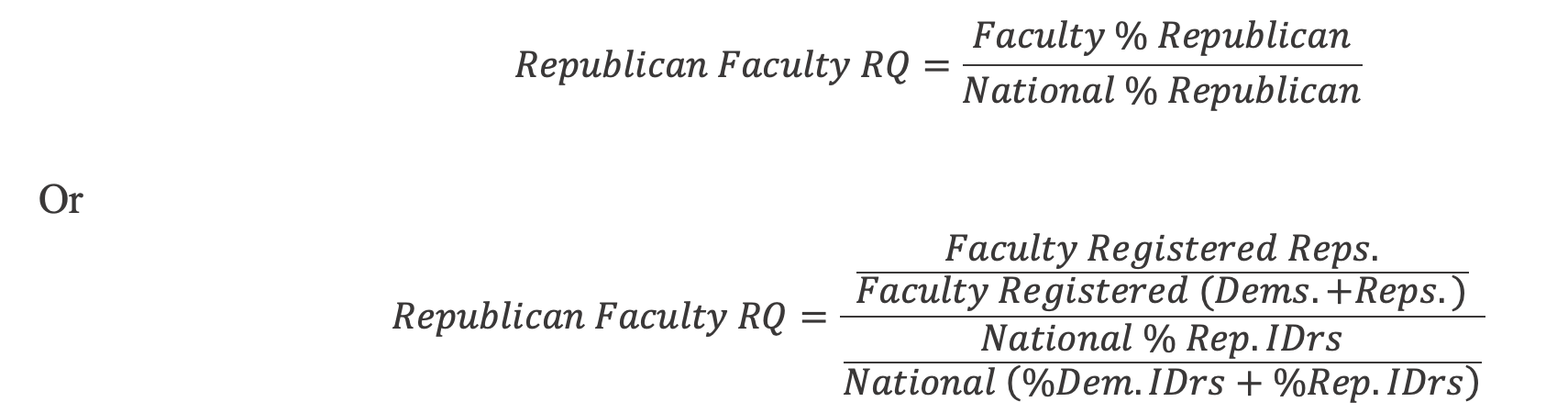
Figure 4 depicts Faculty Republican RQs, calculated by dividing Faculty % Republican by the national Republican share of two-party identifiers, according to Gallup (Jones, 2020):

Figure 4.
Faculty Republican RQs are, therefore obtained as follows:
Appendix B. Representation Quotients for Republican and African American Faculty at 114 Institutions
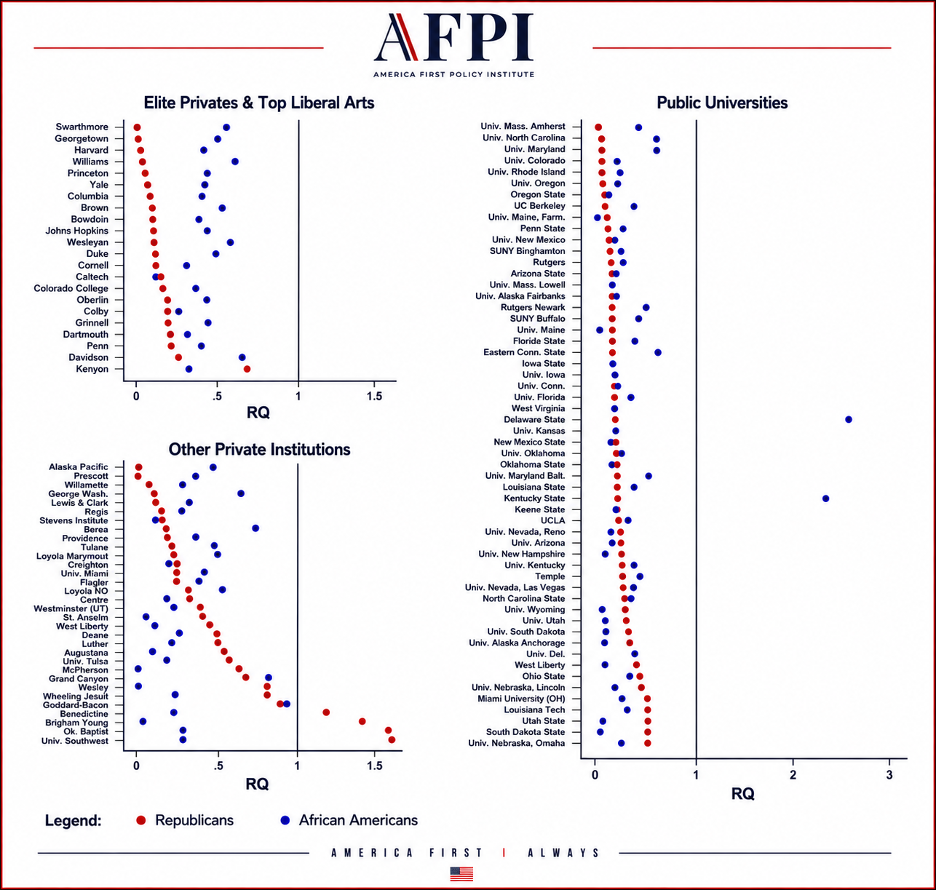
Note. Data from Homogenous: The Political Affiliations of Elite Liberal Arts College Faculty, Academic Questions, 2018 (https://prod.nas.org/academic-questions/31/2/homogenous_the_political_affiliations_of_elite _liberal_arts_college_faculty); National Center for Education Statistics, Integrated Postsecondary Education Data System (IPEDS) [Data set], U.S. Department of Education, 2024 (https://nces.ed.gov/ipeds/); U.S. Party Preferences Steady During Trump Era, Gallup, 2020 (https://news.gallup.com/poll/274694/party-preferences-steady-during-trump-era.aspx); Black Alone, Percent, U.S. Census, 2025 (https://www.census.gov/quickfacts/fact/table/US/RHI225222), and author’s calculations.
Appendix C. Methods for collecting Diversity Statements
Column 3 of Table 2 was filled in consulting 340 faculty job postings obtained via a web scrape from August 12 to December 6, 2024. These data were generously made available to the author by Arnold et al. (2025a). Duplicate and non-academic job postings were excluded.
In line with Paul and Maranto (2021), job postings were screened for DEI-associated keywords along with references to diversity statement prompts. Those keywords were: “divers*,” “equit,*” “inclus,*” “social justice,” “underrepresented,” “anti-racism,” “intersect,*” and “minorit*.” Partial words were used to allow for searches to hit on multiple terms—for example, a search for “inclus*” could identify terms like “inclusive,” “inclusivity,” and “inclusion.”
After searching faculty job postings for diversity statement prompts and keywords, the author manually reviewed all flagged postings to prevent miscoding. This resulted in statements like the following not being counted towards a job posting being coded as containing a diversity statement:
We invite applications from scholars with outstanding potential, working at the intersections of music and history, who will complement the specializations of current Harvard music faculty, and whose interests cross disciplinary and methodological boundaries. (Harvard University, 2024a)
Applicants should have a well-established record of exceptional teaching and research. Women and members of underrepresented groups are strongly encouraged to apply. Ph.D. in mathematics or related field. Documents requested to apply for this position: Resume/CV Cover Letter Statement of Research Interest Bibliography/Publications List Statement of Teaching Interest. (Princeton University, 2025)
In the first example, the keyword “intersection” refers to academic disciplines rather than to dimensions of alleged social marginalization. In the second example, the keyword “underrepresented” is used in the context of soliciting applications; however, the prompt does not appear to suggest that successful applicants should address this goal in some way.
Along similar lines, “equal opportunity” statements like following, were not counted as diversity statements:
We are an equal opportunity employer and all qualified applicants will receive consideration for employment without regard to race, color, religion, sex, national origin, disability status, protected veteran status, gender identity, sexual orientation, pregnancy and pregnancy-related conditions or other characteristic protected by law. (Harvard University, 2024b)
APPENDIX D. DIVERSITY STATEMENTS AT SELECT UNIVERSITIES: 2024
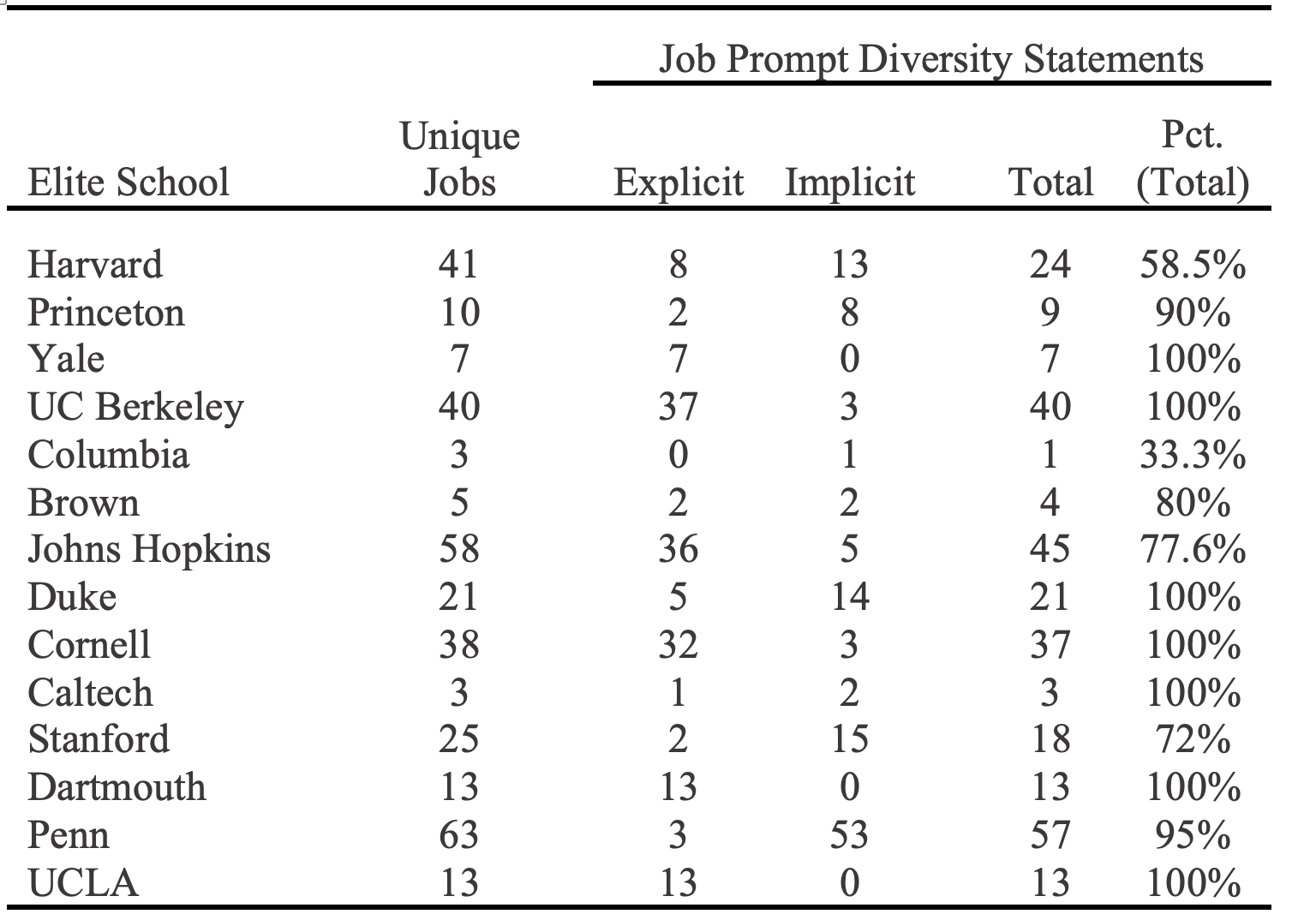
Note. Data from What’s Going on with DEI Statements in Faculty Hiring? Analysis of Faculty Job Ads from Fall 2024, Heterodox Academy, 2025 (https://heterodoxacademy.org/reports/whats-going-on-with-dei-statements-in-faculty-hiring-analysis-of-faculty-job-ads-from-fall-2024/) and author’s own calculations.
Appendix E. Estimates of Diversity Statement Prompts in Faculty Job Postings
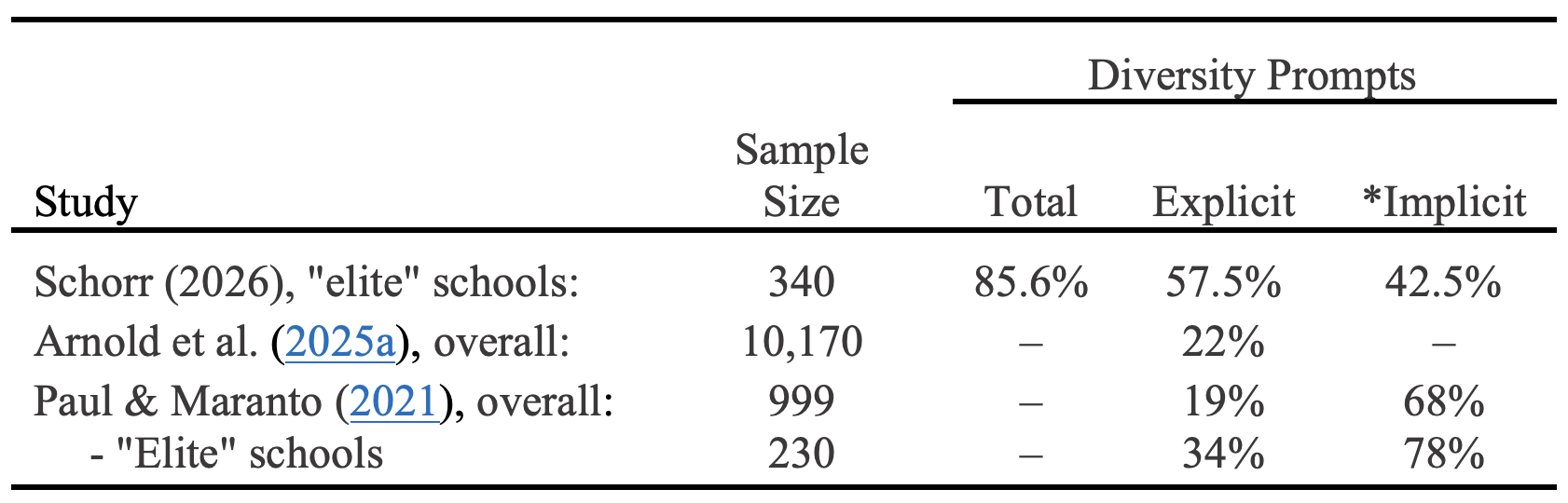
Note. Data from What’s Going on with DEI Statements in Faculty Hiring? Analysis of Faculty Job Ads from Fall 2024, Heterodox Academy, 2025 (https://heterodoxacademy.org/reports/whats-going-on-with-dei-statements-in-faculty-hiring-analysis-of-faculty-job-ads-from-fall-2024/); Other Than Merit: The Prevalence of Diversity, Equity, and Inclusion Statements in University Hiring. American Enterprise Institute, 2021 (https://www.aei.org/wp-content/uploads/2021/11/Other-than-merit-The-prevalence-of-diversity-equity-and-inclusion-statements-in-university-hiring.pdf), and author’s own calculations.
[1] Conservatives are not the sole targets of viewpoint discrimination in higher education—for example, Kaufmann (2021) finds evidence of discrimination against gender critical feminist faculty (e.g., feminist opponents of transgender inclusion in women's sports). However, such discrimination is still plainly directed against views associated with “conservatives” or “the right.”
[2] See Dewey (1916), Gutmann (1987), and Nussbaum (2010) for additional support for the premise that higher education benefits the public by promoting civic equality and equal citizenship.
[3] Inbar and Lammers (2012) operationalize discrimination as a respondents’ willingness to penalize colleagues for their conservative views in reviewing job and grant applications, papers, and excluding colleagues from presenting their work (Inbar & Lammers, 2012, p.11). Other research uses this same approach (e.g., Kauffman, 2021; Honeycutt & Freberg, 2017).
[4] Conservative faculty appear to discriminate less often against their liberal peers than vice versa (e.g., Honeycutt, 2022; Peters et al., 2020). In some cases, conservatives show comparable or even slightly higher willingness to discriminate on individual items (Honeycutt & Freberg, 2017; Kaufmann, 2021); however, given their near-negligible presence in higher education, viewpoint discrimination overwhelmingly penalizes conservatives.
[5] Kaufmann (2021) uses a list experiment approach to circumvent social desirability bias whereas most studies employ convenience samples (e.g., Inbar & Lammers, 2012; Honeycutt & Freberg, 2017).
[6] These estimates are taken from conservative (6%) and moderate (9%) as well as liberal (85%) faculty. As such, they are best taken at face value—as subjective, faculty-wide assessments of biases against conservatives—rather than as capturing liberal faculty’s revealed biases.
[7] The National Association of Scholars maintains a “cancellation” database tracking American and Canadian academics who have been subjected to demands for censure, suspension, firing, various punitive (e.g., “sensitivity” or “implicit bias”) trainings, and other retaliation in response to their work or publicly or privately stated views (Acevedo, 2020).
[8] Respondents are asked whether they would support efforts by students or the administration to remove a faculty member whose research showed: 1) “greater ethnic diversity leads to increased societal tension and poorer social outcomes,” 2) “the British empire did more good than harm,” 3) “children do better when brought up by two biological parents than by single or adoptive parents,” or 4) “a higher share of women and ethnic minorities in organizations correlates with reduced organizational performance” (Kaufmann, 2021).
[9] FIRE finds mixed support for diversity statements among faculty. For example, half of faculty (50%) regard diversity statements as “ideological litmus test(s) that violat(e) academic freedom” (Honeycutt et al. 2023). Half of faculty also describe requiring DEI statements for employment (50%) and promotion or tenure (52%) as “rarely” or “never” justified (Honeycutt, 2024).
[10] By way of analogy, the notion of “systemic racism” unites interpersonal and institutional racial discrimination within a broader self-reinforcing social system (Feagin, 2013).
[11] See: Knight Foundation and Ipsos (2024), Grady and Lewis (2024), Welding (2024). Stevens (2023), Honeycutt (2022), and Schorr (2025).
[12] The conservative share of cancelled events was nearly as high as the progressive share (183 vs 195) during this period; however, the kinds of events targeted differed in important respects. For example, a major contributor to conservative cancellation attempts during this period involved a single national organization—The Cardinal Nauman Society—resisting an 18-year annual campaign to host the Vagina Monologues at private, Catholic colleges (Schorr, 2025).
[13] Honeycutt (2025) reports results from a 2022 survey asking faculty members to rate how well they feel described by the labels “political activist,” “radical,” “Marxist” and “socialist,” using a 7-point scale. Comparing his findings to a similar 2006 survey by Gross and Simmons (2014), Honeycutt (2025) finds the proportion of respondents reporting at least a 4 increased substantially for the labels “political activist,” “radical,” and “Marxist” (Gross and Simmons [2014] did not include the label “socialist” in their survey). However, Honeycut (2025) notes that results for the term “political activist” and “radical” are not perfectly comparable insofar as Gross and Simmons (2014) excludes non-“liberal”-identifying respondents from their totals whereas Honeycutt (2025) does not.
[14] Party registration is a useful, if imperfect, proxy for political ideology. Both measures are highly (and increasingly) correlated in survey data (Abramowitz & Saunders, 1998; Saad, 2019). Likewise, political contributions are highly predictive of ideology, and both registration and (especially) contributions additionally speak more to revealed (vs. asserted) preferences (Bonica, 2014). The intention of including this data here is not to advocate for greater representation of one party affiliation over another but rather to refer to an empirical data set that is widely used in the academic literature on this topic to help illustrate the paper’s arguments.
[15] Langbert and Stevens (2020) match party registration data from 2019 to FEC donations data from the 2016 and 2018 election cycles. They limit their survey to 20 professors per department across each of the following: biology, chemistry, mathematics, anthropology, economics, sociology, psychology, English, and philosophy. Though broad (n=12,372), this sample does not comprehensively measure faculty partisan registration across the surveyed institutions.
[16] Figure 3 depicts the proportion of registered Republican and Democratic faculty divided by the two-party vote share, excluding independent, non-registered, and third-party registered faculty. For a similar figure including those totals, see Rozado (2024b).
[17] An important aside is that the absent of arrests could indicate a university’s unwillingness to enforce rules rather than an absence in rule breaking.
[18] The numerator, 124, is taken from encampment protest lists compiled by the Chronicle of Higher Education and Best Colleges (Culter and Taylor, 2024; Bryant and Attridge, 2024). The denominator, 2,518, is taken from a search of the National Center for Education Statistics’ (NCES) Integrated Postsecondary Education Data System (IPEDS) dataset (NCES, N.d.). It could be argued that the 5% (technically, 4.9%) estimate understates the magnitude of encampment protests and thus overstates their association with “elite” universities. The fact that several large public universities hosted encampments means that the proportion of overall students attending encampment-hosting universities was considerably larger than 5%. At the same time, the duration of many encampments was short (e.g., 1–3 days) and the schools listed in Table 2 hosted encampments for longer durations, on average (5-14 days, Bryant and Attridge, 2024).
[19] This job posting provides an example of an unsubtle yet implicit diversity statement prompt. Following the quoted section, the posting reiterates the same themes, referencing “belonging,” “the rich diversity of our… backgrounds,” the importance of ensuring “all members of the community feel secure and welcome, that the contributions of all individuals are respected, and that all voices are heard,” and emphasizing “(a)ll members of our community have a responsibility to uphold these values.” It then asks applicants to provide a cover letter, a curriculum vitae, three sample(s) of written works, and, in bolded text, “anything else requested in the position description.”
[20] Paul and Maranto (2021) examine job postings for 1. diversity statements and 2. references to “diversity,” as determined by a keyword search for the fragment “divers*.” As described in Appendix C., this report utilizes a broader list of search terms. Additionally, Paul and Maranto (2021) estimate 1 and 2 separately for their entire sample as well as for a subset of “elite” schools, defined as schools placed within “the top 100 of the 2020 US News & World Report ‘Best National Colleges’ or ‘Best Liberal Arts Colleges’” (Ibid, 3). This is a broader definition of “elite” than the one employed here.
[21] FIRE’s free speech scores/rankings also include points for policies (e.g., “Chicago Statements” and institutional neutrality); however, student climate assessments appear to dominate the scoring metric (FIRE, 2026c)
[22] Others argue universities are not adequately implementing the needed reforms yet they nonetheless oppose federal intervention (George and West, 2025; FIRE, 2025).
[23] For example, in a podcast interview with Heterodox Institution President John Tomasi, Wesleyan University President Michael Roth concedes that conservatives underrepresentation in higher education is “a real problem…because of the commitment our professors have to their own biases and that our admissions staff have to their biases, and [that] our student life staff have to their biases” (Tomasi, 2025b, @20:24 minutes). Later, in the same interview, Roth describes the Trump Administration’s higher education reform “playbook” as “right out… authoritarianism 101” (Ibid, @53.57 minutes).
[24] One can add a third objection: that quotas for conservative faculty, are impractical insofar as they disincentivize “token” conservative faculty from thoughtfully engaging with issues, lest their views change and they lose their protected spots (Morton, 2025). Setting aside the merits of this critique in the case of affirmative action-style reforms, it would seem to take hiring, promotion, grant review and other discrimination as a given and instead address the consequences of that discrimination (viewpoint homogeneity) rather than the discrimination itself.
[25] Banishing conservatives from academia can distort faculty and student perceptions, causing mainstream conservative and other positions to appear “fringe.” For example, in a recent essay defending the exclusion of conservatives from higher education, the (left-leaning) author places “scare quotes” around the term “real, biological women” and adds, “I’m not making this up, it’s the very language of the January 20 executive order, “Defending Women from Gender Ideology Extremism and Restoring Biological Truth to the Federal Government” (Scott, 2025). The author’s apparent incredulity is belied by polls suggesting 69% of Americans oppose allowing males to compete in female sports (Brenan, 2025b).
[26] It is unclear how deep the well of otherwise well-qualified Nazi sympathizing faculty may be; however, it is worth recalling the proportion of faculty describing their own views as “socialists” (26%), “radicals” (17.3%), and “Marxists” (8%, Honeycutt, 2025). Communist regimes—derived from Marxism, identifying as “socialist,” and “radical” by any definition—killed perhaps four times as many people as fascist regimes during the 20th Century (Courtois, 1999).
[27] Likewise, Paulsen’s (2014) argues intellectual (i.e., viewpoint) diversity is properly regarded as a secondary instrumental value—useful insofar as it aids in the pursuit of truth.
[28] Since January 20, 2025, the Department of Education, Section 117 (foreign gift and contract disclosure) investigations of Harvard University, the University of Pennsylvania, the University of Michigan, and the University of California, Berkely (U.S. Department of Education, 2026). A 2019–2021 investigation of 19 universities uncovered $6.5 billion in previously unreported funding (The White House, 2025).
[29] According to recent estimates, 265,919 students from the People’s Republic of China (PRC) were enrolled in U.S. universities during the 2025/2025 academic year, of which over half (51.9%) pursued degrees in science, technology, engineering, and math (Institute of International Education, 2026). Recent reports detail espionage and attempted agroterrorism incidents by Chinese nationals at U.S. universities, as well as efforts by PRC intelligence to coerce Chinese students studying in the U.S. (Boyer, 2025; U.S. Department of Justice, 2025). Efforts to restrict student enrollment from rival nations and address security concerns have both faced resistance from universities (Association of American Universities [AAU], 2025a; AAU, 2025b).
[30] Under the law’s ‘Do No Harm’ provision, bachelor’s degree programs that fail—over two out of three consecutive years—to produce graduates whose average earnings exceed those of high school graduates in the same state lose access to federal grant and loan funding. Master’s degree programs are held to a similar standard, requiring that graduates’ average earnings exceed those of bachelor’s degree holders in the same field and state (AFPI, 2025).
[31] For example, during the Charge of the Light Brigade in the Crimean War, misunderstood (yet obeyed) orders resulted in a catastrophic cavalry charge. During the First World War, failed offensives (e.g., the Battle of the Somme) proved disastrous in part due to rigid operational plans and limited tactical flexibility at lower levels of command (Keegan, 1993; van Creveld, 1985). More broadly, military historians have contrasted rigid, centralized command systems with more decentralized models of authority. During the Second World War, Germany’s rapid defeat of France is often cited as illustrating the advantages of a more decentralized command approach (Lind, 1985; Citino, 2004).
Resources