AI and the Labor Market: American Workers Are Winning the AI Era
Key Takeaways
« Americans fear the possible future impact of AI on their wages and employment, especially as many technology leaders prophesy an uncertain job market. It is an America First priority to ensure that hard-working Americans can support themselves and their families through work.
« We find that AI has not had any negative impact on wages or net employment. The evidence suggests that: the AI buildout is creating many American jobs; the AI buildout is not merely a short-term boost for jobs; predictions of AI-driven unemployment have not materialized; If AI has had any effect on net employment, it is likely positive; hard-to-measure effects may increase the positive economic impact of AI for workers.
« In accordance with these findings, we recommend that the Department of Labor improve its AI workforce tracking and that Congress provide for DOL to improve its AI and labor readiness.
Introduction
Claims of an impending jobs catastrophe fill chyrons and headlines across the country. A narrative exists among some tech leaders that AI could wipe out half of all entry-level white-collar jobs and “spike unemployment to 10-20% in the next one to five years” (VandeHei & Allen, 2025). In February 2026, panic set in for some after tech CEO Jack Dorsey laid off nearly half (4,000) of his employees, which he attributed to productivity gains from AI (Angelo, 2026).
Many Americans share these concerns. A 2025 Reuters/Ipsos poll of over 4,000 Americans found that 71% “fear AI causing permanent job loss” (Lange & Alper, 2025). A March 2026 Quinnipiac poll found that 70% of Americans believe AI is “likely to lead to a decrease in the number of job opportunities for people,” with the most pessimistic outlook among young people (Quinnipiac, 2026).
Ensuring that hard-working Americans are able to obtain a job to support themself and their family is one of the most important priorities for the America First agenda. This has motivated the second Trump Administration’s economic agenda, which includes priorities such as domestic reshoring, tariffs, and negotiated foreign investments. Concerns about the impact of AI on jobs come against a backdrop of incredible technological progress, unlocked by the pro-innovation policies of the Trump Administration, which are driving American growth, excellence, and global AI dominance.
Despite this success, many Americans, who depend on the security of their jobs to support families and sustain the communities that form our country, understandably fear whether they will be left behind by this tide of change. According to polling across 32 countries, the U.S. was one of the most pessimistic about AI’s impact on their job market and economy (Ipsos, 2026).
It is difficult to predict the future. But we are now far enough into the AI revolution, sparked by the release of ChatGPT more than three years ago, that we can analyze the past and present. Thus, this issue brief seeks to answer the following question: What has been the impact of AI on employment in America?
The results of the studies suggest one key finding: there is no evidence that AI has been responsible for a negative impact on wages or net employment. We demonstrate this through five facts supported by quantitative evidence:
- The AI buildout is creating American jobs, especially blue-collar jobs.
- The AI buildout is not merely a short-term boost for jobs.
- Predictions of AI-driven unemployment have not materialized in the data.
- If AI has had any effect on net employment, it is likely positive.
- Hard-to-measure effects may increase the positive economic impact of AI for workers.
However, the empirical realities of today do not necessarily safeguard employment in the future. As such, the U.S. government should take reasonable actions that will ensure a well-informed, rapid response to possible future impacts on the labor market. We recommend that:
- The Department of Labor (DOL) improve its tracking of AI’s impact on the labor market through updated surveys, partnerships with non-governmental data sources, and requiring large firms and government agencies to report AI employment and wage impacts.
- Congress pass legislation requiring reporting of large-scale workforce disruption due to AI and provide for DOL to build AI readiness through hiring and agility.
What the Evidence Shows Today
Whether AI will cause rising unemployment or declining wages in the future is difficult to predict, hence the widespread disagreement among experts. What we can do is look at the labor market impacts of AI today. Doing so leads us to one key conclusion: there is no evidence that AI has had a negative impact on wages or net employment. Instead, the evidence demonstrates the following five takeaways:
(1) The AI buildout is creating American jobs, especially blue-collar jobs. The AI infrastructure buildout in energy and data centers is of an unbelievable scale. A December 2025 Federal Reserve project-level forecast predicted American data center investment would reach a $370 billion annualized rate of expenditure by Q2 2026 (Brandsaas et al., 2025). According to more recent reports, the four largest data center providers alone (Google, Amazon, Microsoft, and Meta) are expected to commit roughly $725 billion in capital expenditures in 2026 (James, 2026). According to a June 2026 analysis by Epoch AI, the AI data center boom alone, not accounting for associated energy infrastructure, has doubled the share of U.S. GDP attributable to computing infrastructure since 2023, now accounting for 1.5% of GDP (Juniewicz, 2026).
This nationwide build-out, which has been enabled by President Trump’s pro-growth and pro-innovation policies, is a boon for blue-collar workers. In the most recent Bureau of Labor Statistics state and county data, for example, Loudon County, Virginia (the American county with the most data centers) posted the largest year-over-year employment gain of any Virginia county (2.9%), nearly twice the second-highest growth (BLS, 2026a). Data centers have been described as a “gold rush” for construction workers, who are often earning 25-30% higher salaries due to AI investment (Chen, 2025; Paoli, 2025). The Information Technology & Innovation Foundation reports that the AI boom generated over 110,000 construction jobs in 2024—when investment was far lower than in 2026 (Ostertag, 2025). The buildout is creating such a surplus of jobs in the trades that data center operator Meta created its own “fiber optics academy” to train thousands of data center technicians (Meta, 2026).
(2) The AI buildout is not merely a short-term boost for jobs. Some contest that, though the AI boom creates jobs in the short-term, those jobs are temporary and disappear once construction is over. As a result, they argue we should recognize that these gains are temporary and should thus moderate our enthusiasm. But this position goes too far. Although the contention that data center construction produces a high-intensity job-creation period is correct, there are two reasons why job creation isn’t limited to the short-term. . First, McKinsey estimates that each data center industry job created leads to an additional 3.5 jobs created in the surrounding economy (Barth et al., 2025). Those jobs last. Second, the buildout is ongoing, which means that data centers are being constructed all the time. Each new data center’s jobs are temporary, but many new data centers are being constructed all the time. McKinsey estimates that global spending on data centers could reach $7 trillion by 2030, much of which will be in the United States (McKinsey, 2026). Even in especially pessimistic growth scenarios, the Federal Reserve forecasts strong data center investment until at least the end of 2027 (Brandsaas et al., 2025). Estimates based on the production of chips and AI scaling suggest that investment will likely continue to grow at an exponential rate through at least 2030 (Epoch AI, 2025). Therefore, the jobs boom associated with the AI boom will continue, and, in all likelihood, will increase, through the end of the decade—creating lasting jobs and careers.
(3) Predictions of AI-driven unemployment have not materialized in the data. To date, there is no evidence that AI is increasing unemployment rates, even in the most AI-exposed occupations (defined as the occupations whose day-to-day the researchers consider most susceptible to AI automation). There is some evidence that in the most AI-exposed occupations, the youngest cohort of workers may be experiencing some decline in employment. However, it is unclear whether AI has played a role in this phenomenon. Several research studies (which we describe here) support these conclusions.
In March 2026, economists Massenkoff and McCrory wrote Labor Market Impacts of AI: A New Measure and Early Evidence (2026). To assess AI’s potential impact on jobs, they assign categories of occupations and assign them a rating in terms of how exposed their day-to-day tasks are to AI automation. They then create two baskets of occupations: the 25% with the highest exposure (e.g., computer programmers, customer service representatives, and medical record specialists) and the 30% with the lowest exposure, which was zero (e.g., motorcycle mechanics, cooks, and lifeguards). Comparing the two groups via Current Population Survey data, the authors find “[t]he average change in the [employment] gap since the release of ChatGPT is small and insignificant, suggesting that the unemployment rate of the most exposed group has increased slightly but the effect is indistinguishable from zero.” In other words, jobs that can be automated by AI have not experienced higher levels of unemployment. Figure 1 demonstrates this comparison from 2016 to 2025, which shows no discontinuity before and after the ChatGPT release.
Figure 1
Trends in Unemployment Rate for Workers with High AI Exposure and No AI Exposure
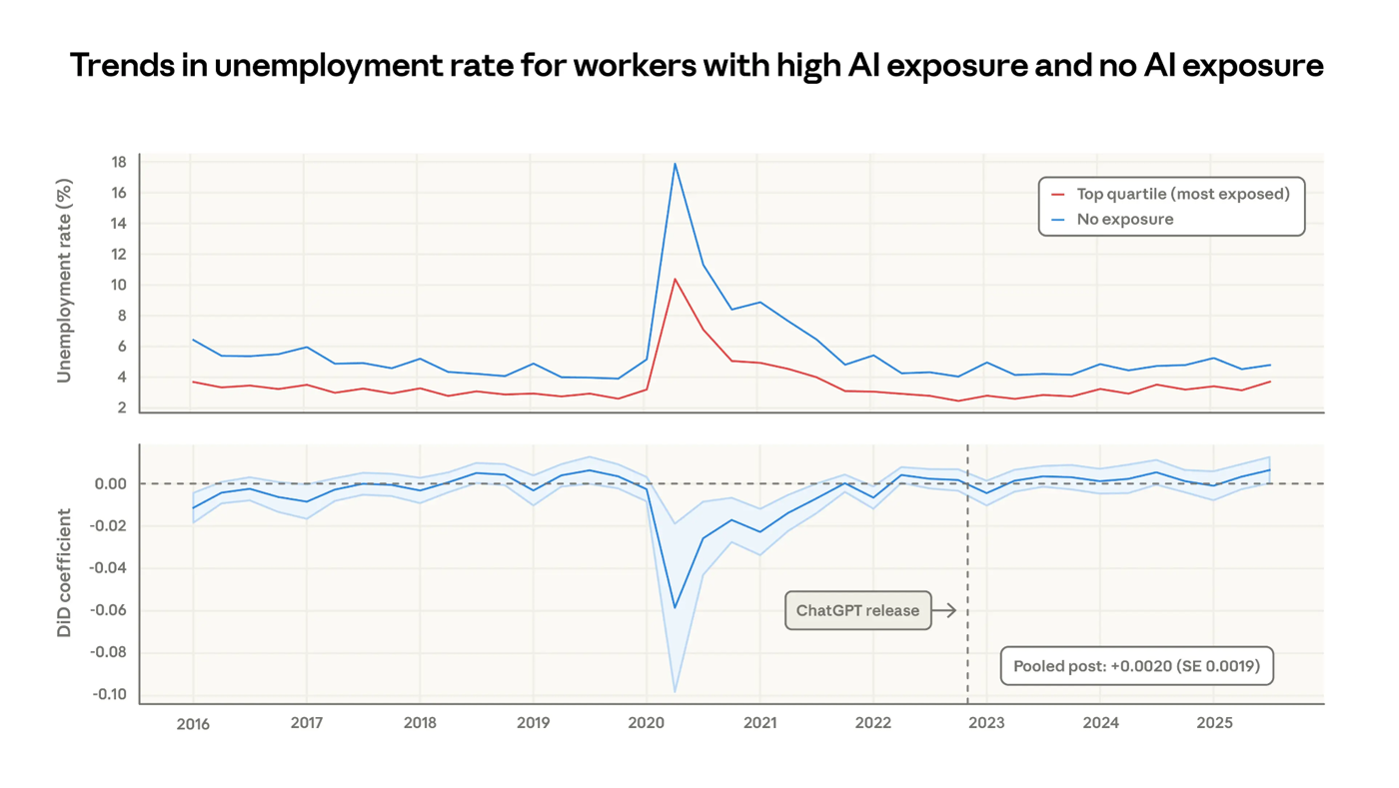
Note. “The top panel shows the unemployment rate for workers in the top quartile of exposure (red line) and the 30% of workers with zero exposure. The bottom panel measures the gap between these two series in a difference-in-differences framework.” From Massenkoff and McCrory, Labor Market Impacts of AI: A New Measure and Early Evidence, 2026.
A June 2026 analysis by the Yale Budget Lab corroborates these findings using a similar methodology and by assessing evidence from other metrics (YBL, 2026). It considers first whether Americans are switching occupations faster than before. This would support the hypothesis that individuals are losing jobs at a higher rate due to AI, but then finding new, possibly less attractive jobs before they show up in unemployment data. It also considers whether those individuals who do show up in unemployment data disproportionately come from high-AI-exposure occupations. It concludes that:
The Budget Lab's labor market analysis, updated to incorporate May 2026 CPS microdata, does not provide clear evidence of labor market disruption associated with AI. Churn across occupations, AI exposure among the unemployed, and comparisons of AI-exposed and unexposed workers all remain flat, lie within historical ranges, or continue along pre-AI trends.
One paper that appears to challenge this conclusion is Brynjolfsson et al.’s (2025) Canaries in the Coal Mine? Six Facts about the Recent Employment Effects of Artificial Intelligence, but its data do not support the interpretation the authors suggest. This work claims that the hiring of early-career software engineers has significantly declined since ChatGPT’s release. They do so by reporting the headcount of software engineers (SWEs), separated by age group, using payroll data covering 25 million workers. From this data, they observe that there was a sharp downturn in headcount of 22- to 25-year-old SWEs after late 2022 (Figure 2, left). However, this causal inference they make does not hold up to scrutiny. First of all, the authors also acknowledge but fail to highlight that without breaking the data down by age the headcount trend is fully constant. Second, consider the hypothesis being proposed. The argument is that there is a negative demand shock for entry-level SWEs due to AI automation.
Basic economics tells us that, in such a case, we would expect the wage level and employment level of SWEs to decrease as a result. However, Brynjolfsson et al. show the opposite: the wages for entry-level SWEs have actually increased faster than for other SWEs (Figure 2, right). This is more consistent with a negative supply-side shock, in which the quantity of SWEs in the data set decreases and wages increase. This could be, for example, because younger people in the data set are moving on to other jobs as AI opportunity expands and therefore employers must offer larger wages to retain them (Deming, 2026).
These results are further corroborated by an analysis by the Federal Reserve Bank of New York, which finds that there is “no clear divergence in labor demand between junior and senior positions in occupations with high AI exposure” (Audoly et al., 2026).
Figure 2
Software Developer Headcount and Wages in the Brynjolfsson et al. Data Set, by Seniority
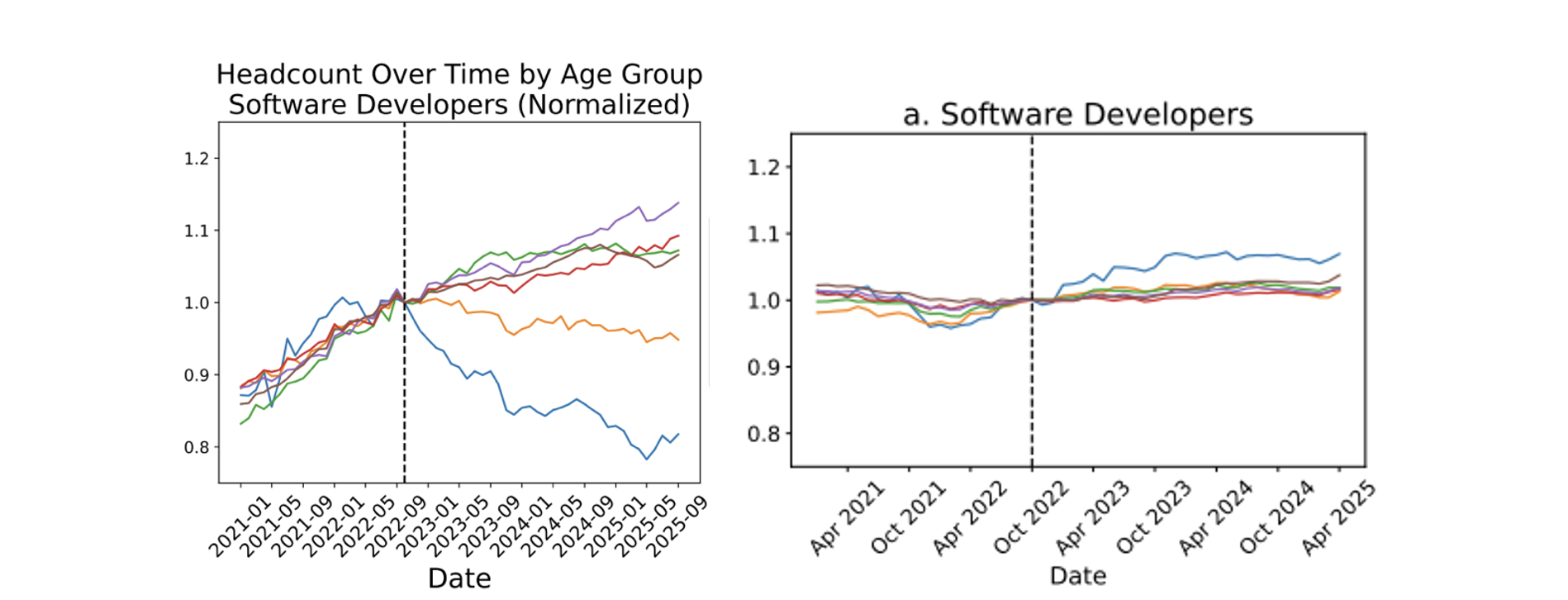
Note. Headcount (left) and wages (right) of software developers in the Brynjolfsson et al. data set over time. Each colored line represents a different seniority level; blue represents the entry level (22-25 years old). Brynjolfsson et al., Canaries in the Coal Mine?, 2025.
Additionally, the March 2026 paper Still Waters, Rapid Currents: Early Labor Market Transformation under Generative AI, replies to Brynjolfsson et al., showing that declines in employment are not driven by firms adopting AI chatbots (Humlum & Vestergaard, 2026). They use a difference-in-differences analysis that compares employment trends “by whether firms have actually adopted generative AI.” The authors write that their “estimates are sufficiently precise to rule out even modest changes.”
(4) If AI has had any effect on net employment, it is likely positive. As we showed above, no robust research has found a connection between AI and declining employment. However, some research has found possible evidence of a connection between AI and increasing employment.
First, a February 2026 analysis by Citadel Securities finds that internet job postings for SWEs have grown far faster than overall job postings since mid-2025 (Flight, 2026). Figure 3 shows this effect. This suggests that recent advances in AI have increased the demand for SWEs as more companies develop and adopt AI products.
Second, a December 2024 analysis of AI adoption and employment effects found no effect on employment or job openings but did find a small positive wage effect for AI-exposed jobs (Hartley et al., 2024).
Figure 3
Job Postings for Software Engineers Versus Overall from Jan 2024 to Jan 2026
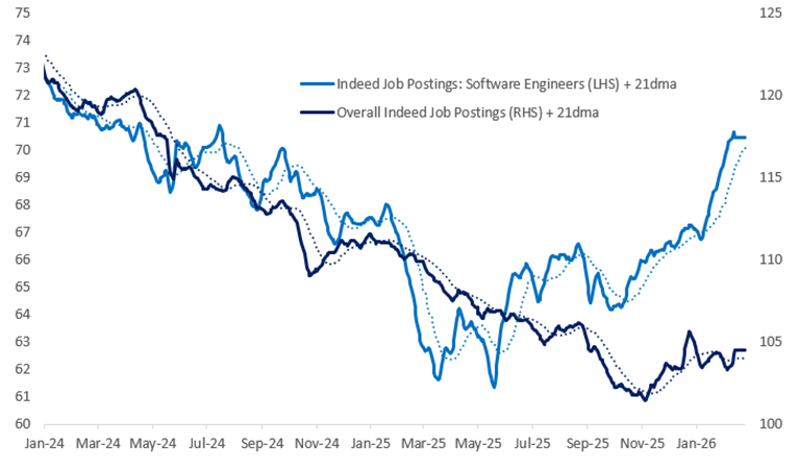
Note. Job postings for software engineers have outgrown overall job postings since mid-2025. Flight, The 2026 Global Intelligence Crisis, 2026.
Finally, economists at the finance platform Ramp published a landmark paper in June 2026 that studied bill pay data from over 21,000 U.S. firms. This paper, A New Look at AI’s Impact on Jobs, found that “companies that adopt AI tend to grow faster following adoption” (Kharazian et al., 2026). In its data set, “entry-level headcount rises 12% for high-intensity adopters” of AI (Figure 4), and overall headcount grows by 10.2% over the two years following adoption Although the study does not rule out selection bias and other confounding factors, which prevent proof of a causal effect, this lends evidence to the view that AI adoption is not currently replacing, but is instead multiplying, the value of human workers. These impacts were observed across roles, “including engineering, sales, administration, and customer service.”
Figure 4
Entry-Level Headcount Between High- and Low-Adopting Firms in the Kharazian et al. Data Set
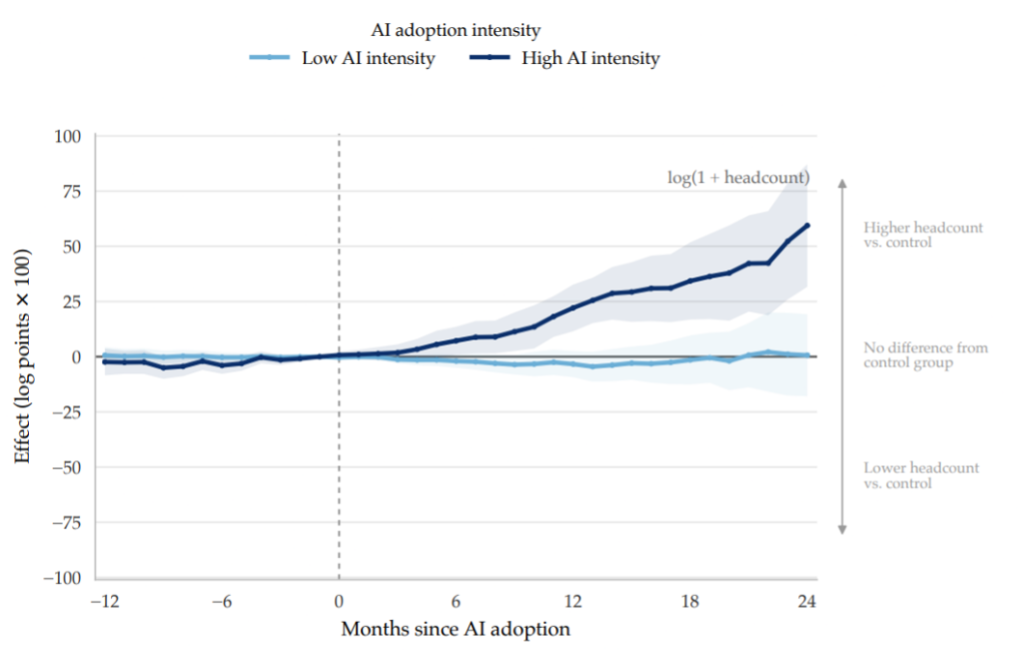
Note. A comparison of headcount for entry-level roles at firms with high versus low levels of AI adoption in the Ramp data set over time relative to the date of AI adoption. Dark blue is high-intensity adoption firms; light blue is low-intensity adoption firms. Kharazian et al., A New Look at AI’s Impact on Jobs, 2026.
(5) Hard-to-measure effects may increase the positive economic impact of AI for workers. Not every workforce impact can be captured by wage and employment metrics. There are several theories that suggest the positive economic impact of AI will benefit workers in other ways.
A large 2025 study by OpenAI and academic researchers titled How People Use ChatGPT found, among other things, that non-work AI usage is increasing faster than work-related usage. According to the authors, this “suggests that the welfare gains from generative AI usage could be substantial” (Chatterji et al., 2025). This would manifest as increased productivity at household tasks, like cooking and purchasing items, as well as in areas like personal medicine. These would be hugely important to Americans but not necessarily appear in wage, employment, or GDP metrics. Another study by Brynjolfsson et al. finds that access to AI tools increases the productivity of customer support agents, with findings that are likely to generalize to other fields as well (Brynjolfsson et al., 2023). This supports the findings of the Chatterji et al. paper and may indicate further gains in areas such as entrepreneurship.
Further, one economic analysis calculates the value of AI to American workers directly: by asking them how much they would need to be paid to relinquish AI access. The average respondent said $98 per month, indicating a $97B surplus of value going to American workers (Collis & Brynjolfsson, 2025). Finally, some authors have written that the adoption of AI agents and other advanced AI systems may increase participation and efficiency in unique ways that will translate to gains for consumers and firms. For example, widespread adoption of AI agents could eliminate the need for regulation in various industries by reducing the indirect costs of transactions and agreements (Shahidi et al., 2025).
Policy Recommendations
The U.S. government should take reasonable action to protect the safety of work into the future, no matter what trajectory AI takes. Two recommendations follow from this:
- The Department of Labor (DOL) should improve its tracking of AI’s impact on the labor market. DOL currently has limited visibility into these impacts. In March 2026, a bipartisan group of nine senators wrote a letter identifying gaps in current tracking of “how AI is impacting workers.” They identified that “the federal government’s statistical agencies’ data, research, and measurement on artificial intelligence significantly lags behind non-governmental labor market data” (Warner et al., 2026). Relevant surveys include the Current Population Survey, Job Openings and Labor Turnover Survey, and National Longitudinal Survey to include more targeted questions related to AI and its impact on wages and hiring. These surveys are among the main sources of occupation-level data, but survey only tens of thousands of households per month, which is insufficient for statistically significant analysis of specific occupational categories. Further, their response rates have consistently fallen over time (BLS, 2026b). Updates and new data sources are sorely needed. DOL should update these surveys to include questions specifically related to AI and that track jobs separated by how AI-exposed they are, and should increase their sample sizes to measure AI effects. In so doing, the Trump Administration should take care not to repeat the mistakes of the Obama Administration, which created an initiative to track “green jobs” that ultimately failed due to the difficulty of defining such jobs (BLS, 2013; Carrington, 2015). The Federal Reserve has begun to advance this goal of better AI-related workforce tracking through its new task forces on Data and Productivity and Jobs, which will “assess the economic impact of new general-purpose technologies, including artificial intelligence” (Federal Reserve, 2026).
Given the advantage of private-sector data, as demonstrated by several of the research papers surveyed in this piece, the Department of Labor should partner with jobs-related firms and major payroll processors to provide the government with real-time signals on AI’s labor market impacts. This partnership should provide:
- Aggregated and de-identified data that protects individual and firm privacy;
- Timely, occupation-level employment and hiring reads, published monthly;
- Series built to interoperate with existing BLS measures, so the public can scrutinize the reasons companies claim to change their workforce; and
- Grants to expand analysis of AI as a source or driver of labor market trends.
- Congress should consider requiring firms with more than 500 employees and employers within the U.S. government to report changes in wages and employment levels associated with AI when they occur. This would boost awareness of labor market impacts and allow the U.S. government to respond more quickly in the case of substantial impacts. Congress could also improve DOL’s ability to understand changes from AI by providing for it to hire AI experts through flexible hiring mechanisms including the Intergovernmental Personnel Act, Direct-Hire Authority, and a new statutory provision allowing the Secretary of Labor to hire several AI experts throughout the Department without regard to existing hiring regulations. Any such action on these considerations should include a five-year sunset.
Conclusion
Despite fearmongering by technological leaders, which has led to widespread worry among the American public, the evidence clearly shows that AI has not had a negative impact on U.S. wages or net employment levels. We find, in fact, that any net impact to date has likely been positive, even without accounting for the huge increases in employment and wages for blue-collar jobs associated with the AI infrastructure boom. Nonetheless, the America First position must be to tread carefully, tracking the impact of AI on the labor market more closely over the next several years to ensure that hard-working Americans can support themselves, their families, and their children for generations to come.
Resources