The Data Center Water Use Hoax
Key Takeaways
The mainstream media and several lawmakers have claimed that AI infrastructure uses large amounts of water and will raise household water costs.
These claims are false. In truth, the total water use of all U.S. data centers constitutes less than 0.5% of American freshwater use and there is not a single instance of AI infrastructure raising water prices anywhere in America.
AI data centers are a boon for the country, driving economic growth, job creation, and national power.
Introduction
Several major news outlets and lawmakers have claimed that artificial intelligence (AI) infrastructure poses a threat to Americans’ water access. The New York Times, Bloomberg, and Forbes have each run politicized stories portraying AI data centers negatively because they “consume immense amounts of water.” Four Democratic senators and Senator Bernie Sanders wrote a letter to administration officials opining on the evils of data centers, in part due to their “increasing burdens on water supplies.”
It is true that the explosion in popularity and capability of AI technology sparked by the release of OpenAI’s ChatGPT in 2022 has led to immense growth in the number and size of U.S. data centers. Projections estimate that the total power use of AI data centers, a proxy for scale, will exceed the total power capacity of California before the decade is out.
Further, the largest single data center campuses may continue to grow exponentially to meet the demand for ever more powerful AI models. Today’s largest single site, in New Carlisle, already consumes nearly as much power as the city of San Diego.
However, the claims about water made by these news outlets and lawmakers are false. In fact, AI data centers use very little water. To take just one data point, training the largest AI model to date (Grok 4) consumed
less water than what a single square mile of farmland consumes in one year. It was trained for multiple months on what was, at the time, the world’s largest AI data center (Colossus I).
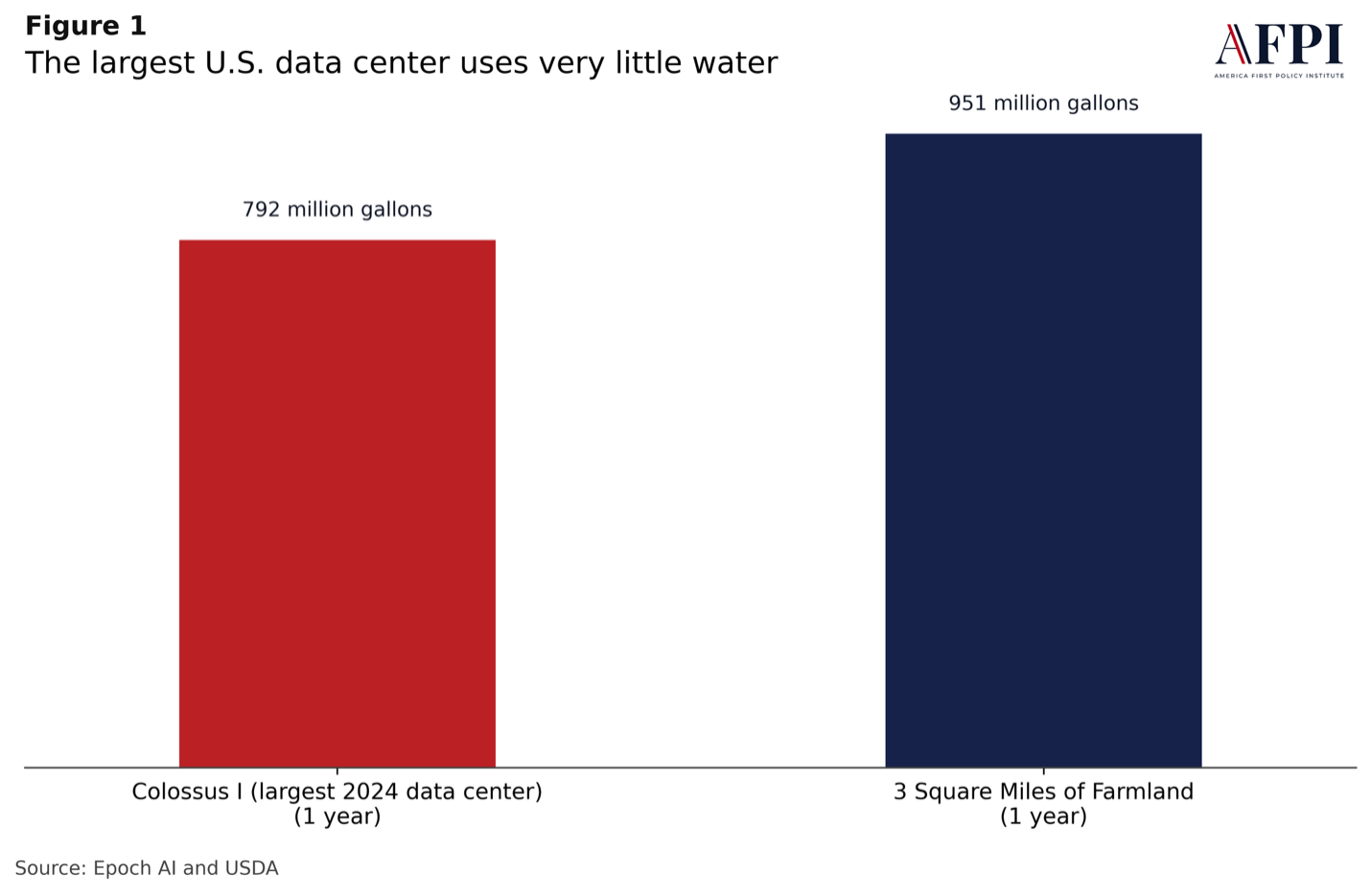
2024 Annual Water Consumption by the Largest U.S. Data Center, Colossus I
Note. The world’s largest AI data center in 2024 (Colossus I) used less water in a year than three square miles of farmland. The United States has over 1.3 million square miles of farmland. Data from What did it take to train Grok, Farms and Farmland, and author calculations.
AI data centers are a tremendous boon for the country.
What are Data Centers?
A data center is a facility that operates numerous interconnected computers and stores substantial digital data. AI data centers are distinct because they operate computer chips specifically designed for AI computing, known as Graphics Processing Units (GPUs) or Tensor Processing Units (TPUs). AI data centers house anywhere between dozens and hundreds of thousands of chips.
Data centers are used to power many different types of AI technology. Social media recommendation algorithms are run in huge AI data centers, as are intelligent military systems and frontier AI models like GPT-5. Multiple large data centers can often be located close to each other on what is known as a “campus,” in order to make use of local energy generation resources and to increase the data transfer speed between data centers.
The cutting-edge chips inside these data centers (primarily produced in Taiwan by the Taiwan Semiconductor Manufacturing Company (TSMC)) draw large amounts of power. NVIDIA’s B200 chip, which is currently the most advanced on the market and is used to train the largest current frontier AI models, draws approximately 600 watts per GPU. The infrastructure around chips, like networking and cooling systems, approximately doubles the total power requirements of the data center, meaning that AI data centers draw roughly a kilowatt per operating GPU.
There are three ways in which AI data centers use water resources. First, operators pump water into the facility to cool its chips, which run hot. This water, however, is returned to the municipal water supply and is therefore a “non-consumptive” use not counted in the water footprint. Second, some of the water used during the cooling process evaporates and is lost from the municipal supply. This is the only direct consumptive use of water in a data center. Third, water resources are used in the generation of electricity used to power the data center’s chips and networking equipment. This is indirect, but still consumptive, water use. Water “consumed” to cool and power data centers, though lost from the municipal supply, returns to the natural water system through evaporation.
The True Water Use of Data Centers
News articles that fearmonger about data centers do not understand water use and largely refrain from any quantitative analysis whatsoever. As one expert, Andy Masley, said in response to these claims, “I’ve come to the conclusion that data centers have not raised household water bills at all, anywhere. … Nowhere in the articles… is any evidence provided at all, either.”
For perspective, the United States consumed approximately 132 billion gallons of freshwater per day in the early 2010s, and likely even more today. The total freshwater consumption of all U.S. data centers in 2023 was between 200 and 580 million gallons per day, depending on the methodology used. This implies that all U.S. data centers, even assuming the largest of these estimates, account for less than 0.5% of America’s freshwater use—hardly a crisis.
Indeed, the U.S. annually loses over three trillion gallons of drinking water due to leaky pipes. That is over 15 times as much water as all U.S. data centers use each year.
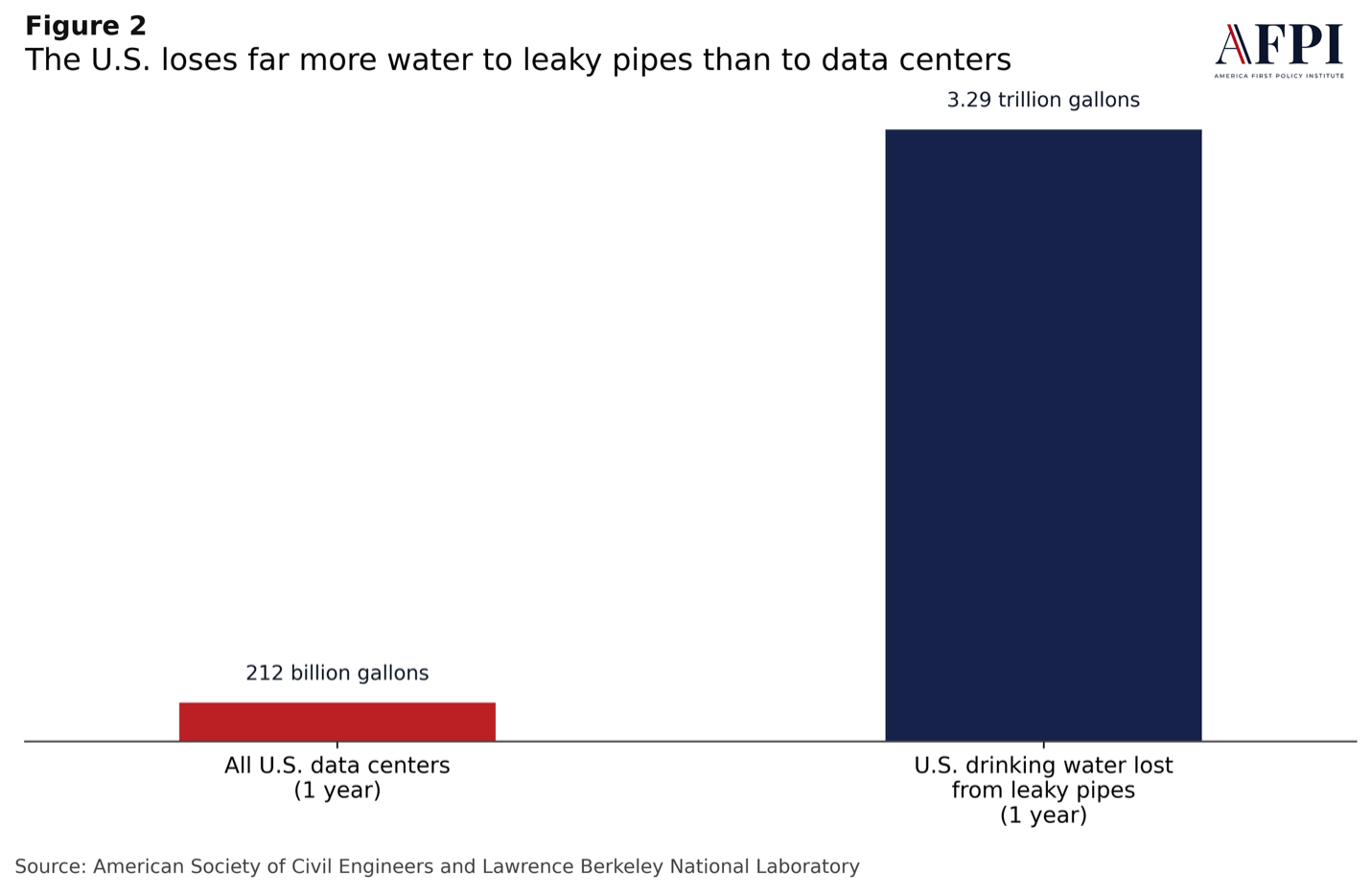
U.S. Drinking Water Lost from Leaky Pipes Compared to Water Usage by All U.S. Data Centers, Annually, in Gallons
Note. The U.S. loses fifteen times as much water to leaky pipes as it does to data centers. Data from 2017 Infrastructure Report Card, 2024 United States Data Center Energy Usage Report, and author calculations.
Data center water use is also far less than freshwater use in irrigation. In the U.S., around half of all consumed freshwater is used to irrigate crops. This means that irrigation accounts for over 100 times more water use than all U.S. data centers combined.
The New York Times and Bloomberg articles point out that data centers are often constructed in areas with high “water stress” levels. Yet the water systems in these areas often benefit, rather than experience harm, when data centers move in, as Masley argues.
Consider Maricopa County, Arizona, one of the highest water stress counties in America. In Maricopa, data centers are expected to use about 900 million gallons of freshwater in 2025. In the same period, Maricopa’s golf courses will use 29 billion gallons of water. This means “data centers make up 0.12% of the country’s water use,” while “golf courses make up 3.8%.” Yet data centers are so much more efficient at converting water into revenue that they generate “50x as much tax revenue per unit of water used than golf courses in the county” do. The residents of Maricopa County are far better off letting data centers move in than they would be otherwise.
Data centers generate benefits beyond tax revenue, as well. When data centers move into new areas, especially those with water scarcity, they create and finance changes that can lower water prices for households. For one, new water demand from data centers drives economies of scale, increasing the efficiency of water distribution and lowering prices. The decreases from this effect are further compounded by the fact that water markets across the country are separated for households and businesses. That is, household demand does not increase while the entire water system’s efficiency does.
Furthermore, large data centers often finance upgrades in local water systems, benefitting both consumers and these businesses. For example, Microsoft agreed to invest over $40 million in Goodyear, Arizona’s wastewater infrastructure in connection with its new data centers. President Trump’s recent call for AI data centers to “pay their own way” has led some data center companies to agree to pay to replenish all of their own energy and water usage.
The misleading water-use claims of these articles, combined with the support lent by the left-wing senators’ letter to the Trump Administration, paint a stunning picture of politicized incompetence. Analysis demonstrates that the so-called “AI water-use issue” should be called the “AI water-use hoax.”
Building More Data Centers
The truth is that the AI data center boom will become one of America’s greatest economic and strategic strengths. Data centers—especially those built in America, by American workers, and using American capital—drive economic growth, create lucrative jobs, and build national power. Far from worrying about their minuscule environmental impacts, we should clear the way for more development.
The impact of the AI boom on the economy is in its infancy but is already a massive component of GDP growth. In the first half of 2025, the AI infrastructure boom contributed a staggering 1.1 percentage points to GDP growth. In 2026, AI capital expenditures are projected to exceed $500 billion, over double the amount in 2024. These numbers do not account for the efficiency gains realized by individuals and firms as a result of adopting AI technology, which are expected to be substantial in the next several years.
AI data centers also create high-paying jobs. AI infrastructure has been described as a “gold rush” for welders, plumbers, electricians, and other trades. Construction workers’ wages have increased by 30% as a result of the AI boom. In Virginia alone, “the data center industry is estimated to contribute 74,000 jobs, $5.5 billion in labor income, and $9.1 billion in GDP” annually. McKinsey estimates that for each data center industry job created, an additional “3.5 jobs are created in the surrounding economy.”
The AI data center boom also has a tremendous impact on the nation’s security and power. It is the total installed computing capacity that determines a country’s AI might, since each additional data center leads to larger overall deployments for both commercial and national security missions. The war in Ukraine has shown us glimpses of the increasing importance of AI technology in warfare. So, too, have recent efforts by Chinese state-linked hackers to automate cyberattacks against Americans. New AI technology developments allowing for autonomous scientific research and development point toward the increasing importance of America’s total computing advantage.
The importance of AI data centers can hardly be understated: America should be building more. President Trump’s vigorous energy deregulation and AI infrastructure acceleration efforts have enabled the data center boom. It is now time for Congress and the states to act.
Federal legislation can further deregulate AI infrastructure projects. The national security importance of data centers is inapposite to the morass of permits and reviews that threaten their cost and completion. At the federal level, pre-construction environmental reviews and historical preservation permits stall projects for years. Radical activists also weaponize them on dubious grounds to interrupt beneficial projects. This may warrant creating a new “Gold Permit” exemption category. The President would be authorized to extend Gold Permits to a limited number of data centers and energy projects deemed critical to national security, such as those powering the AI boom and classified AI computing. Data centers with Gold Permits would receive presumptive permit approval for NEPA, NHPA, CWA, CAA, state-level NEPA-equivalents, and other burdensome federal permits.
Various specific reviews delay data center construction. Federal injunctions related to National Environmental Policy Act (NEPA) reviews are particularly burdensome because they stall projects during litigation; Congress could limit their use on data center and energy projects. States can also stall infrastructure projects using “delay tactics,” such as under Section 401 of the Clean Water Act, which the Environmental Protection Agency (EPA) recently proposed to amend. Congress could codify the proposed changes.
State laws also often delay data center projects. Many states, for example, have so-called “NEPA-equivalents” that impose state-level reviews on top of federal environmental reviews. These state procedures do not provide substantive environmental protections but instead allow litigants to significantly delay projects for years. Such laws should be repealed. In addition, states should recognize the national security importance and local benefits of data centers and establish presumptive permitting and land use approvals for data centers that are likely to eventually reach approval. These presumptive approvals could be conditioned on likelihood factors such as similarity to prior-approved projects, adherence to President Trump’s Ratepayer Protection Pledge, use for AI, and acceptable noise levels.
Policy Recommendations
(1) Congress should pass legislation that reforms burdensome and unnecessary processes that delay data center construction. These reforms should include:
- Creating permitting certainty by blocking future administrations from revoking permits for fully approved projects;
- Limiting injunctions that halt projects during NEPA-related litigation;
- Limiting the ability of states to arbitrarily deny projects under Section 401 of the Clean Water Act; and
- Accelerating National Historic Preservation Act (NHPA) reviews.
(2) State legislatures should establish presumptive permitting and zoning approvals for data centers meeting particular conditions. Qualifying projects should be exempt from local discretionary denial, with localities retaining authority over ministerial items like building code compliance and fire inspection. Approval conditions could be based on factors such as:
- Similarity to projects that have already been approved;
- Adherence to the Ratepayer Protection Pledge for energy;
- Planned use for artificial intelligence workloads; and
- Noise levels of planned data centers.
(3) State legislatures should repeal laws that delay projects and impose regulatory overhead, including laws that adopt NEPA-like requirements. Such laws can create additional delays that frustrate infrastructure projects.
(4) Congress should empower the President to issue “Gold Permits” that exempt projects from federal and state permitting requirements for data center projects deemed critical for national security. This would allow the executive branch to mitigate the impacts of state laws that stall AI data centers and their energy infrastructure, which are critical for national security.
Conclusion
The AI boom (and its accompanying infrastructure build-out) is quickly becoming one of the most important economic and political flashpoints of the decade. Through false narratives, the mainstream media, many lawmakers, and other detractors are smothering American technological progress. The AI water use hoax is only the latest example. Yet analyzing the water use issue quantitatively reveals it to be far from the catastrophic problem. In fact, AI data centers are beneficial across the board: for households, workers, communities, economic growth, and national power. To sustain America’s lead in artificial intelligence, we must clear the way for more AI infrastructure and continue to combat falsehoods about American technology.