August 5, 2026
America’s Cattle Herd Is Stabilizing— And America First Policies Are Helping
This summary report was prepared with the support of AI tools from the Office for Fiscal and Regulatory Analysis.
Executive Summary
The U.S. beef cow herd has contracted for seven straight years, falling to 27.6 million head on January 1, 2026—the smallest since 1961 (USDA NASS 2026a; Peel 2026a). But the U.S. Department of Agriculture’s (USDA) July 2026 Cattle report shows the long decline approaching its end: the all-cattle inventory ticked up 0.2% year over year, and producers are holding back cows and heifers to rebuild (USDA NASS 2026b; Peel 2026b). The turn coincides with a coordinated America First strategy working two tracks at once: near-term price relief for consumers and a rebuilt, more competitive American cattle industry.
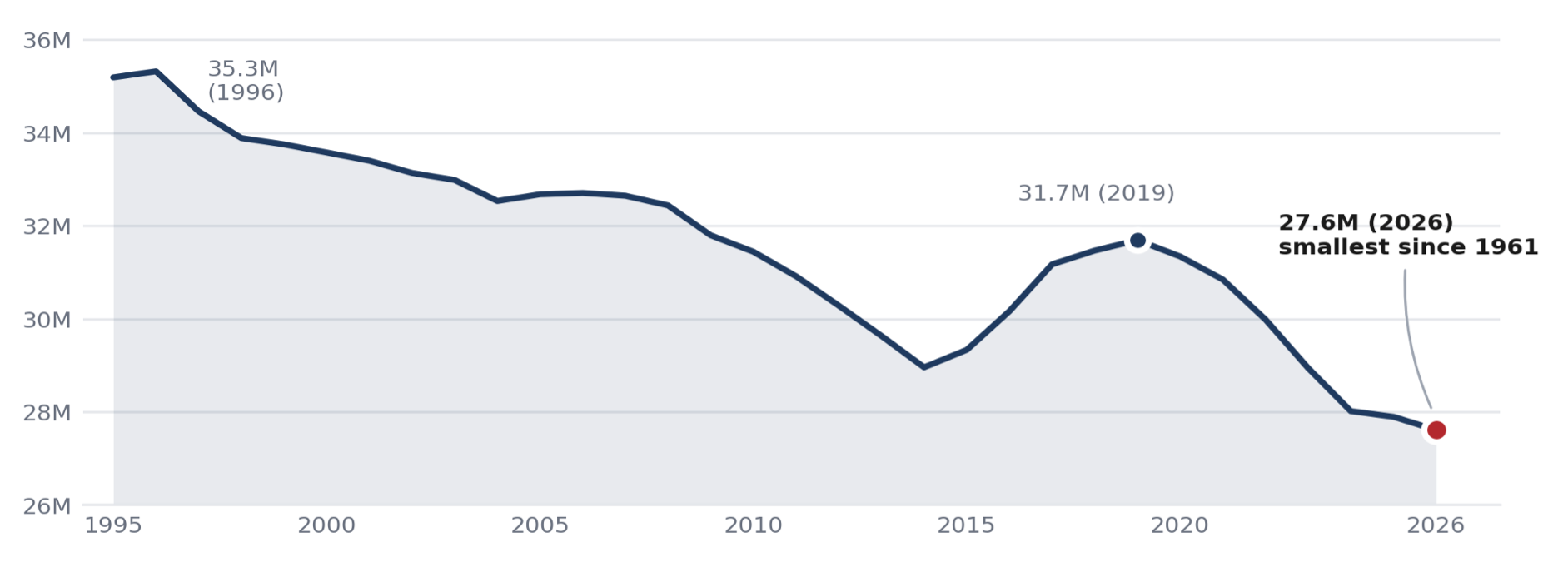
Figure 1. U.S. Beef Cow Inventory, January 1 (Million Head). Source: USDA NASS Cattle reports, revised series.
Signs the Decline Has Stopped
- Herd stabilizing: All cattle and calves totaled 94.2 million on July 1, 2026—up 0.2% year over year. Beef replacement heifers are up 2.7%, and January 2026 brought the first increase in beef replacement heifers in nine years (USDA NASS 2026b; Peel 2026a; Peel 2026b).
- Ranchers are keeping their cows: Beef cow slaughter fell more than 15% in the first half of 2026—the lowest level since 2015—and the culling rate is on track to drop below 8%. Liquidation is winding down (Burdine 2026; USDA ERS 2026).
- Record incentives to expand: Feeder cattle futures set an all-time high above $380/cwt (Oct. 2025); live cattle hit a record above $258/cwt (Apr. 2026); retail beef demand remains robust at record prices (CME Group 2026; USDA ERS 2026; Peel 2026c).
- Economists’ read: Oklahoma State University’s Derrell Peel calls January 2026 “likely to be the cyclical low”; the American Farm Bureau says the July report “signals stabilizing cattle herd.” Main risk: 48% of cattle are in drought areas (late July 2026), up from about 14% a year earlier (Peel 2026a; AFBF 2026; USDA 2026g).
Administration Actions Behind the Turn
- Plan for American Ranchers and Consumers (Oct. 22, 2025): USDA–Interior–U.S. Department of Health and Human Services (HHS)–Small Business Administration framework: expanded grazing, more processing capacity, expedited deregulation, pro-protein nutrition policy—announced citing the 75-year-low herd (USDA 2025e).
- Land and forage (Mar.–Jun. 2026): A USDA–Interior memorandum of understanding streamlines grazing across 240 million federal acres, reopens vacant allotments, and guarantees no net loss of grazing capacity; a June 2026 Forest Service directive restores grazing on national forest lands, with a goal of restoring at least 500,000 head months of grazing over the next two years (USDA 2026b; USDA 2026d).
- Interior grazing overhaul (Sept. 2025–Jul. 2026): The Bureau of Land Management rescinded the 2024 “Public Lands Rule,” restoring multiple-use primacy for grazing (final May 12, 2026), and the same day proposed the first modernization of the grazing regulations in force since 1995, streamlining permitting across roughly 155 million acres. July 2026 monument modifications returned about 2.9 million acres in Utah to multiple-use management, including grazing, and Interior and Commerce rescinded the Endangered Species Act’s “harm” definition (Jul. 2026) (BLM 2026a; BLM 2026b; White House 2026; FWS 2026).
- Water and equipment relief (U.S. Environmental Protection Agency [EPA], 2025–26): On day one of its March 2025 deregulatory campaign, EPA committed to a narrower “waters of the United States” (WOTUS) definition and, with the Army Corps, applied the Sackett ruling immediately through field guidance; a formal WOTUS proposal followed (Nov. 2025). EPA’s diesel exhaust fluid (DEF) fixes (Aug. 2025–Mar. 2026) direct manufacturers to prevent sensor-triggered shutdowns of trucks and tractors—savings the U.S. Small Business Administration estimates at $4.4 billion a year for farmers (EPA 2025a; USACE 2025; EPA 2025b; EPA 2025c; EPA 2026).
- Packer competition (Nov. 2025–Jun. 2026): U.S. Department of Justice civil and criminal probes of alleged meatpacker price fixing and Executive Order 14364 task forces target top-four packer concentration (~85%); USDA added up to $500 million for small and mid-size beef processors (E.O. 14364; Farm Policy News 2026; USDA 2026e).
- Working-family tax relief (Jul. 4, 2025): The One Big Beautiful Bill gives producers the certainty to plan: a permanent $15 million estate-tax exemption (indexed) protects family ranches in generational transfer; permanent 100% bonus depreciation and a $2.5 million Section 179 expensing cap cut the cost of equipment and facilities today; and the permanent 20% small-business deduction supports pass-through ranch operations—helping the next generation step into the business and keep rebuilding the herd (Iowa State CALT 2025).
- Demand side (Jan.–Feb. 2026): The 2025–2030 Dietary Guidelines put animal protein at the center of federal nutrition policy, and HHS Secretary Kennedy told cattle producers in February 2026, “We need a lot of beef, and we want to make it right here in America,” urging them to expand their herds (USDA and HHS 2026; Brownfield Ag News 2026).
- Screwworm defense abroad (2025–present): USDA took the fight to the New World screwworm in Mexico before it could reach American herds—negotiating preclearance inspection and treatment protocols with Mexican authorities, funding a $21 million renovation of the Metapa sterile-fly plant in southern Mexico, and dispersing 100 million sterile flies a week over Mexico and Texas—slowing the pest’s northward spread and buying time for an all-of-government response at home (USDA 2025a; USDA 2025c; APHIS 2026).
- Screwworm defense at home (2025–present): USDA suspended southern-border cattle imports whenever detections advanced (May and July 2025); broke ground on a $750 million sterile-fly production facility in Texas, with an $8.5 million Texas dispersal facility complete and a $25 million Arizona facility announced; and set a biosecurity-first phased border reopening (scheduled Aug. 24, 2026) (USDA 2025b; APHIS 2025; USDA 2025d; USDA 2026c; USDA 2026a; DTN Progressive Farmer 2026; USDA 2026f).
A herd worth rebuilding: American producers have spent generations building the genetics, land stewardship, and business practices behind the world’s premier beef herd—roughly 40% of total U.S. land, both privately owned (~30%) and public (~10%), is available for or used for livestock grazing, which is dominated by cattle (AFBF 2023), and American beef is recognized around the world as a symbol of quality, with exports reaching a record $11.7 billion in 2022 (NRCS 2022; USDA 2025f; USMEF 2023). The actions above protect and build on that inheritance.
Related AFPI work on agriculture and food policy: AFPI 2025a (Farmers First Agenda); AFPI 2025c (agricultural trade); AFPI 2025b (farm provisions of the One Big Beautiful Bill); Katebi 2025 (food safety); Tom 2026 (commentary on USDA’s screwworm response); AFPI 2026 (statement applauding USDA’s SPUR processor program).
Note: The Argentina lean-beef quota and Brazil tariff relief are the strategy’s consumer-price track—near-term relief at the grocery store while domestic supply recovers. Herd rebuilding is early-stage: the cow herd was still down 0.7% year over year in July, and economists caution expansion will be slow.
References