July 29, 2026
Idaho: The Great American Comeback
July 2026 | This report was prepared with the support of OFRA AI tools.
$1,943 Average Working Familes Tax Cuts for Idaho joint filers with 2+ children |
1st New privately developed non-light-water reactor to reach U.S. criticality in 40+ years—at Idaho National Laboratory |
$50M Parental Choice Tax Credit cap—reached in year one, nearly a month early |
~100 Criminal illegal aliens removed from Idaho under Operation No Return |
The Economy: The Working Familes Tax Cuts Lands in America’s Fastest-Growing State Since 2020
Idaho enters the era of the Working Familes Tax Cuts (WFTC)—enacted as the One Big Beautiful Bill (OBBB) and signed July 4, 2025—from a position of strength: No state has grown faster since 2020, state leaders keep cutting taxes, and now what supporters call the largest federal tax relief for working families in a generation stacks on top.
- Idaho is America’s fastest-growing state since 2020: From April 2020 to July 2025, its population grew 10.4%—the fastest rate in the Nation—adding more than 190,000 residents and pushing Idaho past 2 million people, and its 2025 growth rate ranked second (Idaho Department of Labor [IDOL], 2026). The 2023 state-by-state Census comparison also ranked Idaho first in the Nation for median household income growth, at 15.5% (State of Idaho, Office of the Governor, 2024).
- Unemployment stood at 3.7% in May 2026—well below the U.S. rate of 4.3%. Idaho’s edge has doubled since the final quarter of the Biden Administration, when the state’s 3.8% sat 0.3 points below the national 4.1%—today the gap is 0.6 points (Idaho Business Review, 2026; IDOL, 2025).
- A generational investment is underway: Boise-born Micron is building two leading-edge memory fabs in Boise—expected to create more than 17,000 new jobs—as part of the expanded $200 billion U.S. investment plan it announced with the Trump Administration in June 2025. Output from the first Boise fab is scheduled to begin in 2027, and co-locating the fabs with Micron’s Idaho research and development will speed delivery of the high-bandwidth memory that powers artificial intelligence (BoiseDev, 2025; Micron Technology, 2026).
- Idaho keeps cutting taxes: House Bill 40 delivered the largest income tax cut in state history in 2025—another $253 million, taking the income tax rate down to 5.3%—on top of $4.6 billion in tax relief since 2019, which the governor’s office calls the most per capita in the Nation (State of Idaho, Office of the Governor, 2025). And in February 2026, Idaho aligned its own code with the OBBB—ending state income tax on tips and most overtime and boosting the senior deduction, worth about $155 million more to Idahoans this year (Idaho Capital Sun, 2026a).
- Federal reform: The WFTC delivers no tax on tips (up to $25,000), no tax on overtime (up to $12,500/$25,000 joint), a $2,200 Child Tax Credit, a new $6,000 senior deduction, and a deduction of up to $10,000 in car-loan interest on U.S.-assembled vehicles (Internal Revenue Service [IRS], 2025, 2026a). The Tax Foundation estimates the average Idaho filer saves $3,539 in 2026, near the $3,813 national average (Tax Foundation, 2026)—and the relief looms even larger as a share of taxes owed: the average filer in the median state keeps about 15.8% of what they would otherwise pay, with lower-income areas saving the most on a percentage basis (Brashers, 2025). AFPI’s analysis finds the OBBB’s permanent 100% expensing for factories, equipment, and research adds an expected 1.2% to long-run GDP (America First Policy Institute [AFPI], 2025c).
- AFPI has modeled the WFTC state by state: The new worker-focused provisions alone—one slice of the broader $3,539 full-bill average, which also counts permanence of the 2017 tax cuts and business provisions—save the average Idaho filer $891 for tax year 2025, rising to $1,325 for families with children, $1,943 for joint filers with two or more children, and $1,297 for seniors. And now that Idaho exempts tips too, a single Idaho restaurant server keeps an estimated $307 in federal relief alone—more than four times the $71 a comparable server keeps in Illinois (AFPI, Office for Fiscal and Regulatory Analysis, 2026a, 2026b).
- Paychecks stretch further in Idaho: Overall prices run about 4.5% below the national average—with rents about 10% lower (Bureau of Economic Analysis [BEA], 2026a, 2026b)—and Idahoans pay about 27% less for electricity (U.S. Energy Information Administration [EIA], 2025a, 2025b).
Energy: America’s Nuclear Renaissance Is Being Built in Idaho
President Trump’s Executive Orders 14154 (Unleashing American Energy) and 14156 (Declaring a National Energy Emergency) put reliable, affordable energy back at the center of federal policy, and Executive Order 14301 (Reforming Nuclear Reactor Testing at the Department of Energy) launched the U.S. Department of Energy (DOE) Reactor Pilot Program with a presidential deadline: advanced reactors critical by July 4, 2026. The proving ground is DOE’s Idaho National Laboratory (INL)—where 53 reactors have been built since 1951—in a state whose hydropower already keeps electric bills among the lowest in the Nation (Exec. Order No. 14154, 2025; Exec. Order No. 14156, 2025; Exec. Order No. 14301, 2025; DOE, 2026a).
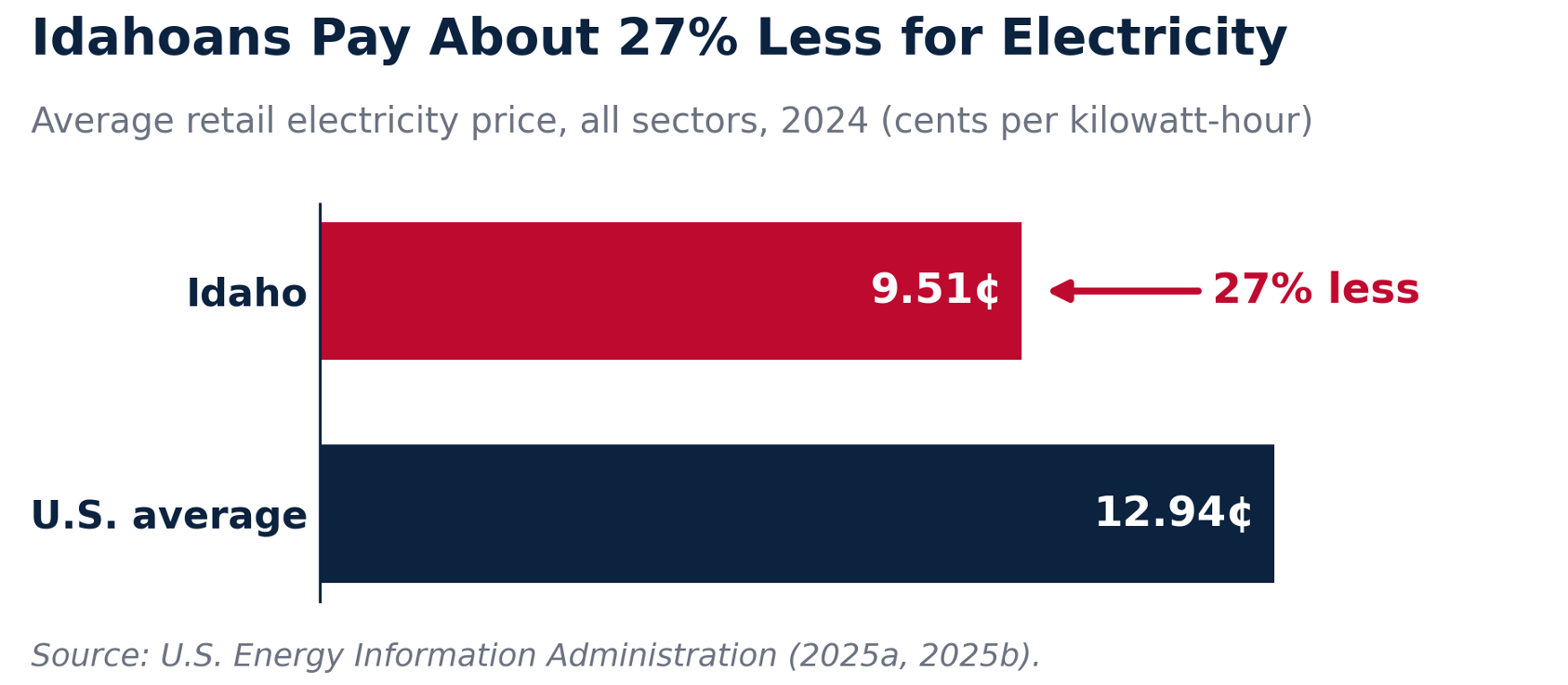
Figure 1. Average Retail Electricity Price, All Sectors, 2024 (Cents per Kilowatt-Hour). Source: EIA (2025a, 2025b).
- History was made at INL on June 4, 2026: Antares Nuclear’s Mark-0 reached criticality under the Reactor Pilot Program—“for the first time in more than four decades, a new privately developed non-light-water reactor has reached criticality in the United States,” in Energy Secretary Chris Wright’s words. The Mark-0 is the 53rd reactor built at the INL site since 1951 and the first of multiple pilot reactors expected to go critical by the July 4 deadline (DOE, 2026a).
- The world’s first microreactor test bed is open for business: The Demonstration of Microreactor Experiments (DOME) began accepting reactor experiments at INL in April 2026, with Radiant’s Kaleidos on track to be tested first and Westinghouse’s eVinci selected to follow—performance data from DOME will feed directly into commercial licensing (DOE, 2025, 2026a, 2026b, 2026c).
- INL also powers national defense innovation: Advanced tri-structural isotropic (TRISO) fuel for Project Pele—the military’s first-of-its-kind mobile microreactor—arrived at INL in November 2025, and DOE’s new Nuclear Energy Launch Pad, established at INL in March 2026, will help companies demonstrate an even wider range of advanced nuclear technologies (DOE, 2026b).
- Affordable, reliable power is Idaho’s calling card: Hydroelectric dams are the state’s largest source of electricity, renewables supplied 69% of generation in 2024—the fifth-highest share of any state—and Idaho had the Nation’s third-lowest average residential electricity price (EIA, 2026a). Across all customers, Idaho power averaged 9.51 cents per kilowatt-hour in 2024, versus 12.94 cents nationally (EIA, 2025a, 2025b).
- Federal reform: Executive Order 14301 set the July 4, 2026, criticality goal the pilot reactors are now meeting (Exec. Order No. 14301, 2025)—and AFPI’s OBBB analysis notes the bill “maintains support to produce reliable nuclear energy through tax relief” (AFPI, 2025b). Nationally, U.S. crude oil production set another all-time record of 13.6 million barrels per day in 2025 (EIA, 2026b).
Education: Idaho’s School Choice Program Hit Its Cap in Year One
Idaho went big on parental choice in 2025—and Idaho families answered. The state’s new Parental Choice Tax Credit hit its statutory cap in its very first year, charter school demand keeps outrunning supply, Idaho has already opted in to the OBBB’s first-ever federal school choice tax credit—and the state’s students outscore the Nation.
- Universal choice arrived, and Idaho families raced to claim it: Gov. Brad Little signed House Bill 93 in February 2025, creating the Parental Choice Tax Credit—up to $5,000 per non-public-school student, or $7,500 for students with special needs. In year one, families filed 7,019 applications for credits covering 12,497 students, and the program hit its $50 million annual cap on July 17, 2026—closing applications nearly a month before the August 15 deadline. Lower-income families got priority, and about 45% of applicants were at or below 300% of the federal poverty level (Idaho Capital Sun, 2026c). The Idaho Supreme Court upheld the program in February 2026 (Idaho Capital Sun, 2026b).
- Choice runs deep: Nearly 10% of Idaho’s public school students attend one of the state’s 74-plus public charter schools—among the highest shares in the Nation—and demand keeps outpacing supply, with roughly 11,000 students on charter waitlists as of late 2023 (Idaho Education News, 2023).
- Idaho students outperform the Nation: Fourth- and eighth-graders posted higher proficiency rates than their national peers in both reading and math on the 2024 Nation’s Report Card—and fourth-grade math proficiency climbed to 41%, up from 36% in 2022 (Idaho Education News, 2025; National Center for Education Statistics, 2025).
- AFPI helped build this wave: Beginning in early 2022, AFPI’s Center for Education Opportunity produced more than 20 research reports, state-specific fact sheets, and model education savings account (ESA) legislation as universal school choice swept the states (AFPI, 2023)—and AFPI calls the OBBB’s new federal scholarship credit “a big, beautiful win for school choice” (AFPI, 2025a).
- Federal reform: Idaho has already opted in to the OBBB’s first-ever federal tax-credit scholarship—Gov. Little issued an executive order in February 2026, joining the more than half of U.S. states signed up for the credit, worth up to $1,700 for donations to scholarship organizations starting January 1, 2027 (IRS, 2026b; State of Idaho, Office of the Governor, 2026a). Workforce Pell Grants took effect July 1, 2026, opening federal aid for short-term skills credentials (U.S. Department of Education, 2026), and Executive Orders 14190, 14191, and 14242 advance the Administration’s K–12 agenda, expand education freedom, and return authority over education to the states (Exec. Order No. 14190, 2025; Exec. Order No. 14191, 2025; Exec. Order No. 14242, 2025).
Safer Communities: Operation No Return Is Taking Criminals Off Idaho’s Streets
Idaho’s communities are seeing the payoff of enforcement that works. The state sits more than 500 miles from the southern border, but the border crisis still reached its communities—through fentanyl, trafficking, and criminal aliens released back onto local streets. Today Idaho is a model interior-enforcement partner: Gov. Little’s Operation No Return uses the state’s 287(g) agreement with U.S. Immigration and Customs Enforcement (ICE) to hand criminal aliens over for deportation, with the Trump Administration’s historic securing of the border reinforcing those gains (State of Idaho, Office of the Governor, 2026b).
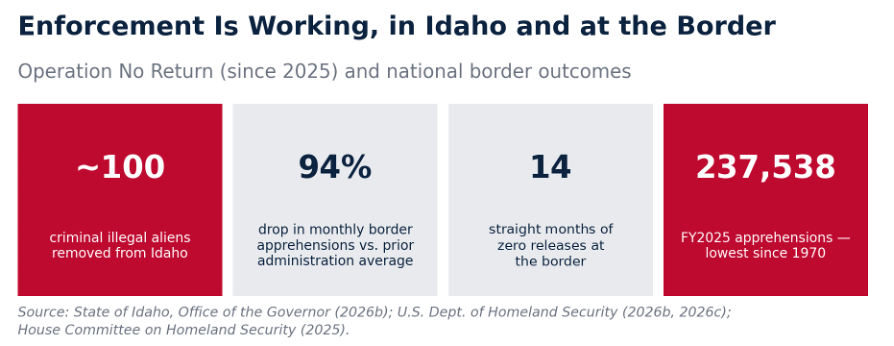
Figure 2. Operation No Return (Since 2025) and National Border Enforcement Outcomes. Sources: State of Idaho, Office of the Governor (2026b); U.S. Department of Homeland Security (2026b, 2026c); House Committee on Homeland Security (2025).
- Idaho’s communities are comparatively healthy—and the national tide is receding: Idaho’s drug overdose death rate in 2024 was nearly 25% below the U.S. rate (USAFacts, 2026), and national overdose deaths fell almost 14% in 2025, a third straight annual decline (Centers for Disease Control and Prevention, 2026).
- Dangerous criminals are leaving Idaho for good: Under Operation No Return, the Idaho State Police takes criminal illegal aliens from county jails at the end of their sentences and transfers them to ICE for deportation—instead of releasing them back into Idaho communities. As of May 2026, nearly 100 have been removed, including convicted child rapists, a kidnapper, a stalker, violent offenders, and drug traffickers (State of Idaho, Office of the Governor, 2026b).
- Illegal immigration is not a free good for a fast-growing state: The Federation for American Immigration Reform (FAIR), an immigration-reduction advocacy group, estimates it cost Idaho taxpayers $405 million in 2023—about $616 per Idaho household, led by $245 million in education costs (a gross-cost estimate). These are precisely the burdens Idaho’s enforcement partnership with federal authorities is working to reduce (FAIR, 2023).
- The pipeline that carried fentanyl into Idaho’s communities is being squeezed at its source: Southwest border apprehensions in FY2025 totaled 237,538—the lowest level since 1970—versus roughly 1.6 million in FY2021 (House Committee on Homeland Security, 2025). In June 2026, apprehensions (9,848) were 94% below the prior administration’s monthly average, and the U.S. Department of Homeland Security (DHS) reports 14 consecutive months of zero releases at the border (Athrappully, 2026; DHS, 2026c).
- Interior enforcement is delivering nationwide—and Idaho’s 287(g) partnership plugs directly into it: DHS reports more than 675,000 removals in the Administration’s first year and an estimated 2.2 million self-deportations (DHS, 2026a).
Conclusion: The Comeback Compounds in Idaho
The Great American Comeback is compounding Idaho’s own winning formula. Federal tax relief worth $3,539 to the average filer stacks on top of the largest state income tax cut in Idaho history—and a state that now exempts tips and overtime from its own income tax and has boosted its senior deduction. The Administration’s nuclear orders turned Idaho National Laboratory into the site of America’s first new non-light-water reactor criticality in more than four decades. The OBBB’s first-ever federal school choice dollars will flow to a state whose families pushed their own $50 million choice program to its cap in year one. And Operation No Return—backed by a secured border—means criminal aliens leave Idaho instead of returning to its streets. America’s fastest-growing state took the federal reforms and ran with them—and the results are showing up in paychecks, power bills, classrooms, and neighborhoods across the Gem State.
References