It’s Time for Congress to End the Diversity Visa Program
Key Takeaways
« The Diversity Visa Program does not serve America’s national interest; Congress should repeal it and implement merit-based immigration.
« The Diversity Visa Program grants up to 55,000 immigrant visas (green cards) annually through a lottery based on random chance.
« Lawmakers purposely designed the Diversity Visa Program to ignore education, skills, and the impact of applicants on the labor market to satisfy Irish constituencies in the Northeast.
« Pervasive fraud and persistent vetting challenges undermine the integrity of the Diversity Visa Program and our entire immigration system, harming both eligible applicants and the American people.
Introduction
The Department of Homeland Security recently announced that it is pausing the Diversity Visa Program in the wake of the tragic shooting at Brown University, where two students were killed and many others gravely injured. The perpetrator, Claudio Manuel Neves Valente, was a Portuguese national and diversity visa recipient. In her announcement, Secretary Noem noted that President Trump has consistently fought to end the Diversity Visa Program. Now, Congress should follow the administration’s lead and repeal this program because it undermines the American workforce, is rife with fraud, poses national security risks, and does not advance America’s national interest.
Since 1995, the Diversity Visa Program, also known as the Visa Lottery, has awarded up to 55,000 immigrant visas (green cards) annually to nationals of “low immigration” countries, i.e., countries that have sent less than 50,000 immigrants to the U.S. over the preceding five years. The precise number of green cards allocated to each country also depends on the overall level of immigration from a country’s geographic region.
The State Department, which manages the Diversity Visa (DV) Program, awards these green cards through a lottery based on sheer luck. To qualify, an applicant only needs a high school education or two years of qualifying work experience. Previously free, there is now a $1 entry fee for the lottery, implemented in 2025. If a foreign national’s name is chosen, the “winner” files an application for a green card, at which point he or she must pay additional fees. Spouses and minor children may immigrate with an applicant.
The DV Program was created out of opportunity and political greed. It was proposed by a handful of members of Congress, mainly from the Northeast, who had significant Irish constituencies they wanted legalized. For that reason, these legislators purposely designed the visa lottery to have minimal educational and work requirements. Congress also waived the labor certification requirement for many employment-based green cards to help low-skilled workers qualify. In short, Congress gave no consideration to whether immigrants arriving through the DV Program would contribute to American society or the economy, nor did it consider how these newcomers would impact American workers.
Not only does the DV Program undercut American workers, but it also undermines the legitimacy of our immigration system due to pervasive fraud and vetting challenges. Just two years after the program began, the State Department began documenting fraud in the DV Program worldwide, including in some of the largest beneficiary countries. The DV Program has also generated national security concerns because nationals from state sponsors of terrorism and other “special interest” countries are eligible to participate. In particular, the increase in immigration from predominantly Muslim-majority countries through a program that is replete with fraud increases America’s vulnerability to extremists and terrorists.
Awarding green cards to foreign nationals based on random chance and low eligibility requirements undermines America’s national interest, as fraud and national security vulnerabilities only compound the problems in the program. Americans would be better served by eliminating the visa lottery and awarding those immigrant visas based on merit. Skilled and well-educated immigrants with a job offer in hand are more likely to be self-sufficient, contribute to the U.S. economy, and assimilate into American society. Likewise, skilled immigrants are less likely to place a burden on federal, state, and local welfare programs—and ultimately, the American taxpayer. To ensure that America’s immigration system places the interests of Americans first, Congress should end the Visa Lottery.
Overview of the Diversity Visa Program
The Diversity Visa Program offers up to 55,000 visas each year to nationals from “low-admission countries,” defined as countries from which fewer than 50,000 nationals immigrated to the U.S. over the previous five-year period
The Immigration and Nationality Act (INA) sets forth a formula for calculating the number of diversity visas granted to the nationals of each country. This formula includes an assessment of whether a low admission country lies within a high-admission region or a low-admission region. The six geographic regions, defined by the Department of State, are:
- Africa
- Asia
- Europe
- North America (other than Mexico)
- Oceania
- South America, Mexico, Central America, and the Caribbean.
The State Department chooses selectees (sometimes called “winners”) through a randomized computer drawing. That drawing selects more people than available visas, as some of the winners who subsequently apply for a green card will be disqualified under the general grounds of inadmissibility applicable to all immigrants, such as criminal activity. If a winner is granted a green card, his/her spouse and minor children may also receive green cards, and the visas for the winner and his/her family are deducted from the 55,000 total visas available. No single country may receive more than 7% of diversity visas in any fiscal year.
The Diversity Visa Program does not consider whether applicants will contribute to the economy or American society. Eligibility for the DV Program is not based on whether an alien has family connections or employment in the U.S. Instead, to be eligible for a diversity visa, an alien must simply have a high school education (or its equivalent) or two years of qualifying work experience. That work experience is defined as two years of work experience in the five years preceding the visa application that (as determined by the Department of Labor) requires at least two years of training or experience. Thus, an alien can immigrate to the U.S. through the DV Program with little to no education, no job, and no job prospects. The alien is not required to speak any English or demonstrate any ability to assimilate.
The DV Program, by design, also ignores the impact of diversity visa immigrants on the American workforce. Labor certification, which is an important protection for American workers that is required for many employment-based visas, is not required for diversity visas. Through the labor certification process, employers must demonstrate to the Department of Labor that there are insufficient workers who are willing, qualified, and available to perform the same work as the alien and that the alien’s work in the U.S. will not depress wages. Proponents argue that waiving the labor certification requirement makes sense, as diversity immigrants are not required to have a job offer, or even obtain a job after arriving in the U.S. However, the express waiver of the labor certification requirement demonstrates how the DV Program was designed to benefit the immigrants over the interests of U.S. citizens.
The Political Genesis of the Diversity Visa
The genesis of the Diversity Visa Program traces back to the Immigration Act of 1965. At that time, Congress restructured America’s immigration system by eliminating the national origins system and replacing it with family and employment-based immigration programs. This major piece of legislation also added important protection for American workers by requiring labor certification for many employment-based green cards.
As Brooklyn College Political Science Professor Anna O. Law details in her research, these significant changes made it more difficult for the Irish to immigrate to the United States. Aspiring Irish immigrants did not typically have close relatives in the United States who could sponsor them, nor did they typically have the skills that would qualify them for employer-sponsored visas. As a result, even though Congress had just jettisoned the national origins system, by the late 1960s, members of Congress began introducing legislation to carve out visas specifically for the Irish that were exempt from the labor certification requirement.
These bills had little backing at first, but support on Capitol Hill grew as conditions changed. As Ireland’s economy faltered in the mid-1970s and early 1980s, tens of thousands of Irish nationals traveled to the U.S. on tourist visas, and many overstayed. During this time, special interest groups increasingly demanded that Congress legalize these Irish migrants. Some argued that the country needed “new seed” immigrants not connected to the United States by family or employment. Some even claimed that the post-1965 system—which dismantled the national origins system—“discriminated” against the Irish.
By the early 1980s, members of Congress began discussing the potential for taking up amnesty legislation (what in 1986 would become the Immigration Reform and Control Act, or IRCA). Congressman Brian Donnelly and Senator Ted Kennedy, both of whom had significant Irish constituencies in Massachusetts, saw an opportunity to slip a program for the Irish into the large bill.
When the Immigration Reform and Control Act of 1986 (IRCA) was debated in Congress, Congressman Donnelly and Senator Kennedy authored amendments that created the NP-5 program. The NP-5 program (NP stood for “non-preference countries”) allocated 5,000 visas in fiscal years 1987 and 1988 to 36 countries “adversely affected” by the 1965 Act. There were no specified levels of education, skills, or employment required. Labor certification was expressly waived, and applications were decided in the order in which they were filed (as opposed to being subject to the per-country caps).
The Irish, who were well organized, received help from their government and benefitted the most from the NP-5 program. Irish nationals received the largest proportion (31%) of NP-5 visas, followed by Canadian nationals (21%) and U.K. nationals (11%). By some estimates, nearly one-third of the Irish recipients of NP-5 visas had been living illegally in the U.S.
Through the Immigration Amendments of 1988, Congress extended the NP-5 program through fiscal years 1989 and 1990 and increased the number of NP-5 visas to 15,000 per year. In 1990, Senator Ted Kennedy and Congressman Bruce Morrison (D-CT) successfully converted the NP-5 program into a permanent program through the passage of the Immigration Act of 1990 (S. 358). The new program, now called the Diversity Visa Program, was scheduled to go into effect in 1995.
Until full implementation, however, Congress established a transitional visa program. Section 132 of the 1990 Act provided 40,000 visas in FYs 1992, 1993, and 1994 for “qualified aliens” from countries that were “adversely affected” by the 1965 changes to the INA. No education level, skill level, or other work experience was required, but applicants were required to have a “firm commitment for employment” for at least one year. Congress then earmarked 40% of visas for this three-year period for the Irish. Congress also expressly waived inadmissibility for failure to have proper documents, making the transitional program nothing more than an amnesty—one adopted only four years after the massive 1986 amnesty.
The DV Program went into full effect in 1995 with an annual cap of 55,000. In FY 1995, the first year of the permanent program, the leading countries of admission were Poland (3,596), Ethiopia (3,088), Nigeria (2,407), Egypt (2,229), and Romania (1,992). Two years later, Congress siphoned off a small portion of diversity visas to benefit two more ethic interests, this time to Nicaraguans and Cubans seeking to legalize through the Nicaraguan Adjustment and Central American Relief Act (NACARA)—another amnesty law adopted by Congress. This change effectively reduced the diversity visa cap by a maximum of 5,000 visas, depending on the number of NACARA applicants. In recent years, due to a dwindling pool of eligible NACARA applicants, only a few hundred visas have been used for NACARA, bringing the total number of diversity visas closer to 55,000 once again.
Congress reduced the diversity visa cap again in FY 2024, this time permitting up to 3,500 diversity visas in FY 2024 and up to 3,000 diversity visas in FY 2025 (and subsequent years) for use by U.S. government employees in foreign countries. This change was intended to help foreign nationals working for the U.S. government in the Middle East who otherwise would not qualify for a visa.
History of Fraud and National Security Concerns
Since its inception, the DV Program has been plagued by fraud—a problem well documented by the State Department, the Inspector General, and the Government Accountability Office (GAO). Just two years after the inception of the DV Program, the Inspector General for the Department of State found that fraud was already prevalent because of bogus documents and the difficulty of evaluating whether applicants met the two main qualifications: achievement of a high school diploma (or its equivalent) or the relevant job experience.
In 2003, the Inspector General issued another scathing report about fraud in the DV program. It read,
The [Diversity Visa] program is subject to widespread abuse ... Identity fraud is endemic, and fraudulent documents are commonplace. Many countries exercise poor control over their vital records and identity documents, exacerbating the potential for program abuse. In some countries, this control is so poor that consular officers must assume that all travel, identity, and civil documents are unreliable.
Rampant identity fraud, State Department officials warned, was particularly concerning because it undermined background and national security checks of applicants, as applicants could freely obtain false documents, whether through the manufacture of fake documents or by bribing government officials to issue documents with false names and biographic information.
The 2003 report highlighted additional problems. For example, duplicate applications, often submitted in different names, were a common method of trying to game the system. Indeed, hundreds of thousands of applications were rejected in both 2002 and 2003 as duplicates. The report also lamented that the State Department had no real standards for determining whether an applicant had met the educational or work requirements, and that applicants often forged documents to show they met these criteria. Finally, the Inspector General warned that the law does not bar nationals of state sponsors of terrorism from participating in the DV Program. In 2007, the GAO reported more concerns about fraud. Consular officers from five of the top ten countries issuing diversity visas told the GAO that fraud was a major concern. Among the most troubling problems were visa “consultants” who would file applications for individuals (with or without their knowledge) and extort money from the winners. Often, these visa consultants would also organize sham marriages to winners of the lottery to collect more money.
In 2012, another troubling report of fraud came from the Embassy in Dhaka, Bangladesh. There, officials discovered that one IP address was responsible for more than 634,000 entries. Bangladeshi officials investigated and found computers with thousands of applications, along with fake education documents and staged marriage photos.
In 2013, the Inspector General documented sophisticated and pervasive fraud schemes taking place in Ukraine:
Organized fraud rings masquerading as travel agencies have taken control of the Diversity Visa Program in Ukraine. They buy, steal, or obtain from public sources personal information about Ukrainian citizens, especially those living in western Ukraine. They use this information to enter these citizens’ names in the online Diversity Visa Program Web site, often without their permission or awareness. In addition, other Ukrainian citizens willingly provide personal information to the fraud rings for entry into the program but are usually unaware that the fraudulent “agencies” continue to enter them year after year.
Under this scheme, State Department officials said, criminal rings would obtain confirmation numbers from the online system, contact Ukrainians who “won” green cards in the lottery, and require them to pay up to $15,000 to obtain the confirmation number and pursue an immigrant visa application. These criminal rings would then engage in more fraud when diversity visa immigrants arrived in the United States by obtaining the immigrants’ Social Security numbers and using them to perpetrate more fraud.
In 2017, Senator Chuck Grassley (R-IA) wrote to Secretary of State Rex Tillerson, requesting a full assessment of “the program’s operation and merits.” In his letter, Senator Grassley specifically highlighted the national security risks of the program, noting that multiple diversity visa recipients had carried out terrorist attacks since immigrating to the U.S. These included:
- Sayfullo Saipov, an Uzbek national and diversity visa recipient, who perpetrated a terrorist attack in New York City in 2017, killing 8 people and injuring many more as he drove a rental truck down a popular pedestrian path.
- Abdurasul Hasanovich Juraboev, an Uzbek national and diversity visa recipient, who was sentenced to 15 years in prison in 2017 after pleading guilty to conspiring to provide material support to the Islamic State.
- Syed Haris Ahmed, a Pakistani national and diversity visa recipient, who was convicted in 2009 of terrorism related activities.
- Imran Mandhai, another Pakistani national and diversity visa recipient, who pled guilty in 2002 to conspiring to bomb several locations near Miami, Florida.
- Hesham Mohamed Ali Hedeyat, an Egyptian national and diversity visa recipient, who perpetrated a terrorist attack in 2002 when he shot and killed two people at Los Angeles International Airport on the 4th of July.
In response to Senator Grassley’s inquiry, the State Department again confirmed the existence of significant fraud within the DV Program. The State Department said that there were persistent problems stemming from bad actors posing as visa consultants or “facilitators” who intercept confirmation codes and extort exorbitant sums of money from “winners” of the lottery and/or arrange fraudulent marriages to them in order to get more people into the U.S. The State Department also discussed the pervasive problem of sham marriages to winners of the lottery.
At the same time, the State Department told Senator Grassley that it had implemented technical enhancements to reduce fraud, including biographic and facial recognition checks to identify and eliminate duplicate entries, requiring applicants to provide a recent photograph, and technical enhancements to limit the ability of automated bots to manipulate the entry system.
Despite these changes, reports of fraud in the DV Program continued. In 2023, Embassy Phnom Penh (Cambodia) reported that visa “consultants” were creating fraudulent application packages, including fake education and work documents, and would charge applicants anywhere from $5,000 to $30,000 to for one. Another fraud scheme included applications that contained tampered photos in an attempt to circumvent the requirement for a recent photo. That same year, Embassy Chisinau (Moldova) reported that, with assistance from the Overseas Criminal Investigations Unit (OCIU), it had detected and thwarted a scheme by a corrupt university official who had provided lottery winners with fraudulent diplomas.
The DV Program has become such a magnet for would-be immigrants and the eligibility criteria so low that the potential for fraud is pervasive. In FY 2025, nearly 20 million foreign nationals entered the Visa Lottery, and 2.5 million entries (over 10%) were disqualified as duplicates. Until 2025, there was no cost to enter the DV Program, and the program’s costs were covered by a fee paid when the “winners” were processed, vetted, and given green cards. In September 2025, however, the State Department imposed a $1 registration fee for the visa lottery. This new registration fee, the Department says, will more fairly place the cost of managing the DV Program on those who register for it.
In August 2025, the Trump Administration also proposed a new rule that requires aliens entering the DV Program to have a valid passport, submit passport information, and submit digital scans of the biographic and signature pages when registering for the lottery. This rule, similar to one the State Department attempted to implement under the first Trump Administration, is intended to prevent bad actors from entering unwitting persons into the lottery without their knowledge. It will also help the State Department more efficiently verify entrants’ identities, expose fraudulent marriages, and weed out duplicate entries.
The Diversity Visa Program: A Current Snapshot
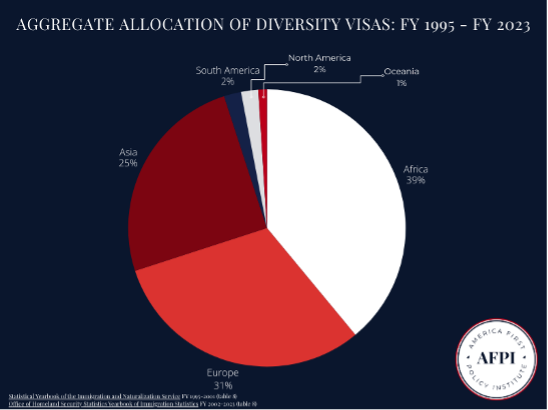
Overall, Africans and Europeans have benefited the most from the DV Program, with Asia in third place in terms of recipients. Over time, however, the number of recipients from Asia has gradually increased, and the number of recipients from Europe has gradually decreased.
Figure 1
Diversity Visa Recipients by Year and Region FY 1995-FY 2023
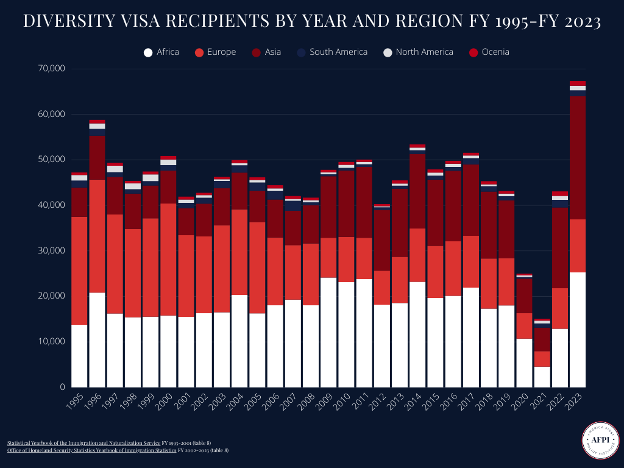
Figure 2
Aggregate Allocation of Diversity Visas: FY 1995-FY 2023
Nationals from states that sponsor terrorism are still permitted to participate in the DV Program. In FY 2023, for example, over 1,610 Iranians and 800 Cubans received diversity visas. In addition, thousands of aliens from “special interest countries” received diversity visas in FY 2023. These included aliens from Afghanistan (750), China (30), Iraq (740), Kyrgyzstan (1,970), Libya (300), Mauritania (140), Nigeria (20), Syria (200), Tajikistan (1,550), Turkey (1,480), Uzbekistan (2,790), and Venezuela (360).
Importantly, in June 2025, President Trump issued an executive order suspending the entry of certain nationals to the United States as immigrants. This travel restriction covers nationals from countries such as Iran, the Democratic Republic of the Congo, Cuba, Afghanistan, Libya, Somalia, Sudan, Yemen, Turkmenistan, and Venezuela (among others) and will override the eligibility of these nationals to receive immigrant visas through the visa lottery, so long as it is in effect. In December 2025, President Trump expanded the suspension of entry to nationals from additional countries, including South Sudan and Syria, among others.
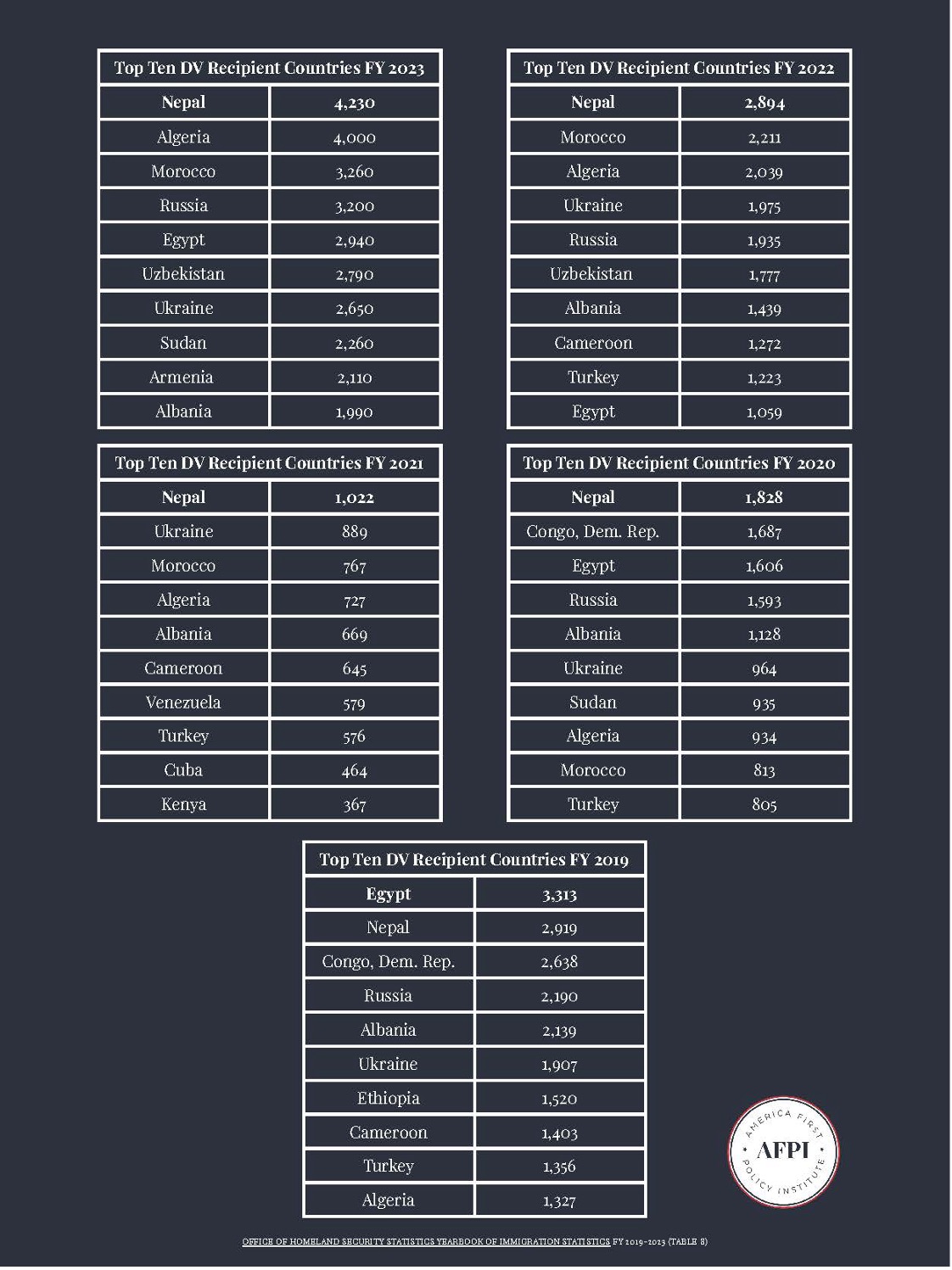
Contributing to the national security concerns is the large number of DV beneficiaries arriving from Muslim-majority countries. In FYs 2020, 2022, and 2023, six of the top ten recipient countries (counting Albania) were predominantly Muslim. This reflects growing enrollment overall in the lottery, and growing enrollment by nationals from Muslim-majority countries entering the lottery, including countries that have a history of Islamist extremism. State Department statistics show that between FY 2007 and FY 2020, enrollment in the DV Program from Muslim-majority countries increased 116%. In FY 2020 (the most recent pre-Covid year available) nationals from Muslim-majority countries comprised 44% of total enrollment in the DV Program, even though they constitute approximately 26% of the world’s population. The large number of nationals seeking diversity visas from predominantly Muslim countries, including countries with a history of Islamist extremism, through a program that is rife with fraud increases America’s vulnerability to extremists and terrorists.
Figure 3
Top Ten DV Recipient Countries FY 2019-2023
Conclusion
After 30 years, the Diversity Visa Program does not advance America’s national interest, nor was it ever designed to do so. Indeed, sold under the guise of “diversity,” the program was unabashedly designed to import less-educated, low-skilled workers of Irish descent to appease the constituencies of Northeast politicians. The program has been riddled with fraud from its inception, making security checks and eligibility determinations unreliable. Additionally, lax rules that fail to address the dangers posed by state sponsors of terrorism and other terrorist groups present significant national security concerns.
The Trump Administration has rightfully paused the Diversity Visa Program in the wake of the shooting at Brown University. America’s immigration programs should not be designed based on the ease with which foreign nationals can use (or abuse) them. Instead, such programs should place the interests of Americans first. It is time that Congress ends the DV Program and replaces it with a program that promotes merit-based immigration, where individuals are selected to come to the United States based on education, skill, self-sufficiency, and ability to contribute to our economy and society.