July 30, 2026
WISCONSIN: THE GREAT AMERICAN COMEBACK
$1,640
Average Working Families Tax Cuts for joint filers with 2+ children in Wisconsin’s 3rd District
2053
Point Beach—Wisconsin’s only operating nuclear plant—two units relicensed through 2050 and 2053
60,972
Students in Wisconsin’s four parental choice programs in 2025–26—a record high
17
Unintentional overdose deaths in La Crosse County in 2024—down from 55 in 2023, the county’s lowest total in more than 10 years
The Economy: The Working Families Tax Cuts Delivers for America’s Dairyland
The Working Families Tax Cuts (WFTC)—enacted as the One Big Beautiful Bill (OBBB) and signed July 4, 2025—delivers what supporters call the largest federal tax relief for working families in a generation, and its provisions are built for farm country: permanent 100% expensing for equipment and facilities, a permanent 20% small-business deduction (AFPI, 2025c), and a stronger dairy safety net (American Farm Bureau Federation, 2025). The America First Policy Institute’s (AFPI) Office for Fiscal and Regulatory Analysis (OFRA) estimates the law’s new worker-focused provisions alone save the 3rd District’s biggest beneficiaries—joint filers with two or more children—an average of $1,640 for tax year 2025 (AFPI, OFRA, 2026c).
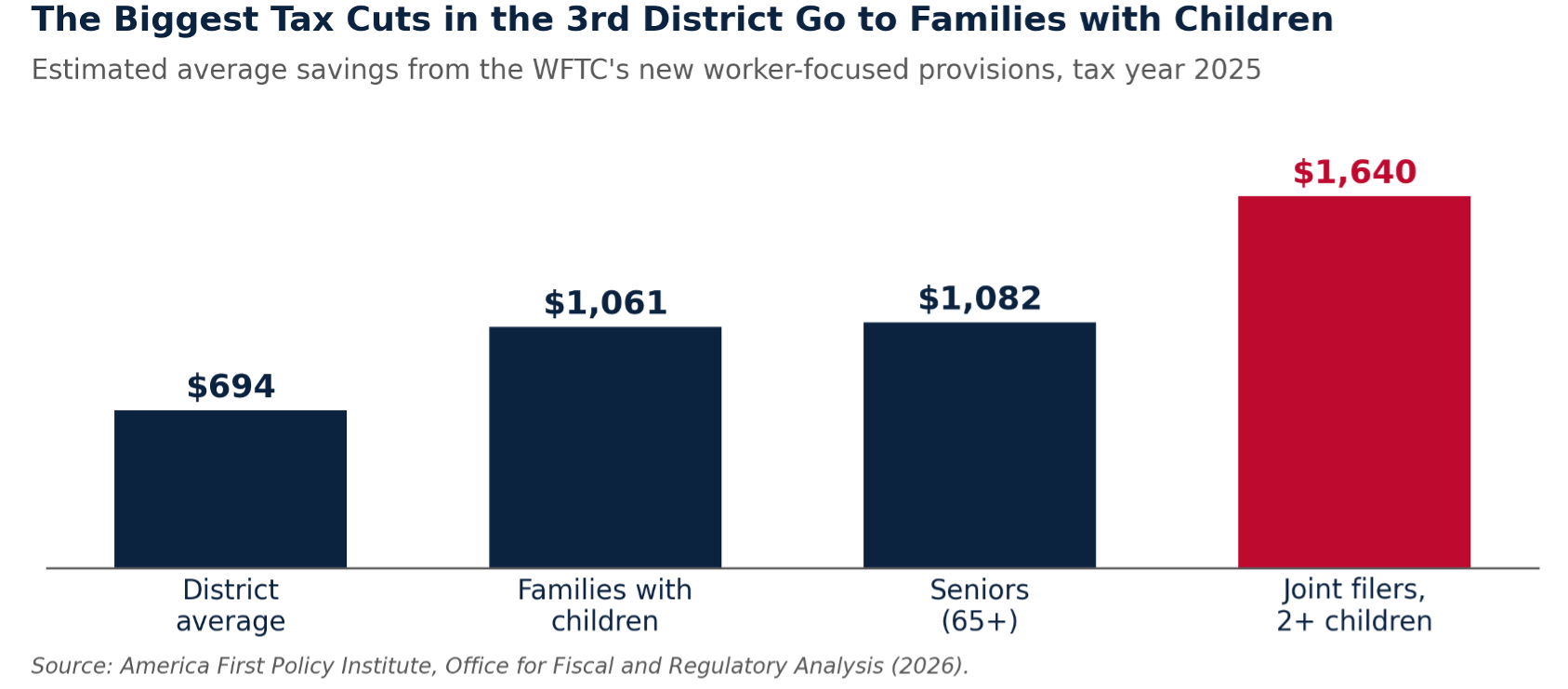
Figure 1. Estimated Average Working Families Tax Cuts Savings by Household Type, Wisconsin’s 3rd Congressional District, Tax Year 2025. Source: AFPI, OFRA (2026c).
- Wisconsin is working: The state’s unemployment rate ticked down to 3.3% in June 2026—0.9 points below the U.S. rate of 4.2%—with labor force participation at 64.5%, a full three points above the national rate (Wisconsin Department of Workforce Development [DWD], 2026). That edge has held since the close of the Biden Administration, when Wisconsin’s 3.0% stood 1.1 points below the national 4.1% in December 2024 (DWD, 2025).
- Paychecks are rising—and stretch further: Per capita personal income reached $70,570 in 2025, up 4.1% before inflation (Bureau of Economic Analysis [BEA], 2026a), and the 3rd District’s median household income was $73,367 in 2024 (Census Reporter, n.d.; U.S. Census Bureau, 2024). Overall prices run about 5.9% below the national average—with rents about 20.7% lower (2024 data) (BEA, 2026b, 2026c). Stack federal tax relief on below-average prices, and affordability becomes a western Wisconsin advantage.
- Federal reform: The WFTC delivers no tax on tips (up to $25,000), no tax on overtime (up to $12,500/$25,000 joint), a $2,200 Child Tax Credit, a new $6,000 senior deduction, and a deduction of up to $10,000 in car-loan interest on U.S.-assembled vehicles (Internal Revenue Service [IRS], 2025, 2026a). The Tax Foundation’s 2026 average-tax-cut map estimates the average Wisconsin filer saves $3,177 in 2026, below the national average of $3,813 (Tax Foundation, 2026)—but the relief looms even larger as a share of taxes owed: The average filer in the median state keeps about 15.8% of what they would otherwise pay (Brashers, 2025).
- AFPI has modeled the WFTC district by district: The new worker-focused provisions alone—one slice of the broader $3,177 statewide full-bill average for tax year 2026, which also counts permanence of the 2017 tax cuts and business provisions—save the average 3rd District filer $694 for tax year 2025, rising to $1,061 for families with children, $1,082 for seniors, and $1,640 for joint filers with two or more children (AFPI, OFRA, 2026c). Statewide, a Wisconsin nurse who works overtime keeps an estimated $1,808—about 47% more than the $1,227 a similar nurse saves in Illinois at a nearly identical wage (AFPI, OFRA, 2026a, 2026b).
- The OBBB is built for dairy and cranberry country: Wisconsin makes 25% of the Nation’s cheese—more than any other state (Cowsmo, 2025; U.S. Department of Agriculture [USDA], 2025)—and grows about 60% of its cranberries (PolitiFact, 2023), including major marshes in Monroe County, in the district (PBS Wisconsin, 2018). The OBBB locks in a $15 million death-tax exemption so family farms pass to the next generation and raises the Dairy Margin Coverage program’s Tier I cap from 5 to 6 million pounds (American Farm Bureau Federation, 2025), and AFPI estimates the bill pours $62 billion into the farm safety net and cuts taxes for farmers by more than $10 billion (AFPI, 2025c).
- The district builds the future: El Capitan—delivered in late 2024 as the world’s fastest supercomputer, and still America’s fastest (No. 2 worldwide on the June 2026 TOP500 list)—was built at Hewlett Packard Enterprise’s high-performance-computing manufacturing center in Chippewa Falls (Hewlett Packard Enterprise, 2024; HPCwire, 2021; Swinhoe, 2021; TOP500, 2026), and La Crosse–based Kwik Trip is investing more than $151 million in its dairy, bakery, and distribution operations under an expansion announced in 2023—more than 500 new jobs by 2027 (Wisconsin Economic Development Corporation, 2023).
Energy: Wisconsin’s Power Supply Is Secured for Another Generation
President Trump’s Executive Orders 14154 (Unleashing American Energy) and 14156 (Declaring a National Energy Emergency) put reliable, affordable energy back at the center of federal policy, and Executive Order 14302 (Reinvigorating the Nuclear Industrial Base) directs an American nuclear renaissance (Exec. Order No. 14154, 2025; Exec. Order No. 14156, 2025; Exec. Order No. 14302, 2025). Wisconsin produces little oil or natural gas of its own (U.S. Energy Information Administration [EIA], n.d.), so the state’s energy story is the power it builds and keeps—and in September 2025, federal regulators secured its nuclear anchor for two more decades.
- Point Beach is licensed into the 2050s: On September 29, 2025, the Nuclear Regulatory Commission (NRC) renewed the operating licenses of NextEra Energy’s two-unit Point Beach plant—Wisconsin’s only operating nuclear power plant—authorizing Unit 1 to run through 2050 and Unit 2 through 2053 (NextEra Energy, 2025; U.S. Nuclear Regulatory Commission [NRC], 2025).
- New generation is being built for a growing grid: In May 2025, state regulators approved We Energies’ $1.5 billion plan for more than 1,200 megawatts (MW) of new natural gas generation—an 1,100-MW plant in Oak Creek and a 128-MW facility in Paris—to serve surging demand, including Microsoft’s $3.3 billion data center campus under construction in Mount Pleasant (BizTimes Milwaukee, 2025).
- The district has nuclear history—and nuclear ambitions: La Crosse–headquartered Dairyland Power Cooperative, whose member cooperatives and municipal utilities serve rural western Wisconsin, operated the state’s first commercial nuclear power plant at Genoa, in the district, from 1967 to 1987—and in 2022 it signed an agreement with NuScale Power to evaluate deploying small modular reactors (Dairyland Power Cooperative, n.d.; Public Service Commission of Wisconsin, n.d.).
- More supply is the affordability play: Wisconsin residential electricity averaged 19.21 cents per kilowatt-hour in April 2026, about 2% above the national average of 18.83 cents (EIA, 2026a). Keeping Point Beach online and adding firm, home-grown generation is how Wisconsin keeps power reliable and prices in check as demand grows.
- Federal reform: Executive Order 14302 sets the goal of 10 new large reactors under construction by 2030 (Exec. Order No. 14302, 2025), and AFPI’s OBBB analysis notes the bill “maintains support to produce reliable nuclear energy through tax relief” (AFPI, 2025a). Nationally, U.S. crude oil production set another all-time record of 13.6 million barrels per day in 2025 (EIA, 2026b).
Education: The Birthplace of School Choice Keeps Breaking Records
School choice was born in Wisconsin: In 1990, Milwaukee launched the Nation’s first modern school voucher program with 337 students in seven schools (Borsuk, n.d.; Wisconsin Legislative Council, 2025). Thirty-five years later, a record 60,972 students use the state’s four parental choice programs (Wisconsin Examiner, 2025), and the OBBB’s new federal scholarship tax credit—up to $1,700 per donor—launches January 1, 2027, in states that opt in (IRS, 2026b).
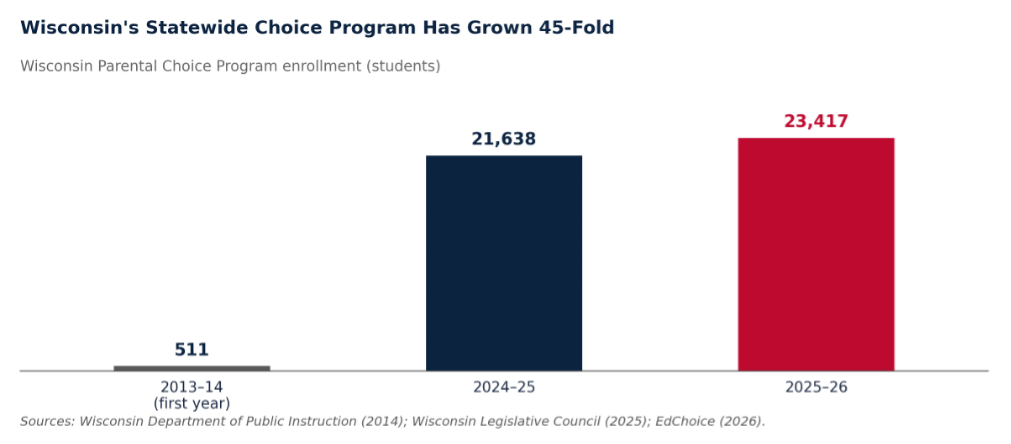
Figure 2. Wisconsin Parental Choice Program (Statewide) Enrollment, From 511 Students in Its First Year to 23,417 in 2025–26. Sources: Wisconsin Department of Public Instruction (2014); Wisconsin Legislative Council (2025); EdChoice (2026).
- Choice keeps growing: Enrollment across the Milwaukee, Racine, statewide, and special-needs choice programs rose by 2,349 students to 60,972 in 2025–26 (Wisconsin Examiner, 2025). The statewide Wisconsin Parental Choice Program has grown roughly 45-fold—from 511 students in 2013–14 (Wisconsin Department of Public Instruction [DPI], 2014) to 21,638 in 2024–25 (Wisconsin Legislative Council, 2025) and 23,417 students in 2025–26 (EdChoice, 2026; enrollment counts vary slightly by source)—and beginning in 2026–27, the statutory cap on school-district participation is gone entirely (Wisconsin Examiner, 2025).
- Choice is on the ground in western Wisconsin: Regis Catholic Schools in Eau Claire enrolls students tuition-free through the statewide choice program (Regis Catholic Schools, n.d.), and Aquinas Catholic Schools in La Crosse enrolls choice students across its preschool-through-12th-grade system (Aquinas Catholic Schools, n.d.).
- Public-school choice is a Wisconsin habit, too: In 2024–25, 75,126 students attended a public school outside their home district through open enrollment (DPI, 2025b)—a program especially valuable to rural families across the Driftless Area. And results hold up: Wisconsin students on average performed at or above the Nation in every grade and subject tested on the 2024 Nation’s Report Card (DPI, 2025a).
- Federal reform: As of July 24, 2026, 30 states had signed up for the OBBB’s federal scholarship tax credit (IRS, 2026b)—but Wisconsin is not among them: The Legislature passed a bill to opt the state in, and Gov. Evers vetoed it on March 30, 2026. Wisconsinites can still claim the federal credit for donations, but the resulting scholarships will flow to students in participating states unless Wisconsin opts in (Wisconsin Examiner, 2026). Meanwhile, Workforce Pell Grants took effect July 1, 2026, opening federal aid for short-term skills credentials (U.S. Department of Education, 2026), and Executive Orders 14190, 14191, and 14242 expand education freedom and return authority over education to the states (Exec. Order No. 14190, 2025; Exec. Order No. 14191, 2025; Exec. Order No. 14242, 2025).
- AFPI helped carry Milwaukee’s idea nationwide: Beginning in early 2022, AFPI’s Center for Education Opportunity produced more than 20 research reports, state fact sheets, and model education savings account legislation as universal school choice swept eight states (AFPI, 2023)—a movement that began in Wisconsin.
Safer Communities: Wisconsin’s Fentanyl Crisis Is Receding—and Enforcement Is Locking In the Gains
Fentanyl reached every corner of Wisconsin—including the river towns of the 3rd District. Now the tide is turning where families live: Overdose deaths are falling across Wisconsin, and La Crosse County just recorded its fewest in more than a decade. Under the Trump Administration, the border has been secured at historic speed, and interior enforcement has surged—reinforcing and locking in those hard-won gains.
- The fentanyl tide is receding in western Wisconsin: Unintentional overdose deaths among La Crosse County residents fell from 55 in 2023 to 17 in 2024—the county’s lowest total in more than 10 years (News 8000, 2025; WIZM, 2025)—and deaths were holding at that low level through late 2025 (WXOW, 2025).
- Statewide, the crisis is easing: Overdose deaths fell from a record 1,830 in 2022 to 1,185 in 2024—a drop of more than a third (Casey, 2026; Wisconsin Department of Health Services, n.d.). Nationally, overdose deaths fell almost 14% in 2025—a third straight annual decline (Centers for Disease Control and Prevention, 2026).
- Interior enforcement has surged in Wisconsin: In late June 2026, U.S. Immigration and Customs Enforcement (ICE) arrested 39 illegal aliens across the state in one of its largest Wisconsin operations since January 2025—many with criminal records including convictions for sexual abuse, drunk driving, and drug possession, according to the agency (Wisconsin Watch, 2026). ICE has made at least 1,700 arrests statewide over the past year, and roughly 80% of those arrested from January 2025 through March 2026 had prior criminal convictions or pending criminal charges (Wisconsin Watch, 2026).
- Enforcement shrinks a real fiscal burden: The Federation for American Immigration Reform, an immigration-reduction advocacy group, estimates illegal immigration costs Wisconsin taxpayers about $695 million a year—including roughly $505 million for education (Federation for American Immigration Reform, 2023). AFPI’s Wisconsin analysis urges E-Verify to shut off the illegal-hiring magnet, citing an estimated 65,000 illegal aliens working in the state (AFPI, 2025b).
- The southwest border—the corridor the Drug Enforcement Administration (DEA) identifies as a primary route for the Mexican-cartel pipeline that supplies Wisconsin’s fentanyl (DEA, 2024)—has been transformed: Southwest border apprehensions in fiscal year (FY) 2025 totaled 237,538—the lowest level since 1970—versus roughly 1.6 million in FY 2021 (House Committee on Homeland Security, 2025). In June 2026, apprehensions (9,848) were 94% below the prior administration’s monthly average, and the U.S. Department of Homeland Security (DHS) reports 14 consecutive months of zero releases at the border (Athrappully, 2026; DHS, 2026b). DHS also reports more than 675,000 removals in the Administration’s first year and, by its own estimate, 2.2 million self-deportations (DHS, 2026a).
Conclusion: The Comeback Is Compounding in Western Wisconsin
The Great American Comeback is reaching the Driftless Area. Federal tax relief worth $3,177 to the average Wisconsin filer in tax year 2026—and $1,640 in tax year 2025 to the district’s joint filers with two or more children from the worker-focused provisions alone—lands in an economy where unemployment sits at 3.3%, and America’s fastest supercomputer was built in Chippewa Falls. Point Beach is licensed to power Wisconsin into the 2050s, while La Crosse’s own Dairyland Power studies the next generation of reactors. The state that invented school choice just set another record—60,972 students—with the last statewide-program caps coming off in 2026–27. And with enforcement surging and the border secured, those hard-won gains are being locked in where it matters most: La Crosse County’s overdose deaths have fallen to their lowest level in more than a decade—and are holding there. The federal reforms are in place—western Wisconsin’s families are collecting the returns.
References