August 3, 2026
LOUISIANA: THE GREAT AMERICAN COMEBACK
This report was prepared with the support of Office for Fiscal and Regulatory Analysis (OFRA) AI tools. Published August 2026; data as of July 30, 2026.
$1,694
Average Working Families Tax Cuts for Louisiana joint filers with 2+ children
60%
Share of U.S. LNG exports shipped from Louisiana’s four export terminals in 2024
#1
Louisiana’s rank among states for reading growth on the 2026 Education Scorecard
55%
Drop in New Orleans murders since 2022—down to 121 in 2025
The Economy: Federal Tax Relief Is Accelerating a Louisiana Investment Boom
Louisiana is putting together one of the strongest growth stories in the South: a record-sized economy, back-to-back historic private investments, a sweeping state tax reform—and now the largest federal tax relief for working families in a generation under the Working Families Tax Cuts (WFTC), enacted as the One Big Beautiful Bill (OBBB) and signed July 4, 2025.
- Louisiana’s economy hit a record $354.0 billion in the first quarter of 2026—up $21 billion in current dollars from a year earlier (Bureau of Economic Analysis [BEA], 2026a)—and growth outpaced the Nation’s in the first quarter of 2026: Real GDP rose at a 2.9% annual rate, ahead of the 2.1% U.S. pace (BEA, 2026d)—while per capita personal income climbed 3.7% in 2025 to $63,940 (BEA, 2026b). Unemployment was 4.4% in June 2026—near the national rate of 4.2% and little changed from the end of 2024 (4.4% state, 4.1% U.S.)—while Louisiana employers added roughly 17,000 jobs over the past year (U.S. Bureau of Labor Statistics [BLS], 2026a, 2026b, 2026c; Muller, 2026).
- Investment is pouring in: Meta chose Richland Parish for Hyperion, the largest data center in its global fleet—and in July 2026 expanded the project to more than $50 billion, supporting more than 7,500 jobs at peak construction and 1,000 operational jobs, plus an energy agreement saving Entergy Louisiana customers $2.65 billion over 20 years (Meta, 2026; Louisiana Economic Development [LED], 2024).
- Hyundai picked Donaldsonville in Ascension Parish for its first North American steel mill—a $5.8 billion plant that will produce 2.7 million metric tons of American steel a year and create 1,300 direct jobs, with construction anticipated to begin in the third quarter of 2026 (LED, 2025a).
- The state cut taxes too: A flat 3% individual income tax took effect January 1, 2025, replacing a graduated tax with a 4.25% top rate—vaulting Louisiana from 37th to 31st on the Tax Foundation’s 2026 State Tax Competitiveness Index and from 32nd to 15th on its individual income tax component, with further gains projected as the corporate franchise tax is repealed (Tax Foundation, 2026a).
- Federal reform: The WFTC delivers no tax on tips (up to $25,000), no tax on overtime (up to $12,500/$25,000 joint), a $2,200 Child Tax Credit, a new $6,000 senior deduction, and a deduction of up to $10,000 in car-loan interest on U.S.-assembled vehicles (Internal Revenue Service [IRS], n.d., 2025). The Tax Foundation estimates the average Louisiana filer saves $2,915 in 2026—and because Louisiana incomes and tax bills are lower, the relief looms larger where it counts: Louisiana is among the handful of states where filers save the largest percentage of the income taxes they would otherwise owe—versus about 15.8% saved by the average filer in the median state (Tax Foundation, 2026b; Brashers & O’Quinn, 2025). The America First Policy Institute’s (AFPI) analysis finds the OBBB’s manufacturing investment incentives—including permanent 100% expensing—are expected to add 1.2% to long-run GDP (AFPI, 2025a).
- AFPI has modeled the WFTC state by state: The new worker-focused provisions alone—one slice of the broader $2,915 full-bill average, which also counts permanence of the 2017 tax cuts and business provisions—save the average Louisiana filer $624 for tax year 2025, rising to $785 for families with children, $1,694 for joint filers with two or more children, and $1,002 for seniors (AFPI, Office for Fiscal and Regulatory Analysis, 2026).
- Paychecks stretch further in Louisiana: Overall prices ran about 12% below the national average in 2024—with rents nearly 37% lower (BEA, 2026c, 2026e, 2026f).
Energy: Louisiana Is America’s LNG Powerhouse
President Trump’s Executive Orders 14154 (Unleashing American Energy) and 14156 (Declaring a National Energy Emergency) put affordable, reliable energy back at the center of federal policy and ended the prior administration’s freeze on liquefied natural gas (LNG) export permits (Exec. Order No. 14154, 2025; Exec. Order No. 14156, 2025)—and few states gain more than Louisiana, the home port of American LNG.
- America is the world’s largest LNG exporter, shipping a record 15.0 billion cubic feet per day in 2025—and Louisiana’s four export terminals handled three-fifths (60%) of U.S. LNG exports in 2024. Sabine Pass in Cameron Parish is the Nation’s largest LNG terminal, accounting for 39% of all U.S. export cargoes since shipments began in 2016 (U.S. Energy Information Administration [EIA], 2025a, 2026).
- New LNG projects keep coming to Louisiana: Energy Secretary Chris Wright’s first LNG export approval after the freeze was lifted went to Commonwealth LNG in Cameron Parish in February 2025 (U.S. Department of Energy, 2025), and two months later Woodside greenlit the $17.5 billion Louisiana LNG project in Calcasieu Parish—the largest foreign direct investment in state history and the first greenfield LNG project to reach a final investment decision since President Trump returned to office, supporting roughly 15,000 jobs during construction (LED, 2025b; Woodside Energy, 2025).
- Louisiana is central to the natural gas economy: The state ranks third in marketed natural gas production—about 9% of the U.S. total, anchored by the Haynesville Shale—and is home to the Henry Hub in Erath, the pricing benchmark for natural gas traded across North America (EIA, 2025a).
- Louisiana refines and moves America’s fuel: The state’s 15 refineries process almost 3 million barrels of crude oil per day—about one-sixth of the Nation’s refining capacity, second only to Texas—and the Louisiana Offshore Oil Port is the Nation’s first and only deepwater oil port (EIA, 2025a).
- Energy abundance keeps bills low: Louisiana’s average retail electricity price across all sectors was 8.80 cents per kilowatt-hour in 2024—about 32% below the U.S. average of 12.94 cents and among the lowest in the Nation (EIA, 2025b; EIA, 2025c).
- Federal reform: The OBBB raised the Gulf of America offshore revenue-sharing cap, and in March 2026 Interior made the largest disbursement ever to the Gulf states—a record $460.9 million, with more than $203 million flowing to Louisiana for coastal restoration and hurricane protection (U.S. Department of the Interior, 2026; Higgins, 2026). AFPI’s analysis details how the OBBB locks in these energy-dominance wins (AFPI, 2025b).
Education: Families Are Racing to Claim School Choice—and Students Lead the Nation’s Comeback
Gov. Jeff Landry signed the LA GATOR Scholarship Program—universal education savings accounts (ESAs) for Louisiana families—into law in 2024, with AFPI fact sheets, expert testimony, and strategic communications supporting the campaign that enacted it (AFPI, 2025c; Louisiana Department of Education [LDOE], 2025b). It is part of a national movement AFPI’s Center for Education Opportunity has supported with research reports and model ESA legislation (AFPI, 2023). The first scholarships launched in 2025–26, and families answered with one of the loudest demand signals in the country—while Louisiana students turned in the Nation’s best academic recovery.
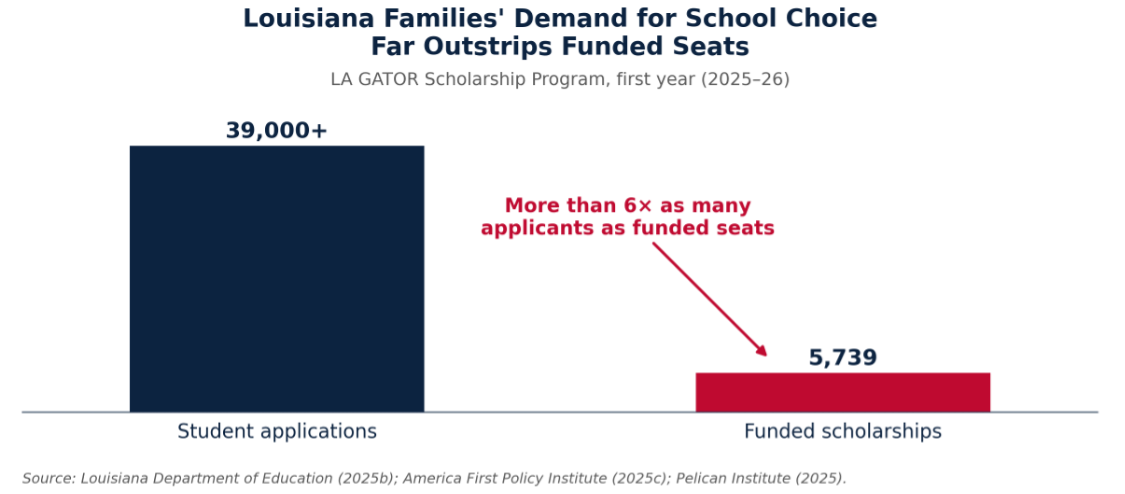
- Families want in: More than 39,000 students applied for LA GATOR in its first year—from every corner of the state—and nearly 35,000 were found eligible, but first-year funding covered just 5,739 scholarships, fewer than 700 of them for new applicants. Demand outstripped funded seats by more than six to one (LDOE, 2025b; AFPI, 2025c; Pelican Institute, 2025).
- And demand keeps building: In the program’s second application window, for 2026–27, 17,848 students applied—16,993 of them deemed eligible (LDOE, 2026a; Pelican Institute, 2026).
- The results are the Nation’s best: Louisiana ranks #1 among states for reading growth and #2 for math on the 2026 Education Scorecard from researchers at Harvard, Stanford, and Dartmouth—and is the only state where students have surpassed pre-pandemic levels in both reading and math (Education Recovery Scorecard, 2026; LDOE, 2026b).
- The Nation’s Report Card tells the same story: Louisiana fourth-graders climbed to 16th in the Nation in reading on the 2024 National Assessment of Educational Progress (NAEP)—up from 50th in 2019—after leading the Nation in fourth-grade reading growth for the second straight test cycle (National Center for Education Statistics, 2025; LDOE, 2025a).
- Federal reform: Louisiana is among the 30 states (as of July 24, 2026) already opted in to the OBBB’s first-ever federal tax-credit scholarship—a credit worth up to $1,700 for donations to scholarship organizations, effective January 1, 2027—after Gov. Landry signed the state up in December 2025 (IRS, 2026a, 2026b; Ballotpedia, 2026; Cassidy, 2025). Executive Orders 14190, 14191, and 14242 expand education freedom and return authority over education to the states (Exec. Order No. 14190, 2025; Exec. Order No. 14191, 2025; Exec. Order No. 14242, 2025).
Safer Communities: Murders and Overdose Deaths Are Falling Fast—and Louisiana’s Federal Partnership Is Reinforcing the Gains
Louisiana’s communities are getting safer—New Orleans murders and statewide overdose deaths are falling fast. Louisiana is a Gulf state, hundreds of miles from the southern land border, but the border crisis still reached its neighborhoods through the fentanyl pipeline—and today a full state-federal enforcement partnership, backed by the Trump Administration’s securing of the border, is reinforcing those gains: Gov. Landry’s “Operation GEAUX” executive order directed state agencies into U.S. Immigration and Customs Enforcement’s (ICE) 287(g) program, and dozens of Louisiana law enforcement agencies now partner with ICE (The Center Square, 2025; NOLA.com, 2025b).
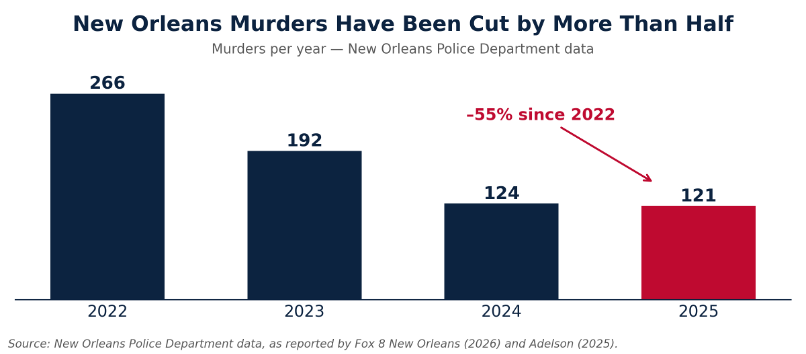
- New Orleans logged 121 murders in 2025—down 55% from 266 in 2022, when the city led the Nation in murders—and violent crime fell for a third straight year (Fox 8 New Orleans, 2026; Axios, 2025; PBS News, 2026; Adelson, 2025).
- Overdose deaths are dropping sharply: Louisiana drug-involved deaths fell 31% in a single year—from 2,456 in 2023 to about 1,700 in 2024, the lowest since 2020—with deaths involving synthetic opioids like fentanyl down 34.6% (WWNO, 2025; Louisiana Department of Health, n.d.), while national overdose deaths fell almost 14% in 2025, a third straight annual decline (Centers for Disease Control and Prevention, 2026).
- Enforcement has faces: The U.S. Department of Homeland Security (DHS) launched Operation Catahoula Crunch in the New Orleans area in December 2025; DHS says the operation logged roughly 370 arrests in its first weeks, including Jorge Vierra-Serrano, a Cuban national DHS says was convicted of forcible rape and aggravated battery, and Hung Ngoc Tran, a Vietnamese national DHS says was convicted of sexual assault and fondling a child and had defied a removal order since 2010 (DHS, 2025a, 2025b, 2025c; Fox 8 New Orleans, 2025; NOLA.com, 2025a).
- Louisiana is a model state partner: The state has banned sanctuary policies, and the Louisiana State Police, the Department of Public Safety and Corrections, and the Department of Wildlife and Fisheries have all been directed to join the 287(g) program (Federation for American Immigration Reform [FAIR], 2024; The Center Square, 2025; NOLA.com, 2025b). FAIR’s national study puts the fiscal burden of illegal immigration at $150.7 billion a year (FAIR, 2023).
- The pipeline that carried fentanyl into Louisiana is being squeezed at its source: The Drug Enforcement Administration’s (DEA) Operation Engage initiative in New Orleans—part of a field division covering Louisiana—targets fentanyl, which local officials have identified as the area’s top drug threat, along with methamphetamine (DEA, n.d.), and the DEA’s national threat assessment profiles the Mexico-based cartels that produce and traffic it (DEA, 2025)—a supply line that runs through the southwest border, where apprehensions in fiscal year (FY) 2025 totaled 237,538—the lowest level since 1970—versus roughly 1.6 million in FY2021 (House Committee on Homeland Security, 2025).
- The national gains are holding—and Louisiana’s 287(g) partnerships plug directly into them: In May 2026, southwest border apprehensions (9,998) were 94% below the prior administration’s monthly average (DHS, 2026b), DHS reports 14 consecutive months of zero releases into U.S. communities (DHS, 2026c), and the Administration’s first year saw more than 675,000 removals plus a DHS-estimated 2.2 million self-deportations (DHS, 2026a).
Conclusion: Louisiana Shows the Comeback Is Real
The Great American Comeback is accelerating Louisiana’s own momentum. Federal tax relief worth $2,915 to the average filer stacks on a new 3% flat state income tax; the Administration’s energy orders reopened LNG permitting for projects across Cameron, Calcasieu, and Plaquemines Parishes; the first-ever federal school choice dollars will reach a state where more than 39,000 students applied for scholarships in year one; and Operation Catahoula Crunch—backed by a secured border—is reinforcing declines that have brought murders and overdose deaths to lows Louisiana has not seen in years. Louisiana took the federal reforms and ran with them—and the numbers show it.
References