July 10, 2026
North Carolina Education: A National Leader in Freedom and Rising Achievement
This report was prepared with the support of OFRA AI tools.
A NATIONAL LEADER IN EDUCATION FREEDOM
North Carolina has emerged as one of America’s leading examples of education freedom and parental rights. Through home schooling, private-school choice, and public charter schools, more North Carolina families than ever are choosing the setting that best fits their children—and independent scorecards now rank the state among the strongest in the country for parental choice. That expansion of freedom is a significant achievement in its own right, apart from any single measure of public-school performance.
- Universal school choice. Beginning in 2024–25, the General Assembly removed the income cap on the Opportunity Scholarship, making all K–12 students eligible regardless of income and dropping the prior-public-school requirement (North Carolina State Education Assistance Authority [NCSEAA], 2023).
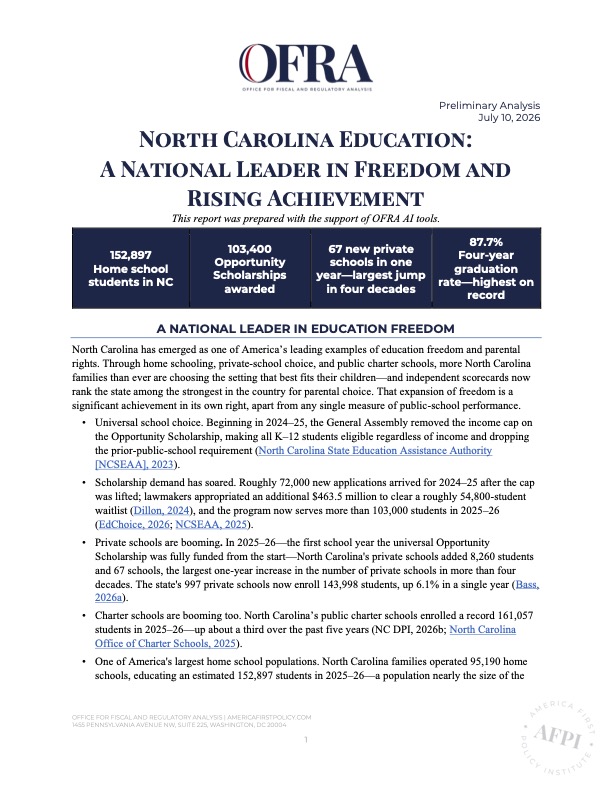
- Scholarship demand has soared. Roughly 72,000 new applications arrived for 2024–25 after the cap was lifted; lawmakers appropriated an additional $463.5 million to clear a roughly 54,800-student waitlist (Dillon, 2024), and the program now serves more than 103,000 students in 2025–26 (EdChoice, 2026; NCSEAA, 2025).
- Private schools are booming. In 2025–26—the first school year the universal Opportunity Scholarship was fully funded from the start—North Carolina's private schools added 8,260 students and 67 schools, the largest one-year increase in the number of private schools in more than four decades. The state's 997 private schools now enroll 143,998 students, up 6.1% in a single year (Bass, 2026a).
- Charter schools are booming too. North Carolina’s public charter schools enrolled a record 161,057 students in 2025–26—up about a third over the past five years (NC DPI, 2026b; North Carolina Office of Charter Schools, 2025).
 One of America's largest home school populations. North Carolina families operated 95,190 home schools, educating an estimated 152,897 students in 2025–26—a population nearly the size of the state's entire charter sector. Homeschool enrollment eased from the prior year's record of 165,243 as thousands of families moved into private schools once Opportunity Scholarships were fully funded—movement between options that is itself the hallmark of a choice-based system (Bass, 2026a; North Carolina Division of Non-Public Education, 2026).
 - Independent scorecards rank North Carolina among the leaders. The state was the single biggest gainer in the American Legislative Exchange Council’s 2025 education-freedom rankings, rising to 12th nationally, and the Center for Education Reform’s Parent Power Index has historically placed North Carolina in or near the top 10 nationally (American Legislative Exchange Council, 2025; Center for Education Reform, 2025).
- The 2026 state budget locks in the gains. On July 7, 2026, Gov. Josh Stein signed a $34 billion state budget after lawmakers rejected proposals to freeze the Opportunity Scholarship, reimpose an income cap, or cut nearly $400 million from the program (Bass, 2026b; Zhu, 2026). The budget commits up to $1 million to launch the new federal tax-credit scholarship and adds integrity safeguards, including residency verification and annual audits of at least 4% of participating schools (Bass, 2026b).
AND ACHIEVEMENT IS RISING, TOO
Expanding education freedom has not come at the expense of results. A growing body of research finds that states with more school choice tend to perform better on the Nation’s Report Card, even after accounting for demographics (Wolf et al., 2024). North Carolina’s own recent numbers point in the same direction:
- Graduation at record highs. In the 2024–25 school year, the state’s four-year high school graduation rate reached 87.7%—up from 87.0% the prior year and the highest since reporting began in 2006 (North Carolina Department of Public Instruction [NC DPI], 2025a, 2025c).
- Test scores climbed broadly. Students scored higher on 12 of 15 math and reading assessments in 2024–25 (NC DPI, 2025c), and grade-level proficiency rose to 55%, up from 54.2% the prior year—though still short of the pre-pandemic rate of 58.8% in 2018–19 (NC DPI, 2025d).
- College readiness improved. The average composite score on the ACT college-readiness exam for 11th graders rose to 18.2 (NC DPI, 2025c), and a record 54% of the Class of 2025 passed at least one college-level course during high school (NC DPI, 2026c).
- Career preparation is setting records. More than a third of North Carolina students—36.1%—took a career and technical education (CTE) course in 2024–25, the second-highest participation rate in the Nation, and CTE students earned a record 382,964 industry-recognized credentials, up 6.9% over the prior year (NC DPI, 2026d). Nearly 87,000 high schoolers also enrolled in college courses through Career and College Promise, the state’s dual-enrollment program—a 10% increase over the prior year—and North Carolina is a national leader in early college high schools, with 138 schools where students can earn a diploma and an associate degree at the same time (NC DPI, 2026a).
- Math gains on the Nation’s Report Card. On the National Assessment of Educational Progress (NAEP), North Carolina fourth graders averaged 239 in math versus 237 nationally, and the share scoring at or above proficient rose to 41% in 2024, up from 35% in 2022. North Carolina’s math results look stronger still on a demographically adjusted basis (National Center for Education Statistics, 2024; Urban Institute, 2025). Progress remains uneven, however: Average scale scores showed no statistically significant change since 2022, and the state’s reading scores tracked at or just below the national average.
FEDERAL REFORMS RETURNING EDUCATION TO FAMILIES AND STATES
The Trump Administration has moved federal education policy toward parental rights, school choice, and local control—shifts that reinforce North Carolina’s own reforms and reach families nationwide.
- • A first-ever national school-choice tax credit. The One Big Beautiful Bill, signed July 4, 2025, created a permanent federal tax credit of up to $1,700 for donations to scholarship-granting organizations, effective January 1, 2027 (America First Policy Institute, 2025; EdChoice, 2025; McDermott & Skinner, 2025).
- North Carolina opted in. In June 2026, the General Assembly overrode a gubernatorial veto to enroll North Carolina in the federal tax-credit scholarship program, extending a new stream of choice funding to eligible families (Ballotpedia News, 2026).
- Workforce Pell expands training options. The One Big Beautiful Bill also created Workforce Pell Grants, extending federal student aid for the first time to short-term career training programs running eight to 15 weeks, effective July 1, 2026. Governors, in consultation with state workforce boards, determine which programs qualify—giving North Carolina a direct hand in aligning federal aid with its high-demand fields (U.S. Department of Education, 2026).
- • Expanding educational freedom. Executive Order 14191, “Expanding Educational Freedom and Opportunity for Families,” signed January 29, 2025, directs the Department of Education to help states use federal funds for K–12 scholarships and to prioritize school choice in discretionary grants (Exec. Order No. 14191, 2025).
- Refocusing K–12 classrooms. Executive Order 14190, “Ending Radical Indoctrination in K–12 Schooling” (January 29, 2025), directs agencies to end federal support for gender ideology and discriminatory equity ideology, strengthening parental rights and protecting students from radical ideological instruction (Exec. Order No. 14190, 2025).
- • Returning authority to the states. On March 20, 2025, the president directed the secretary of education to facilitate closing the U.S. Department of Education and return authority over education to states and local communities while preserving essential services. In July 2025, the U.S. Supreme Court allowed the resulting staff reductions to proceed while litigation continues; a full statutory closure would still require an act of Congress. North Carolina lawmakers have echoed the effort, introducing House Joint Resolution 1030 to urge Congress to support devolving authority from the U.S. Department of Education to the states (DiPierro & Fensterwald, 2025; North Carolina General Assembly, 2025; Walsh, 2025).
WHY IT MATTERS FOR NORTH CAROLINA
Federal policy has real weight in North Carolina classrooms. In 2024–25, the state’s public schools received about $1.1 billion in federal funding, excluding child nutrition and pandemic-relief dollars (NC DPI, 2025b); Title I aid for low-income students accounted for roughly $518 million in 2024 (North Carolina Budget & Tax Center, 2025). Reforms that give states greater flexibility over these dollars—alongside universal choice and one of the nation’s largest home-school sectors—give North Carolina families more tools to match education to each child’s needs.
CONCLUSION
North Carolina’s recent education record is, first and foremost, a story of expanding freedom: Families now choose among home schooling, private schools, and charter schools in in record numbers overall, and independent scorecards rank the state among the national leaders in parental choice—an achievement valuable in its own right. Rising graduation rates and test scores have accompanied that shift, consistent with evidence that education freedom and achievement go together (Wolf et al., 2024). Federal reforms—a first-ever national scholarship tax credit, expanded school choice, and restored local control—build on that foundation. As these policies take effect, they stand to give North Carolina families still more power to educate their children according to their own values.
References