November 24, 2025
Nuclear Moratoria: Barriers to Affordable, Reliable Power
Banning Nuclear Energy Leads to Higher Costs FOR Everything
Many states still restrict or ban new civil nuclear plants through moratoria—laws that either prohibit construction outright or impose special preconditions (for example, a statewide referendum or poison-pill waste-repository requirements that are unneeded to assure safety). These rules suppress investment in firm, dispatchable power; raise long-run costs; and strain reliability, especially for states that have set carbon emissions goals that otherwise depend on intermittent solar and wind energy.
In an era of rising power demand, state policymakers Must EMBRACE nuclear energy
U.S. electricity demand is climbing to record highs as reindustrialization, data centers, and both consumer and industrial electrification add significant levels of new, 24/7 demand. States that wish to benefit from revived American industry and the associated jobs need firm generation capacity, not intermittent sources. Nuclear energy uniquely delivers dense, emissions-free, and reliable power that stabilizes the grid.
Nuclear Energy is Cost-Effective
- While nuclear energy has high up-front capital costs, it benefits from longevity and reliability to keep costs low over the long term.
- Like many capital-intensive projects, a nuclear plant’s initial cost is high, but once those costs are paid, the only remaining costs are operations and fuel.
- Nuclear plants are often licensed for 40 years, with 20-year extensions granted thereafter. Many plants have applied to operate for 80 years, which allows them to continue generating very cost-effective energy over many decades.
- Analysis of FERC Form 1 data from Orr and Rolling finds that the long life of nuclear assets allows existing generators to provide electricity more cheaply than existing wind and solar counterparts, with an average cost for nuclear of $26.19 per MWh nationwide compared with wind and solar, which cost $52 per MWh and $73 per MWh, respectively.
Nuclear Energy is Safe
- Contrary to scenes sometimes depicted in television, movies, or other media, nuclear energy is a safe and increasingly safer energy source with a long, stellar record of managing
its inherent risks.
- Nuclear energy is among the safest forms of energy production according to the OECD.
- The most well-known nuclear power accident in U.S. history, the partial meltdown of the Three Mile Island nuclear reactor plant, resulted in no deaths, injuries, or direct health effects (and caused less exposure to radiation than a single chest x-ray).
- Even when compared to other low-carbon emissions sources, nuclear energy is comparatively safe. Wind energy has the greatest frequency of accidents, nearly twice that of nuclear power. Both wind and solar power have higher normalized risk per TWh than nuclear energy.
- Some states have passed nuclear bans that hinge on future advancements in disposal of spent nuclear fuel (SNF), commonly referred to as nuclear “waste.” Such laws unnecessarily impede the construction of safe nuclear energy, as indefinite storage for the very small amount of SNF generated is environmentally sound and safe for people.
- "Dry cask storage” is a safe way to indefinitely store spent nuclear fuel; such systems are designed to contain radiation, manage heat and prevent nuclear fission, as well as “resist earthquakes, projectiles, tornadoes, floods, temperature extremes and other scenarios.”
- According to the U.S. Nuclear Regulatory Commission: “Since the first casks were loaded in 1986, dry storage has released no radiation that affected the public or contaminated the environment. There have been no known or suspected attempts to sabotage cask storage facilities. Tests on spent fuel and cask components after years in dry storage confirm that the systems are providing safe and secure storage.”
Nuclear Fuel Can Be Recycled
- U.S. policymakers discontinued commercial reprocessing of spent nuclear fuel (SNF) in the mid-1970’s. But reprocessing could quickly become another option available if policymakers desired (and perhaps sooner rather than later) reducing the volume of fuel to be stored by up to 80%.
- U.S. reprocessing plants operated safely for decades in Savannah River, SC; and Morris, IL.
- Other countries, notably France
but also the U.K., Russia, and Japan, have advanced reprocessing programs that recycle the up to 96% of SNF that is recoverable minerals. Indeed, more than 90% of uranium’s energy remains even after its life cycle in a traditional reactor.
- A 2006 Boston Consulting Group study found that reprocessing SNF in the U.S. could be economically competitive with direct disposal of used fuel.
Too many states retain active moratoria on new nuclear plants
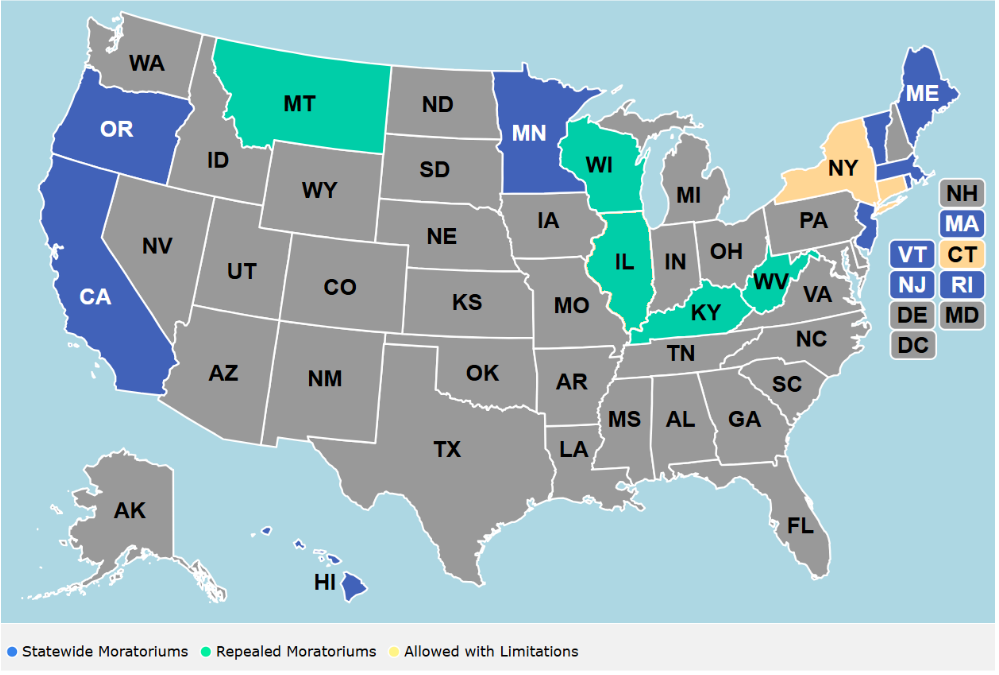
Which states currently have statewide restrictions on new nuclear energy?
- Nine states have statewide moratoria on new nuclear energy construction: California, Hawaii,[1]
Maine, Massachusetts, Minnesota, New Jersey, Oregon, Rhode Island, and Vermont.
- Connecticut and New York have narrower but still severe restrictions on new nuclear power.
- Yet ironically even states with bans, such as California and Hawaii, have nuclear-powered ships and submarines safely docked at their ports.
- Recently, several states have wisely repealed bans:
Wisconsin (2016), Kentucky (2017), Montana (2021), W. Virginia (2022), and Illinois (2025, pending the Governor’s signature).
[1] Hawaii, uniquely, has a constitutional restriction on new nuclear power.