Building Energy Dominance: A Near-Term Permitting Agenda
Key Takeaways
« Permitting delay is a hidden tax on American building, paid in higher costs, deferred investment, and infrastructure that arrives too late to meet national priorities.
« In the near term, an America First Agenda is focused on making routine work routine again, requiring timely decisions from agencies, right-sizing judicial review, and unleashing states to lead.
« If America can take initial steps to reform our broken permitting system, we will set industry on a path to achieve energy dominance, reshored manufacturing, and global AI leadership.
Preface
America is failing to build and maintain the infrastructure required for national defense, industrial revival, and the artificial intelligence revolution. The stakes are high because these priorities depend on the affordable, reliable energy that powers every industry, from advanced warfighting aircraft and cutting-edge chips for AI compute to mineral extraction and processing at home. Chief among the barriers is a federal permitting system that limits the growth of the national infrastructure needed to strengthen America’s economy, security, and technological leadership. These permitting barriers are often cast as environmental protections. Yet environmental quality has dramatically improved over the past half-century, including a 79% decline in aggregate emissions of the six principal air pollutants even as GDP, energy consumption, and population have increased (Environmental Protection Agency, 2026). Despite these advancements, regulatory frameworks have become more onerous and costly while delivering fewer practical benefits. That status quo is unacceptable.
Recognizing this, the current administration has taken bold action to help builders and workers navigate the existing system, but more fundamental reform to eliminate permitting obstacles remains necessary. This paper spells out an agenda for reforming our outdated permitting system to further the energy dominance agenda.
Introduction: Permitting Delay Is a Hidden Tax on American Building
A permitting system built for energy dominance should prioritize timely project completion, lower household costs, and the infrastructure needed for the next generation of advanced technologies. If “time is money,” delay in the project approval process is a tax on the American people. Delays occur when projects that are ready to be built spend months or years waiting for official approvals. These delays raise costs through longer financing timelines, higher interest costs, and extended periods where workers and equipment sit idle. The burden of delay is especially egregious when delay stems from process requirements that are unrelated to project safety, such as repeated paperwork submissions or duplicative agency requests. These non-substantive obstacles consume time and money without producing meaningful public benefits. Meanwhile, families and businesses suffer as much-needed infrastructure, such as roads, power plants, and transmission lines, takes longer to build or repair.
Delay imposes costs and uncertainty without producing a commensurate public benefit. Permitting delays risk America’s international competitiveness and impose high costs on the economy, workers, and American standards of living. According to a March 2026 analysis of the publicly available permitting data and survey data, “permitting delays cost [U.S.] manufacturers at least $7.9 billion every year” (National Association of Manufacturers & Foundation for American Innovation, 2026). Across society, the cost grows immensely because every American is made worse off when productivity stalls and the next generation of projects goes unbuilt or lags behind schedule. As of 2025, one analysis estimates that there is “$1.1 trillion to $1.5 trillion of infrastructure capital expenditure currently in federal permitting” (Sternfels et al., 2025). The authors estimate that the second-order effects of delay, such as unrealized spending by project workers, account for between “$1.7 trillion to $2.4 trillion in unrealized cumulative GDP.”
The fundamental problem is that our nation’s environmental laws began as relatively narrow and well-intentioned policies intended to improve and safeguard environmental quality. They are now unrecognizable, having morphed through judicial, executive, and agency interpretation into a legal regime that stifles projects. Manufacturing, energy, transportation, and maritime projects are all too slow, with too few environmental benefits to justify the laborious regulatory process.
Congress has grappled unsuccessfully with permitting reform. The most recent effort, the Manchin-Barrasso Energy Permitting Reform Act of 2024 (EPRA), reflected a budding bipartisan compromise that collapsed under the weight of unresolved political demands. Republicans made ending the previous administration’s ban on exports of liquefied natural gas (LNG) a key legislative ask, which was then obviated as the 2024 election changed the political landscape. Meanwhile, reform-minded Democrats, led by Senator Manchin, made transmission reforms a centerpiece of their bid. This issue remained a point of skepticism for many conservatives, as poorly structured transmission buildouts managed by monopoly utilities can serve as an implicit, taxpayer-financed subsidy for solar and wind. Ultimately, more ambitious reform proposals will be needed across a wider range of permitting issues than EPRA identified.
A broader reform horizon may seem daunting, so reformers can focus the reform opportunity by first targeting the near-term reforms that would reduce delay where delay is least defensible and most costly. Many commonsense reforms would accelerate project delivery while preserving substantive environmental protections. This paper, therefore, focuses on four priorities: simplifying approvals for routine work, ensuring timely processing of permit applications, ensuring balanced review of projects by the courts, and devolving more permitting work locally where federal law can safely delegate authority, recognize state work, or avoid duplicative review.
Near-term reforms to prioritize
First, an America First agenda supports reforms to simplify the permitting involved in routine work. Excessive permitting requirements restrict routine operations and slow down projects. These unnecessary permitting delays are often defended as environmental safeguards, but process burdens that do not meaningfully reduce environmental risk no longer serve that purpose. The aim should not be to weaken substantive environmental protections, but to make regulatory review proportionate to real-world risk, restore accountability to the approval process, and remove procedural bottlenecks that needlessly raise the cost of building energy, industrial, and other strategic infrastructure.
To allow American projects to more efficiently conduct routine work, Congress could prioritize near-term permitting reforms that reduce delays where they are least defensible and most costly. Projects that repair, replace, modernize, expand, or repower existing facilities usually present less uncertainty than a wholly new development on untouched land. A better statutory framework would reflect that difference through faster approval processes. Congress could also expand standardized pathways such as categorical exclusions and general permits for recurring low-risk work, especially at existing industrial sites, brownfields, rights-of-way, and previously disturbed lands. Lawmakers could also take steps to allow broader practical use of prior analyses rather than requiring agencies to start from scratch each time. These improvements would build on reforms already in federal law, allowing agencies to rely on programmatic environmental documents and to adopt another agency’s categorical exclusions as appropriate.
Second, an America First agenda supports reforms to make permitting deadlines enforceable. Agencies should have a fixed deadline to determine whether an application is complete, another deadline to identify missing information, and a firm deadline to approve or deny an application once review is underway; any extensions should be narrow, justified, and exceptional. Where deadlines already exist, Congress could ensure that agencies cannot ignore them without consequence. Deadlines without consequences create perverse incentives, so an America First agenda supports reforms to pair them with meaningful accountability measures, including supervisory escalation, public reporting, and other remedies that make inaction harder to hide. The recommendations below explain how Congress can apply this approach across the permitting process.
Third, an America First agenda supports reforms to right-size judicial review. Currently, litigation is creating a second layer of permitting requirements that may delay projects for years. Legal claims should be brought promptly, and remedies should be tailored to address any legal defects, rather than becoming a project-wide veto. When the problem is narrow, the remedy should be similarly narrow, and the agency should be directed to fix it on a clear and prompt timetable. The Supreme Court recently reaffirmed that the National Environmental Policy Act (NEPA) is a procedural statute, not a substantive command to reach particular environmental outcomes, and Congress could codify that understanding. Congress could reinforce that litigation exists for real legal errors, not to function as a second permitting regime.
Fourth, an America First agenda supports reforms to let states lead where federal law can safely delegate authority or recognize state review. Too often, federal permitting duplicates work that has already been done satisfactorily by state agencies, which subjects projects to another permitting process without adding meaningful environmental protection. States are closer to the lands, communities, infrastructure needs, and economic tradeoffs under review and can often move faster while remaining accountable for environmental review. Congress could build on models such as the Department of Transportation’s State Assignment Program by expanding state assumption of federal environmental-review responsibilities, and by allowing federal agencies broader license to use adequate, relevant, and current environmental documents from the states. These reforms would preserve substantive safeguards by reducing duplicative efforts and allowing more decisions to be made closer to the communities most affected.
Section I: Make Routine Work Routine Again
Policymakers should right-size review to actual impacts
Simplifying routine work means making maintenance, repair, expansion, and modernization at existing previously disturbed sites easier when the work does not introduce new environmental risks. The current system often treats routine work as if it were a new project on untouched land. A survey of U.S. manufacturers found that in the past decade, 63% had encountered issues with the permitting system when “adding or modifying production equipment” (National Association of Manufacturers & Foundation for American Innovation, 2026). That mismatch consumes agency time, delays work that should be straightforward, and raises costs without corresponding public benefits. The same survey found that 51% of respondents prioritized making small upgrades easier to permit and that 44% prioritized speeding up renewals when operations had not materially changed (National Association of Manufacturers & Foundation for American Innovation, 2026). These findings show that the permitting problem is not limited to large new projects; it also affects ordinary equipment changes, small upgrades, and renewals that should be among the easiest categories of work to process. Routine work should move through a streamlined review, while a full review should be reserved for actions that raise genuinely new or uncertain risks.
Faster pathways for modernization should be expanded
Routine projects that upgrade, replace, or modernize existing assets often present a more predictable impact profile than new development on untouched sites. The law could reflect that reality by making these categories easier to review and approve. Reforms along these lines would allow firms to replace aging equipment, install safer and more efficient technology, and extend the useful life of existing facilities.
Recommendation: Amend New Source Review provisions to streamline reviews for existing facilities, modernizations, and upgrades
Under the Clean Air Act, Congress could amend New Source Review (NSR) provisions to create a streamlined review process for existing facilities seeking to modernize equipment, upgrade pollution controls, or make efficiency improvements. That change would allow firms to install cleaner, safer, and more efficient equipment while distinguishing maintenance and modernization at already-approved facilities from new projects requiring ground-up review, thereby reducing delays and costs while preserving more comprehensive review for changes that materially increase emissions or other impacts. The New Source Review Permitting Improvement Act offers one model for reform by limiting NSR applicability to changes at existing facilities that would increase the facility’s legally significant emissions capacity, including whether it can emit more pollution per hour than it could at any point during the prior 10 years (H.R. 161, 2025).
Recommendation: Reform National Ambient Air Quality Standards to exclude foreign emissions, natural emissions, and other non-controllable events from nonattainment designations
Clean Air Act reform could also address how national ambient air quality standards (NAAQS) can constrain new investment even when local sources are not the real cause of measured air quality problems. Jurisdictions that fail to meet NAAQS (“nonattainment areas”) can face substantial penalties, including fines and delays or cancellations of projects. Current policy fails to distinguish between domestically produced emissions and foreign emissions that drift into U.S. jurisdictions (America First Policy Institute, 2026). The FENCES Act offers a reform model by clarifying that emissions originating outside the United States do not count for the purposes of establishing nonattainment designations where an area would attain the relevant standard save for the foreign emissions (H.R. 6409, 2025). The CLEAR Act would implement additional, helpful reforms by including exemptions for other non-controllable events, such as risk mitigation for wildfires, and revising the NAAQS review cycle to occur every ten years instead of every five years; it would also allow the EPA to consider whether NAAQS standards are attainable and give states more opportunities to correct deficient State Implementation Plans (SIPs) (H.R. 4218, 2026). Together, such reforms would help ensure that normal work is not slowed or penalized for emissions outside the control of U.S. builders and developers.
Recommendation: Expand NEPA categorical exclusions to include maintenance, repairs, upgrades, and plan modifications that do not increase environmental risks
Under NEPA, Congress could expand categorical exclusions, or CATEXs, for upgrades, maintenance, and repair at existing facilities and lease sites, and modifications to existing plans that do not pose new risks to the environment. CATEXs offer a streamlined method for NEPA compliance and are designed for categories of actions that do not normally have significant effects on the human environment and therefore should not require a new environmental assessment or environmental impact statement.
Determinations should not be reinvented from scratch
The federal government need not require each agency to reinvent the same low-risk determination. When one agency has already established a sound categorical exclusion for a recurring activity, another agency should be able to adopt that definition and apply that exclusion where the proposed action is similar.
Such a concept has garnered support across a range of political climates and has shown promising progress in the last few political cycles. President Trump’s 2017 Executive Order on “discipline and accountability” helped speed environmental review (Executive Order 13807, 2017). Congress later gave agencies a more concrete tool in the Fiscal Responsibility Act, which amended NEPA to allow agencies to adopt categorical exclusions listed in another agency’s NEPA procedures under 42 U.S.C. § 4336c (2024). It also allowed agencies to rely on prior programmatic environmental documents for related actions under 42 U.S.C. § 4336b, reducing the need to redo broad analysis that has already been completed (2024).
Building on this momentum in 2025, the Bureau of Land Management and Bureau of Indian Affairs used that authority to adopt a series of Department of Energy categorical exclusions for recurring activities including reconductoring and other upgrades to existing transmission facilities in previously disturbed or developed facility areas, adding fiber-optic lines within existing rights-of-way or previously disturbed utility corridors, and upgrading or rebuilding existing powerlines within existing rights-of-way or otherwise previously disturbed or developed lands (U.S. Department of the Interior, Bureau of Land Management, & Bureau of Indian Affairs, 2025). Other agencies, such as the Department of Energy, Federal Energy Regulatory Commission, U.S. Army Corps of Engineers, and Bureau of Land Management, have taken similar steps (National Petroleum Council, 2025).
Recommendation: Allow agencies to use NEPA categorical exclusions and prior programmatic environmental reviews when reviewing substantially similar actions
Congress could go further by ensuring that agencies can use legislatively enacted categorical exclusions where the underlying category of activity is substantially similar. In addition, the current five-year limit on reliance without reevaluation could be replaced with a more functional standard. If an earlier programmatic analysis remains relevant to the action at hand, agencies should be able to reuse it rather than prepare a new, redundant document simply because time has passed. The House-passed SPEED Act would move current law partway in this direction by amending NEPA section 109 to allow agencies to adopt categorical exclusions not only from another agency’s procedures, but also when those exclusions were legislatively enacted by Congress (H.R. 4776, 2025). The principle applies especially to redevelopment on land and corridors that have already been used, studied, or built out.
Recommendation: Streamline development on disturbed and previously developed sites
Previously disturbed land, retired industrial sites, brownfields, and existing corridors generally present less uncertainty than untouched land. This is where the principle of reusing prior determinations is particularly beneficial. These sites commonly present less uncertainty since the land use is already known, access routes and utility corridors may already exist, prior environmental information may be available, and the project is less likely to disturb untouched land.
To that end, an America First reform agenda supports clarifying that qualifying redevelopment on covered brownfield locations is not, by itself, a major federal action under NEPA, for which designation as such triggers additional environmental review. The draft Brownfields Inventory and Permitting Efficiency Act offers one such model for “nationally significant infrastructure facilities,”[1] (2026). Such an approach would make it easier to reuse already disturbed land for important projects instead of pushing development toward untouched sites and longer review timelines.
Permit-by-rule and general permits can speed projects
Permit-by-rule (PBR) and general-permit systems streamline the approval process for recurring, low-risk activities, without abandoning environmental safeguards. This is because the impacts of such projects are predictable and manageable, so project-specific permitting structures such as EISs and EAs are often unnecessary. Examples of existing streamlined authorization systems include FERC’s blanket certificate program under the Natural Gas Act, permit-by-rule and similar standardized air-permitting programs under the Clean Air Act, and Nationwide Permits issued by the U.S. Army Corps of Engineers for activities related to oil and gas pipelines and electric utility lines, among others (U.S. Army Corps of Engineers, 2026).
Recommendation: Expand permit-by-rule systems, general permits, and blanket-certificate thresholds to expedite recurring low-risk activities
Permit-by-rule and general permits share the underlying aims of identifying recurring categories of activity, setting standard eligibility criteria and operating conditions, and reducing the need for case-by-case permit drafting. Models differ among jurisdictions. In some permit-by-rule systems, the rule itself supplies the operative permit conditions, and coverage becomes effective once the source makes any required filing or registration.[2] In others, the rule functions even more automatically, with no individualized permit application unless the regulator later requires one.[3] These programs help build, expand, and maintain needed infrastructure faster by reducing redundancies in the process and could be expanded for recurring and low-risk activities.
An America First agenda supports expanding these tools. For example, the Clean Air Act authorizes states to implement their own permitting programs, including permitting by rule. To ensure that states can benefit further from PBR structures, Congress could clarify that states may use EPA-approved PBRs that have already been adopted by other states (National Petroleum Council, 2025). Congress could also consider further reforms to broaden the reach of PBR structures, including by requiring agencies to meet a deadline to identify recurring low-risk categories and place them on a schedule for conversion into permit-by-rule, general-permit, or notice-of-coverage pathways. An example of such reforms can be found in the FREE Act, which would direct agencies to evaluate their permitting systems, consider whether permitting by rule could replace existing processes in whole or in part, and establish written standards for permit-by-rule systems where adopted (H.R. 689, 2025).
Congress could likewise expand the reach of existing programs by permanently increasing FERC blanket-certificate thresholds, as well as by expanding their reach by project type,[4] and by extending the CWA’s section 404(e)(2) general-permit term from five years to ten years. Together, these recommendations—expanded categorical exclusions, broader reuse of prior analyses, fast lanes for projects on brownfield sites, and increased access to general-permit and PBR systems—would speed recurring, low-risk activity by converting from-scratch compliance processes into more streamlined and predictable ones. These reforms would reduce duplicative or unnecessary paperwork, shorten avoidable delays, lower project compliance and financing costs, and allow agencies to focus on projects that present genuinely new or uncertain risks.
Section II: Require Timely Decisions from Agencies
For projects that require individual review, long approval timelines must be shortened. Delay can cause needed projects to go unbuilt, arrive too late, or become more expensive. The problem can be especially significant for capital-intensive projects in the mining, energy, and industrial sectors, leading to greater dependence on foreign supply chains and lower domestic capacity. Several analyses demonstrate the need for reforms. In 2020, CEQ found that “for final EISs, the average document length was 661 pages… and the median document length was 447 pages,” while the 75th percentile for page length was 748 pages or longer (Council on Environmental Quality, 2020b). A separate 2020 CEQ timelines report found that the average time from notice of intent to record of decision for EISs completed from 2010 to 2018 was 4.5 years, with a median of 3.5 years (Council on Environmental Quality, 2020a). As depicted in Figure 1, a more recent CEQ report using a revised methodology found that the median time from notice of intent to final EIS for final EISs issued from 2019 to 2024 was 2.8 years (Council on Environmental Quality, 2025; Council on Environmental Quality, 2020b).[5]
Figure 1
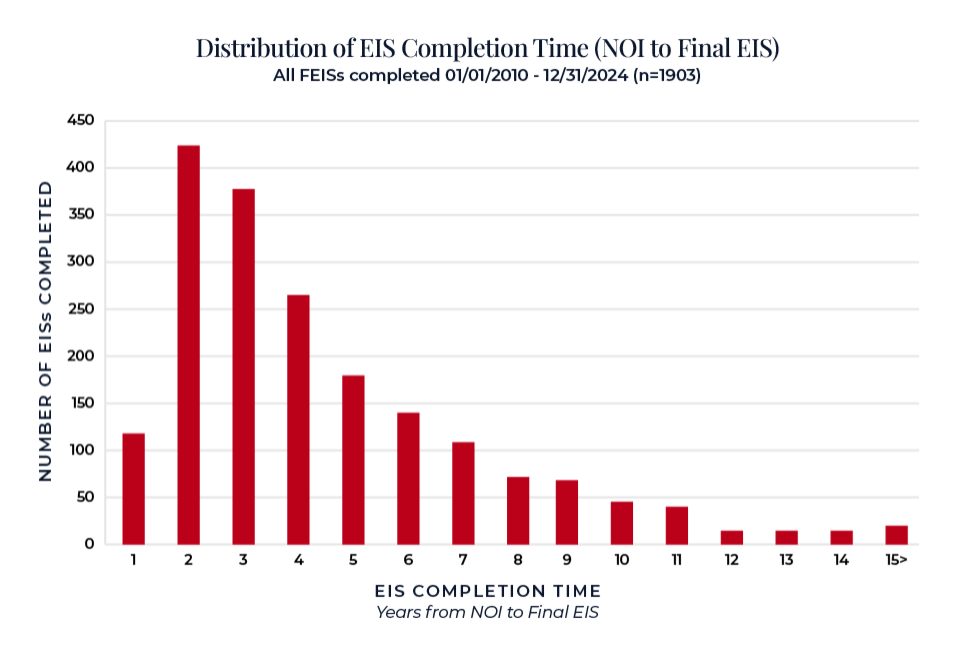
Note. Data from Environmental Impact Statement Timelines (2010–2024), by the Council on Environmental Quality, 2025, Figure 3 and underlying Excel workbook (https://ceq.doe.gov/docs/nepa-practice/CEQ_EIS_Timeline_Report_2025-1-13.pdf).
This reflects the skewed nature of EIS completion timelines, where many applications are completed within two years, while those at the high end take up to 15 years or longer, as seen in Figure 2. Worse, the skew becomes more unfavorable when examined on a sector-by-sector basis. The longest permitting timelines are found in the sectors that most urgently need permitting acceleration to further the agenda of unleashing America’s energy and natural resources: mining averages eight to nine years, while oil and gas pipelines, energy generation, and electricity transmission each average roughly four to five years (Sternfels et al., 2025). At a time of increasing energy and electricity demand, as well as strategic geopolitical competition with China, sustaining such delays is not a conscionable policy outcome—America must build the reliable energy and industrial capacity needed to secure our prosperity.
Figure 2
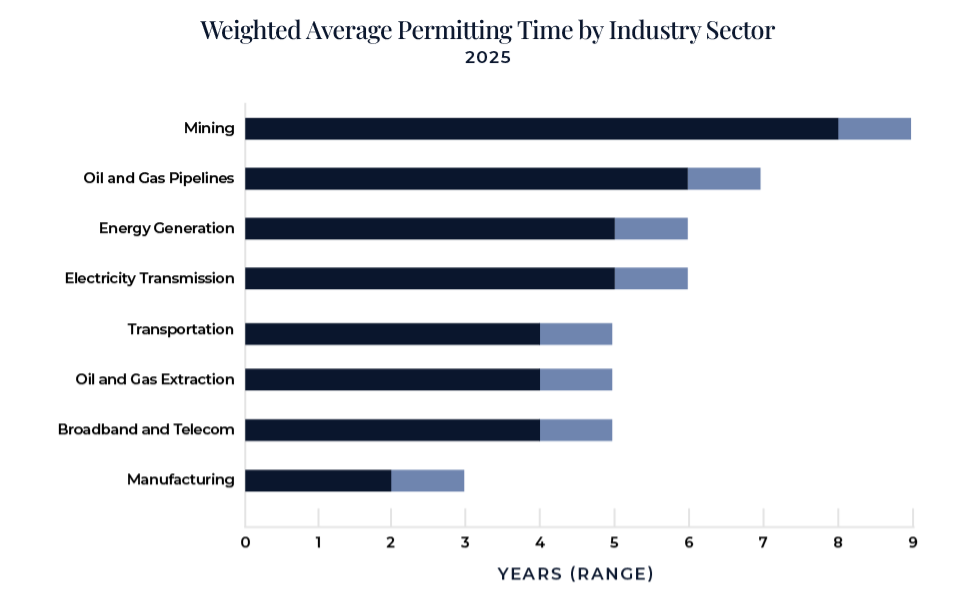
Note. Data from Unlocking US federal permitting: A sustainable growth imperative, by Sternfels et al., 2025, Exhibit 2 (https://www.mckinsey.com/industries/public-sector/our-insights/unlocking-us-federal-permitting-a-sustainable-growth-imperative).
Recommendation: Require enforceable deadlines for each major stage of the permitting process
The losses stemming from unwarranted permitting delays are not recoverable. However, future losses could be prevented through enforceable permitting deadlines. Agencies have deadlines set under established law and regulation. Congress could ensure that they are meaningful, enforceable, and that agencies are held accountable to them, especially through the avenues outlined later in this brief. Yet even as we urge reform, we note up front that better enforcement of deadlines must be part and parcel of a larger permitting reform package and should be paired with the litigation reforms suggested in the subsequent section.
Set a front-end completeness deadline
An America First agenda promotes policies that define clear deadlines for determining whether an application is complete prior to the start of the formal review process. Agencies should have a fixed period to say whether an application is complete and, if not, what is missing. Without a front-end deadline, agencies can delay a project before real review even begins by leaving an application in limbo or by issuing repeated, non-delimited requests for additional information before a formal clock starts. Congress could require agencies to publish clear filing requirements in advance and then identify any missing material within a defined timeframe. If the agency misses that deadline, the review clock should begin regardless, which would bring order to the front end of the process. NEPA’s right-of-way provisions already recognize the concept of a completeness trigger, where the statutory deadline for an EA or EIS may run from the date an agency notifies the applicant that the application is complete.
Recommendation: Require a front-end completeness deadline to prevent unreasonable delays before review begins
Congress could extend that kind of front-end clarity across the broader federal permitting system. This requirement would apply wherever project sponsors must submit an application or request for certification before review can begin. Under Clean Water Act section 401, for example, Congress could build on the existing receipt-based timing framework by requiring a prompt front-end determination and an early written identification of missing material.
Once the government determines that an application is complete, it should promptly issue a decision. Congress could pair each major step in the approval pathway with a clear deadline for approval or denial and allow extensions only in narrow and justified circumstances. Existing law under NEPA already imposes one-year and two-year deadlines for environmental assessments and environmental impact statements in many cases, while also allowing a project sponsor to go to court if an agency misses an applicable deadline. Congress could broaden the approach across the various permitting processes. The SPEED Act contains reforms along these lines, including a 60-day deadline for agencies to document receipt of the application and determine whether it is complete, or identify additional information needed for review (H.R. 4776, 2025).
Recommendation: Reduce FAST-41 cost thresholds to expedite permit processing for mid-sized projects
For projects that require multi-agency coordination, Congress could also lower the cost threshold for project inclusion under FAST-41[6] from $200 million to a lower threshold, such as $50 million. Many mid-sized energy, mineral, and industrial infrastructure projects face delays across multiple agencies, but are too small to qualify for FAST-41. Lowering the threshold would offer other important projects access to coordinated timetables, increased permitting transparency, and improved interagency accountability.
Agencies should file one consolidated information request
Once an application is filed, the agency should have a single, fair opportunity to say what is missing. Non-delimited requests for more information convert the process into a moving target and make project planning nearly impossible. The Jordan Cove LNG terminal and Pacific Connector pipeline illustrate the problem at hand. Jordan Cove filed with FERC in May 2013, and Pacific Connector followed in June 2013 (Jordan Cove Energy Project, L.P., 2013). Between May 2014 and October 2015, Commission staff sent Pacific Connector four data requests seeking precedent agreements or other evidence of need (Federal Energy Regulatory Commission, 2020).
Recommendation: Require one consolidated agency request for additional information early in the review process
Though this was not the only issue at hand with the project, Congress could require agencies to issue one written request for missing information early in the process, with any later requests limited to material changes by the applicant, genuinely new information, or other unusual circumstances. The SPEED Act would partially address this problem by requiring an agency, within 60 days of receiving an application, either to notify the applicant that the application is complete or to request in writing the additional information needed to determine completeness and to begin preparing an environmental document (H.R. 4776, 2025).
Consequences are needed for missed deadlines
Recommendation: Require accountability measures and penalties when reviewing agencies miss permitting deadlines
Deadlines without consequences are just aspirations. A stronger reform agenda would make delays costly to the government. The right consequence can vary by permit type, and reformers have proposed many solutions. Among them, the UNSHACKLE Act, introduced in the 118th Congress, would impose penalties for noncompliance, including docking the salary of the relevant agency’s head, reimbursing applicant fees, and treating a permit or authorization as approved if it is not issued or denied within the bill’s deadline (S. 5323, 2024). The FREEDOM Act would also strengthen consequences for agency delay by making certain missed permitting deadlines judicially reviewable and by allowing a reviewing court to authorize a qualified contractor to complete needed analysis or documentation—so that the onus would be on the agency to make a final decision, rather than allowing unfinished paperwork to be an excuse for inaction (H.R. 7329, 2026). The bill would also protect fully permitted projects from being halted except in narrow circumstances (H.R. 7329, 2026). Many other proposals exist, and of course, no single remedy will fit every permit. However, the overall principle should be simple: when the government misses a statutory deadline, the agency’s legal position should worsen, not remain unchanged while the applicant waits.
Section III: Right-Size Permitting Litigation
Litigation should not act as a second permitting system
Unfortunately, difficulties for project developers do not end with the agency permitting gauntlet. Once the permitting process concludes, many critical projects face litigation from activists, and an increasing number of thought leaders today describe this as a top barrier to timely and judicious permitting (McPherson-Smith, 2023; National Petroleum Council, 2025; Poole, Jr., 2024). The frequency and seeming inevitability of having to defend against activist-driven lawsuits tend to compel planners and builders to produce ever-larger, more complicated permitting applications to “litigation-proof” their work, thereby exacerbating already-slow permitting timelines (National Petroleum Council, 2025). This is true even as agencies win a strong majority of cases related to the challenges filed, implying that many lawsuits may be weak or delay-oriented (Chiappa et al., 2024).
Numerous studies document the impact of a burdensome litigation process. For example, a study from Stanford University found, assessing 171 large energy projects and 184 large transportation projects, that some categories of projects faced “average litigation rates of 50% or more, with permit process duration averaging as much as seven years for energy projects” (Bennon & Wilson, 2023). A 2024 analysis of 387 NEPA cases in federal appellate courts, 2013-2022, found that an average of 4.2 years elapsed between publication of an environmental impact statement or environmental assessment and conclusion of the corresponding appellate challenge (Chiappa et al., 2024). A 2025 follow-up to this analysis surveyed 423 energy-related NEPA challenges and found that roughly 7% of energy projects included in the analysis were litigated for more than six years (Trembath et al., 2025). This is especially concerning for the energy dominance agenda because reliable fossil fuel projects accounted for 66% of all challenged energy projects (Trembath et al., 2025).
The impact of this litigation is substantial simply in the delay produced. Judge Karen LeCraft Henderson of the D.C. Circuit Court of Appeals, concurring in Appalachian Voices v. Federal Energy Regulatory Commission, observes that though the “cottage industry that uses the nation’s environmental laws to retard new development” rarely wins on their “dubious claims” they nonetheless “emerge victorious because delay is the coin of the realm” (Appalachian Voices v. Federal Energy Regulatory Commission, 2025). It would seem that the litigation process is both a punishment and a strong disincentive for builders to even consider projects that might improve communities or strengthen the nation. Judge Henderson further notes that, “developers—overwhelmed by the torrent of challenges—often abandon their projects rather than weather the storm. Many more are cowed from even entering the market” (Appalachian Voices v. Federal Energy Regulatory Commission, 2025).
Unfortunately, NEPA has been transformed into a law that no longer usefully serves its original purpose. The majority opinion for the Supreme Court’s 8-0 ruling in Seven County Infrastructure Coalition v. Eagle County reflects this well:
NEPA has transformed from a modest procedural requirement into a blunt and haphazard tool employed by project opponents (who may not always be entirely motivated by concern for the environment) to try to stop or at least slow down new infrastructure projects. Some project opponents have invoked NEPA and sought to enlist the courts in blocking or delaying even those projects that otherwise comply with all relevant substantive environmental laws … Delay upon delay, so much so that the process seems to border on the Kafkaesque. Fewer projects make it to the finish line. Indeed, fewer projects make it to the starting line. Those that survive often end up costing much more than is anticipated or necessary, both for the agency preparing the EIS and for the builder of the project. (Seven County Infrastructure Coalition v. Eagle County, 2025)
For the energy projects the United States must bring online to maintain adequacy, the impact has been substantial. The National Petroleum Council observes how permitting has slowed the growth of reliable generation, documenting that between 2013 and 2024, “natural gas demand increased by 49%, while pipeline capacity grew only 26%, and storage capacity rose an incremental 2% from 2013 to 2023” (National Petroleum Council, 2025).
Prevent NEPA from becoming a sector-wide veto
Permitting review should focus on the action before the agency, not become a platform for collateral policy fights about an entire sector. An untethered scope creates the potential for endless litigation. Several reforms are needed in this space to ensure an appropriately narrowed scope for judicial review.
Recommendation: Codify the Seven County ruling to keep agency reviews focused on projects within the agency’s regulatory authority
First, an America First reform agenda supports codifying the holdings established in Seven County. Specifically, Congress could clarify that NEPA is a procedural statute, not a substantive one, and does not mandate specific environmental outcomes. Additionally, Congress could make clear, as stated in the case, that “agencies are not required to analyze the effects of projects over which they do not exercise regulatory authority,” that agencies are not required to consider “the environmental effects of upstream and downstream projects that are separate in time or place,” and that NEPA does not allow courts to “delay or block agency projects based on the environmental effects of other projects separate from the project at hand” (Seven County Infrastructure Coalition v. Eagle County, 2025). The SPEED Act adopts reforms along these lines, including by defining “reasonably foreseeable” effects narrowly (H.R. 4776, 2025).
Recommendation: Tie agency reviews to the project proposal, not remote or speculative effects outside the agency’s control
Under the same broad principle, the ESA Amendments Act of 2025 would require section 7 consultations to focus on effects that are caused by the action itself and reasonably certain to occur. It also requires consultations to confine the action area to the area directly affected, building on the idea that federal review should be tied to the project actually before the agency rather than remote or speculative effects (H.R. 1897, 2025).
Petitioners must have a concrete stake in any litigation
Judicial review should remain available to parties with a real stake in the outcome, but it should not operate as a general anti-development weapon. Under current doctrine, constitutional standing requires injury in fact, causation, and redressability: that the plaintiff has suffered or imminently will suffer a “concrete and particularized injury” which is “traceable to the allegedly unlawful actions of the opposing party,” and that the injury “is redressable by a favorable judicial decision” (Legal Information Institute, n.d.). The Supreme Court has also recognized that aesthetic and recreational injuries can qualify when they are personally experienced, and that organizations may sue on behalf of members when the requirements for “associational standing” are met (Lujan v. Defenders of Wildlife, 1992; Sierra Club v. Morton, 1972; Hunt v. Washington State Apple Advertising Commission, 1977).
Current doctrine still leaves substantial room for litigation by parties whose connection to a project is thin, generalized, or strategically constructed for purposes of delay. That is a serious problem for an economy that needs to build pipelines, transmission lines, generation, and industrial facilities on predictable timelines. Such legal developments have contributed to the formation of a supercharged litigation system where project developers must, “as night follows day,” defend themselves in court against groups who claim no proximate relation to the project and against whom no direct harms can be demonstrated (Citizens Action Coalition of Indiana, Inc. v. Federal Energy Regulatory Commission, 2025). This is not justice, and it certainly is not how America will succeed in building world-class energy infrastructure.
Recommendation: Limit judicial review to issues raised during public comment, while preserving review for parties with a concrete and particularized injury
Congress need not eliminate meaningful public participation to curb abuse. It can preserve room for serious conservation concerns and project-specific objections while making it harder for remote actors to use weakly connected injuries as a pretext for obstruction. AFPI has previously recommended NEPA reform provisions that “strike a common-sense balance between facilitating public input and limiting efforts by opportunistic activists to hamstring developments” (McPherson-Smith, 2023). Specifically, reforms could “make judicial review claims contingent upon the prior submission of public comment during an agency’s administrative proceedings,” and “only allow judicial review claims based on issues raised within those previously submitted comments” (McPherson-Smith, 2023). Congress could also ensure that standing to sue under NEPA is limited to those who can demonstrate direct harms. The SPEED Act would enact partial reforms along these lines by requiring prior substantive participation in the comment process for many claims and by narrowing who may sue (H.R. 4776, 2025). Similarly, for litigation under the Clean Air Act’s (CAA) citizen-suit provisions, the Fair Air Enforcement Act would limit standing for enforcement litigation to state governments and relevant agencies rather than allowing a vehicle for litigation campaigns that may function more as a project-blocking tool than enforcement (S. 3049, 2025).
Shorter timelines to sue would prevent drawn-out litigation
Legal challenges should be brought promptly. Long filing deadlines for lawsuits, even legitimate ones, engender uncertainty and leave projects exposed long after the administrative process is already complete. In many cases, NEPA-related challenges proceed under the Administrative Procedure Act and, absent a shorter statute, may be brought under the default six-year federal limitations period. As described above, appeals processes can take even longer, averaging more than four years for energy projects according to a 2024 review of the time between EIS or EA completion and a final appellate decision (Chiappa et al., 2024). Remarkably, agencies prevailed in 80% of NEPA challenges in the dataset (Chiappa et al., 2024).
Recommendation: Reduce the statute of limitations for lawsuits after final agency action is made public
Given extended delays and the high success rate of agencies, Congress has a strong basis for shortening filing deadlines. AFPI has proposed shortening the statute of limitations under NEPA to 120 days after an agency announces an action in the Federal Register (McPherson-Smith, 2023). The SPEED Act would require most NEPA claims to be filed within 150 days after final agency action is made public (H.R. 4776, 2025). For Clean Water Act Section 404 matters, the Judicial Review Timeline Clarity Act would impose a 60-day filing deadline (H.R. 3905, 2025). The ESA Amendments Act of 2025 would apply the same principles in the ESA context. Section 505 would impose a 150-day deadline for judicial review of biological opinions, while Section 303 would bar judicial review during the five-year monitoring period after delisting, helping prevent successful recovery decisions from being immediately relitigated (H.R. 1897, 2025).
Such “speak now or forever hold your peace” rules would serve the public interest by encouraging the early resolution of potential issues and by limiting bad-faith activist attempts to hamstring projects over the course of years with scattershot claims. It is worth noting that similar reforms have already been endorsed on a bipartisan basis through the passage of the Fixing America’s Surface Transportation (FAST) Act. Covered projects under the FAST-41 framework enjoy the privilege of a two-year statute of limitations and, “in the case of an action pertaining to an environmental review conducted under NEPA,” are barred except to commenters who submitted sufficiently detailed comments during the environmental review (42 U.S.C. § 4370m-6, 2024).
Expedited review ought to be commonplace
Delays can kill a project, so every effort should be made to ensure disputes are adjudicated quickly and efficiently. Faster judicial review can be the difference between a correctable error and a de facto veto.
Recommendation: Set firm timelines for final judgments, appeals, and remands in permit litigation
To ensure that this is done, Congress could set deadlines for each element of the judicial process, including filings, final judgments in the case, appeals, and final judgments on appeals. The SPEED Act generally requires final judgment within 180 days of the administrative record's filing and would require courts to set prompt schedules for correction on remand (H.R. 4776, 2025). The Judicial Review Timeline Clarity Act would similarly require courts to remand Section 404 matters on a defined timetable rather than allowing them to drift indefinitely (H.R. 3905, 2025).
Recommendation: Make tailored remedies and remand without vacatur the default when legal defects are narrow and correctable
When a defect is narrow, the remedy should usually be narrow as well. Currently under NEPA, there are several remedies available to courts when a permit is found to be out of compliance: courts can wholly vacate the permit, issue a temporary injunction to stop ongoing work, or remand the permit for correction by the issuing agency (“remand without vacatur”). Courts should correct the identified legal problem promptly, rather than defaulting to a project-wide shutdown. This is especially important where a permit can be fixed on remand without invalidating the entire project. The SPEED Act would make remand without vacatur or injunction the default remedy for a noncompliant final agency action and would require the court to identify the errors to be corrected and set a schedule for doing so (H.R. 4776, 2025). For Section 404 permits, the Judicial Review Timeline Clarity Act would likewise bar vacatur, revocation, or injunction unless the court finds an imminent and substantial danger to human health or the environment for which no other equitable remedy is available (H.R. 3905, 2025).
Of the pieces of the permitting puzzle Congress may consider in the near term, reforming permitting litigation is the most crucial. No other element of the permitting process allows as much unbounded potential for delay. These reforms may offer the greatest long-term opportunity for any project, regardless of perceived “red” or “blue” provenance or benefit, to receive a balanced permitting process that delivers certainty to project developers.
Section IV: All Building Is Local, So Permit Local
Where federal law can safely delegate authority, recognize state work, or avoid duplicative review, an America First agenda supports reforms to make more room for state-led permitting. State and local actors often have better information and incentives to manage site conditions, community needs, and practical tradeoffs in their environments.
The Department of Transportation’s (DOT) State Assignment Program is an instructive example of the successful delegation of federal authority to the states. Under NEPA, the program allows the Secretary of Transportation to assign, and states to assume responsibility for federal environmental review, consultation, and compliance for eligible transportation projects. Nine states are participating in the program as of April 2026 (U.S. Department of Transportation, 2024, 2026).[7]
For states that have benchmarked and tracked permitting process improvements, the results have been transformative in speeding up development—even for states known to favor environmental outcomes. As a 2025 monitoring report shows in the tables below, California achieved significant time savings in the preparation and approval of environmental documents, saving a median of 122.4 months—10 years—in EIS preparation from notice of intent to final EIS approval (California Department of Transportation, Division of Environmental Analysis, 2025). In fiscal year 2020-21, the most recent year for which both cost savings are available and in which the program addressed environmental documents beyond CEs, the net savings were estimated at $49.2 million (California Department of Transportation, 2021). Such results, far from marginal gains, show that when states are trusted to lead within a defined legal framework, project delivery can accelerate dramatically without eliminating environmental review.
Table 1. Environmental Document Review and Approval Time Savings
| Median Timeframe in Months (Number of Projects) | |||
| Milestone | Pre-NEPA Assignment Program Projects | NEPA Assignment Program Projects Through June 2024 | Median Time Savings in Months |
| Begin QC of administrative draft EA to draft EA approval | 5.4 (29) | 2.2 (303) | 3.2 |
| Begin QC of administrative final EA to FONSI approval | 2.5 (22) | 1.6 (288) | 0.9 |
| Begin QC of administrative draft EIS to draft EIS approval | 9.3 (8) | 6.0 (24) | 3.3 |
| Begin QC of administrative final EIS to final EIS approval | 9.9 (4) | 5.7 (23) | 4.2 |
Note. Data from Annual monitoring report under the Surface Transportation Project Delivery Program SFY 2023–24, California Department of Transportation, Division of Environmental Analysis, 2025 (https://dot.ca.gov/-/media/dot-media/programs/environmental-analysis/documents/env/327-nepa-monitoring-report-sfy-23-24-signed-a11y.pdf).
Table 2. Environmental Document Preparation Time Savings
| Median Timeframe in Months (Number of Projects) | |||
| Milestone | Pre-NEPA Assignment Program Projects | NEPA Assignment Program Projects Through June 2024 | Median Time Savings in Months |
| Begin environmental studies to draft EA approval | 42.3 (31) | 30.7 (353) | 11.6 |
| Begin environmental studies to FONSI approval | 54.1 (31) | 39.4 (327) | 14.7 |
| Notice of Intent to draft EIS approval | 69.9 (8) | 38.6 (26) | 31.3 |
| Notice of Intent to final EIS approval | 193.9 (5) | 71.5 (22) | 122.4 |
Note. Data from Annual monitoring report under the Surface Transportation Project Delivery Program SFY 2023–24, California Department of Transportation, Division of Environmental Analysis, 2025 (https://dot.ca.gov/-/media/dot-media/programs/environmental-analysis/documents/env/327-nepa-monitoring-report-sfy-23-24-signed-a11y.pdf).
Table 3. Section 7 Consultation Time Savings
| Median Timeframe in Months (Number of Biological Opinions) | ||||
| Milestone | Pre-NEPA Assignment Program Projects | NEPA Assignment Program Projects Through June 2024 | Median Time Savings in Months | |
| Submittal of Section 7 documentation to resource agency to Biological Opinion | 11.0 (25) | 6.0 (210) | 5.0 | |
Note. Data from Annual monitoring report under the Surface Transportation Project Delivery Program SFY 2023–24, California Department of Transportation, Division of Environmental Analysis, 2025 (https://dot.ca.gov/-/media/dot-media/programs/environmental-analysis/documents/env/327-nepa-monitoring-report-sfy-23-24-signed-a11y.pdf).
In 2025, DOT judiciously built on the success of the State Assignment Program, inviting additional states to join the existing program (Duffy, 2025). It also entered into a first-of-a-kind agreement with the state of Connecticut to delegate authority to accelerate reviews of transportation projects implicated under Section 106 of the National Historic Preservation Act (U.S. Department of Transportation, 2025). DOT estimates that this agreement “could cut up to six weeks or more from the schedules of at least 90 projects in Connecticut each year” (U.S. Department of Transportation, 2025).
As the Congress continues work on the next highway and surface transportation bill, it could consider how delegation of processes from the federal government to the states can inform permitting reform more broadly. Transportation permitting has often served as the testing ground for reforms that later become useful across energy, industrial, and other infrastructure sectors.
Recommendation: Expand state assumption of federal environmental-review responsibilities
Other federal agencies could follow DOT’s example by examining which permitting authorities could be delegated to the states, and Congress could require such a review. Sen. Lee’s UNSHACKLE Act has proposed similar reforms (S. 5323, 2024). Federal policy could allow states to assume greater permitting authority beyond NEPA, including the substantive environmental statutes. Rep. Petronis’ Restoring Federalism in Clean Water Act Permitting Act would require the EPA to review the regulations governing state assumption of Section 404
permitting under the Clean Water Act to streamline the process and encourage more states to take the lead (H.R. 3902, 2025). Comparable language was later incorporated into the House-passed PERMIT Act (H.R. 3898, 2025). Both NEPA and the Clean Water Act can become bottlenecks in project delivery, and reforming only one while ignoring the other would leave the broader problem only half-solved.
Recommendation: Avoid duplicative federal review by recognizing the validity of state EAs and EISs where state review is adequate, current, and relevant
In addition to delegating reasonable authorities to responsible states, policymakers could allow federal agencies to avoid duplicative effort and benefit from local expertise by allowing the reuse of state environmental studies in the development of EISs, EAs, and other environmental documents. Reforms along these lines are included in Sen. Lee’s UNSHACKLE Act (S. 5323, 2024).
Case Studies: Why Reform Is Needed in Practice
The case studies below are not meant to furnish a separate example for every reform lane. Instead, they show how delay, sequential review, and litigation compound in practice even after major agencies have acted.
Case Study 1: Atlantic Coast Pipeline
The Atlantic Coast Pipeline illustrates the paper’s judicial-review problem concretely: even after years of agency review and multiple approvals, overlapping permit challenges, repeated vacaturs, and broad standing theories kept the project in prolonged legal jeopardy. ACP was a proposed natural gas pipeline, roughly 600-mile long, to run across West Virginia, Virginia, and North Carolina (Atlantic Coast Pipeline, n.d.). The project was first considered in 2014 at an expected price tag of $4.5 to $5 billion, but by the time of its cancellation in July 2020, the estimated cost had risen to $8 billion (Dominion Energy & Duke Energy, 2020).
Rising project costs matter because the costs of permitting failure are not felt only by the developer. They are shouldered by workers, local tax bases, energy consumers, and the broader energy system that can never enjoy the benefits of new or updated infrastructure. A 2014 analysis estimated that the ACP would generate $2.7 billion in cumulative construction-related economic impact and support 17,240 cumulative jobs across the three-state region, with total capital expenditures of $4.6 billion (Chmura Economics & Analytics, 2014). Project materials also estimated average annual local property-tax revenue of about $28 million and average annual energy-cost savings of roughly $377 million, in addition to strengthening America’s infrastructure for reliable energy (Atlantic Coast Pipeline, n.d.). Such figures illustrate the scale of the opportunity costs associated with the failure of major energy infrastructure.
Relevant federal agencies like the U.S. Fish and Wildlife Service (FWS) and the National Park Service (NPS) conducted their analyses and granted permits and opinions supporting the ACP, but the project then became mired in repeated vacatur and remand proceedings due to activist litigation. The Fourth Circuit Court of Appeals sided with their lawsuits, first in May 2018 when it vacated FWS’s biological opinion/incidental take statement, then in August when it vacated the National Park Service’s approval for the Blue Ridge Parkway crossing. The Court sided with the activists again in December when it vacated the U.S. Forest Service’s special use permit for the pipeline, then once again when it vacated the FWS’s revised biological opinion and incidental take statement in July 2019. Other challenges involved the project’s FERC certificate, Army Corps of Engineers permit, a separate National Park Service permit, and the air permit for the Buckingham Compressor Station (Shaffer, 2019). The U.S. Supreme Court, in a 7–2 decision, reversed the Fourth Circuit on the Appalachian Trail crossing issue, but it was not enough to save the project, which was canceled the following month.
The project’s opponents were able to use the interaction of broad doctrine for standing, repeated vacatur, and overlapping permit challenges to keep the project in extended legal jeopardy. In its 2018 National Park Service decision, the Fourth Circuit held that the environmental organizations had associational standing because their members used and enjoyed the affected areas and alleged that the pipeline would diminish their aesthetic and recreational value.
Recommendations for Congress from this report
Several policy changes could have reduced the likelihood of this outcome. First, reforms that tie judicial review more closely to prior participation and to concrete, project-specific injury could narrow the field of plaintiffs able to challenge permits after the fact. Second, expedited judicial schedules and tighter procedural guardrails could reduce the period during which a project remains vulnerable to cumulative delay. Third, a stronger presumption in favor of remand without vacatur could allow agencies to correct discrete legal errors without bringing an entire project to a halt. The example of the ACP shows that a permitting system that allows repeated, project-wide disruption is poorly suited to delivering major infrastructure on time and at predictable cost; it also supports reforms that narrow standing to real participants with concrete stakes, accelerate judicial review, and favor prompt remand over project-wide shutdown.
Case Study 2: The Boardman to Hemingway Transmission Line Project
The Boardman to Hemingway Transmission Line Project illustrates a related but distinct failure: even a regionally significant reliability project can remain tied up for years through sequential review and procedural challenges long after the relevant agencies have acted. The Boardman to Hemingway (B2H) Transmission Line Project is a roughly 293-mile, 500-kV transmission line from Boardman, Oregon, to the Hemingway substation in Idaho (Oregon Department of Energy, n.d.; Idaho Power Company, n.d.-c). The project is intended to increase transfer capability between the Pacific Northwest and the Intermountain West by about 1,000 megawatts in each direction and to meet regional needs in the Pacific Northwest and Intermountain West. Idaho Power says the line will help utilities meet customer demand during the Pacific Northwest’s winter peak and the Mountain West’s summer peak (Idaho Power, n.d.-c). It is also expected to support new load growth for businesses, residences, and other customers and improve electricity reliability for the region (Bureau of Land Management, n.d.).[8]
Project planning for the Boardman to Hemingway Transmission Line began in 2007, and the project then moved through a lengthy sequence of federal and state approvals before entering construction. The Bureau of Land Management issued its Record of Decision in November 2017, while related federal approvals followed from other agencies; opponents then sued in federal court in 2019 to challenge the federal approvals, but the district court dismissed those claims in August 2021 (Idaho Power Company, n.d.-a; Stop B2H Coalition v. Bureau of Land Management, 2021). On the state side, Oregon’s Energy Facility Siting Council issued the site certificate on September 27, 2022, and the Oregon Supreme Court affirmed that approval in 2023 (Stop B2H Coalition v. Department of Energy, 2023). Construction began in 2025, and Idaho Power expects that the “in-service date for the transmission line will be no earlier than 2027” (Idaho Power Company, 2025). In short, B2H was not a project that failed to obtain approvals; it was a regionally significant transmission project that remained tied up for years even after major agencies had acted. Permitting delay can occur in both the length of the approval process itself and the litigation that follows.
The litigation against B2H also illustrates how permitting disputes can be broadened well beyond the core question of whether a project is needed. Challenges to the BLM’s record of decision and Oregon’s EFSC approval included arguments about party status, noise, visual impacts, historic properties, route alternatives, and related procedural objections, all of which were ultimately rejected by the reviewing courts (Stop B2H Coalition v. Bureau of Land Management, 2019). Whatever the merits of any individual claim, the larger pattern is clear: once a major infrastructure project enters prolonged litigation, opponents can attack it on multiple procedural fronts even after years of state and federal agency reviews have already occurred.
Recommendations for Congress from this report
Several of the reforms proposed in this paper speak directly to the dynamics shown by B2H. Tighter limits on who may sue and what issues may be raised after the comment process would narrow the scope for serial, procedural challenges. Faster judicial schedules would reduce the period during which a project remains vulnerable to cumulative delay. A stronger presumption in favor of remand without vacatur would make it harder for litigation to halt a project wholesale when a narrower remedy would suffice. B2H therefore supports the case for reforms that do not eliminate environmental review but do reduce the ability of procedural challenges to delay already-approved infrastructure for years. It also underscores the cost of cumulative delay even when the project ultimately survives.
Conclusion
Today’s system imposes delay, uncertainty, and compounding costs, which harm the public interest. For a nation that needs affordable and reliable energy, stronger industrial capacity, and a faster infrastructure buildout, that is not a neutral administrative inconvenience. It is a policy failure.
The near-term agenda is deliberately narrower than the full reform horizon. Congress can materially improve project delivery now by making routine work routine again, requiring timely decisions from agencies, right-sizing judicial review, and allowing for more state leadership in the permitting process. These reforms would not eliminate every permitting dispute, but they would begin to restore proportion, accountability, and a clearer path to timely approval.
In the longer run, however, reformers should not mistake NEPA as the overarching problem. Many of the system’s recurring pathologies do point back to NEPA’s structure and the way it is litigated. For that reason, future reformers should be willing to revisit whether NEPA, as currently structured, has outlived its useful purpose. However, they should also look more closely at the substantive environmental statutes that often serve as separate bottlenecks in project delivery, including the Clean Air Act, the Clean Water Act, and related permitting regimes. A strategic reform agenda will require attention not only to procedural law, but also to the substantive legal authorities that can delay, narrow, or block construction even after NEPA questions are resolved. America will not achieve energy dominance, industrial revival, or durable strategic strength with a permission structure that obstructs building at both the procedural and substantive levels.
Summary of Recommendations
Section 1: Make Routine Work Routine Again
- Amend New Source Review provisions to streamline reviews for existing facilities, modernizations, and upgrades.
- Reform National Ambient Air Quality Standards to exclude foreign emissions, natural emissions, and other non-controllable events from nonattainment designations.
- Expand NEPA categorical exclusions to include maintenance, repairs, upgrades, and plan modifications that do not increase environmental risks.
- Allow agencies to use NEPA categorical exclusions and prior programmatic environmental reviews when reviewing substantially similar actions.
- Streamline development on disturbed and previously developed sites.
- Expand permit-by-rule systems, general permits, and blanket-certificate thresholds to expedite recurring low-risk activities.
Section II: Require Timely Decisions from Agencies
- Require enforceable deadlines for each major stage of the permitting process.
- Require a front-end completeness deadline to prevent unreasonable delays before review begins.
- Reduce FAST-41 cost thresholds to expedite permit processing for mid-sized projects.
- Require one consolidated agency request for additional information early in the review process.
- Require accountability measures and penalties when reviewing agencies miss permitting deadlines.
Section III: Right-Size Permitting Litigation
- Codify the Seven County ruling to keep agency reviews focused on projects within the agency’s regulatory authority.
- Tie agency reviews to the project proposal, not remote or speculative effects outside the agency’s control.
- Limit judicial review to issues raised during public comment, while preserving review for parties with a concrete and particularized injury.
- Reduce the statute of limitations for lawsuits after final agency action is made public.
- Set firm timelines for final judgments, appeals, and remands in permit litigation.
- Make tailored remedies and remand without vacatur the default when legal defects are narrow and correctable.
Section IV: All Building Is Local, So Permit Local
- Delegate more permitting authority to qualified states.
- Expand state assumption of federal environmental-review responsibilities.
- Avoid duplicative federal review by recognizing the validity of state EAs, EISs, and other environmental documents where state review is adequate, current, and relevant.
[1] The Act defines a “nationally significant infrastructure facility” as one used “ for the fabrication, assembly, testing, advanced packaging, production, or research and development of semiconductors … materials used to manufacture semiconductors, or semiconductor manufacturing equipment… for the extraction, recovery, refining, or processing of critical minerals … or rare earth elements… for artificial intelligence, including a data center and any other infrastructure that supports artificial intelligence; and … for energy generation.”
[2] The Federal Minor New Source Review Program in Indian Country under 40 CFR § 49.156 (2026) is an example of a notice-required program. Under the program, a source seeking to operate under a permit by rule must submit a Notification of Coverage before construction or modification, and once EPA posts that notification online, the source may proceed without further agency action.
[3] An example of a more automatic program is the EPA’s authorization structure for Underground Injection Control Wells. Under this framework, for example, Class V wells (used to inject non-hazardous fluids underground) are “authorized by rule,” and the operator does not need an individual permit application unless and until the regulator requires one (40 C.F.R. § 144.24, 2026; Environmental Protection Agency, 2026).
[4] The FERC blanket certificate program under the Natural Gas Act encourages minor, routine upgrades for natural gas infrastructure by allowing certain lower-cost projects to proceed either automatically or through a prior-notice process rather than through a full new certificate proceeding. In June 2025, in order to facilitate timely development of natural gas infrastructure, FERC temporarily increased the prior-notice cost limitation from $41.1 million to $61.65 million for qualifying projects placed in service by May 31, 2027 (Federal Energy Regulatory Commission, 2025).
[5] This report used a methodology aligned with the Fiscal Responsibility Act’s deadline to completion of the final EIS rather than issuance of the record of decision. At the time of the CEQ report’s publication, prior to both Marin Audubon Society v. Federal Aviation Administration and the Fiscal Responsibility Act (FRA), CEQ had previously promulgated guidance that final EISs “shall normally be less than 150 pages and for proposals of unusual scope or complexity shall normally be less than 300 pages.” Under that framework, “7 percent were 150 pages or shorter, and 27 percent were 300 or shorter (Council on Environmental Quality, 2020b). The FRA later codified CEQ’s guidance and provided legal remedies to project sponsors. It remains unclear how much compliance with the page limits has improved since the period covered by the 2020 CEQ length report.
[6] FAST-41 was created in 2015 to provide project management support for complex infrastructure projects and functions as a coordinator across agencies to increase “the transparency and predictability of federal environmental reviews and authorizations” (Permitting Council, 2024).
[7] The participating states are Alaska, Arizona, California, Florida, Maine, Nebraska, Ohio, Texas, and Utah.
[8] Although later regulatory filings indicated that part of PacifiCorp’s share of B2H could serve one or more large-load customers, the project was approved and justified as a regionally significant transmission line intended to increase reliability and transfer capability (Meredith, 2025).
Resources