July 21, 2026
Tennessee: The Great American Comeback
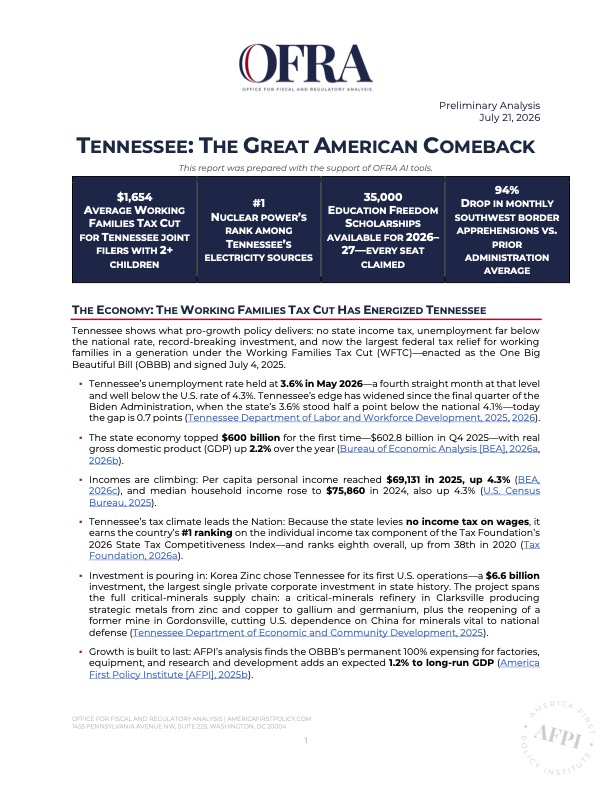
This report was prepared with the support of OFRA AI tools.
The Economy: The Working Families Tax Cut Has Energized Tennessee
Tennessee shows what pro-growth policy delivers: no state income tax, unemployment far below the national rate, record-breaking investment, and now the largest federal tax relief for working families in a generation under the Working Families Tax Cut (WFTC)—enacted as the One Big Beautiful Bill (OBBB) and signed July 4, 2025.
- Tennessee’s unemployment rate held at 3.6% in May 2026—a fourth straight month at that level and well below the U.S. rate of 4.3%. Tennessee’s edge has widened since the final quarter of the Biden Administration, when the state’s 3.6% stood half a point below the national 4.1%—today the gap is 0.7 points (Tennessee Department of Labor and Workforce Development, 2025, 2026).
- The state economy topped $600 billion for the first time—$602.8 billion in Q4 2025—with real gross domestic product (GDP) up 2.2% over the year (Bureau of Economic Analysis [BEA], 2026a, 2026b).
- Incomes are climbing: Per capita personal income reached $69,131 in 2025, up 4.3% (BEA, 2026c), and median household income rose to $75,860 in 2024, also up 4.3% (U.S. Census Bureau, 202
- Tennessee’s tax climate leads the Nation: Because the state levies no income tax on wages, it earns the country’s #1 ranking on the individual income tax component of the Tax Foundation’s 2026 State Tax Competitiveness Index—and ranks eighth overall, up from 38th in 2020 (Tax Foundation, 2026a).
- Investment is pouring in: Korea Zinc chose Tennessee for its first U.S. operations—a $6.6 billion investment, the largest single private corporate investment in state history. The project spans the full critical-minerals supply chain: a critical-minerals refinery in Clarksville producing strategic metals from zinc and copper to gallium and germanium, plus the reopening of a former mine in Gordonsville, cutting U.S. dependence on China for minerals vital to national defense (Tennessee Department of Economic and Community Development, 2025).
- Growth is built to last: AFPI’s analysis finds the OBBB’s permanent 100% expensing for factories, equipment, and research and development adds an expected1.2% to long-run GDP (America First Policy Institute [AFPI], 2025b).
- Federal reform: The WFTC delivers no tax on tips (up to $25,000), no tax on overtime (up to $12,500/$25,000 joint), a $2,200 Child Tax Credit, a new $6,000 senior deduction, and a deduction of up to $10,000 in car-loan interest on U.S.-assembled vehicles (Internal Revenue Service [IRS], 2025a, 2025b). The Tax Foundation estimates the average Tennessee filer saves $3,817 in 2026 (Tax Foundation, 2026b)—and the relief looms even larger as a share of taxes owed: the average filer in the median state keeps about 15.8% of what they would otherwise pay, and Memphis-area taxpayers save more as a percentage of taxes paid than taxpayers anywhere else in the country (Brashers, 2025).
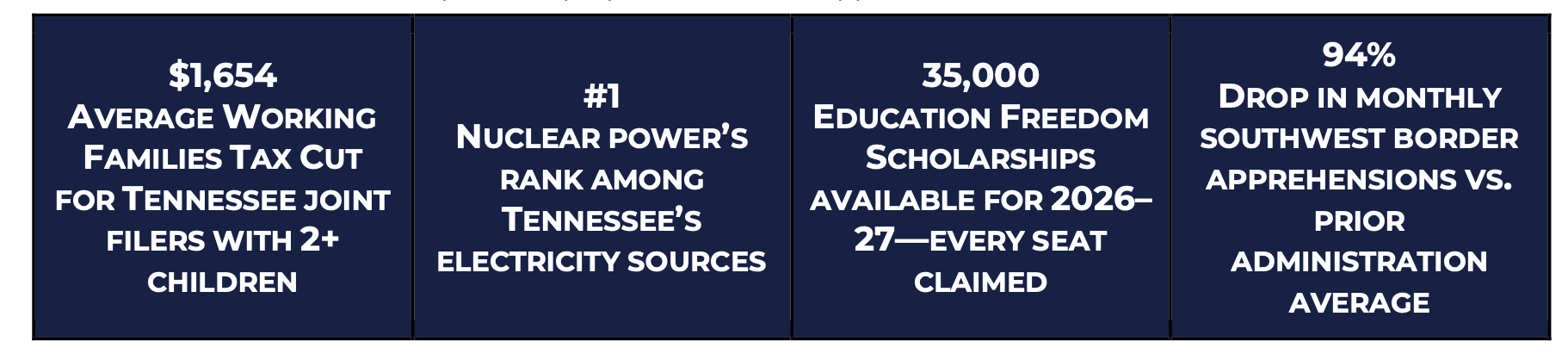
- AFPI has modeled the WFTC state by state: The new worker-focused provisions alone—one slice of the broader $3,817 full-bill relief, which also counts permanence of the 2017 tax cuts and business provisions—save the average Tennessee filer $732 for tax year 2025, rising to $942 for families with children, $1,654 for joint filers with two or more children, and $1,142 for seniors. A Tennessee teacher-and-office-clerk family with two children saves an estimated $1,404—nearly double the $729 the same family keeps in Illinois, even though Illinois wages are higher (AFPI, Office for Fiscal and Regulatory Analysis, 2026b, 2026c).
- Paychecks stretch further in Tennessee: Overall prices run about 8% below the national average—with rents nearly 21% lower (BEA, 2026d)—and Tennesseans pay about a fifth less for electricity (U.S. Energy Information Administration [EIA], 2026a). Add no state income tax, and affordability is a Tennessee advantage.
Energy: Tennessee Is America’s Leader in Nuclear Innovation
President Trump’s Executive Orders 14154 (Unleashing American Energy) and 14156 (Declaring a National Energy Emergency) put reliable, affordable energy back at the center of federal policy, and Executive Order 14302 (Reinvigorating the Nuclear Industrial Base) directs an American nuclear renaissance—with Tennessee, home of the Tennessee Valley Authority (TVA) and Oak Ridge, leading the comeback (Exec. Order No. 14154, 2025; Exec. Order No. 14156, 2025; Exec. Order No. 14302, 2025).
- Nuclear is Tennessee’s largest source of electricity (EIA, 2025). TVA’s three nuclear plants—including Watts Bar and Sequoyah in Tennessee—generate enough power for about 5.1 million homes and businesses (TVA, 2025b).
- Tennesseans pay less for power: Residential electricity averaged 14.94 cents/kWh in April 2026—about 21% below the national average of 18.83 cents (EIA, 2026a).
- Tennessee leads America’s small modular reactor (SMR) push: In May 2025, TVA became the first U.S. utility to file a construction permit application for a GE Vernova BWRX-300, at the Clinch River site, where TVA holds the country’s first and only SMR early site permit. The U.S. Nuclear Regulatory Commission (NRC) docketed the application in July 2025, and site preparation could begin as soon as 2026 (TVA, 2025a; U.S. Department of Energy [DOE], 2025).
- Orano USA selected Oak Ridge for “Project IKE,” a $5 billion uranium enrichment facility that DOE in 2024 called the largest investment in Tennessee history at the time. In January 2026, DOE selected the project for a $900 million federal award to rebuild the domestic nuclear fuel supply chain—and the facility will support more than 300 permanent jobs—“top-tier jobs,” in the words of state officials (DOE, 2024; Orano USA, 2025, 2026; Tennessee Department of Economic and Community Development, 2024).
- New natural gas generation is being built: TVA’s roughly 1,500-MW Kingston Energy Complex will power more than 878,000 homes—fed by a new 122-mile East Tennessee pipeline that began construction in fall 2025—and is expected online in 2027 (TVA, 2026; WBIR, 2025).
- Federal reform: Executive Order 14302 (May 2025) sets the goal of 10 new large reactors under construction by 2030 (Exec. Order No. 14302, 2025)—and AFPI’s OBBB analysis notes the bill “maintains support to produce reliable nuclear energy through tax relief” (AFPI, 2025a). Nationally, U.S. crude oil production set another all-time record of 13.6 million barrels per day in 2025 (EIA, 2026b), and Interior disbursed $14.61 billion in fiscal year (FY) 2025 federal energy revenues (U.S. Department of the Interior, 2025).
Education: Tennessee Sets the Standard for Parental Choice and Control
Tennessee has gone all in on parental empowerment. Universal school choice became law in 2025, demand has outstripped supply two years running, and the state was among the first to claim the new federal school choice dollars created by the OBBB—all while its public school results outpace the Nation.
- Universal choice is law: Gov. Bill Lee signed the Education Freedom Scholarship Act in February 2025, giving families $7,295 per student for 2025–26. Families filed 42,827 applications from 94 of 95 counties, and all 20,000 first-year scholarships were claimed (Tennessee Department of Education [TDOE], 2025a, 2026c).
- Demand keeps surging: The program expanded to 35,000 scholarships for 2026–27 (worth $7,530 each)—and 56,440 applications poured in, up 31.8% in one year, with a 99% renewal rate and more than 17,700 families still waitlisted (TDOE, 2026a, 2026c).
- Choice runs deeper: Tennessee’s 115 public charter schools serve more than 44,000 students (Tennessee SCORE, 2025); the state’s original education savings account (ESA) pilot serves about 4,800 Memphis, Nashville, and Chattanooga students with roughly $9,800 accounts (EdChoice, 2026); and about 10.75% of Tennessee K–12 students were homeschooled in 2023–24, up from 9.0% the year before (Johns Hopkins University Institute for Education Policy, 2026).
- National scorekeepers took notice: ALEC’s 2026 Index of State Education Freedom ranks Tennessee 16th, scores the new Education Freedom Scholarship Act as the state’s strongest program, and counts Tennessee among the states that passed universal ESA programs in 2025 (American Legislative Exchange Council [ALEC], 2026).
- AFPI helped build this wave: Beginning in early 2022, AFPI’s Center for Education Opportunity produced more than 20 research reports, state-specific fact sheets, and model ESA legislation as universal school choice swept the states (AFPI, 2023)—momentum Tennessee joined with its own Education Freedom Act.
- Federal reform: Tennessee is among the 27 states that have already opted in to the OBBB’s first-ever federal tax-credit scholarship—a federal tax credit worth up to $1,700 for donations to scholarship organizations (IRS, 2026). Workforce Pell Grants took effect July 1, 2026, opening federal aid for short-term skills credentials (U.S. Department of Education, 2026; Tennessee SCORE, 2026), and Executive Orders 14190, 14191, and 14242 expand education freedom and return authority over education to the states (Exec. Order No. 14190, 2025; Exec. Order No. 14191, 2025; Exec. Order No. 14242, 2025).
- The results back it up: Tennessee fourth-graders posted a six-point gain in math since 2022 on the 2024 Nation’s Report Card—vaulting past the national average (42% proficient vs. 40%)—and Tennessee students beat the national proficiency average in all four core tests (TDOE, 2025c; National Center for Education Statistics, 2025). The Class of 2025 posted a record 92.3% graduation rate (TDOE, 2025b), and 2026 state tests put third-grade English proficiency at its highest level since at least 2017 (TDOE, 2026b).
Border Security: Tennessee’s Federal Partnership Makes Communities Healthier and Safer
Tennessee’s communities are getting safer—violent crime and overdose deaths are falling from Memphis to Knoxville. The turnaround is no accident: After a border crisis that pushed fentanyl and gangs into every county and strained services, Tennessee became the model state partner for interior enforcement—and under the Trump Administration, the border has been secured at historic speed.
- The federal Memphis Safe Task Force—created by presidential memorandum in September 2025 with the Tennessee National Guard—has logged more than 10,000 arrests, seized 1,708 illegal firearms, and located 154 missing children (U.S. Marshals Service, 2026). Memphis closed 2025 with 184 murders—down 26% and under 200 for the first time since 2019 (Memphis Police Department, 2026; WREG, 2026).
- Crime is falling statewide: Tennessee Bureau of Investigation data show 2024 murders down more than 19% and total offenses down more than 6% (Tennessee Bureau of Investigation, 2025).
- The fentanyl tide is turning: Tennessee overdose deaths fell about 31% in a single year—from 3,616 in 2023 to 2,499 in 2024 (Tennessee Department of Health, 2025; USAFacts, 2026)—while national overdose deaths fell almost 14% in 2025, a third straight annual decline (Centers for Disease Control and Prevention, 2026). A Drug Enforcement Administration–led surge, Operation Knoxville Thunder, arrested 70 traffickers and seized more than 90 kilograms of drugs this spring—with Knox County overdose deaths down 24% during the operation (Drug Enforcement Administration, 2026).
- Tennessee is the model state partner: The January 2025 special session created a Centralized Immigration Enforcement Division, funded local 287(g) participation, and made adopting sanctuary policies a felony for local officials (State of Tennessee, Office of the Governor, 2025)—and AFPI calls Tennessee’s 2026 immigration package “a model for the states” (AFPI, 2026a). FAIR’s national study puts the fiscal burden of illegal immigration at $150.7 billion a year, including hundreds of millions annually for Tennessee schools—costs Tennessee’s enforcement partnership with federal authorities is working to reduce (Federation for American Immigration Reform, 2023).
- Southwest border apprehensions in FY2025 totaled 237,538—the lowest level since 1970—versus roughly 1.6 million in FY2021 (House Committee on Homeland Security, 2025). In May 2026, apprehensions (9,998) were 94% below the prior administration’s monthly average, and U.S. Department of Homeland Security (DHS) reports 14 consecutive months of zero releases into U.S. communities (DHS, 2026a, 2026c).
- Interior enforcement is delivering: DHS reports more than 675,000 removals in the Administration’s first year and an estimated 2.2 million self-deportations (DHS, 2026b). In Tennessee, U.S. Immigration and Customs Enforcement (ICE) made 5,667 arrests from January 20 through mid-October 2025—a pace that accelerated to 35 arrests a day by October (Institute for Public Service Reporting, 2025). A Nashville operation with the Tennessee Highway Patrol arrested 196 illegal aliens—including Tren de Aragua and MS-13 affiliates, a convicted child sex predator, an MS-13 member wanted for aggravated murder in El Salvador, and an alien convicted of aggravated assault (ICE, 2025; WSMV, 2025).
Conclusion: Tennessee Shows What the Comeback Looks Like
The Great American Comeback is compounding Tennessee’s own winning formula. Federal tax relief worth $3,817 to the average filer stacks on top of a state with no income tax; the OBBB’s nuclear tax relief and the Administration’s energy orders are accelerating an Oak Ridge–centered nuclear renaissance; the first-ever federal school choice dollars will flow to a state that has already claimed every one of its 35,000 Education Freedom Scholarships; and a secured border plus the Memphis Safe Task Force are helping drive overdose deaths and murders to lows not seen in years. Tennessee took the federal reforms and ran with them—the Volunteer State is showing the rest of the country what the comeback looks like.
References