Easy to Vote—Hard to Cheat

The foundation of the American system of self-governance is liberty, and the core expression of the people’s liberty is the ability to vote in free and fair elections. Safeguarding the integrity of our elections is paramount to preserving our republic. Election Integrity will work with relevant stakeholders across the country and within states to help ensure there are strong laws in place at the local level—making it easy to vote, but hard to cheat.

Election Integrity (CEI) has a simple goal: “Easy to Vote, but Hard to Cheat.”

With that pursuit in mind, CEI developed this educational, interactive, color-coded map that compares an individual state's current election integrity laws to other states. There are three main policy areas widely acknowledged to better protect voters: photo ID requirements, strong laws against ballot harvesting, and ballots returned to election officials by Election Day. CEI weighted these three key voter protections more heavily as a guide for the comparative categories of red, yellow, and green. (Click here to learn more about CEI’s specific methodology) This map will serve to better educate Americans on the local voter protection measures needed to restore faith, trust, and confidence in our elections.
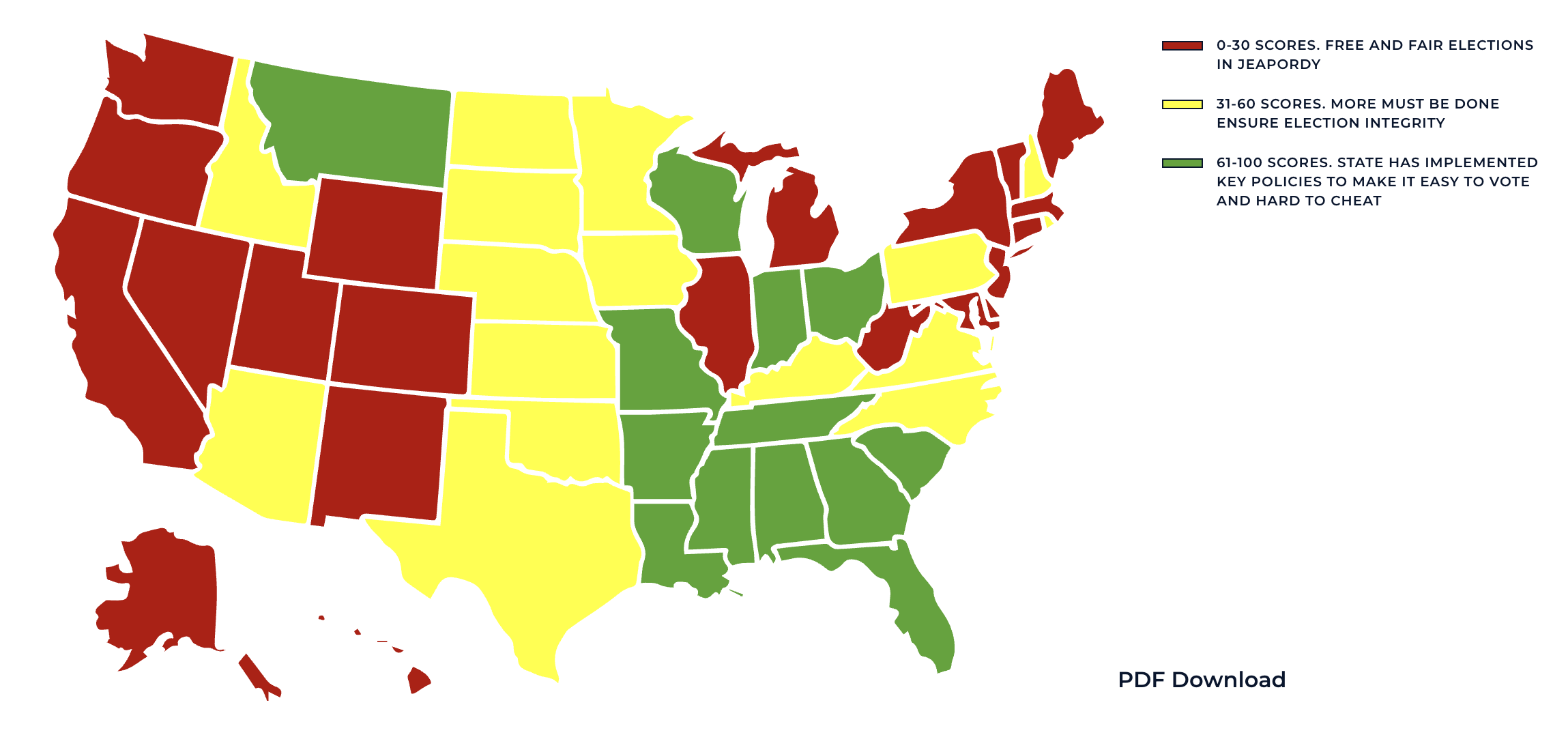
The U.S. Constitution gives State Legislatures the right and responsibility to decide how their states will conduct elections. CEI will work to educate legislators, business leaders, grassroots organizations, and other relevant stakeholders as to the importance and impact of strong election integrity measures.

Team

Latest

Statement | March 5, 2026

AFPI Applauds Termination of National Student Clearinghouse–Tufts Student Voter Data Partnership

Washington, D.C.—The America First Policy Institute (AFPI) issued the following statement from Anna Pingel, Campaign Director for Secure Elections, after the National Student Clearinghouse (NSC) announced it will terminate its partnership with Tufts University’s National Study of Learning, Voting, and Engagement (NSLVE) program amid an ongoing U.S. Department of Education investigation into potential violations of student data privacy protections.

Op-Ed | March 3, 2026

Voter ID Laws Are Widely Backed by Americans, Including Hispanics

Hispanic Americans deeply believe in the promise of this country. Our stories are rooted in sacrifice, hard work, and faith in the American Dream. One of the most sacred rights that dream guarantees is the right to vote.

Expert Insights | March 3, 2026

No ID, No Proof, No Problem? Fixing HAVA’s Section 303 Voter Registration Blind Spot

Section 303 of the Help America Vote Act (HAVA) was designed to ensure that voter registration records contain basic identifying information. When an applicant has neither a driver’s license nor a Social Security number, however, the statute permits the state to assign a unique identifying number for voter registration purposes. That administrative fallback was meant to keep the registration process moving, not to substitute for substantive eligibility verification. States should clarify in law that applicants assigned a HAVA unique identifying number may not be placed on the active voter rolls unless and until they provide documentary proof of United States citizenship.

Statement | February 17, 2026

AFPI: NC Voter Roll Settlement Highlights Importance of SAVE America Act

Bill Analysis | February 16, 2026

THE SAVE AMERICA ACT: STRENGTHENING PROTECTIONS FOR FEDERAL ELECTIONS

The SAVE America Act strengthens protections for federal elections by pairing two core safeguards: 1) requiring documentary proof of United States citizenship at voter registration and 2) requiring photo identification at the point of voting. AFPI has documented instances of non-citizen voter registration and voting, and has recommended proof-of-citizenship requirements and stronger voter list maintenance as key safeguards.

Join The
Movement


By providing your information, you become a member of America First Policy Institute and consent to receive emails. By checking the opt in box, you consent to receive recurring SMS/MMS messages. Message and data rates may apply. Message frequency varies. Text STOP to opt-out or HELP for help. SMS opt in will not be sold, rented, or shared. View our Privacy Policy and Mobile Terms of Service.