A New North American Trade Model: Examining Key Issues in the 2026 USMCA Joint Review
Key Takeaways
« A mandatory joint review for the U.S – Mexico – Canada agreement (USMCA) began July 2026, where the parties will formally discuss whether to extend the agreement.
« The North American Free Trade Agreement (NAFTA), the USMCA’s predecessor, contributed to the mass outsourcing of jobs and increases in bilateral trade deficits. The first Trump Administration renegotiated NAFTA into the USMCA from 2018 to 2020, which made substantive improvements.
« U.S. negotiators could use the joint review process, created by the USMCA, to continue making improvements and update the agreement to reflect an evolving economic landscape.
« Canada imposes trade and services barriers which disadvantage American exporters, and its recent attempt to engage economically with the people’s Republic of China presents an economic and national security risk.
« Mexico engages in practices which generate unfair competitive advantages, from poor labor standards to dumping, with attendant security concerns related to cartel activity and migration.
« On a trilateral basis, the three members should update the USMCA to realize a trading bloc that is strategically autonomous and secure.
Background
On July 1, 2026, the United States, Mexico, and Canada began a scheduled joint review of the U.S.-Mexico-Canada Agreement (USMCA), a comprehensive free trade agreement (FTA) governing commerce of nearly $2 trillion between the three countries.[1] Total goods and services trade with Canada and Mexico constitutes approximately a quarter of overall U.S. trade, affecting millions of jobs and important industries through highly integrated supply chains.
If each of the three parties agrees to extend the USMCA, the agreement will continue for 16 more years, with recurring joint reviews still occurring every six years. Without unanimous approval, the parties will hold annual joint reviews until they reach a revised agreement or until 2036, at which point the USMCA automatically lapses. Each party also reserves the right to withdraw entirely from the agreement, which would take effect after six months’ notice.
The joint review will not be a mere formality to rubber-stamp an extension; on July 1, 2026, the United States notified the other members of its decision not to renew the agreement in its current form, while proclaiming its intent to negotiate with the other parties. The breadth of the relevant issues means the joint review is likely to conclude with either substantive revisions to the current USMCA, potentially incorporating separate bilateral deals between the U.S.-Canada and U.S.-Mexico, or the parties stuck at an impasse, which would begin the road to a sunset. As of August 12, the U.S. and Mexico have already held three separate rounds of formal negotiations, with a fourth scheduled for September in Washington, D.C. Notably, discussions between the U.S. and Canada have lagged comparatively, with zero formal negotiating rounds.
President Trump has consistently questioned the utility of the North American trade status quo. During his 2016 presidential campaign, then-candidate Trump labeled the precursor to the USMCA, the North American Free Trade Agreement (NAFTA), the “single worst trade deal ever approved in this country.” Once in office, the first Trump Administration initiated renegotiations of NAFTA, which led to the USMCA, taking effect in 2020. The second Trump Administration has made it clear that they continue to seek changes to the North American trade status quo, from imposing tariffs on Mexico and Canada to questioning the value of a renewed trade deal. On July 20, 2026, President Trump announced tariffs of 50% on Canadian autos, alcohol, and dairy under Section 338 of the Tariff Act of 1930, citing “Canada’s discriminatory treatment of U.S. commerce.”
AFPI supports the administration’s ongoing efforts to revamp its North American trade relationships to the benefit of American businesses and workers, particularly on account of the many issues that have emerged since the USMCA’s enactment in 2020, a situation that the joint review mechanism is intended to address. This expert insight examines these specific issues, both bilaterally and trilaterally, the history of the USMCA, current U.S.-Canada and U.S.-Mexico trade relationships, and the opportunity for members to forge an upgraded partnership that enhances continental security and self-sufficiency.
NAFTA
NAFTA, which the USMCA replaced, went into effect in 1994. NAFTA created the largest free-trade zone in the world by integrating the U.S. and Canada’s highly advanced economies with Mexico’s emerging economy. This multilateral free trade area was a major shift from previous liberalized trade agreements, which were typically bilateral deals between like economies.
The signature provision of NAFTA was the virtual elimination of tariffs between the three countries. While most trade between the U.S. and Canada was already duty-free due to the 1989 Canada-U.S. Free Trade Agreement (CUSFTA), NAFTA extended this arrangement to Mexico, which had historically pursued protectionist trade policies. NAFTA immediately eliminated many tariffs, with others largely phased out within 10 years.
NAFTA was the first multilateral trade agreement to contain a comprehensive services framework, covering important sectors such as banking, land transportation, and tourism, requiring each country to provide non-discriminatory treatment to the services of these affected sectors.
Complementing the market-opening provisions for trade in goods and services, NAFTA created enforceable rights
protecting private assets against state interference, providing for intellectual property and investment protections. These non-discrimination obligations eliminated previous government restrictions, such as laws restricting international technology transfers.
Impact of NAFTA on the U.S. Economy
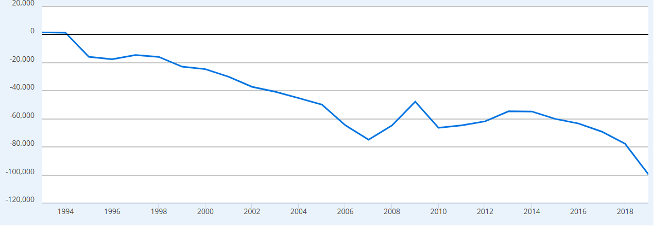
While trade volumes increased in both directions after the enactment of NAFTA, the U.S. saw imports increase substantially more than exports with both Canada and Mexico, leading to surging trade deficits with both countries. In 1993, the last year before NAFTA’s enactment, the U.S. ran a goods trade surplus with Mexico; by 2000, the surplus became a $24.2 billion deficit, and in 2019, it had ballooned to $99.4 billion (see Figure 1). The goods deficit with Canada increased nearly fivefold between 1993 and 2000, peaking at $74.6 billion in 2008.
For Mexico in particular, the sudden increase in trade deficits reflected the relocation of production by U.S. firms south of the border to take advantage of its low labor costs—a shift enabled by NAFTA’s policies of duty-free movement of goods into the U.S. market and the investment protections for firms operating in Mexico. This outsourcing phenomenon caused a major loss of U.S. jobs, which was further compounded when jobs that survived outsourcing faced stronger import competition due to imbalanced trade. One estimate found that by 2010, the trade imbalance with Mexico had caused the displacement of nearly 700,000 U.S. jobs, over 60% of which were in manufacturing. In total, the U.S. lost 4 million manufacturing jobs between 1994 and 2020.
While NAFTA proponents may argue that the agreement brought countervailing welfare gains in the form of increased productivity and lower consumer prices, the argument overlooks the profound distributional effects of NAFTA. Increased exposure to low-cost imports from Mexico disproportionately affected blue-collar industries and high school-educated workers, while also having negative externalities for workers outside the affected industries in geographically concentrated areas. This meant that in many communities and towns across America, NAFTA contributed to wide swaths of people losing the ability to meaningfully provide for their families and the broader community, eroding the social value work provides.
Figure 1
U.S. Goods Trade Balance with Mexico, 1993-2019, in millions of dollars
Changes in the USMCA
By 2016, NAFTA was increasingly untenable, leading to bipartisan calls for its reform. The first Trump Administration, keeping a core campaign promise, initiated renegotiation proceedings only a few months after taking office. Official negotiations commenced in August 2017 and concluded in September 2018, with the new agreement, the USMCA, superseding NAFTA. Both houses of the U.S. Congress passed the USMCA in an overwhelmingly bipartisan fashion, with a 385-41 vote in the House and an 89-10 vote in the Senate.
The USMCA retained NAFTA’s zero-tariff provisions, liberalized services trade, and investment protections, but made substantive changes to address the trading asymmetries NAFTA created.
The flagship provision of the USMCA was strengthened rules of origin requirements, especially for automobiles. The agreement required North American content of automobiles to be 75%, up from 62.5% under NAFTA; 40-45% of the vehicle’s value to be made by workers earning at least $16 per hour; and at least 70% of the steel and aluminum to be sourced in North America. Additionally, the agreement closed a loophole whereby auto parts that were not identified when NAFTA was first enacted in the early 1990s were “deemed” to originate from North America, regardless of the actual regional content.
Revising NAFTA over two decades after its original ratification allowed North American trade negotiators to update the agreement to better reflect the modern economy. The provision that best embodied this benefit was a digital trade chapter, addressed for the first time, given that NAFTA was negotiated before the existence of the commercial internet. The chapter’s core provisions include no duties on digital products, free cross-border data flows, and a ban on data localization requirements, which mandate that data be stored in one country.
The USMCA also updated labor and environmental standards, adapting to comply with new international agreements signed after NAFTA’s adoption, and obligating Mexico to make new labor reforms. These provisions were meaningfully more binding than in NAFTA, subjecting each party to a dispute settlement process that included a specific U.S.-Mexico Rapid Response Mechanism to track Mexico’s compliance. Other provisions in the USMCA benefited U.S. exporters, such as creating updated tariff-rate quotas (TRQs) for Canada’s poultry, dairy, and eggs imports, which would allow the export of more U.S. goods in those sectors, up to a specific quantity, at a duty-free rate.
Article 34.7 Joint Review Opportunity
Perhaps the most innovative provision in the USMCA was Article 34.7, which facilitates the current joint review process. Without precedent in modern U.S. trade agreements, the USMCA requires each party to review the agreement every six years, with the possibility of the deal sunsetting after 16 years if each party does not agree to extend.
Unlike NAFTA and other trade agreements, which are presumed to continue indefinitely, the USMCA can allow the parties to periodically re-evaluate the agreement, update it to reflect an evolving economic relationship among members, and address any outstanding issues. For U.S. negotiators, the joint review is one of the key avenues to advance important priorities given the other members’ reliance on the U.S. market, with the possibility of allowing the deal to expire if sufficient reforms aren’t made to the advantage of U.S. workers and businesses.
U.S.–Canada Bilateral Trade Issues
Although the USMCA governs an integrated trading bloc between three countries, the U.S. faces distinct issues with Canada and Mexico, given the differences in their economies, standards of living, and governance. Consequently, this expert insight examines trade, economic, and security concerns of the U.S.-Canada and U.S.-Mexico trade relationships through separate bilateral lenses before moving to trilateral issues.
Trade Relationship Overview
Canada has historically been one of the top trading partners for the U.S. In 2025, the American market accounted for 73% of Canada’s total exports and 46% of its imports. Canada’s exports to the U.S. sustain a significant share of its economy, responsible for 19% of Canadian GDP in 2023. Conversely, the Canadian economy accounted for 11% of the U.S.’s total imports and 15% of its exports. Canada’s top imports from the U.S. are vehicles, mechanical machinery, mineral fuels and oils, and electrical machinery.
The U.S. is significantly less reliant on Canada than vice versa on account of a much larger economy and a more diversified trade portfolio. However, the U.S. also imports many important goods from Canada, especially raw commodities, such as crude oil, potash, and aluminum.
The total bilateral goods and services trade between the U.S. and Canada in 2024, the most recent year for which data for services are available, was $909.1 billion. The total goods traded in 2025 totaled $719.5 billion, on which the U.S. ran a $46.4 billion trade deficit, down $15.5 billion from the previous year. The U.S. trade deficit with Canada is almost entirely explained by energy products, which alone had an $85 billion deficit in 2025, meaning the U.S. had a surplus in all other sectors combined.[2][3]The U.S. also ran a $10 billion deficit for agricultural products.
Agricultural Non-Tariff Barriers
Canada operates an agricultural system that controls the production and imports of its poultry, eggs, and dairy commodities to stabilize price levels, known as the “supply management system.” These industries have been carved out from many of the liberalization requirements since CUSFTA/NAFTA. The mechanism by which Canada controls imports is through TRQs, setting prohibitively high tariffs for quantities imported above a set threshold, such as 245% on cheese and 298% on butter.
Canada’s administration of dairy TRQs is more contentious than its out-of-quota rates; the supply management system allocates 80-85% of its quotas for dairy products to domestic processors, producing a perverse incentive where the main competitors to U.S. dairy producers reserve the right to decide how much is imported. The U.S. has appealed this system as being violative of USMCA rules to an inter-party dispute settlement panel multiple times, ultimately obtaining mixed results, as the panel in 2023 ruled that Canada could continue to exclude retailers from TRQ allocation. The Trump Administration cited these discriminatory practices when imposing 50% tariffs on Canadian dairy products on July 20, declaring in a proclamation that Canada also disfavored U.S. dairy exports relative to similar EU exports by granting unequal trade terms.
Onerous Canadian requirements on plastic packaging also act as a technical trade barrier against U.S. agricultural exports. As part of its goal to achieve zero plastic waste by 2030, the Canadian government has imposed minimum recycled content requirements, restricted single-use plastics, and labeled plastic items as “toxic substances.” While countries should take measures to reduce plastic pollution, concerns exist that these standards are overly broad and not based on scientific evidence, as a Canadian Federal Court found in 2023.
Cultural Exemption
Canada continues to enjoy carve-outs on liberalization commitments for specific “cultural industries” that date back to the CUSFTA. These sectors are defined by the Canadian government as industries “engaged in the publication, distribution or sale of books, magazines, film, video and music, as well as broadcasting.”
The putative reason for these exemptions is to protect historical Canadian languages and customs from foreign influence; however, Canada has tried to expand these exemptions to include modern digital platforms. While the USMCA provides for reciprocal action by the U.S. and Mexico to these cultural exemptions, given that U.S. companies are the overwhelming leaders of digital and streaming services, these restrictions constitute an unfair services barrier against the U.S.
Digital Services Tax
Canada enacted a Digital Services Tax (DST) in 2024: a 3% levy on tech firms with revenues exceeding 750 million euros globally and 20 million CAD in Canada. While facially neutral in language, the revenue thresholds used meant the levy affected predominantly U.S. companies, extracting an estimated $2.3 billion annually from American firms and costing thousands of American jobs. The Canadian government formally rescinded its DST in June 2025 after President Trump called it “a direct and blatant attack on our country” and announced the termination of trade discussions over the matter. The episode underscored the leverage the U.S. possessed in trade negotiations with Canada, given its reliance on the American market. On a broader level, the digital service tax is emblematic of the type of issue the joint review provision can address, given that Canada pursued this policy after 2020.
Economic Engagement with the People’s Republic of China
Amid growing trade tensions with the U.S., Canada has attempted to strengthen relations with America’s principal adversary, the People’s Republic of China. In January 2026, China and Canada negotiated a new economic agreement where Canada reduced duties on Chinese electric vehicles (EVs)—lowering rates from 100% to the most-favored-nation (MFN) rate of 6.1%—in exchange for Chinese concessions on agricultural tariffs. Furthermore, the deal committed to greater two-way investment in sectors such as energy and agriculture.
The agreement signed in January and the prospect of further economic integration between the two countries constitute an economic and national security threat to the U.S. Through closer engagement with Canada, China could: 1) facilitate the entry of goods, including surveillance-capable EVs, that are otherwise restricted by the U.S, into the American market, and 2) deny the flow of critical goods the U.S. imports from Canada, such as energy products and critical minerals, by purchasing Canadian companies and assets. The historic tariff regime by the second Trump Administration has heightened the incentive for China to use Canada as a backdoor to advance its designs to displace the U.S.-led global order.
The USMCA anticipated the dangers of a member engaging economically with China and allowing it to take advantage of the liberalized trade relationship in North America. Article 32.10 allows two parties to withdraw and form a bilateral deal should a member pursue an FTA with a “non-market country,” a provision that negotiators at the time incorporated to address the latent possibility of members getting closer to China.
U.S.–Mexico Bilateral Trade Issues
Trade Relationship Overview
Mexico is the largest trading partner of the U.S, with total trade in goods and services of $935.1 billion in 2024. In 2025, total goods trade equaled $872.8 billion, with a goods trade deficit of $196.9 billion, the largest of any country besides China. Services trade totaled $95.6 billion in 2024, with the U.S. running a surplus of $5.3 billion.
Mexico’s commerce is extremely dependent on the American market; in 2025, the U.S. absorbed 82% of Mexican goods exports, and U.S. goods accounted for 38% of Mexico's total imports. The Mexican market accounted for 15% of U.S. imports and 16% of exports, similar levels to Canada.
For specific good categories, Mexico imports high volumes of machinery, mineral fuels, electrical machinery, and vehicles from the United States. Mexico is especially import-reliant on the U.S. for natural gas, sourcing over 70% of its total supply from the U.S.
In contrast to the U.S.-Canada trade deficit, which is largely attributable to energy, the U.S. deficit with Mexico is concentrated in manufacturing goods, namely in vehicles ($98 billion), machinery ($84 billion), and electrical machinery ($33 billion).[4]
Automobile RVCs
The automotive sector constitutes the largest part of the U.S.-Mexico trade relationship and represents the crux of the trading asymmetry between the two countries. Vast differences in production costs have incentivized automakers to relocate significant parts of their production to Mexico, culminating in sustained trade deficits that reached a peak of $108.4 billion in 2024. The USMCA sought to address this imbalance through an elevated 75% regional value content (RVC) requirement, the labor value requirement, and the steel and aluminum sourcing mandates.
Even with these important changes, the incentive to outsource production may persist for two key reasons. First, the RVC requirement is indifferent to where the production occurs in North America, allowing a vehicle to theoretically enter the U.S. duty-free without containing any U.S. content. United States Trade Representative (USTR) Jamieson Greer has stated that the U.S. seeks to address this issue, saying, “we are going to be talking about rules of origin in a way that enhances U.S. content in these goods.” Second, Mexico has interpreted the RVC requirement to mean that any component of a vehicle that meets USMCA requirements can have 100% of its value count towards the 75% threshold, even if that part includes materials from non-USMCA countries, known as a “roll-up.” This interpretation prevailed in USMCA panels, which would allow for vehicles with more non-U.S. or non-North American content than the law permits on the surface.
Wages & Labor Standards
The single largest factor that gives Mexico an artificial cost advantage over automobiles and other manufactured goods is the discrepancy in labor costs and standards. Mexican auto workers earn an average of $5.70 an hour compared to $35.30 in the U.S. In the USMCA, Mexico made major commitments to the U.S. to address the underlying weak labor standards that lead to low wages, including the establishment of the RRLM and enforcement mechanisms for democratic unions. However, questions remain about the scope of the RRLM and the extent to which Mexico is willing to commit state resources to tackle labor abuses.
Seasonal Dumping Practices
Global trading rules and agreements, including the USMCA, provide member countries with remedies against dumping practices, where a country exports its products to a foreign market at a lower price than the price sold in its domestic market or the cost of production. The most common remedy is an anti-dumping (AD) duty, which covers the margin between the export price and the fair market price.
Current global dumping laws, however, are insufficient to cover seasonal dumping in agriculture, where perishable or seasonal crops are strategically dumped at specific harvest windows in the foreign market. Initiating dumping claims against this practice can be difficult as producers generally have to prove “material injury” to their sector over a sustained period. U.S. farmers from Florida and Georgia have consistently raised concerns about these practices by Mexico, especially on imported tomatoes, peppers, and berries.
Security, Migration, & Cartel Activity
Issues in the U.S.-Mexico relationship that U.S. negotiators can address in the joint review are not limited strictly to the economic domain. As AFPI outlined in a research report, the Mexican government’s historical toleration of drug cartels, its insufficient enforcement of migration laws, and its pursuit of geopolitical activities that run contrary to U.S. interests in Latin America constitute a legitimate threat to the U.S., and the joint review process provides an opportunity to induce greater cooperation.
Trilateral Issues on Security and Supply Chains
While bilateral negotiations and frameworks are most conducive to addressing specific issues, there are other areas where the cooperation of all three parties is integral to the economic security of each member and the continent. Through closer alignment in strategic sectors and trade policy, the members can create an economic bloc that is strategically self-reliant, secure against external actors, and possesses resilient supply chains.
Tariff Policy
Existing tariffs across member countries and the authority for members to apply tariffs outside of the USMCA framework are contentious issues for the three parties. In February 2025, the U.S. imposed duties of 25% on Canada and Mexico (later increased to 35% for Canada) under the International Emergency Economic Powers Act (IEEPA) for their alleged failures to combat fentanyl trafficking and the latter’s failure to curb illegal migration.
After tariffs issued under IEEPA were struck down by the Supreme Court of the United States, the Trump Administration imposed a 10% global tariff under Section 122 of the Trade Act of 1974. The Section 122 tariffs expired on July 24, 2026, per the statute’s 150-day limit. One day before, on July 23, the Trump Administration imposed tariffs of 10% on Mexico and Canada, under Section 301 of the Trade Act of 1974, citing their alleged failures to impose or effectively enforce a prohibition on the importation of goods made with forced labor. On July 20, 2026, the Trump Administration announced tariffs of 50% under Section 338 of the Tariff Act of 1930 against Canadian automobile, dairy, and alcohol products, to take effect on August 19, 2026.
Critically, certain goods deemed compliant under the USMCA (i.e., goods meeting the rules of origin requirements in the agreement) have been exempt from both the IEEPA, Section 122, and Section 301 tariffs. Both countries are still subject to sectoral tariffs, regardless of whether the goods are USMCA-compliant, such as steel and aluminum, as well as goods included in the proposed Section 338 tariffs against Canada.
Another important dimension of the discussion on tariffs is the differences Canada and Mexico have taken on retaliatory tariffs. Canada is one of only two countries (the other being China) to take such measures, imposing tariffs on more than 60 billion Canadian dollars (CAD) worth of American goods, the equivalent of roughly $42 billion. On the other hand, Mexico has gone beyond forgoing retaliatory action to making substantive policy changes to better address U.S. concerns, including raising tariffs on Chinese goods. USTR Greer has cited Canada’s retaliatory tariffs as one of the reasons for the asymmetry in progress in U.S. negotiations with Canada and Mexico.
Rules of Origin and Transshipment Practices
In addition to the RVC requirements discussed above, the second Trump Administration has imposed broad-based tariffs on most of its trading partners, while simultaneously granting exemptions for USMCA-compliant goods. These two dynamics mean that there is an added incentive for countries outside the bloc, notably China, to illegally transship goods through Mexico and Canada compared to when the USMCA first took effect in 2020.
The illegal transshipment practices can take the form of repacking, falsified documentation, misclassifying the tariff code, and using shell companies. China has been the chief perpetrator of such methods, intensifying their use in response to increased tariffs in both the first and second Trump Administrations. Other factors compounding the risk of illegal transshipments are fragmented customs regimes and insufficient enforcement efforts against fraudulent practices. For instance, Mexico’s IMMEX program allows companies to temporarily import intermediate goods duty-free if they are used to manufacture goods for export. However, the Mexican government has discovered repeated abuses of the program, such as misclassifying goods and concealing the country of origin.
Critical Minerals
Critical minerals are those “essential to the economic or national security of the United States and [which] have supply chains that are vulnerable to disruption.” Because they are essential to modern defense systems and advanced electronics, it is imperative that countries can source these materials through resilient supply chains that withstand geopolitical disruption. This is particularly important given China’s established dominance over the refining stage of the supply chain, serving as the world's leader for the processing of 19 of the 20 designated strategic minerals.
Each member of the USMCA has substantial critical mineral deposits that are ripe for further development and use. The U.S is a major producer of minerals such as beryllium, helium, and zinc; Canada is a top producer in potash, uranium, aluminum, and gold with significant reserves in lithium; Mexico is the world’s number one producer of silver and possesses major lithium resources as well as potential in other rare earth elements. Combined, USMCA members can complement each other to create an overall trading bloc that is resource-abundant and impervious to global disruption. However, every single member currently lacks the midstream processing capacity needed to reduce China’s strategic leverage over global supply chains.
Immigration
Policies facilitating mass migration are harmful to the integrity of a trading bloc, which requires individual countries to have strong capacity in the economic sectors they specialize in to benefit mutually. Both unfettered immigration into one country and illegal entry inside the trading bloc can lead to other countries absorbing more immigrants than they otherwise would have allowed, undercutting domestic workers. Thus, robust controls on immigration at the borders of each member, and movement between members, are necessary.
North America has seen major progress in reducing immigration over the past year; the second Trump Administration has achieved historic results in reducing illegal entry, especially on the southern border. For immigration entering USMCA member countries, both the U.S. and Canada have moderated immigration levels in the past year following a preceding interval of record-high immigration, which boosted asset prices and strained social services. Mexico has also cracked down on migrants transiting the country, seeing record-low apprehensions in 2025. The joint review may be an opportunity to formally codify these achievements and preserve the commercial integrity of the USMCA.
Artificial Intelligence
Artificial intelligence (AI) is the defining technology that will drive economic growth and security dynamics for the foreseeable future. AI capabilities and adoption have accelerated in recent years, particularly after the generative AI boom in 2022. As these changes occurred after the adoption of the USMCA in 2020, the parties may look to incorporate into a revised agreement any relevant considerations related to AI. This situation is analogous to the USMCA, including a digital trade chapter to modernize NAFTA, a trade deal negotiated before the commercial internet.
The legal foundation to formally integrate AI into the North American economy exists in the USMCA's digital trade chapter, which guarantees free cross-border data flows and bars data localization mandates. However, further reforms may be needed to ensure the U.S. continues to lead in innovation and that advanced AI technology does not leak to America’s adversaries.
Conclusion
The U.S., Mexico, and Canada have convened for the joint review of the USMCA at a crossroads for North American trade and the members’ respective economies. Against the backdrop of growing trade tensions between the parties, the fate of an economic agreement that covers economies representing nearly 30% of global GDP and $2 trillion in trade hangs in the balance.
For U.S. negotiators, the joint review presents an opportunity to modify the agreement to further advance the interests of American workers and businesses. NAFTA neglected this cornerstone principle, integrating the continent’s economies on unbalanced terms, fueling mass outsourcing and contributing to the hollowing out of American industries. The USMCA made positive changes to correct these fundamental flaws, and the agreement's most innovative provision, the mandatory review under Article 34.7, allows the U.S. to continue addressing these imbalances and improving its trading relationship in a consequential manner.
Some of the key issues involve Canada’s goods and services barriers against American exporters, from dairy quotas to digital discrimination, and its overtures to the People's Republic of China. Concerning Mexico, its economic practices—which confer upon it an artificial competitive advantage, including poor labor standards and dumping—present concerns. Trilaterally, the parties could look to updating the agreement to serve their strategic interests, seeking new partnerships in areas such as critical minerals and artificial intelligence. Through constructive negotiations and amendments to the deal that handle core issues, the review can not only further an America First agenda but also reforge and strengthen a North American partnership that is secure, durable, and in the interest of all parties.
[1] A Free Trade Agreement governs a “free-trade area’, which is defined by the General Agreement on Tariffs and Trade (GATT), as a “group of two or more customs territories in which the duties and other restrictive regulations of commerce… are eliminated on substantially all the trade between the constituent territories in products originating in such territories” (GATT Trade 1994, 1994, art. XXIV, para. 8(b)).
[2] Query: U.S. trade balance with Canada (total exports FAS value minus general imports customs value), all commodities at the HTS 2-digit level, annual data for full year 2025.
[3] “Energy products” refer to Chapter 27: “Mineral fuels, mineral oils and products of their distillation; bituminous substances; mineral waxes.”
[4] Query: U.S. trade balance with Mexico (total exports FAS value minus general imports customs value), all commodities at the HTS 2-digit level, annual data for full year 2025.