August 10, 2026
Alaska: The Great American Comeback
This report was prepared with the support of OFRA AI tools.
$1,661
Average Working Families Tax Cuts savings for Alaska joint filers with 2+ children (tax year 2025)
$163.7M
Record bids in the March 2026 NPR-A oil and gas lease sale—the first since 2019
1st
Alaska’s charter school sector ranked first in the Nation on NAEP performance (Harvard study, 2009–2019)
5%
Drop in Alaska drug overdose deaths in 2024—down to 339, the first decline since 2022
The Economy: The Working Families Tax Cuts Land in the Last Frontier
The Working Families Tax Cuts (WFTC), enacted as the One Big Beautiful Bill (OBBB) and signed July 4, 2025, deliver what supporters call the largest federal tax relief for working families in a generation, just as the state’s unemployment rate breaks out of a years-long rut.
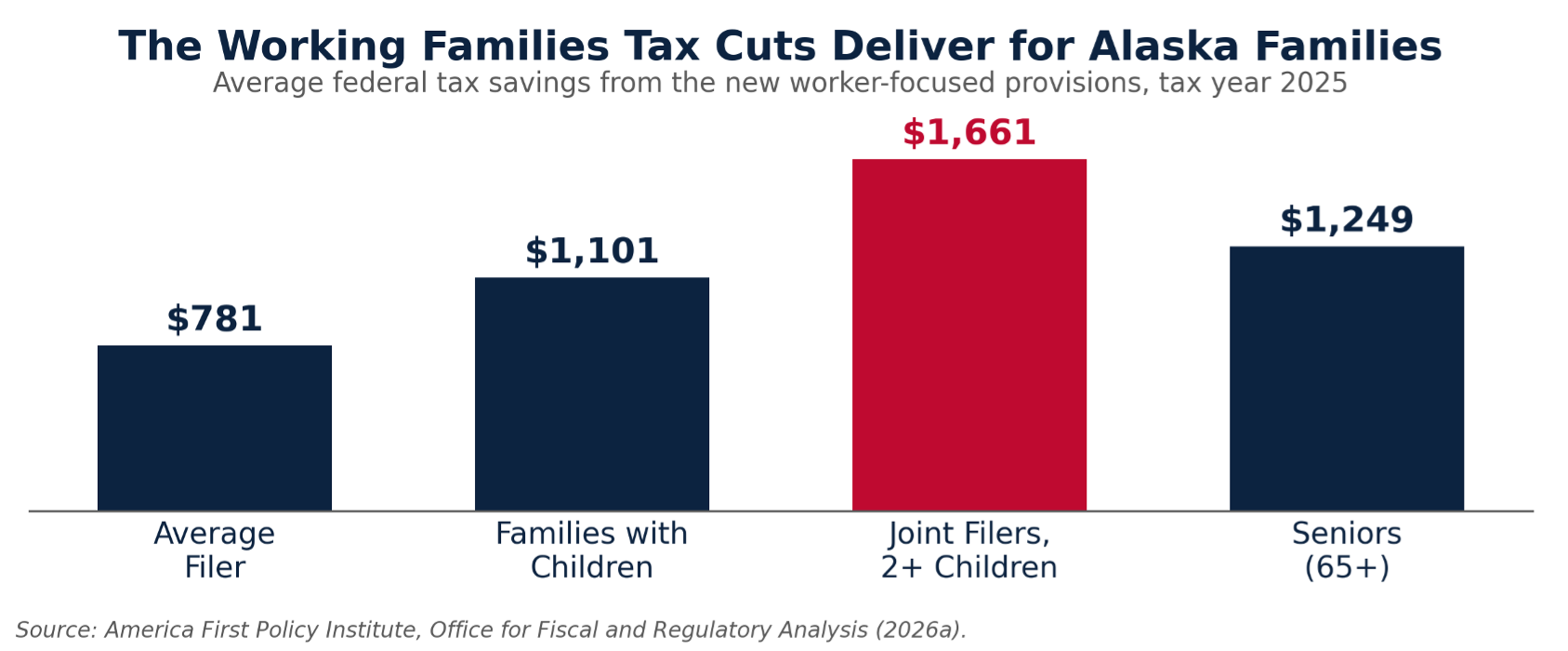
Figure 1. Average Working Families Tax Cuts savings by key group, Alaska, tax year 2025. Source: AFPI, Office for Fiscal and Regulatory Analysis (2026).
- Unemployment fell to 4.4% in June 2026—a break below the 4.6–4.7% band where the state’s rate had sat almost every month for more than a year, including the final months of the prior administration. The gap to the national rate (4.2% in June) has narrowed to 0.2 points, and in the Anchorage/Mat-Su region the unadjusted rate was just 3.8%, down from 4.4% a year earlier—even as total nonfarm jobs slipped 0.3% year-over-year on federal-workforce cuts, with the private sector adding 1,000 jobs (Alaska Business Magazine, 2026; Bureau of Labor Statistics [BLS], 2026a, 2026b).
- The oil patch is hiring again: Alaska’s oil and gas sector added 900 jobs over the year to June 2026—a 10.2% jump, to 9,700—while transportation, warehousing, and utilities added another 800 (Alaska Business Magazine, 2026).
- Federal reform: The WFTC delivers no tax on tips (up to $25,000), no tax on overtime (up to $12,500/$25,000 joint), a $2,200 Child Tax Credit, a new $6,000 senior deduction, and a deduction of up to $10,000 in car-loan interest on U.S.-assembled vehicles (Internal Revenue Service [IRS], 2025, 2026a). Counting the full bill—including permanence of the 2017 tax cuts and business provisions—the Tax Foundation estimates the average Alaska filer saves $3,503 in 2026, near the $3,813 national average (Tax Foundation, 2026)—and the relief looms even larger as a share of taxes owed: The average filer in the median state keeps about 15.8% of what they would otherwise pay (Brashers & O’Quinn, 2025). AFPI’s analysis finds the OBBB’s permanent 100% expensing for factories, equipment, and research adds an expected 1.2% to long-run GDP (America First Policy Institute [AFPI], 2025b).
- AFPI has modeled the WFTC state by state: The new worker-focused provisions alone—one slice of the broader $3,503 full-bill average—save the average Alaska filer $781 for tax year 2025, rising to $1,101 for families with children, $1,661 for joint filers with two or more children, and $1,249 for seniors. An Alaska police officer family with two children keeps an estimated $1,545 (AFPI, Office for Fiscal and Regulatory Analysis, 2026).
- Affordability is Alaska’s challenge—and its energy agenda’s target: Overall prices ran about 2% above the national average in 2024 (Bureau of Economic Analysis [BEA], 2026a, 2026b), and electricity averaged 22.17 cents per kilowatt-hour—sixth-highest in the Nation, versus 12.94 cents nationally (U.S. Energy Information Administration [EIA], 2025a, 2025c). That cost gap is exactly what the state’s push to pipe North Slope gas to Alaskans—backed by a presidential order—aims to close (see Energy below).
Energy: The North Slope Is Open for Business Again
On day one, President Trump signed Executive Order 14153 (Unleashing Alaska’s Extraordinary Resource Potential)—a state-specific order unique among the Administration’s energy actions—directing federal agencies to expedite permitting and leasing in Alaska, reopen the Arctic National Wildlife Refuge (ANWR) and National Petroleum Reserve–Alaska (NPR-A) programs the prior administration had restricted, and prioritize the Alaska LNG project (Exec. Order No. 14153, 2025). Together with Executive Orders 14154 (Unleashing American Energy) and 14156 (Declaring a National Energy Emergency) (Exec. Order No. 14154, 2025; Exec. Order No. 14156, 2025), the orders are landing in a state where the oil comeback is already measurable.
- After decades of decline, the oil is flowing north again: EIA forecasts Alaska crude oil production will grow in 2026 for the first time since 2017—the largest annual increase since 2002 (EIA, 2025b). The Pikka project (Santos/Repsol) produced first oil in May 2026 and is expected to plateau at 80,000 barrels per day, with projections that it could become Alaska’s No. 2 producing field (Alaska’s News Source, 2026c).
- Willow is halfway home: ConocoPhillips’ $8.5–9 billion Willow project—which the company calls the largest project in size and scale on the North Slope in more than 20 years—employs as many as 3,000 workers during peak construction and is projected to maintain 300 permanent positions, with first oil expected in early 2029, peak output of about 180,000 barrels per day, and $8–17 billion in projected new revenue for federal, state, and North Slope Borough governments (ConocoPhillips, 2026).
- Investors just voted with their wallets: The March 18, 2026, NPR-A lease sale—the first since 2019 and the first of five mandated by the OBBB—drew a record $163.7 million in bids from 11 companies on 187 tracts covering about 1.33 million acres, with majors like ConocoPhillips, ExxonMobil, and a returning Shell among the winners—results conservation groups are challenging in court. A University of Alaska economist called it the most successful sale by multiple measures in at least a decade—and the OBBB raises Alaska’s share of the revenue from 50% to 70% starting in fiscal year 2034 (Alaska’s News Source, 2026d).
- Alaska LNG—the new natural gas pipeline at the top of the state’s agenda—is advancing toward a final investment decision: Glenfarne, the project’s lead developer, has preliminary offtake agreements covering about 13 million of the 16 million tons per year it needs to reach a final investment decision on the $44 billion, 20-million-ton project—with preliminary agreements in place with TotalEnergies, JERA, Tokyo Gas, CPC, PTT, and POSCO—and Phase One, a 765-mile pipeline, is expected to start delivering North Slope gas to the Anchorage region in 2029—help for the electricity costs described above (Glenfarne Group, 2026; Pipeline & Gas Journal, 2026). EO 14153 expressly directs agencies to prioritize the project’s permitting (Exec. Order No. 14153, 2025).
- Federal reform: EO 14153 also directed the reinstatement of the ANWR Coastal Plain leasing program and the rescission of the prior administration’s NPR-A restrictions—a rollback completed in December 2025, when the president signed a congressional disapproval resolution restoring the first Trump Administration’s NPR-A management plan—and ordered a review to secure the long-term viability of the Trans-Alaska Pipeline System (Alaska’s News Source, 2026d; Exec. Order No. 14153, 2025). Nationally, U.S. crude oil production set another all-time record of 13.6 million barrels per day in 2025 (EIA, 2026), and AFPI’s analysis details the OBBB’s wins for American energy dominance (AFPI, 2025a).
Education: Alaska Families Pioneered School Choice—Now Federal Dollars Follow
Alaska built one of America’s most flexible systems of parental choice long before it was fashionable—statutory allotments that follow homeschooling families, and charter schools that a Harvard study ranks first in the Nation—and Gov. Mike Dunleavy has now opted the state into the OBBB’s first-ever federal school-choice tax credit (Alaska Department of Education & Early Development [DEED], 2026).
- More than 24,000 Alaska students were enrolled in the state’s public correspondence programs in 2024–25—programs that provide annual allotments of up to $4,500 that families direct to curriculum, courses, and materials (EdChoice, 2026). The Alaska Supreme Court reversed a lower-court ruling that had struck down the allotment statutes in 2024, keeping the program intact while a narrower question about private-school spending continues in the lower courts (Alaska Department of Law, 2024).
- Alaska’s charter schools are the Nation’s best—by the numbers: In the first-ever state ranking of charter sector performance on the Nation’s Report Card, Harvard researchers Paul Peterson and M. Danish Shakeel found Alaska’s charter sector ranked first among 35 states and the District of Columbia, based on fourth- and eighth-grade NAEP results from 2009 to 2019 (Peterson & Shakeel, 2024; Alaska Beacon, 2023).
- The early-literacy needle is moving: Under the Alaska Reads Act, the share of K–3 students reading at national benchmark rose from 44% at the start of the 2024–25 school year to 60% by the end—with kindergartners jumping from 23% to 62%—growth state officials say outpaces the national average (Mat-Su Valley Frontiersman, 2025). The candid backdrop: Alaska’s overall NAEP scores still rank near the bottom of the states, which is exactly why the state’s bet on early literacy and parental choice matters (Alaska Beacon, 2025; National Center for Education Statistics, 2025; Sabbatini, 2025).
- AFPI helped build the school-choice wave: Beginning in early 2022, AFPI’s Center for Education Opportunity produced more than 20 research reports, state-specific fact sheets, and model education savings account legislation as universal school-choice swept the states (AFPI, 2023).
- Federal reform: Gov. Dunleavy opted Alaska into the OBBB’s Federal Scholarship Tax Credit on January 26, 2026—one of 30 states signed up as of July 24, 2026. Starting January 1, 2027, Alaskans can redirect up to $1,700 of their federal tax bill, dollar for dollar, to scholarship organizations serving Alaska students (DEED, 2026; IRS, 2026b). Workforce Pell Grants took effect July 1, 2026, opening federal aid for short-term skills credentials (U.S. Department of Education, 2026), and Executive Orders 14190, 14191, and 14242 expand education freedom and return authority over education to the states (Exec. Order No. 14190, 2025; Exec. Order No. 14191, 2025; Exec. Order No. 14242, 2025).
Safer Communities: Joint Federal-State Sweeps Are Pulling Fentanyl Off Alaska’s Streets
Though Alaska has no southern border—its frontiers are Canadian and maritime—the fentanyl crisis reached it anyway, largely through the mail (Drug Enforcement Administration [DEA], 2024), and hit harder than almost anywhere: Overdose deaths hit a record in 2023 even as they fell nationally (Alaska Beacon, 2026). The turn came in 2024, and federal-state enforcement partnerships—from Anchorage sweep operations to the state corrections system’s 287(g) agreement with U.S. Immigration and Customs Enforcement (ICE)—are now working to lock in and extend those gains (Alaska Department of Health, 2025; Alaska’s News Source, 2026a).
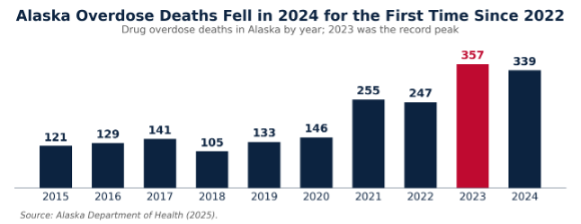
Figure 2. Drug overdose deaths in Alaska by year, 2015–2024. Source: Alaska Department of Health (2025).
- The deadliest tide is receding: Alaska overdose deaths fell to 339 in 2024—down 5% from the record 357 in 2023, the first decline since 2022—with fentanyl-involved deaths down 7%, benzodiazepine deaths down 54%, and heroin deaths down 69%. State health officials caution it is too early to call it a lasting trend—fentanyl was still involved in 73% of 2024 overdose deaths (Alaska Department of Health, 2025; Alaska Beacon, 2026). Nationally, overdose deaths fell almost 27% in 2024 and almost 14% more in 2025—a third straight annual decline (Centers for Disease Control and Prevention [CDC], 2025, 2026).
- Operation Summer Heat delivered: The June 24–26, 2026, sweep across Anchorage—about 140 personnel from local, state, and federal agencies, including federal agents flown up from the Lower 48—made 127 arrests and seized 11 guns, 2,362 grams of fentanyl, 14,792 grams of methamphetamine, and 3,349 grams of cocaine. “When you’re taking this amount of drugs off the street at one particular time, that makes an impact,” Anchorage Police Chief Sean Case said (Alaska’s News Source, 2026b).
- Federal prosecutors are dismantling the pipeline at its source: In a case announced by the U.S. Attorney and the DEA’s Anchorage office, 54 people were indicted in connection with an alleged transnational drug ring—run from a California prison cell—that mailed drugs to Alaska communities as small as Goodnews Bay and Savoonga. Law enforcement intercepted roughly 36 kilograms of fentanyl connected to the enterprise, which prosecutors also linked to two alleged murders and an overdose death; the defendants are presumed innocent unless proven guilty (DEA, 2024).
- Alaska plugs into interior enforcement: The Alaska Department of Corrections has a 287(g) agreement with ICE that gives it the authority to carry out certain immigration-enforcement functions—when a criminal alien is booked into state custody, the agreement triggers an alert, and ICE can lodge a detainer placing a federal hold on the individual (Alaska’s News Source, 2026a).
- The national pipeline that carried fentanyl north is being squeezed: Southwest border apprehensions in FY2025 totaled 237,538—the lowest level since 1970—versus roughly 1.6 million in FY2021 (House Committee on Homeland Security, 2025). In June 2026, monthly apprehensions (9,848) were 94% below the prior administration’s monthly average, and the U.S. Department of Homeland Security (DHS) reports 14 consecutive months of zero releases into U.S. communities (Athrappully, 2026; DHS, 2026).
- Interior enforcement is delivering nationwide—and Alaska’s 287(g) partnership connects to it: DHS reports 675,000 removals in the Administration’s first year and, by its own estimate, 2.2 million self-deportations (Barr, 2026; DHS, 2026).
Conclusion: Alaska’s Resources, America’s Comeback
The Great American Comeback runs through Alaska. A day-one presidential order built specifically for Alaska is reopening the North Slope—record lease-sale bids, Pikka’s first oil, Willow’s 3,000 peak construction jobs, and a $44 billion LNG project advancing toward a final investment decision. The first-ever federal school-choice dollars will flow to a state whose correspondence allotments and Nation-leading charter schools pioneered parental choice. And in Anchorage, joint federal-state sweeps are pulling fentanyl off the streets as overdose deaths turn downward. Alaska spent a decade waiting for Washington to get out of the way; now Washington is pushing in the same direction—and the results are showing up in paychecks, drill sites, classrooms, and neighborhoods across the Last Frontier.
References