August 5, 2026
New Mexico: The Great American Comeback
A profile of New Mexico’s 2nd Congressional District | July 2026 | This report was prepared with the support of AI tools from the Office of Fiscal and Regulatory Analysis.
$1,619
Average Working Families Tax Cuts for New Mexico joint filers with 2+ children
#1
Lea County’s rank among all U.S. oil-producing counties—Eddy County ranks #2
$1,700
Federal scholarship tax credit created by the OBBB—open to New Mexico families if the state opts in
89%
Drop in Border Patrol encounters since FY2023 in the sector covering New Mexico
The Economy: Federal Tax Relief Goes Further in New Mexico
New Mexico’s economy has never been bigger—and Washington just delivered the largest federal tax relief for working families in a generation, the Working Families Tax Cuts (WFTC), enacted as the One Big Beautiful Bill (OBBB) and signed July 4, 2025. Because New Mexico’s incomes and tax bills run below the national average, the new relief stretches further here than in most states.
- New Mexico’s economy hit a record $160.3 billion in the first quarter of 2026—up about $9 billion in current dollars from a year earlier (Bureau of Economic Analysis [BEA], 2026a)—and the growth is not just inflation: real gross domestic product (GDP) rose 2.9% over the year ending in the first quarter of 2026 and now stands more than 20% above its level at the end of 2019, powered by the Permian Basin (BEA, 2026c).
- Paychecks are growing: per capita personal income jumped 5.7% in 2025 to $61,645 (BEA, 2026b). Work remains on jobs: unemployment was 4.8% in June 2026, above the U.S. rate of 4.2%, after the state closed 2024 at 4.2% against a national 4.1% (U.S. Bureau of Labor Statistics [BLS], 2026a; BLS, 2026b)—one more reason the tax relief and energy paychecks below matter.
- Federal reform: The WFTC delivers no tax on tips (up to $25,000), no tax on overtime (up to $12,500/$25,000 joint), a $2,200 Child Tax Credit, a new $6,000 senior deduction, and a deduction of up to $10,000 in car-loan interest on U.S.-assembled vehicles (Internal Revenue Service [IRS], 2025a; IRS, 2025b). The Tax Foundation estimates the average New Mexico filer saves $2,587 in 2026 versus the $3,813 national average (Watson, 2026)—but because New Mexico incomes and tax bills are lower, the relief looms larger where it counts: the Heritage Foundation counts New Mexico among the eight states and areas whose filers keep the biggest share of the taxes they would otherwise owe, versus about 15.8% for the median state (Brashers & O’Quinn, 2025). AFPI’s analysis finds the OBBB’s permanent 100% expensing for factories, equipment, and research adds an expected 1.2% to long-run GDP (America First Policy Institute [AFPI], 2025b).
- AFPI has modeled the WFTC state by state and district by district: The new worker-focused provisions alone—one slice of the broader $2,587 full-bill average, which also counts permanence of the 2017 tax cuts and business provisions—save the average New Mexico filer $627 for tax year 2025, rising to $819 for families with children, $1,619 for joint filers with two or more children, and $1,062 for seniors (AFPI, Office for Fiscal and Regulatory Analysis [OFRA], 2026a). In southern New Mexico’s 2nd Congressional District, joint filers with two or more children save an average $1,404, a nurse working overtime keeps an estimated $1,386, and a police officer family with two children keeps $773 (AFPI, OFRA, 2026b).
- The border corridor is booming: According to the president of the Border Industrial Association in a Dallas Fed interview, 2024 was the best year ever for the Santa Teresa industrial base in the district’s Doña Ana County, whose roughly 80 companies now account for about 69% of New Mexico’s total exports—exports to the world rose 141% in 2024—while contributing about $2 billion a year to the state economy; Santa Teresa’s port of entry is the sixth-largest commercial port on the entire U.S.–Mexico border (Federal Reserve Bank of Dallas, 2025).
- Paychecks stretch further in New Mexico: Overall prices ran about 8% below the national average in 2024—with rents about 26% lower (BEA, 2026d; BEA, 2026e)—and electricity averaged 9.18 cents per kilowatt-hour across all sectors in 2024, about 29% below the U.S. average of 12.94 cents (U.S. Energy Information Administration [EIA], 2025a; EIA, 2025b).
Energy: New Mexico Is the Engine of America’s Oil Comeback
President Trump’s Executive Orders 14154 (Unleashing American Energy) and 14156 (Declaring a National Energy Emergency) put affordable, reliable energy back at the center of federal policy and directed agencies to remove barriers to development on public lands (Exec. Order No. 14154, 2025; Exec. Order No. 14156, 2025)—and no state earns more from federal energy lands than New Mexico, America’s No. 2 oil producer behind Texas (Golding et al., 2025; U.S. Department of the Interior [DOI], 2025).
- Production keeps setting records: New Mexico pumped 2.24 million barrels of crude oil per day in 2025—an all-time high, up 11% in one year and more than double the 923,000 barrels per day of 2019 (EIA, 2026a). That is roughly one-sixth of the record 13.6 million barrels per day the United States produced in 2025 (EIA, 2026b).
- The heart of the boom is in southern New Mexico: Lea County is #1 among all U.S. oil-producing counties, pumping more than 1 million barrels per day—and neighboring Eddy County ranks #2. In Novi Labs’ 2025 ranking, each of the 2nd District’s two Permian counties individually out-produces every oil county in Texas or North Dakota (Novi Labs, 2025).
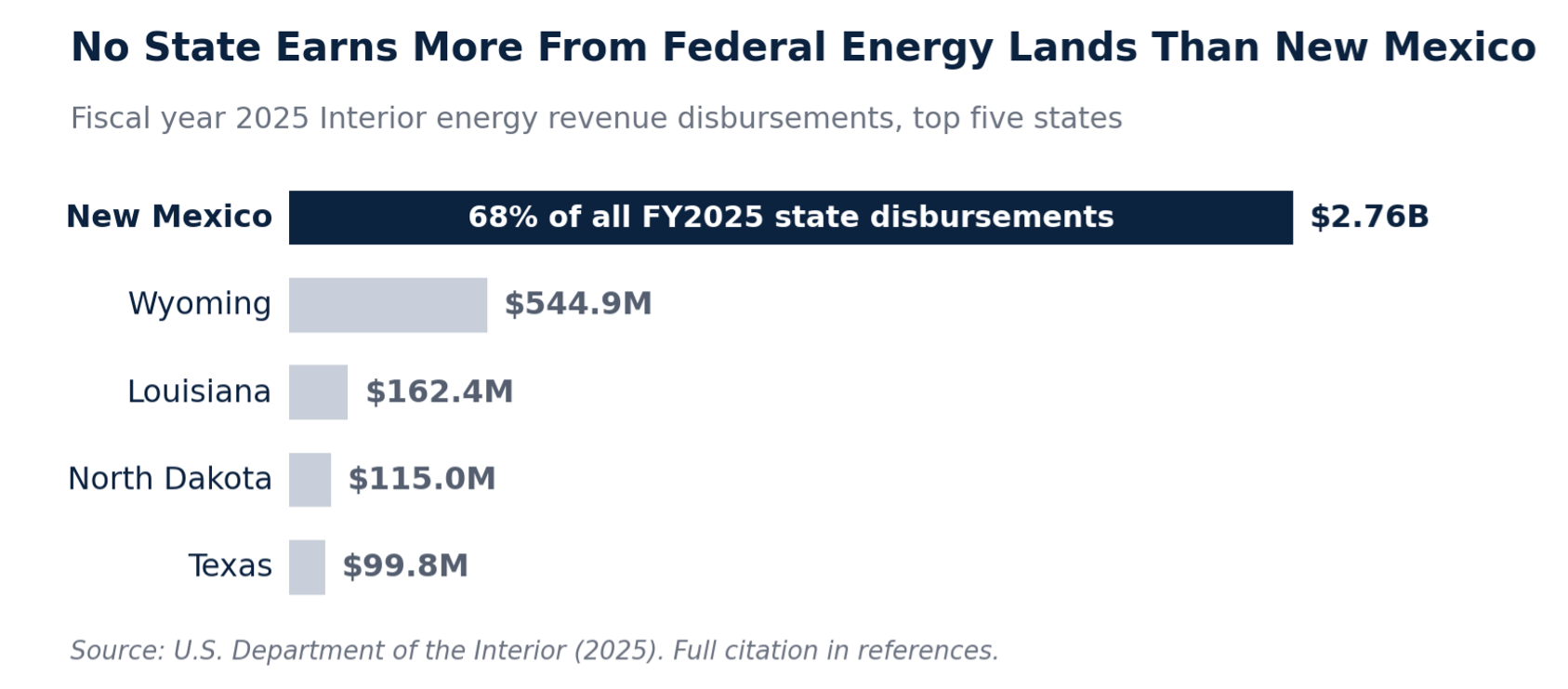
- Washington’s energy paycheck flows straight back: Roughly two-thirds of New Mexico’s Permian production comes from federal lands (Golding et al., 2025), so Interior’s fiscal year (FY) 2025 disbursement of $2.76 billion in federal energy revenues to New Mexico—the most of any state, roughly 68% of the $4.07 billion shared among 34 states, and five times second-place Wyoming—flows back to the state, supporting public services in communities like Hobbs and Carlsbad. Interior credits Executive Order 14154 and the OBBB’s leasing reforms with encouraging production on public lands (DOI, 2025).
- Oil is funding New Mexico’s future: Oil and gas paid about $11.3 billion in state and local taxes, royalties, and bonuses in the year through June 2024—supplying roughly one-third of the state’s general fund recurring revenue in fiscal year 2024 and filling the permanent funds that finance early childhood programs and tuition-free college. Lea and Eddy counties—home to just 130,000 of New Mexico’s 2 million people—generate those benefits statewide (Golding et al., 2025).
- Federal reform: The OBBB reduced the cost of doing business on public lands (DOI, 2025)—and AFPI’s analysis details how the bill locks in energy-dominance wins from expanded lease sales to a new fast lane for energy projects (AFPI, 2025a).
Education: Federal Reforms Put School Choice Within Reach for New Mexico Families
New Mexico families are seeking educational options—homeschooling has more than doubled since before the pandemic and, as of 2021–22, about one student in 12 attended a public charter school (Johns Hopkins University Institute for Education Policy, 2026)—yet New Mexico remains a state with no private school choice program (EdChoice, 2025). The OBBB changes the math: its new federal tax-credit scholarship, effective January 1, 2027, offers a federal tax credit of up to $1,700 for donations to scholarship organizations—at no cost to the state budget, since the credit is federal—if the state opts in (IRS, 2026a; IRS, 2026b). AFPI’s Center for Education Opportunity helped build the national school choice wave with more than 20 research reports, state fact sheets, and model education savings account (ESA) legislation (AFPI, 2023).
- Families want options: About 6.7% of New Mexico K–12 students were homeschooled in 2023–24—more than double the 2.5% share of 2019–20 (Johns Hopkins University Institute for Education Policy, 2026)—and the state had 97 public charter schools as of 2022 (National Alliance for Public Charter Schools, 2022), while charter enrollment stood at 8.6% of students in 2021–22, up from 7.4% two years earlier (Johns Hopkins University Institute for Education Policy, 2026).
- The federal door is open—Santa Fe has not walked through it: As of July 24, 2026, 30 states had already signed up for the OBBB’s federal scholarship tax credit (IRS, 2026a), but New Mexico’s governor had not opted in—her office said in August 2025 that the state would not participate, though as of spring 2026 it was seeking more federal guidance before making a final decision (Albuquerque Journal, 2026; Stone, 2026)—while state legislators publicly urged her to claim the program for New Mexico families (Source New Mexico, 2026).
- The credit expands educational opportunity: The OBBB’s federal scholarship tax credit allows scholarship funds to be used for the full range of qualified elementary and secondary education expenses—including private school tuition and fees; academic tutoring; books, supplies, and instructional equipment; special needs services; uniforms; transportation; room and board; supplementary services such as extended-day programs; and educational technology and internet access—as authorized under Sections 25F and 530(b)(3) of the Internal Revenue Code (IRS, 2025c). By allowing scholarship funds to follow students rather than systems, the credit gives families the flexibility to choose the educational resources that best meet their children’s unique needs.
- The stakes could not be higher: On the 2024 Nation’s Report Card, New Mexico’s fourth-graders averaged 201 in reading versus 214 nationally—lower than 50 states and jurisdictions, and higher than none—with just 20% reading at or above NAEP Proficient (National Center for Education Statistics, 2025). Results like these are why AFPI champions universal school choice and parental empowerment (AFPI, 2023).
- The 2nd District has the most to gain: Las Cruces Public Schools served about 23,600 students across 40 schools in the 2022–23 school year (Ballotpedia, n.d.), and a federal scholarship program would open new options for families from Las Cruces to Hobbs (IRS, 2026b).
- Federal reform: Workforce Pell Grants took effect July 1, 2026, opening federal aid for short-term skills credentials at community colleges—including for students in Las Cruces and across southern New Mexico (U.S. Department of Education, 2026)—and Executive Orders 14190, 14191, and 14242 expand education freedom and return authority over education to states and parents (Exec. Order No. 14190, 2025; Exec. Order No. 14191, 2025; Exec. Order No. 14242, 2025).
Safer Communities: A Secured Border and Federal Task Forces Are Taking Criminals Off New Mexico’s Streets
New Mexico is a border state—the entire state sits inside the U.S. Border Patrol’s El Paso Sector, and the crisis years hit its border counties directly. Under the Trump Administration, federal task forces are taking transnational gang members off New Mexico streets, the U.S. Army now patrols a defense area along the New Mexico line, and the border itself has been secured at historic speed.
- Federal task forces are dismantling Tren de Aragua (TdA) in New Mexico: In December 2025, federal prosecutors indicted 11 alleged TdA members and leaders—10 of whom prosecutors describe as illegally present in the United States—on racketeering charges accusing them of kidnapping, interrogating, and strangling a victim in an Albuquerque apartment and burying his body in a desert grave; the Homeland Security Task Force behind the case includes New Mexico State Police and the Las Cruces/Doña Ana County Metro Narcotics Agency (U.S. Department of Justice [DOJ], 2025). The U.S. Department of Homeland Security (DHS) announced the January 2026 arrest of an alleged TdA member charged in that murder (DHS, 2026a), and in June 2026 two illegal aliens were sentenced for a violent hostage-taking and human-smuggling operation run out of an Albuquerque stash house (DOJ, 2026).
- The Army holds the line in the 2nd District: In April 2025, the New Mexico National Defense Area—about 170 square miles of land running along the border through Hidalgo, Luna, and Doña Ana counties—became part of the U.S. Army’s Fort Huachuca installation, allowing Joint Task Force–Southern Border troops to temporarily detain and search trespassers until they are handed over to Border Patrol (U.S. Army Fort Huachuca, n.d.; Stars and Stripes, 2025).
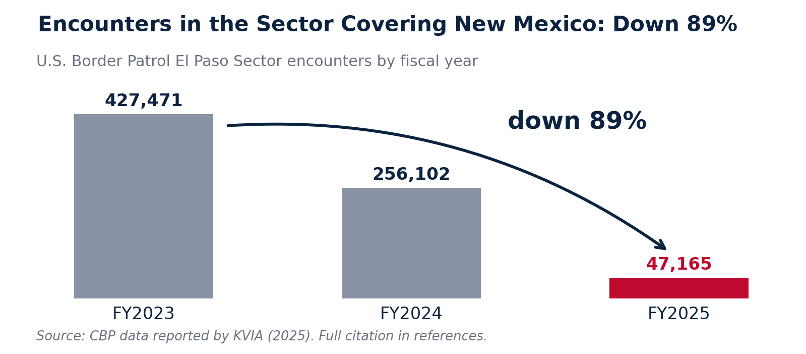
- Crossings have collapsed: The El Paso Sector—covering all of New Mexico and far-west Texas—recorded 47,165 encounters in FY2025, down 89% from 427,471 in FY2023 (KVIA, 2025). Nationwide, FY2025’s 237,538 southwest border apprehensions were the lowest since 1970, versus roughly 1.6 million in FY2021 (House Committee on Homeland Security, 2025).
- The gains keep compounding: DHS reports that southwest border apprehensions totaled just 9,848 in June 2026—94% below the prior administration’s monthly average—and counts 14 consecutive months of zero releases at the border (DHS, 2026c). On interior enforcement, DHS reports more than 675,000 removals in the Administration’s first year and estimates that 2.2 million illegal aliens have self-deported (DHS, 2026b; Commander, 2026).
- The fentanyl fight is not finished—and New Mexico shows why enforcement matters: National overdose deaths fell almost 14% in 2025, a third straight annual decline (Centers for Disease Control and Prevention [CDC], 2026), but New Mexico was one of the few states where overdose deaths rose in 2025 (CDC, 2026; Santa Fe New Mexican, 2026)—making sustained federal interdiction and gang takedowns critical for the state’s families. These challenges are compounded by revelations that, beginning in 2023 under the Biden Administration, U.S. Drug Enforcement Administration (DEA) agents allowed substantial quantities of fentanyl to flow onto New Mexico streets as part of broader trafficking investigations—a strategy now under intense scrutiny (Associated Press, 2026). FAIR, an advocacy organization, estimates the net national fiscal burden of illegal immigration at $150.7 billion a year (Federation for American Immigration Reform, 2023).
Conclusion: The Comeback Is Compounding in Southern New Mexico
The same two counties that lead America in oil production are financing New Mexico’s classrooms and trust funds; the federal tax relief that averages $2,587 per filer statewide reaches deepest for the smaller paychecks of southern New Mexico; the border sector covering the whole state has seen recorded encounters fall 89%; and the new federal school choice program is still on the table for New Mexico—if Santa Fe opts in. The Great American Comeback is already at work from Las Cruces to Hobbs—and with federal reforms still arriving, New Mexico’s share of it keeps growing.
References