August 10, 2026
Iowa: The Great American Comeback
This report was prepared with the support of OFRA AI tools. Data as of July 31, 2026.
$1,847
Average Working Families Tax Cuts for Iowa joint filers with 2+ children (tax year 2025)
27%
of the Nation’s fuel ethanol capacity sits in Iowa’s 42 plants—the most of any state (January 1, 2025)
43,784
Students First education savings accounts approved for 2025–26, the first year of universal eligibility
16%
decline in Iowa overdose deaths in 2025, to 359 from 427 (preliminary)
The Economy: The Working Families Tax Cuts Land on Top of Iowa’s New Flat Tax
On January 1, 2025, Iowa’s income tax became a single flat 3.8% rate—down from graduated rates topping out at 5.7% in 2024 (Iowa Capital Dispatch, 2025a), reform that lifted Iowa to #17 overall and #11 on the individual income tax component of the Tax Foundation’s 2026 State Tax Competitiveness Index (Tax Foundation, 2026a). Now the Working Families Tax Cuts (WFTC), enacted as the One Big Beautiful Bill (OBBB) and signed July 4, 2025, stack federal relief on top of that state advantage—in a state where unemployment runs a full point below the Nation’s.
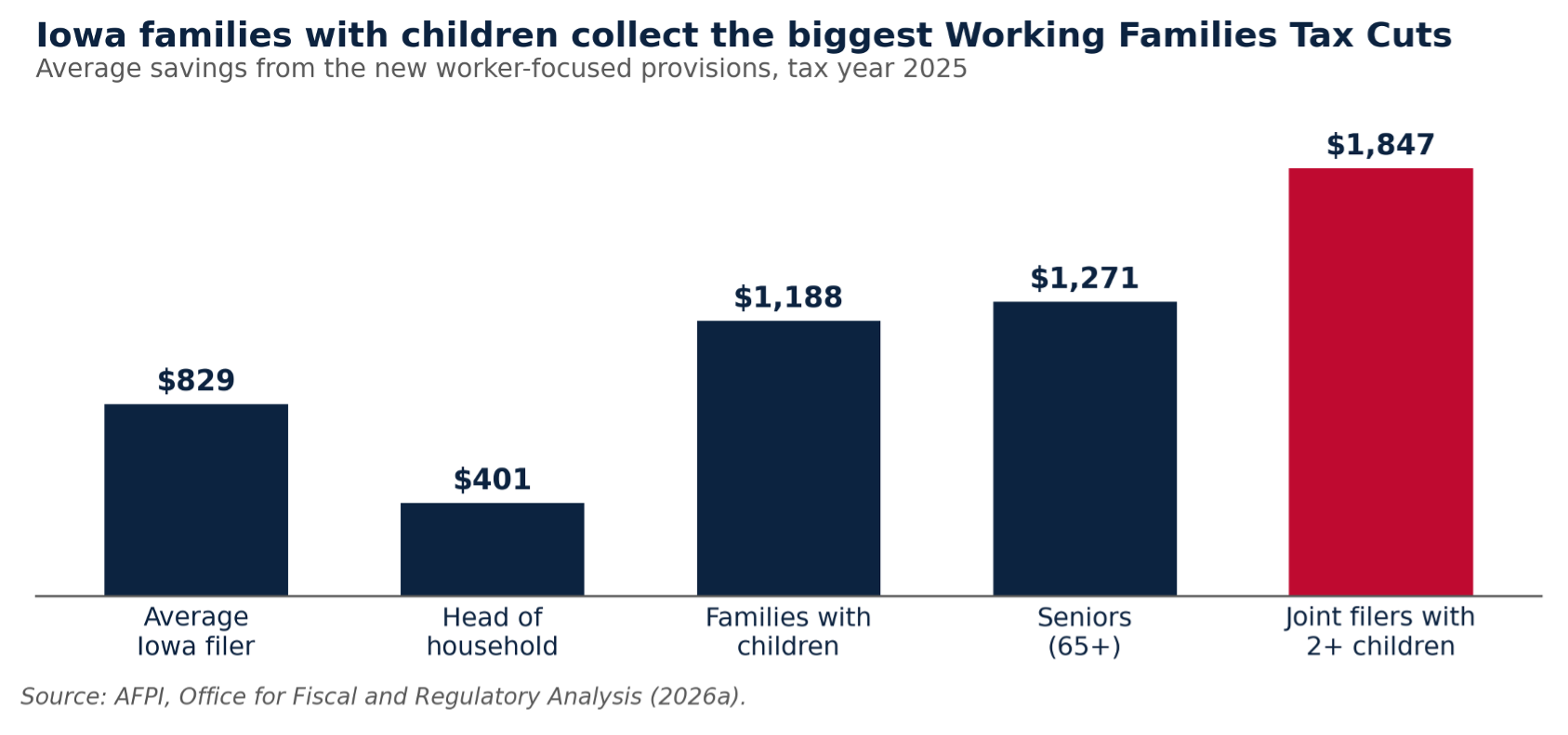
Figure 1. Average Working Families Tax Cuts savings by key group, Iowa, tax year 2025. Source: AFPI, Office for Fiscal and Regulatory Analysis (2026a).
- Iowans keep finding work: The state’s unemployment rate held at 3.2% in June 2026—a full point below the 4.2% U.S. rate—down from 3.5% a year earlier. Payrolls have added 7,800 jobs since February, with private employers accounting for all of June’s gain (Iowa Workforce Development, 2026; Bureau of Labor Statistics, 2026). The honest caveat is that total nonfarm employment still trails last June by 9,500 jobs, with manufacturing down 4,300—the gap the OBBB’s permanent full expensing for factories and equipment is built to close (America First Policy Institute [AFPI], 2025c).
- Federal reform: The WFTC delivers no tax on tips (up to $25,000), no tax on overtime (up to $12,500/$25,000 joint), a $2,200 Child Tax Credit (Internal Revenue Service [IRS], 2026a), a new $6,000 senior deduction, and a deduction of up to $10,000 in car-loan interest on U.S.-assembled vehicles (IRS, 2025). Counting the full bill—including permanence of the 2017 tax cuts and the business provisions—the Tax Foundation estimates the average Iowa filer saves $3,130 in 2026 (Tax Foundation, 2026b). Measured as a share of taxes owed, the relief looms larger still: by a separate Heritage Foundation estimate, the average filer in the median state keeps about 15.8% of what they would otherwise pay (Brashers & O’Quinn, 2025).
- AFPI has modeled the WFTC state by state. The new worker-focused provisions alone—one slice of the broader $3,130 full-bill average—save the average Iowa filer $829 for tax year 2025, rising to $1,188 for families with children, $1,847 for joint filers with two or more children, and $1,271 for seniors. An Iowa truck driver and home health aide raising two children keep an estimated $1,250—more than 70% more than the $729 a comparable family keeps in high-tax Illinois on similar wages (AFPI, Office for Fiscal and Regulatory Analysis, 2026a, 2026b).
- The bill was built for farm country, and Iowa is farm country: The OBBB makes the 20% small-business deduction permanent, locks in a $15 million death tax exemption, indexed for inflation, so family farms pass to the next generation, makes 100% immediate expensing permanent, and pours $62 billion into the farm safety net and crop insurance. All told, AFPI estimates the bill cuts taxes for farmers by more than $10 billion (AFPI, 2025b), and finds the bill’s manufacturing investment incentives, led by permanent full expensing, are expected to add 1.2% to long-run GDP (AFPI, 2025c).
- A paycheck goes further in Iowa: Overall prices ran about 12% below the national average in 2024—with rents about 35% cheaper (Bureau of Economic Analysis [BEA], 2026a; BEA, 2026b), and the state economy reached a record $284.4 billion annual rate, in current dollars, in the first quarter of 2026 (BEA, 2026c).
Energy: Iowa’s Corn Fields Fuel the Country—and Its Power Bills Stay Low
President Trump’s Executive Orders 14154 (Unleashing American Energy) and 14156 (Declaring a National Energy Emergency) put reliable, affordable energy back at the center of federal policy—Executive Order 14156 defines energy to include biofuels, and Executive Order 14154 directs agencies to give biofuels particular attention as a domestic energy resource (Exec. Order No. 14154, 2025; Exec. Order No. 14156, 2025). That definition matters more in Iowa than anywhere else: the state turns more corn into fuel than any other, and its electricity is among the cheapest in the country.
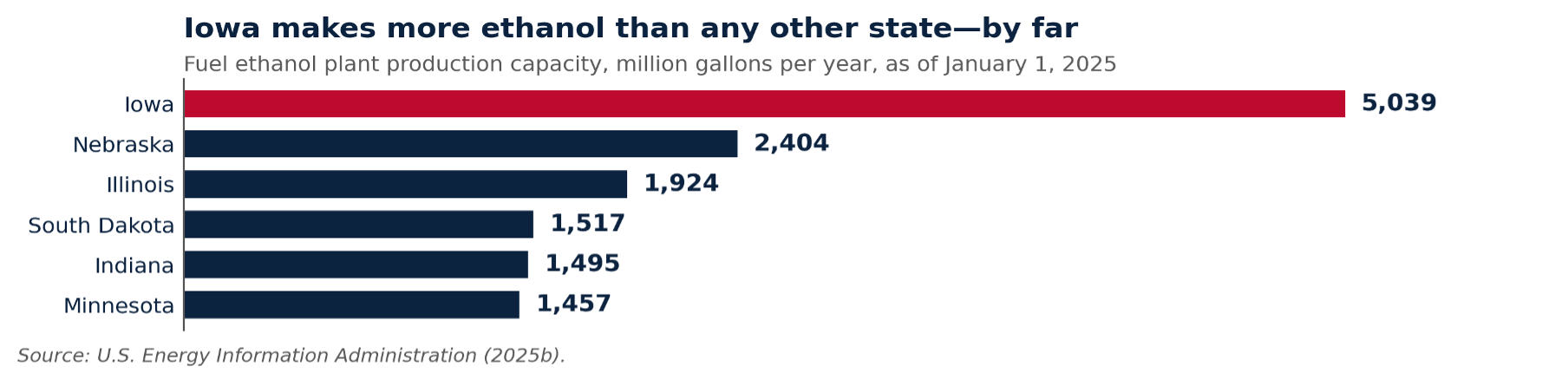
Figure 2. Fuel ethanol plant production capacity, top six states, as of January 1, 2025. Source: U.S. Energy Information Administration (2025b).
- Corn becomes fuel at scale: Iowa’s 42 fuel ethanol plants can produce 5,039 million gallons a year—the most of any state, and about 27% of the entire U.S. total of 18,477 million gallons as of January 1, 2025. Nebraska, the runner-up, has less than half Iowa’s capacity (U.S. Energy Information Administration [EIA], 2025b).
- Iowa’s wind fleet is the most productive in the country by share: Wind supplied 62.8% of Iowa’s electricity generation in 2024—the largest wind share of any state—from 13,016 megawatts of nameplate capacity, and EIA lists wind as Iowa’s primary energy source for electricity (Iowa Utilities Commission, 2025; EIA, 2025a).
- Power is cheap: Iowa’s average retail electricity price was 9.34 cents per kilowatt-hour in 2024, about 28% below the 12.94-cent national average. That is the seventh-cheapest average retail price among the 51 jurisdictions EIA scores (EIA, 2025a; EIA, 2025c).
- Federal reform: On March 27, 2026, the EPA finalized Renewable Fuel Standard volumes for 2026 and 2027—a total applicable volume of 26.81 billion Renewable Identification Numbers (RINs) of renewable fuel in 2026, rising to 27.02 billion in 2027, with 70% of small refinery exemptions reallocated to other refiners so the obligations are actually met (U.S. Environmental Protection Agency, 2026). Nationally, the energy agenda is delivering too: U.S. crude oil production set an all-time record of 13.6 million barrels per day in 2025 (EIA, 2026), and AFPI’s analysis details the OBBB’s wins for American energy dominance (AFPI, 2025a).
Education: Iowa Went Universal on School Choice—and Federal Dollars Are Next
The 2025–26 school year was the first in which every Iowa K–12 student qualified for a Students First education savings account (ESA), the third and final step of the phase-in Gov. Kim Reynolds signed in January 2023 (Iowa Department of Education, 2026a; Office of the Governor of Iowa, 2023). Families answered: Applications outran the program’s first year by half (Iowa Alliance for Choice in Education, 2025; Office of the Governor of Iowa, 2023). Now the OBBB’s first-ever federal school choice tax credit is coming to Iowa on top of it.
- Demand is the story: Iowa families submitted 45,328 applications, and 43,784 accounts were approved for 2025–26—the first year of universal eligibility—up from 27,866 participating students in 2024–25, when income limits still applied (Iowa Alliance for Choice in Education, 2025; Iowa Department of Education, 2025a). Each account is worth $7,988 for 2025–26 and $8,148 for 2026–27, matching the per-pupil funding public districts receive (EdChoice, 2026; Iowa Department of Education, 2025c, 2026a).
- Choice in Iowa is not only private: Since the state rewrote its charter law in 2021, 15 new public charter schools have been approved, and more than 43,000 public school students—about 9% of district enrollment—open enroll into a district other than their own (Iowa Alliance for Choice in Education, 2025; Iowa Department of Education, 2025a).
- The results are mixed, and Iowa says so plainly: On the 2024 Nation’s Report Card, Iowa ranked 10th among the states in 8th-grade reading—which the state credits to its investment in the science of reading—while math rankings fell to 30th in 4th grade and 23rd in 8th, results the Department of Education called a reason to push evidence-based math instruction statewide (Iowa Department of Education, 2025b). Meanwhile Iowa’s high school graduation rate reached 88.8% for the class of 2025, a five-year high that exceeds prepandemic levels (Iowa Department of Education, 2026b).
- AFPI helped build the school choice wave: beginning in early 2022, AFPI’s Center for Education Opportunity produced more than 20 research reports, state-specific fact sheets, and model ESA legislation as universal school choice swept the states (AFPI, 2023).
- Federal reform: Iowa opted into the OBBB’s Federal Scholarship Tax Credit on January 5, 2026, and is one of 30 participating states as of July 24, 2026. Starting January 1, 2027, Iowans can redirect up to $1,700 of their federal tax bill, dollar for dollar, to scholarship-granting organizations serving students in families below 300% of area median income (Office of the Governor of Iowa, 2026; IRS, 2026b). Workforce Pell Grants took effect July 1, 2026, opening federal aid for short-term skills credentials (U.S. Department of Education, 2026), and Executive Orders 14191 and 14242 expand education freedom and return authority over education to the states, while Executive Order 14190 takes aim at radical indoctrination in K–12 schooling (Exec. Order No. 14190, 2025; Exec. Order No. 14191, 2025; Exec. Order No. 14242, 2025).
Safer Communities: Overdose Deaths Are Falling as Iowa Joins Federal Enforcement
Iowa’s drug deaths have been falling since 2022, and the state has spent the past year wiring itself into federal enforcement: The Iowa Department of Public Safety signed a 287(g) task force agreement with U.S. Immigration and Customs Enforcement (ICE) in March 2025, and Iowa National Guard soldiers began supporting ICE operations that September (St. Louis Public Radio, 2025; Iowa Capital Dispatch, 2025b). Supporters say the federal partnership is helping lock in gains that began before the current Administration took office.
- The tide is receding: Iowa recorded 359 fatal overdoses in 2025, down from 427 in 2024 and 473 in 2022—a 16% one-year decline—with opioid-involved deaths falling to 121 from 172. State figures for 2025 are preliminary and will rise slightly as records are filed, and psychostimulants such as methamphetamine have now passed opioids as Iowa’s leading overdose killer, at 198 deaths (The Gazette, 2026). Nationally, overdose deaths fell almost 14% in 2025, a third straight annual decline (Centers for Disease Control and Prevention, 2026).
- Iowa is plugged into interior enforcement: The Iowa Department of Public Safety’s 287(g) agreement deputizes three Iowa State Patrol special agents to perform certain immigration-enforcement functions, including issuing detainers, and 20 Iowa National Guard soldiers began providing administrative and logistical support to ICE offices statewide on September 8, 2025—a mission since extended through September 30, 2026, and now staffed at 16 service members (St. Louis Public Radio, 2025; Iowa Capital Dispatch, 2025b; The Gazette, 2025). ICE reports that on September 26, 2025, ICE Des Moines officers—assisted by the Iowa State Patrol—arrested Ian Andre Roberts, whom the agency identifies as an illegal alien from Guyana under a 2024 final order of removal, in possession of a loaded handgun (U.S. Immigration and Customs Enforcement, 2025).
- Federal prosecutors are dismantling the supply chain: On January 23, 2026, seven defendants were sentenced to federal prison—up to 22 years—for a methamphetamine conspiracy across Council Bluffs and Omaha that prosecutors say was supplied by Mexican-based traffickers, in a case worked by the Drug Enforcement Administration alongside the Southwest Iowa Narcotics Enforcement Task Force, the Iowa Division of Narcotics Enforcement, and local police (U.S. Department of Justice, 2026). Iowa’s own drug strategy identifies cartel-supplied methamphetamine smuggled from outside the United States as the state’s leading illicit drug—the most frequently reported primary drug of use and the largest driver of drug-related prison admissions (Iowa Department of Public Safety, 2026).
- The Federation for American Immigration Reform, an advocacy organization, estimates in its 2023 cost study the net fiscal burden of illegal immigration on U.S. taxpayers at $150.7 billion a year, costs it says fall heavily on state and local budgets for schooling, healthcare, and law enforcement—burdens Iowa’s enforcement partnership is working to reduce (Federation for American Immigration Reform, 2023).
- The national pipeline that carried fentanyl and methamphetamine into Iowa is being squeezed at the source: Southwest border apprehensions in FY2025 totaled 237,538—the lowest level since 1970—versus roughly 1.6 million in FY2021 (House Committee on Homeland Security, 2025). In June 2026, monthly apprehensions (9,848) ran 94% below the prior administration’s monthly average, and U.S. Customs and Border Protection reports 14 consecutive months of zero releases into U.S. communities (Athrappully, 2026).
- Interior enforcement is delivering nationwide, and Iowa’s 287(g) task force connects to it: The U.S. Department of Homeland Security (DHS) reports more than 675,000 removals in the Administration’s first year and, by its own estimate, 2.2 million self-deportations (U.S. Department of Homeland Security, 2026; Commander, 2026).
Conclusion: Iowa’s Fields, America’s Comeback
The Great American Comeback compounds what Iowa already does well. Federal tax relief worth $3,130 to the average filer lands on top of a brand-new 3.8% flat tax and unemployment a full point below the Nation’s. A federal energy agenda that counts biofuels as energy lands in the state that makes 27% of America’s ethanol and pays some of the cheapest electricity prices in the country. The first-ever federal school choice dollars will flow to a state whose students just claimed 43,784 education savings accounts in the first year anyone could. And overdose deaths are falling as Iowa troopers, Guard soldiers, and federal agents work the same cases. Iowa did the hard part first; Washington is finally pushing in the same direction.
References