Powering America’s Future with Affordable, Reliable Electricity
Key Takeaways
« America should meet growing electricity demand by expanding reliable domestic energy production that keeps power affordable for families, businesses, and communities.
« America’s leadership in new and emerging technologies depends on abundant, reliable energy and policies that allow new generation and grid infrastructure to be built quickly and efficiently.
« Large new loads should pay their own way. Data centers and other hyperscale customers should build, bring, or buy the power they need and pay for the infrastructure required to serve them, rather than shifting costs to households and small businesses.
« The evidence does not show that data centers are currently a major driver of higher residential electricity rates, but policymakers should adopt ratepayer protections now to safeguard Americans amidst future growth.
Introduction
Affordable, reliable energy is the foundation of American prosperity. Families need electricity they can afford; businesses need dependable power to expand, hire, and compete; and communities need reliable energy infrastructure that supports investment and growth. Nationally, the United States needs abundant domestic energy to remain the world’s leading economy, military power, and technological innovator.
This basic and longstanding energy imperative is becoming more urgent. After many years of slow growth in electricity demand, America is entering a phase in which the grid is increasingly called on to serve larger customers with more concentrated loads. Data centers are a powerful and near-term example. Their growth is a highly visible test of whether recent U.S. energy policy has fostered the kind of affordable, reliable, and abundant energy needed to ensure prosperity for families and communities.
Artificial intelligence (AI) makes that test especially important. AI is already reshaping economic growth, military capability, and industrial competition, and over time may become one of the most important determinants of national strength (AFPI, 2025; Aliaga, 2025; Bondar, 2025; Hegseth, 2026; Pruet et al., 2026). For the United States, that means leadership in advanced technologies will depend not only on better models, better chips, and more top engineers, but also on the physical systems needed to power advanced computation. Progress in emerging technologies may soon be constrained by whether the United States can build enough energy infrastructure quickly enough to support large-scale data centers and frontier computing.[1] To a greater extent than many typical loads, these facilities require large quantities of highly reliable and dispatchable electricity.
These realities for national strategy and consumer welfare carry two immediate implications. First, great care should be taken to ensure that the costs for the energy infrastructure required by hyperscale data centers[2] are not socialized among households, small businesses, and other consumers. Second, the United States must build more reliable, dispatchable generation rather than assume that intermittent energy is equally useful for advanced technologies such as artificial intelligence. This will ensure that families’ electricity bills are kept in check and that the power that everyday Americans need remains reliable.
The United States is fully capable of the task ahead. To protect ratepayers amidst the rising electricity demand, the U.S. should expand firm domestic power, remove unnecessary barriers to building critical projects, and align costs with the parties that create them. America should welcome technology-driven energy growth, but do so only on terms that strengthen reliability, reduce dependence on unreliable generation for new large loads, and protect ratepayers.
Affordable, Reliable Energy Is a Strategic Advantage
Technological competition with China increasingly resembles earlier forms of great-power competition in which underlying industrial capacity was a key determinant of strategic outcomes. In past eras, access to fuel and the ability to sustain production helped to shape military and economic strength.[3] Electricity will play a similar role in powering America’s future. A country that can support advanced computation and other industries at scale with reliable, cost-effective power will be better positioned to lead in both commercial and strategic applications (Gliech, 2015; Air University History Office, 2019; Martin, 2018).
That is why the United States should treat energy policy as a key component of America’s technological and industrial strategy. Maintaining leadership in advanced computing and other emerging technologies will require large additions of reliable power. Indeed, the U.S. Department of Energy (DOE) found that major projections of incremental U.S. data-center electricity demand by 2030 range from roughly 35 to 108 GW (DOE, 2025c). While precise estimates vary, the direction is clear: major analyses anticipate a sharp increase in electricity needs; OpenAI has gone further by proposing a broader national target of adding 100 GW of new energy capacity annually to accommodate additional computational growth (Lehane, 2025; Mills, 2025; Singer et al., 2025).
Some commentators argue that the answer is simply an “all of the above” approach that adds “as many electrons as possible” to the grid (Clarion Energy Content Directors, 2025). However, for large, around-the-clock loads, not all megawatts are equally useful. The issue is not only how much electricity can be added on paper, but whether that electricity can be delivered reliably and affordably enough to support rapidly scaling loads.
China’s recent energy choices are illustrative here. Beijing continues to expand firm power[4] despite Western media and intellectual elites portraying China’s rise as a story of wind and solar. China’s energy system remains overwhelmingly fossil-fuel-based, with coal central to its energy security posture, and its recent nuclear buildout is unmatched by any other country (IEA, 2025a; IEA, 2025b; World Nuclear Association, 2026). For all practical purposes, China is positioning itself to pair technological expansion with dependable power rather than with generation resources whose contribution becomes increasingly unreliable when the system is under stress.[5]
In responding to China, America must add the right new megawatts. Simply adding nameplate capacity is insufficient, as large, high-uptime loads require energy that is available on demand and during periods of system stress. By expanding reliable, dispatchable power at the speed and scale that advanced technology requires, the United States can preserve and build upon its existing strategic advantages, which currently rest on physical and digital infrastructure, compute capacity, and capital investment (Haag, 2025). That is the core energy reality underlying technological competitiveness (Pilz et al., 2025a; Colby, 2024a; Colby, 2024b).
Against a Scarcity Mindset
Technology-driven electricity demand should not push policymakers toward a scarcity mindset. Calls to limit energy use, slow deployment, or accept weaker growth mistake a policy failure for a physical inevitability. Some commentators have warned that the data center buildout could “exhaust the grid,” while others have argued for more constrained end-user AI consumption (Halper & O’Donovan, 2024; Vanderbauwhede, 2023). These warnings are symptoms of an undersupplied grid, not a fixed limit on what the U.S. grid can support. The remedy is straightforward: Build reliable, dispatchable power at speed and scale.
Some pundits also claim that the data center buildout should be constrained because additional load on the grid will raise rates for consumers. This is a worrying proposition; however, recent state-level analyses do not show that states with high concentrations of data centers have unusually high electricity prices or faster growth in electricity prices. S&P Global reports that “data center expansion is not currently the predominant driver of increased electricity prices in U.S. states,” even as it acknowledges that affordability and credit risks can arise as utilities invest to serve large new loads (S&P Global Ratings, 2026). Similarly, Pyle and Simmons (2026) do not find evidence of a statistically significant relationship between faster price increases for electricity and data center concentration. Stevens et al. (2025) find that state policy differences, including net-zero policies, “primarily” shape differences in electricity rates, a result consistent with the broader point that data center growth is only one of several factors affecting retail prices. A recent analysis from Lawrence Berkeley National Laboratory (LNBL) and The Brattle Group also finds that other factors such as grid investments and renewable energy mandates have been significant drivers of residential electricity price increases; the study did not find that data centers were major contributors to higher prices (Wiser et al., 2026).
Figure 1
State-Level Change in Data Center Power Demand and Residential Electricity Prices, 2021-2025
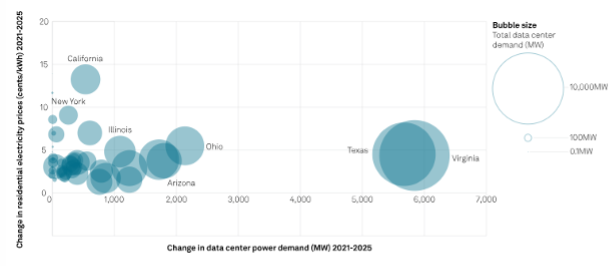
Note. Data as of April 15, 2026. kWh = kilowatt-hour. MW = megawatt. Bubble size represents each state’s total installed data center capacity (MW). From S&P Global Ratings (2026).
America Has Entered a New Era of Electricity Demand
The task of building reliable energy at scale is all the more urgent as America moves out of a two-decade stretch characterized by low growth in electricity demand (Wilson et al., 2025). Now the United States is entering a new phase in which new technologies, including large data centers, are driving a material increase in power demand. EIA forecasts domestic electricity consumption to rise sharply through 2027, while Grid Strategies projects that U.S. peak load growth, or growth in peak energy demand, over the next five years will be far higher than utilities expected only a few years ago, with data centers accounting for a large share of that increase (U.S. Energy Information Administration, 2026; Wilson et al., 2025). A June 2026 estimate suggests that the United States accounted for 312.6 TWh of data-center power demand in 2025, 39.7% of the global total (Energy Institute, 2026). Data centers are not the only source of rising demand, but they are the clearest near-term example of the broader electricity challenge now facing utilities and grid planners.
Electricity demand for AI compute comes from two workloads: training and inference. AI training, which is used to create models like OpenAI’s GPT-5, requires large, co-located data centers, the current largest of which draw over a gigawatt of electricity on a single campus (Epoch AI, 2026b). Large-scale inference, which involves using already-trained models to answer queries and solve problems, relies less on large single campuses but instead requires massive amounts of total computational capacity that can be spread between data centers. Training and inference each account for a large fraction of AI computational resource use (“compute”). Accounting for their energy demand should be a priority for policymakers seeking to create an electric system that is maximally affordable and reliable. Of particular interest, both training and inference display historical trends indicating increasing energy demand from AI in the future.
Trends in Efficiency, Inference, and Scaling
For many years, efficiency gains at individual facilities, better chip design, and the migration from smaller, legacy data centers to larger and more efficient cloud and colocation facilities helped offset rising digital activity (Shehabi et al., 2024; Patel et al., 2024). More recently, however, that period of relative flatness has given way to a new demand profile shaped by AI applications and larger hyperscale facilities that have added load even as the public policy environment has increased strain on reliable generators (Wilson & Zimmerman, 2023; Kearney, 2024; Patel et al., 2024; North American Electric Reliability Corporation [NERC], 2026a).
One reason AI-related computing demand has grown so quickly is that leading AI technology firms are racing to build increasingly capable models. Recent improvements in model performance have largely depended on training larger models on more data with substantially more computing power. The performance gains from additional computing use in training are predictable in so-called “scaling laws,” identified for large language models as early as 2020 (Kaplan et al., 2020). In 2022, researchers found that the compute needed to train the largest-scale AI models doubles roughly every 10 months (Sevilla et al., 2022). Since 2022, the trend has accelerated to a doubling time of about 5 months (Epoch AI, n.d.).
In the short term, exponentially increasing demand for computational capacity implies a vast increase in the demand for energy. This is because growth in computing needs outstrips growth in AI chip efficiency. As a result, the largest models are trained with more chips every year, drawing more power. According to one estimate, the amount of power required for AI computing is roughly doubling annually (Pilz et al., 2025c). Exponential growth in the power draw of individual campuses (which can be used for AI training) has led some to estimate that power demands are the single most likely barrier to continued AI scaling in the future (Sevilla et al., 2024).
Inference electricity demand could grow rapidly as usage expands. Exponentially rising revenue trends suggest increased usage, all else held equal, though revenue is only an indirect proxy for electricity use because pricing, model efficiency, and workload mix can change over time (Epoch AI, 2026a). Furthermore, we should continue to expect products at the frontier to require more underlying inference. Before 2025, large language models were used directly as chatbots that would complete the next token to generate answers. Late 2024 and early 2025, however, saw the emergence of so-called “reasoning” models, which think before they answer (OpenAI, 2024). These models generate tokens in the background to create answers for customers, increasing their performance but also their computational cost (i.e., total inference) for the companies serving them.
This has begun a trend of increasing inference costs to elicit the best possible capabilities from models at any given time, referred to as inference time scaling, or scaffolding (Muennighoff et al., 2025). More recently, popular coding products like OpenAI’s Codex use even more background tokens to complete user queries, further increasing the inference demand of AI adoption (OpenAI, 2025). Although inference costs for a given level of capabilities have been shown to decrease rapidly, the most popular use cases still require computationally intensive scaffolding to elicit state-of-the-art capabilities (Cottier et al., 2025).
Forecasting Rising Electricity Demand
Across a wide range of estimates, projections consistently point to substantial new electricity demand from data centers.[6] The U.S. Department of Energy’s (DOE) 2025 resource adequacy report uses a midpoint assumption of 50 GW of data center-driven demand growth by 2030, while Wilson et al. (2025) estimate 90 GW of peak demand growth from data centers over the next five years (U.S. Department of Energy, 2025c). Meanwhile, LBNL estimates that data centers could rise from 4.4% of U.S. electricity consumption in 2023 to between 6.7% and 12% by 2028 (Shehabi et al., 2024). The International Energy Agency (IEA) likewise projects that U.S. data centers will account for nearly half of domestic electricity-demand growth by 2030 (IEA, 2025c).
From AI Chip Stock to Potential Electric Load
Assessments of the global stock of AI chips can help illustrate the possible upper range of AI-related electric load. Pilz et al. (2025a) use expected chip production and efficiency trends to estimate global power demand for AI data centers over time. Separately, Pilz et al. (2025b) estimate that the United States accounts for about 74.5% of AI supercomputer performance in their dataset.[7] Since Pilz et al.’s analysis assumes the U.S. seeks to retain roughly a 75% share of global AI compute, this paper uses 75% as an illustrative U.S. share assumption. Applying that assumption to Pilz et al.’s global estimates yields an illustrative U.S. power-demand scenario of 51 GW by 2027 and 245 GW by 2030. That scenario is based on Sevilla et al.’s estimate that AI chip production could grow by 30% to 100% annually through 2030 if demand continues to grow at recent rates (Pilz et al., 2025a). Pilz et al.’s analysis relies on several assumptions. It assumes that exponential growth in AI compute demand, which has held on trend since at least as early as 2023, will continue. It also assumes that the global stock of AI chips will grow on pace with existing production trends at semiconductor fabs. These assumptions, though not inevitable, appear to be reasonable for at least the next few years given recent data on chip demand and AI data center power requirements since this study was released (Edelman et al., 2026).
Since Pilz et al. (2025a) conducted their study, other researchers have published updated estimates of the global stock of AI chips and of the growth in AI data center power-use efficiency. Growth in power demand can be estimated by comparing growth in AI computing capacity with improvements in data center power-use efficiency and holding other factors constant. This report proceeds with that methodology here. While our scenarios do not replace or supersede data from official sources, they are useful for bounding the planning problem. You et al. (2026) estimate that global AI computing capacity has grown about 3.3 times per year since 2022. In roughly the same period, energy efficiency for leading AI supercomputers improved about 1.51 times per year when measured by Max OP/s per watt (Pilz et al., 2025c). Dividing 3.3 by 1.51 suggests implied chip-level power demand growth of 2.19 times per year. The updated sensitivity suggests that AI chip-level power demand could grow faster than Pilz et al.’s earlier estimate if growth in compute capacity continues to outpace efficiency gains. Under those assumptions, implied U.S. AI power demand would reach 188 GW by 2028.
Figure 2
Projections of Total U.S. AI Power Demand Based on Prior and Updated Forecasts
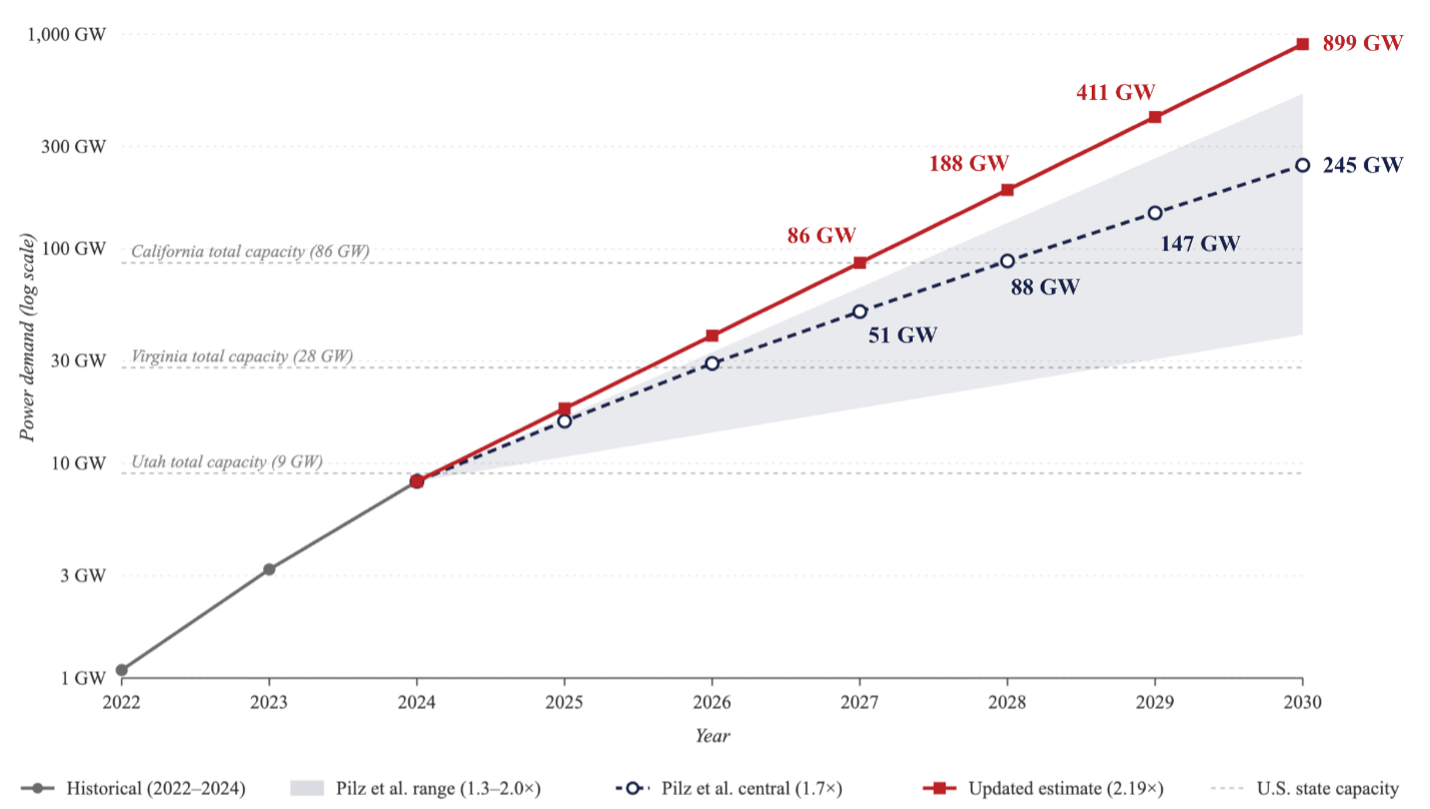
Note. Illustrative stress test comparing of two projections of total U.S. AI power demand through 2030. Both scenarios apply an illustrative assumption that the United States accounts for 75% of global AI compute capacity. The gray line, including its scenario range, is based on Pilz et al. (2025a). The red line is the authors' sensitivity estimate based on updated chip stock growth projections from You et al. (2026) and the Max OP/s energy-efficiency trend reported in Appendix D.1 by Pilz et al. (2025c). The y-axis is logarithmic.
Taken together, these forecasts, scenarios, and sensitivities describe a highly consequential planning question. A 50 GW midpoint by 2030 is large enough to alter resource-adequacy and transmission-planning decisions (U.S. Department of Energy, 2025c). A 90 GW five-year data center estimate is larger still (Wilson et al., 2025), as are illustrative high-end sensitivities derived from Pilz et al. (2025a), You et al. (2026), and Pilz et al. (2025c). Whichever estimate proves to be correct, policymakers and grid planners must recognize that the likely scale of new large load will be large enough to necessitate a sea change as much in the way that energy is constructed as in the energy resources America chooses to prioritize. The types of energy best suited for artificial intelligence, technological competition—and not coincidentally, families and communities—will be detailed in the sections below.
Reliable Electricity for a High-Growth Grid
Advanced computing loads and large data centers require highly reliable energy. Although not all data center loads have the same uptime requirements, some failure-intolerant applications demand extremely high levels of system availability—sometimes described in the information-technology industry as “five nines,” or 99.999% availability. If a task fails between training checkpoints, time, human resources, and money are lost.
According to the Uptime Institute’s 2024 Annual Outage Analysis, power issues are the top cause of “serious and severe” data center outages (Donnellan & Lawrence, 2024). And the cost of outages is not trivial: The Uptime Institute’s Global Data Center Survey 2024 reports that more than half (54%) of IT and data center managers surveyed said that their most recent significant, serious or severe outage cost more than $100,000, with 20% saying that their most recent outage cost more than $1 million, up 4% from 2023 (Donnellan et al., 2024). Beyond costs to data centers, significant downtime also risks the health of the well-paying jobs that data centers bring to communities, as well as disruptions to industry innovation and AI services for small businesses.
Policymakers must equally understand that wind and solar energy do not provide the ultra-reliable energy that advanced computing loads often demand. The Electric Reliability Council of Texas (ERCOT), a relatively sunny and windy market with a substantial number of solar and wind projects, provides a powerful example: During ERCOT’s risk periods, wind energy’s Effective Load Carrying Capability (ELCC)[8] ranged from 8.33% to 33.58% of its nameplate (or hypothetical) capacity;[9] solar power’s ELCC ranged from 1.95% to 36.14% (Carden et al., 2025).
While ERCOT provides a good example, the problem of intermittency remains fundamentally the same nationwide: Even in areas that are relatively sunny or windy, wind and solar resources often receive lower capacity credit than firm resources, especially during periods of heightened system risk. Table 1 in the Appendix, “PJM ELCC Class Ratings,” demonstrates the lower capacity credit[10] of solar, wind, and similar resources in the mid-Atlantic compared to the higher capacity credit of nuclear, natural gas, and coal.
Meanwhile, data centers’ high load factor[11] is even more at odds with the intermittent nature of solar and wind than aggregate U.S. demand. While the U.S. system “operates at about a 60% load factor” today, “Dominion Virginia reported an 82% load factor for large data centers in 2024 and Duke Energy states that it plans for new large loads to have an 80% load factor” (Wilson et al., 2025). Those figures help explain why AI-related demand is poorly matched to resources whose contribution falls most during stressed hours rather than remaining available when needed.
What Resources Protect Reliability?
Just as retail consumers need reliable electricity, the best fit for large, high-uptime loads is firm, dispatchable power. These facilities need electricity that can be delivered in large quantities, sustained over long periods, and relied on during periods of grid stress. This means that reliable and dispatchable energy sources are best suited to energize AI loads and that coal, natural gas, nuclear, hydroelectric, and geothermal power should be prioritized in buildouts designed to serve new large loads.
Such a conclusion should be logical: When demand rises quickly, and the consequences of failure are severe, the sensible response is to build more dependable capacity. The United States has met past waves of industrial growth by adding the kinds of infrastructure that can realistically support the load. The buildout of infrastructure for advanced computing requires the same kind of realism. Weather-dependent resources may contribute electricity, but the new era of demand growth will rest on resources capable of supporting sustained, high-reliability operations. If policymakers want technological development that protects the reliability and affordability of the electricity supply for all Americans, they should make it easier to add reliable generation, retain useful existing capacity, and allow well-constructed self-supply arrangements that strengthen the broader system.
Beyond Reliability: Considerations for Powering Advanced Computing
Beyond reliability, AI data centers create three additional pressures that policymakers must account for to protect affordable, reliable electricity for families and communities. Their growth is concentrated in a limited number of regions, the facilities themselves are getting larger and more computationally intensive, and the loads they impose can be harder to study and manage than traditional commercial demand. Each of those features increases the value of faster additions of firm power, better planning, and real behind-the-meter options.[12]
AI-related data center growth is not spread evenly across the country. Patel et al. (2024) report that 15 states accounted for roughly 80% of national data center load in 2023. Virginia is the clearest example of concentrated data center load and accounted for 13% of reported global operational capacity (Joint Legislative Audit and Review Commission, 2024).[13]
Figure 3
Largest Data Center Utility Demand Regions in 2025
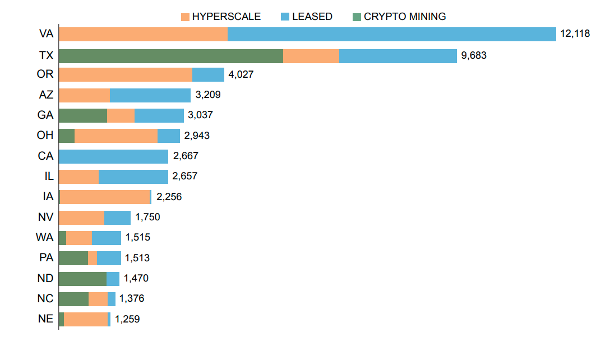
Note. Excludes enterprise-owned data centers. Utility power represents actual and forecasted total electricity supplied to data centers from the power grid, including IT equipment, cooling, lighting, offices, and security systems as of the market monitor release date. Source: National Petroleum Council (2025).
Figure 4
U.S. Hyperscale Data Center Distribution as of 2022
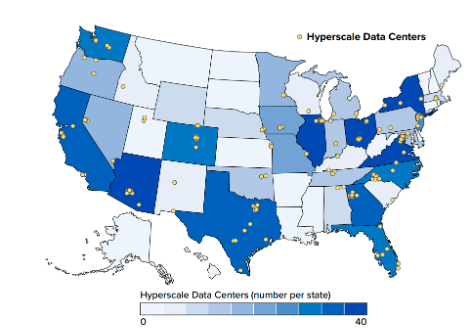
Note. From Patel et al. (2024). The original figure draws on data from CBRE, Cushman & Wakefield, and the U.S. Energy Information Administration.
Data center facilities are also getting larger. The average operational U.S. data center has a load capacity of roughly 30-60 MW, while the average size of a proposed U.S. data center doubled from 150 MW to 300 MW between 2023 and 2024 (Wilson et al., 2025). At the same time, the computational demands driving those facilities have changed significantly. Patel et al. note that the computing intensity of modern AI models is orders of magnitude greater than earlier generations of machine learning systems (Patel et al., 2024). Shehabi et al. (2024) report that smaller internal data centers accounted for more than 60% of server energy consumption in 2014, but only 10% by 2023, while colocation and hyperscale facilities accounted for nearly 80%.
Figure 5
Distribution of Servers by Data Center Type
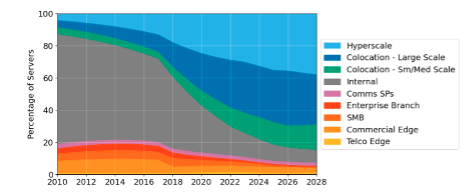
Note. From A. Shehabi et al. (2024). Server distributions are based on an IDC “build” dataset and estimates of the number of servers per rack by data center type.
Figure 6
Server Annual Electricity Use by Space Type
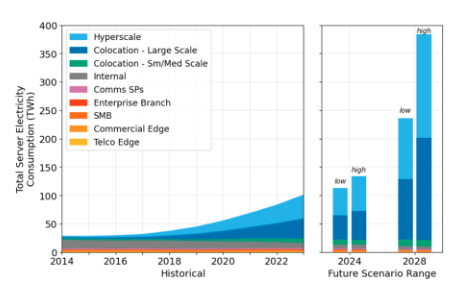
Note. From A. Shehabi et al. (2024). Historical estimates are shown through 2023; 2024 and 2028 represent low and high future scenario ranges. TWh = terawatt-hours.
Those facilities also exhibit different behaviors and risk profiles from the loads grid planners have historically modeled. The North American Electric Reliability Corporation’s (NERC) March 2026 assessment of gaps in existing practices concludes that emerging large loads are challenging the reliability, resilience, and security of the bulk power system, while its May 2026 reliability guideline calls for closer attention to voltage sensitivity, ride-through behavior, frequency stability, coordinated ramping, and other risks associated with large computational loads (NERC, 2026b; NERC, 2026c). Such issues have already been observed in practice: One 450 MW AI training load was observed to ramp down to 40 MW within 36 seconds, illustrating how fast large computational loads can move (NERC, 2025a). NERC has also highlighted the potential for future “reliability risks to the [bulk electricity system] with respect to the voltage ride-through characteristics of large data center loads” (NERC, 2025b). A system prepared for such behavior needs better data, better modeling, and more dependable supply than the grid would need for ordinary commercial growth.
These risks can be mitigated by prioritizing the buildout of reliable, synchronous generation. As wind, solar, and other inverter-based resources (IBRs) displace synchronous generation, the grid becomes more weakly coupled, more voltage-sensitive, and less damped, which makes sudden ramping, voltage disturbances, harmonic interactions from non-linear loads, and oscillatory events materially harder to manage operationally[14] (Al Kez & Foley, 2025[15]; Ebrahim et al., 2023;[16] Alshuaibi et al., 2022;[17] Cho et al., 2017[18]). (For more detail, see Table 2 in the Appendix for a chart mapping large load characteristics and risks.)
The answer to such challenges should not lead policymakers down a path towards “frugal AI” as Vanderbauwhede (2023) and others have suggested. Rather, such challenges can be overcome by building the world’s most resilient and reliable bulk power system and by allowing data centers the freedom to build their own, flexible, behind-the-meter power.
Policy Pillars
Rather than either forcing families to subsidize large tech hyperscalers or slowing American innovation, the wiser response is to make the rules of the buildout clear. New data centers should pay the costs they impose, bring or contract for dependable power, and protect ordinary customers if projects are canceled, delayed, or downsized. Policymakers should welcome data center investment where it strengthens the grid, expands reliable power, and creates well-paying jobs—but they should reject arrangements that could leave households and small businesses responsible for private infrastructure costs.
Protect Ratepayers
The buildout needed to support U.S. technological competitiveness will require new generation, new transmission and distribution, and, in many cases, major upgrades to existing systems. At the heart of the issue will be ensuring that the costs of this buildout are not shifted to families and small businesses. However, encouragingly, research shows that rising electricity demand is negatively correlated with electricity price increases and that there is no statistically significant relationship between data center concentration and faster price increases for electricity (Pyle & Simmons, 2026). Relatedly, Stevens et al. (2025) found that state-level policies are a greater predictor of electricity rates than data center growth.
Recent case studies suggest that data centers themselves may exert downward pressure on residential electricity rates. DTE Energy estimates that conditionally approved data center contracts will lower residential rates for customers by 8%; Montana-Dakota Utilities Co. estimates that Applied Digital’s data centers saved customers $70 in the prior year; and Entergy projects that data center agreements in Arkansas, Louisiana, and Mississippi will save customers $5 billion over 20 years (Wiser et al., 2026). Such findings are directionally consistent with a preprint study of state-level data center capacity additions from researchers at the Electric Power Research Institute and Watershed, which estimates that from 2015 to 2024, each 10% increase in capacity reduced average residential retail electricity prices by approximately 0.4% (Watten et al., 2026). Such findings, though preliminary and not assured, should be encouraging for both policymakers and residential ratepayers.
Nonetheless, ratepayer protection remains a core America First priority and can be achieved by ensuring that costs are paid by the customers who benefit from them. Data centers should not be allowed to socialize, or pass along to non-direct beneficiaries, the cost of any new generation, transmission, and distribution they require. A single large load can still trigger local transmission, distribution, capacity, or generation costs that should be assigned to the customer causing them. In essence, the same “beneficiary pays” principle that has generally attempted to guide cost structure within the bulk power system applies here, but with higher stakes (Lawson & Vann, 2023). This is the first requirement for pursuing AI growth on politically and economically durable terms. If this principle is not upheld, households may find themselves paying for infrastructure they did not request, and which does not directly benefit them.
Codify the Ratepayer Protection Pledge
The White House Ratepayer Protection Pledge expresses the same principle, stating that “[t]he hyperscalers and AI companies that increase electricity demand must pay for the full cost of the energy and infrastructure needed to build and operate data centers, and must not pass this cost on to the American people” (The White House, 2026). Importantly, the pledge obliges these firms to “build, bring, or buy” the generation and infrastructure they need and for which they will be financially accountable, whether they use the full amount of service or not (The White House, 2026).
State governments and utility commissions could codify the Pledge through legislation and rate tariffs. Large-load service agreements should be required to include strong risk protections for ordinary ratepayers, including minimum-bill or take-or-pay obligations, long contract terms, collateral requirements, and stranded-cost protections where appropriate. If a hyperscale customer triggers new generation or grid investment, it should bear the financial risk if the expected load fails to materialize. At the federal level, Congress could reinforce the same principle by directing the Federal Energy Regulatory Commission (FERC) to adopt clear large-load cost-causation rules that ensure that the costs of new data center loads are not socialized among the rate base.
Recent FERC action also aligns with the notion that new large loads require a distinct tariff framework. In June 2026, FERC directed the six regional transmission organizations/independent system operators (RTOs/ISOs) and their transmission owners to “justify or reform” their tariffs for “data centers, manufacturing facilities, and other large energy users” (FERC, 2026). To build upon this direction, policymakers could ensure that these reforms are implemented consistently and transparently across regions so that households and small businesses are not left paying for infrastructure built for private hyperscale customers.
The Pledge also includes an obligation to “contribute to a more reliable grid.” Industry should uphold this element of the pledge by contracting for and investing in new, reliable generation or uprates to firm, reliable power such as natural gas, nuclear power, and coal. Secondarily and as part of a voluntary, “good neighbor” approach, firms could also finance upgrades to existing infrastructure, especially through grid-enhancing technologies (GETs) and other advanced transmission upgrades, which can expand the capacity of existing lines. Though new infrastructure may sometimes be required, smartly implemented GETs can “avoid potentially tens or hundreds of millions of dollars in unnecessary network upgrade costs that would otherwise flow into transmission customers’ bills” (See, 2026). Taken together, these investments can help protect affordable and reliable electricity for local families and communities.
Expand Firm, Reliable Power
U.S. technological leadership will require more than additional nameplate capacity. It will require more firm supply, retention of useful existing generation, and market rules that give dependable capacity its full value. Wind and solar can contribute electricity, but their weather-dependent output cannot meet the needs of large, reliability-sensitive loads during peak or stressed hours. Moreover, even a relatively small penetration of variable renewable energy (VRE) resources on the grid has precipitated an increased risk of blackouts, fast-rising consumer electricity bills, and an ill-advised dependency on Chinese-dominated supply chains (Rolling & Orr, 2025; Stevens et al., 2025; Vasquez, 2023). Policymakers must ensure that the system can support large, reliability-sensitive loads at peak hours. For that task, firm generation carries the burden.
Build and Retain Reliable Electricity on the Grid
In front of the meter,[19] constructing a reliable grid means ensuring generation adequacy and valuing reliable capacity correctly in utility planning, resource procurement, and interconnection policy. It also means moving firm and dispatchable resources, as well as the transmission and distribution required to connect them, through queues and development processes more quickly, including natural gas, nuclear, geothermal, and other technologies that can produce electricity when called upon rather than when conditions are favorable (Federal Register, 2025; Ellis & Vasquez, 2026). New generation matters deeply, but existing reliable generation is important as well. Policymakers could prevent premature retirements, extend the life of useful thermal capacity, and bring suitable retired sites back into service where that can be done economically and on reasonable timelines (Federal Register, 2025).
To prevent premature retirements, policymakers could create a safe harbor rule for existing coal, natural gas, nuclear, hydroelectric, and other reliable resources. Under such a rule, such resources would not be retired if doing so would “violate NERC reliability standards, increase Loss of Load Expectations, or cause resource adequacy shortfalls as determined by regional transmission organizations” (Hayes et al., 2026). The Reliable Power Act and the Power Plant Reliability Act are examples of legislation that would accomplish such an aim (H.R. 3616, 2025; H.R. 3632, 2025).
To provide greater flexibility to existing units, policymakers could allow needed life-extension, uprate, and reliability investments at existing plants to proceed through expedited permitting pathways. In addition to offering expanded NEPA categorical exclusions “for existing facilities seeking to modernize equipment, upgrade pollution controls, or make efficiency improvements,” Congress could amend New Source Review (NSR) provisions to create a streamlined review process which would “allow firms to install cleaner, safer, and more efficient equipment” (Ellis et al., 2026). The New Source Review Permitting Improvement Act offers one model for such reforms (H.R. 161, 2025).
For retired or retiring sites, federal and state policy should fast-track repowering on brownfields and existing industrial sites where transmission, fuel, water, and workforce infrastructure can be reused (Ellis et al., 2026). To bring suitable resources back into service, policymakers could “create a federal fast lane to permit new or upgraded dispatchable generation facilities proposed on existing brownfield sites” (Hayes et al., 2026). For nuclear energy, Congress could codify the licensing reforms directed by Executive Order 14300 (2025) to speed the permitting of new nuclear energy sources.
Demand Response
Some analysts have suggested that demand response agreements, through which new large loads would agree to consume less energy at times of peak demand, should be embraced. The argument is that such arrangements could help utilize available energy during below-peak periods and accommodate more load on the grid at a time when interconnection queues are backlogged, and new generation trails the rate at which new entrants such as data centers can be constructed. While demand response may be useful on a limited, case-by-case basis, AFPI sees it as a suboptimal general solution. PJM’s market monitor notes that “continuing to simply accept the interconnection of large data center loads that cannot be served reliably because there is not adequate dispatchable capacity, is not a reasonable path forward” and eschews proposals that “include the demand side option in place of adding actual generation capacity” (Monitoring Analytics, 2026). The best solution is to require new large data center loads to bring or contract for their own generation and to make it easy to do so, as described in the following subsection.
Encourage Behind-the-Meter Generation—with Guardrails
Data center operators should be allowed and encouraged to pursue self-supply arrangements where they are prepared to finance and operate the needed generation. Behind-the-meter resources can protect ratepayers by reducing pressure on the broader grid, improving on-site reliability, and speeding project development faster than the standard utility interconnection process would allow (Fisher & Lyons, 2026; Satchwell et al., 2025). That is especially true where a project is willing to bring firm power rather than rely on the rest of the system to absorb the risk.
Not every behind-the-meter arrangement is the same. A fully islanded system that serves a customer under voluntary contract raises one set of questions, while a grid-integrated system that can both take from and contribute to the broader grid raises another. The first model, which Fisher and Lyons call “Consumer Regulated Electricity” (CRE), offers a path for large customers to secure new private power without shifting cost to existing ratepayers (Fisher & Lyons, 2026). A key barrier to the development of CRE arrangements is a lack of clarity on whether such arrangements would be subject to federal jurisdiction under the Federal Power Act (FPA). DOE and FERC could clarify through regulations or guidance that genuinely islanded CRE projects are not public utilities subject to the FPA (Fisher, 2025a; Fisher, 2025b). Senator Tom Cotton’s Decentralized Access to Technology Alternatives Act (DATA) Act of 2026 would accomplish this aim (S. 3585, 2026). At the state level, New Hampshire’s bipartisan H.B. 672 and Utah’s SB 132 offer models for allowing islanded, behind-the-meter generation for new customers, including large-load customers (H.B. 672-FN, 2025; S.B. 132, 2025).
Another model, grid-integrated behind-the-meter projects, requires stronger guardrails than fully islanded projects. New large data center loads should not expect the grid and other customers to absorb increased costs or reliability risks. Tariff design should therefore require tighter standards for projects that remain connected to the broader system. Consistent with the three-part test specified by Hayes et al. (2026), such tariffs could require large-load customers to 1) build, bring, or buy additive firm supply, demonstrating that the supply is deliverable during the hours when the system is most at risk; 2) pay the full generation, transmission, distribution, substation, and local network-upgrade costs caused by their service request; and 3) avoid cost-shifting by posting sufficient collateral to protect ordinary customers if the project is delayed, downsized, or canceled. They should also include long-term minimum-bill or take-or-pay obligations, disclosure of operating data, real-time telemetry with grid operators, and clear curtailment rules if the customer’s promised supply is not available.
Such an approach would keep AI firms in compliance with the Ratepayer Protection Pledge, protecting households and small businesses (The White House, 2026). Since the premise of a grid-integrated BTM system is to allow customers to both pull from and contribute to the larger grid as appropriate, firm generation is a naturally better fit, minimizing take from large data center loads while promoting their ability to contribute to grid stability as needed.
Reform Permitting
New energy and industrial infrastructure construction faces a maze of regulations at all levels of government. These often unnecessary or even counterproductive regulations are a primary barrier to American energy abundance (Ellis et al., 2026; National Petroleum Council, 2025; Liscow, 2025). Projects that take years to review, then face years of legal uncertainty, risk arriving too slowly for a system confronting fast-rising large-load demand. If these delays persist, the United States risks falling behind in the energy and industrial buildout needed for domestic prosperity and the global technology competition. If policymakers can clear away the most burdensome regulatory barriers, the private sector will be unleashed to solve the buildout problem.
Cut Red Tape
It is well documented that federal and state permitting processes are often too slow to meet the needs of urgent projects of national importance (Ellis et al., 2026). Fortunately, there are many elements of the permitting process that could be eliminated in their entirety without significant risk to environmental quality. Process laws such as the National Environmental Policy Act (NEPA) and its state-level equivalents, sometimes referred to as SEPAs, do not prescribe or enforce environmental outcomes but do increase, sometimes by many years, the amount of time developers must spend in seeking approvals before a single shovelful of dirt is moved. Reformers should be willing to examine whether NEPA and its state-level analogs have outlived their useful purpose (Ellis et al., 2026).
Regardless of whether NEPA and the SEPAs remain on the books, AFPI recommends that reformers seek to minimize their impact on the construction of data center infrastructure and the energy resources needed to serve it by holistically expanding the availability of categorical exclusions (CX) (Ellis et al., 2026). The SPEED Act, which would take a significant step toward this aim, would “amend NEPA section 109 to allow agencies to adopt [CX] not only from another agency’s procedures, but also when those exclusions were legislatively enacted by Congress” (Ellis et al., 2026; H.R. 4776, 2025). Such reforms to ease regulatory burdens should not be limited to NEPA but should include expanding the use of general and nationwide permits and permit-by-rule structures under the Natural Gas Act, Clean Air Act, and Clean Water Act, and other laws (Ellis et al., 2026).
End Frivolous Litigation
Too often, developers face a second gauntlet after securing their permits, with litigation serving as the next layer of obstruction. While it is important to allow parties with direct and proximate injuries to seek legal relief, the system as currently constructed allows too much leeway to stop projects for those who object simply on aesthetic or other indirect grounds. AFPI supports policies to limit standing to sue to those with direct, demonstrable harms, provided that they have already participated in the public comment process, demonstrating a “stake in the game.”
If strong action is not taken to limit frivolous lawsuits, consequences could be dire for the infrastructure America needs to modernize and develop world-leading industries. A sizable majority of anti-development lawsuits do not succeed (Chiappa et al., 2024). Indeed, many are not expected to prevail in court. Instead, their practical purpose is often to delay projects, raise costs, create uncertainty for investors and developers, and make otherwise viable infrastructure too financially risky or expensive to complete. Writing in Appalachian Voices v. FERC, Judge Karen LeCraft Henderson observed that project opponents often “emerge victorious because delay is the coin of the realm” even when their claims fail (Appalachian Voices v. FERC, 2025). This dynamic means that still other projects are never proposed, buried in an “invisible graveyard” of infrastructure projects. Congress could end this abuse by reforming the litigation process (Ellis et al., 2026; McPherson-Smith, 2023a; McPherson-Smith, 2023b).
Prioritize Development-Ready Sites
More reliable generation is necessary, but its location will matter significantly. The United States should responsibly steer industry and associated energy development toward sites where power can be added quickly, where infrastructure already exists, and where industrial use is already familiar. Siting policy should improve site readiness by pre-screening and speeding review for sites with transmission access, land and water availability, and skilled workforces capable of supporting energy and data center buildout.
Open Sites Under Federal Jurisdiction
The current administration has seen multiple departments take steps to open federal lands for use by private AI data centers and energy developers. DOE identified 16 potential federal sites for AI infrastructure in 2025 and later selected a smaller group for further development (U.S. Department of Energy, 2025a; U.S. Department of Energy, 2025b). The Department of War has also made land available for data center development, including proposed sites on Air Force bases (Albon, 2025).
The Portsmouth site is an example of a quality siting model. DOE is leasing land there for a large data center campus, and the project includes major transmission upgrades financed by the developer rather than by ordinary ratepayers (U.S. Department of Energy, 2026; Maher & Ellis, 2026). Federal siting policy should open similar opportunities to additional firms by requiring landholding federal agencies to identify, on an ongoing basis, development-ready sites across the federal lands portfolio, publish basic site-readiness information,[20] and offer those sites through leases or solicitations. The property lease terms should require developers to finance any required infrastructure upgrades and should prohibit shifting those costs to ordinary ratepayers.
States could pursue the same strategy on their own lands and through their own permitting systems. Legislatures should designate priority sites for industry and associated energy infrastructure, especially on brownfields, retired industrial sites, and former power plants. States could build on existing models such as Georgia’s GRAD (Georgia Ready for Accelerated Development) program, which pre-certifies ready-to-build industrial sites through environmental and endangered species assessment, utility service assessment, zoning designation, and other work (Georgia Department of Economic Development, n.d.). Governors and agencies should then move those sites through faster, narrower review through planned actions and programmatic permitting (Ellis et al., 2026). This can help ensure that environmental review remains short, focused, and well-matched to sites where new power and data center development can proceed quickly.
Make Brownfields Productive Again
Beyond federal lands, existing industrial and energy sites already offer built-in access to grid and transmission infrastructure, as well as essential utilities such as water, and relevant workforces. Reusing these sites also helps balance the need to preserve U.S. agricultural land for food production while still allowing the infrastructure needed for advanced manufacturing, artificial intelligence, and other industry to be built. The workforce element is significant for both new workers and those who may have seen former jobs disappear through deindustrialization or other economic change. In Virginia, for instance, “the data center industry is estimated to contribute 74,000 jobs, $5.5 billion in labor income, and $9.1 billion in GDP” annually (Joint Legislative Audit and Review Commission, 2024).
On the development side, recent work from Pacific Northwest National Laboratory and the House Committee on Energy and Commerce has highlighted the potential for remediating and reindustrializing brownfield sites for data center and related energy infrastructure development (Pacific Northwest National Laboratory, 2024; U.S. House of Representatives, Committee on Energy and Commerce, 2026). Common recommendations, which AFPI supports, include streamlining permitting for the conversion of brownfield sites to data center hubs alongside natural gas or nuclear generation (Pacific Northwest National Laboratory, 2024). The Brownfields Inventory and Permitting Efficiency Act would help accomplish this by directing the Environmental Protection Agency (EPA) to work with states to determine brownfield sites that may be suitable for “nationally significant infrastructure”[21] and by exempting the authorization of such sites from classification as a “major federal action” under NEPA (U.S. House of Representatives, Committee on Energy and Commerce, 2026).
The opportunity for recovering brownfield sites for further productive use could be significant, as recent analysis projects that over 100 GW of aging existing generating resources will retire over the next decade (Gramlich et al., 2024). This may be an overestimate, as some resources may avoid retirement due to heightened pressure to retain useful thermal generation. A number of firm power sources have already been ordered to extend their operations by the DOE under Section 202(c) (U.S. Department of Energy, 2025d), and longer-term solutions may be on the horizon. In any case, retiring sites should be made available through a fast-track permitting process to developers who wish to build or revitalize reliable thermal generation for data centers and other large loads.
Improve Forecasting, Planning, and Interconnection
America’s current planning and interconnection processes were not built for the size and scale of load now being driven by hyperscale data centers. Utilities increasingly receive multiple requests for the same project, sometimes from the end user, and sometimes from developers working on the end user’s behalf. A single project may also shop multiple utility territories at once. That makes it harder to know which projects are real, which are speculative, and where load is most likely to materialize.
Better data collection can contribute to meaningful reform. Large-load customers should be required to provide site-specific information early in the interconnection or service-request process, including load profiles, ramping characteristics, operating assumptions, and any on-site generation plans. Utilities and grid operators should be required to collect that information in a consistent format. Without that kind of data, planners cannot model these loads well, forecast them well, or study their reliability implications with sufficient confidence (NERC, 2026b; Wilson et al., 2025).
Modeling reform is similarly important. NERC has acknowledged this through the development of its Large Loads Action Plan, which is intended to address reliability guidance, modeling for computational loads, and standards development; FERC Commissioner Rosner (2026) similarly recognized the importance of reform in FERC’s June 2026 proceedings on large loads (NERC, n.d.). The Load Forecasting Enhancement Act would move policy in this direction by requiring FERC to establish regional joint boards for the purpose of studying large service requests, data collection, and modeling; and to identify best practices for improving the reliability and affordability of electricity service within that region (H.R. 9332, 2026).
Advanced computing itself may be used to improve grid planning and operations. The Affordable Innovation for the Grid Act would require DOE, in consultation with FERC and the Electric Reliability Organization (NERC plus the six Regional Entities), to assess how “artificial intelligence and high-performance computing technologies” can improve the “capacity, reliable operation, and operational efficiency” of the bulk power system (H.R. 9339, 2026). This would be an appropriate use of advanced computing to make the grid faster, more efficient, and more reliable for all customers.
These reforms could be made operational through legislation, DOE action, and large-load tariff and queue rules through FERC. Congress could set the framework for improved forecasting and modeling, and DOE could support that effort by helping to identify parts of the grid with spare transmission capacity and by backing an expedited path for projects that provide quality data, demonstrate project readiness, and are prepared to bear the costs they impose. FERC could follow on by requiring transmission providers to adopt standard large-load disclosure packages, milestone-based queue commitments, periodic updates to load assumptions, and tariff rules that downgrade or remove projects that fail to provide sufficient data or firm financial commitments. Such reforms would improve study quality, reduce noise in queue forecasts, and help protect ratepayers while ensuring that real projects get the energy they need.
Conclusion
Affordable, reliable energy is among the most important policy priorities for ensuring continued prosperity for American families, businesses, and communities. Meanwhile, previous assumptions about the flat nature of electricity demand are no longer a sound basis for energy policy. America is entering an era of notably higher demand, and it is essential that America meets that demand without raising costs, weakening reliability, or constraining future growth.
At home, families and industry alike will be served well by building a more cost-effective and reliable electric system. On the world stage, America faces a competitor with few pretenses about the nature of industrial energy demand. China understands that energy strength is a condition of industrial and technological power, and it continues to build its technological ambitions on dependable energy resources. Nonetheless, the flexibility, speed, and resilience of the U.S. technological ecosystem provide a built-in advantage that China’s state-directed economy would have to contend strongly to match (Lewis, 2021; Hass, 2026).
The crucial gap is that China is forging ahead with an energy system built atop dependable fuels while sympathetic analysts and media in the West cheer China’s status as a supposed “clean energy powerhouse” and “electrostate” (Zaremba, 2025; Tice, 2026). Meanwhile, years of policy preference in the U.S. for intermittent resources have yielded higher retail rates, a “looming reliability crisis,” and unfavorable grid conditions for developing world-leading manufacturing, technological capacity, and community prosperity (Danly, 2023).
The answer is not to retreat from electricity demand growth; it is to condition the growth on certain terms, and to ensure that the benefits of U.S. technological leadership work for American families. America should build the real, reliable domestic power that advanced computation requires, speed the siting and permitting of the infrastructure needed to serve it, and, crucially, ensure that small businesses and ordinary ratepayers are not left to pay for hyperscaler expansion. Large data center and industrial customers should build, bring, or buy the power they need, as well as the grid infrastructure they require, and operate under rate structures or private-grid arrangements which protect small customers from stranded costs and cross-subsidies.
This is how the United States builds a future that works for all Americans: welcome infrastructure and energy investment; build abundant, reliable, and cost-effective power; and protect American ratepayers. If the United States is willing to pair its technological strengths with a serious program of energy dominance and ratepayer protection, it will remain the country best positioned to power the future.
Policy Summary
Federal Policy
- Congress could direct the Federal Energy Regulatory Commission to apply clear, consistent cost-causation rules so large-load customers pay the generation and grid costs they create.
- Congress could protect reliable plants from premature retirement through a reliability safe harbor. Proposed legislation that could accomplish this goal includes the Reliable Power Act (H.R. 3616) and the Power Plant Reliability Act of 2025 (H.R. 3632).
- Congress could expedite life extensions, uprates, reliability investments, and equipment modernization at existing plants by expanding categorical exclusions and streamlining New Source Review. Proposed legislation that could accomplish this goal includes the New Source Review Permitting Improvement Act (H.R. 161).
- DOE and FERC could clarify, and Congress could codify through the Decentralized Access to Technology Alternatives Act of 2026 (S. 3585), that genuinely islanded private-power systems are not public utilities under the Federal Power Act.
- Congress could expand categorical exclusions through reforms such as those included in the SPEED Act (H.R. 4776) and broaden general permits, nationwide permits, and permits by rule under other environmental and energy laws.
- Congress could limit infrastructure lawsuits to parties with direct, demonstrable harm who participated in the administrative process and should curb litigation used primarily to delay lawful projects.
- Landholding federal agencies should continue to identify and lease development-ready sites, publish basic site information, encourage co-located generation, and require developers to finance project-driven infrastructure upgrades.
- Congress could streamline data center and energy development on brownfields by identifying suitable sites and limiting duplicative federal review. Proposed legislation that would accomplish this goal includes the Brownfields Inventory and Permitting Efficiency Act.
- Congress could improve regional large-load forecasting and modeling via enactment of the Load Forecasting Enhancement Act (H.R. 9332), which would establish FERC regional joint boards to study service requests, data practices, and reliability safeguards.
- Congress could enact the Affordable Innovation for the Grid Act (H.R. 9339) to assess how artificial intelligence and high-performance computing can improve grid capacity, reliability, and efficiency.
State and Local Policy
- States and utility commissions could codify the Ratepayer Protection Pledge through legislation and tariffs requiring large loads to pay their full costs.
- Large-load service agreements should include minimum bills or take-or-pay terms, long contracts, collateral, and exit-fee protections so project delays, cancellations, or downsizing do not create stranded costs for other customers.
- States could authorize genuinely islanded private-power arrangements as models for serving new large loads without shifting costs to existing customers. Models for such legislation include New Hampshire H.B. 672-FN and Utah S.B. 132.
- States could abolish duplicative state environmental policy acts (SEPAs) or equivalent laws. If retained, states could limit their burden through categorical exclusions, general permits, and other streamlined approvals.
- States could designate priority sites for data centers and associated generation, particularly brownfields, former power plants, and retired industrial properties.
- States could pre-certify development-ready sites through programs modeled on Georgia’s GRAD program, to complete environmental, utility, zoning, and related reviews prior to developer application.
Recommendations for Technology Firms and Industry
- Large-load customers should build, bring, or buy the generation and infrastructure they need and bear the financial risk if projected demand does not materialize. Firms should especially consider developing privately financed, behind-the-meter generation under arrangements that do not transfer costs or reliability risks to other customers.
- Technology firms should fulfill the Ratepayer Protection Pledge by investing in new firm generation or uprates to reliable natural gas, nuclear, coal, or other reliable resources.
- Companies may further support host communities by voluntarily financing grid-enhancing technologies and other upgrades that increase the capacity or efficiency of existing infrastructure.
- Developers should provide timely, accurate project data and make credible financial commitments to ensure their proposed demand is incorporated fully into utility and RTO forecasts and infrastructure plans.
Appendix
Table 1
PJM ELCC Class Ratings
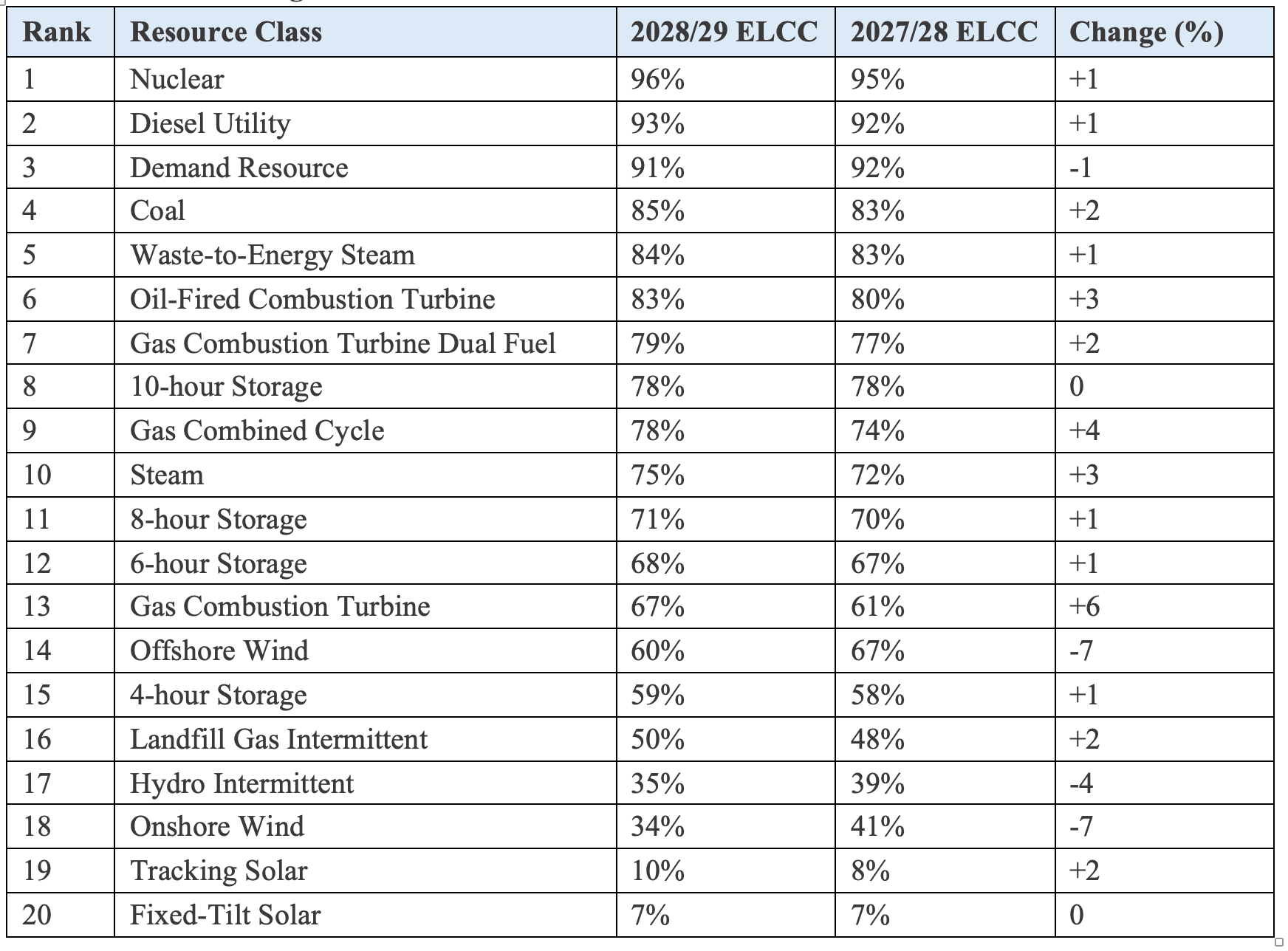
Note. From Bruno (2026). Installed Reserve Margin, Forecast Pool Requirement, and Effective Load Carrying Capability (ELCC) for 2028/2029 BRA, February 19, 2026. Values are PJM class ratings for the 2028/29 and 2027/28 Base Residual Auctions. Rank is based on 2028/29 ELCC. Change is shown in percentage points. ELCC means effective load carrying capability.
Table 2
Large Load Characteristics and Risks Mapping
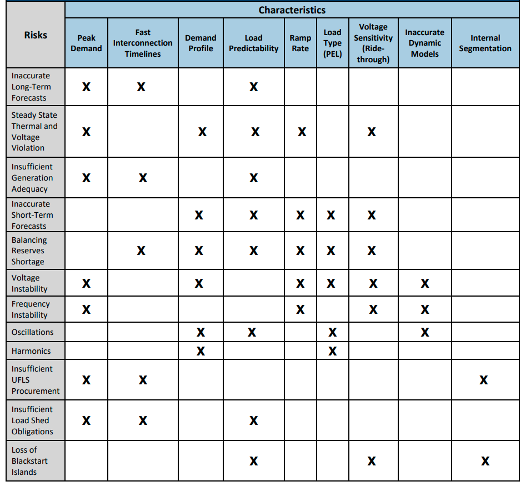
Note. Table 2 shows a mapping of large load characteristics to the risk that it causes or is related to. It should be noted that each large load may have a unique mix of characteristics. Additionally, each characteristic may have different thresholds for causing risks depending on the system and local area it connects to. PEL stands for power electric loads; UFLS stands for under-frequency load shed. From NERC (2025a).
[1] In a hearing before the Senate Committee on Commerce, Science, and Transportation on May 8, 2025, OpenAI CEO Sam Altman testified that “[e]ventually the cost of intelligence, the cost of AI will converge to the cost of energy, and it'll be how much you can have. The abundance of it will be limited by the abundance of energy. So, in terms of long-term strategic investments for the US to make, I can't think of anything more important than energy chips and all the other infrastructure also. But energy is where this, I think, this ends up” (Lima-Strong, 2025; U.S. Senate Committee on Commerce, Science, and Transportation, 2025).
[2] “Hyperscale data centers,” or similarly “hyperscalers” are frequently used terms which may have various meanings. For this report, hyperscale data center means a large cloud, AI, or colocation facility or campus whose expected electric demand is large enough to require dedicated utility planning, interconnection study, or new generation/transmission/distribution investment.
[3] In World War I, British foreign secretary Lord Curzon famously observed that the Allies had “floated to victory on a wave of oil,” underscoring the extent to which modern military success depended on fuel supply (Gliech, 2015). Historians make a similar point about World War II, noting that the United States produced roughly 60% of the world’s crude oil and that campaigns such as the Allied “Oil Plan” against German petroleum, oil, and lubricant capacity were strategically decisive (Air University History Office, 2019; Martin, 2018).
[4] Firm power is defined as “[p]ower or power-producing capacity, intended to be available at all times during the period covered by a guaranteed commitment to deliver, even under adverse conditions” (U.S. Energy Information Administration, n.d.).
[5] China began construction on 94.5 GW of new coal capacity in 2024, a ten-year high, while approving an additional 67 GW (Reuters, 2025; Qin & Shearer, 2025). The International Energy Agency (IEA) likewise describes coal as central to China’s energy security strategy, noting that China accounts for 56% of global coal consumption and that roughly one of every three tonnes of coal consumed worldwide is burned in Chinese power plants, making China and its power sector the single largest driver of global coal demand (IEA, 2025b).
[6] Estimates are built from different methods and assumptions and as such may span a wide range. Utility and regional forecasts are built from customer requests, announced projects, and local planning assumptions (Wilson et al., 2025). Estimates based on interconnection queues may overstate projected loads due to jurisdiction-shopping from developers (NERC, 2025a; Wilson et al., 2025).
[7] The AI supercomputer dataset from Pilz et al. captures only a subset of total global AI-supercomputer capacity. Pilz et al. report that coverage varies across companies, sectors, and hardware types, but state that country-level distribution is likely more robust because it was cross-checked against other data.
[8] Effective Load Carrying Capability is a probabilistic estimate of a generator’s contribution to resource adequacy (that is, how much additional load a generation resource can reliably support without increasing the system’s expected reliability risk) (Pham et al., 2024).
[9] Nameplate capacity means the maximum rated output of a generator under specified conditions. It does not describe how much dependable capacity the system can count on during peak or stressed hours.
[10] Capacity credit means the amount of a resource’s nameplate capacity that planners count towards meeting reliability needs during peak periods or periods of system risk.
[11] Load factor is “the ratio of average to maximum load for some specified period” (U.S. Energy Information Administration, n.d.).
[12] “Behind-the-meter” is a term used to describe generation or storage assets located on the customer’s side of the utility meter, which are not transmitted through the bulk power system (U.S. Department of Energy, n.d.; Power-Sonic, n.d.).
[13] The intensity of data center concentration in Northern Virginia appears to be driven by federal government demand as well as other factors such as fiber infrastructure, comparatively cost-effective power, available land, state tax incentives, and proximity to other major national customers (Joint Legislative Audit and Review Commission, 2024).
[14] Notably, such risks were recently illustrated in a prominent example, the April 2025 blackout event on the Iberian Peninsula. The European Network of Transmission System Operators for Electricity (ENTSO-E) and other researchers found that many of the same challenges mentioned above, including voltage control, oscillatory events, and “a lack of sufficient synchronous reactive power absorption capacity,” figured prominently in the causes of the blackout (ENTSO-E, 2026; Rouco et al., 2026).
[15] “The rapid rise of AI and data-driven computation is ushering in a new class of fast-ramping, logic-driven electrical loads that threaten to destabilise [sic] modern power systems, particularly those dominated by IBRs” (Al Kez & Foley, 2025).
[16] “The irregularity, intermittency, and nonlinearity of solar power generation can affect the utility grid voltage stability during peak load demand… Based on the rapid increase in the adoption of renewable energy sources instead of conventional energy sources, there will be an impact on the stability and dynamic performance of power systems” (Ebrahim et al., 2023).
[17] “With the increasing load variability and high penetration of renewable energy resources with intermittent nature, such as wind generation, forced oscillation events are becoming more frequent and more severe” (Alshuaibi et al., 2022).
[18] “[O]wing to the increased adoption of photovoltaic and wind resources connected to the grid via power electronic converters …harmonic stability [concerns] have become crucial” (Cho et al., 2017).
[19] “Front-of-meter” is a term used to describe large-scale resources on the utility’s side of the meter and which operate on the bulk power system, such as power plants managed by a utility (U.S. Department of Energy, n.d.; Power-Sonic, n.d.).
[20] Agencies could identify site properties such as the available acreage, existing transmission and distribution access, water and wastewater options, environmental remediation needs, security constraints, and whether co-located firm generation is feasible.
[21] The legislation defines a “nationally significant infrastructure facility” in section 101 of CERCLA to include semiconductor facilities, critical mineral facilities, artificial intelligence, and energy generation (U.S. House of Representatives, Committee on Energy and Commerce, 2026).
Resources