April 16, 2026
Hand-Marked Paper Ballots vs. QR Codes: Implications for Election Security
Hand-Marked Paper Ballots secure Our Elections
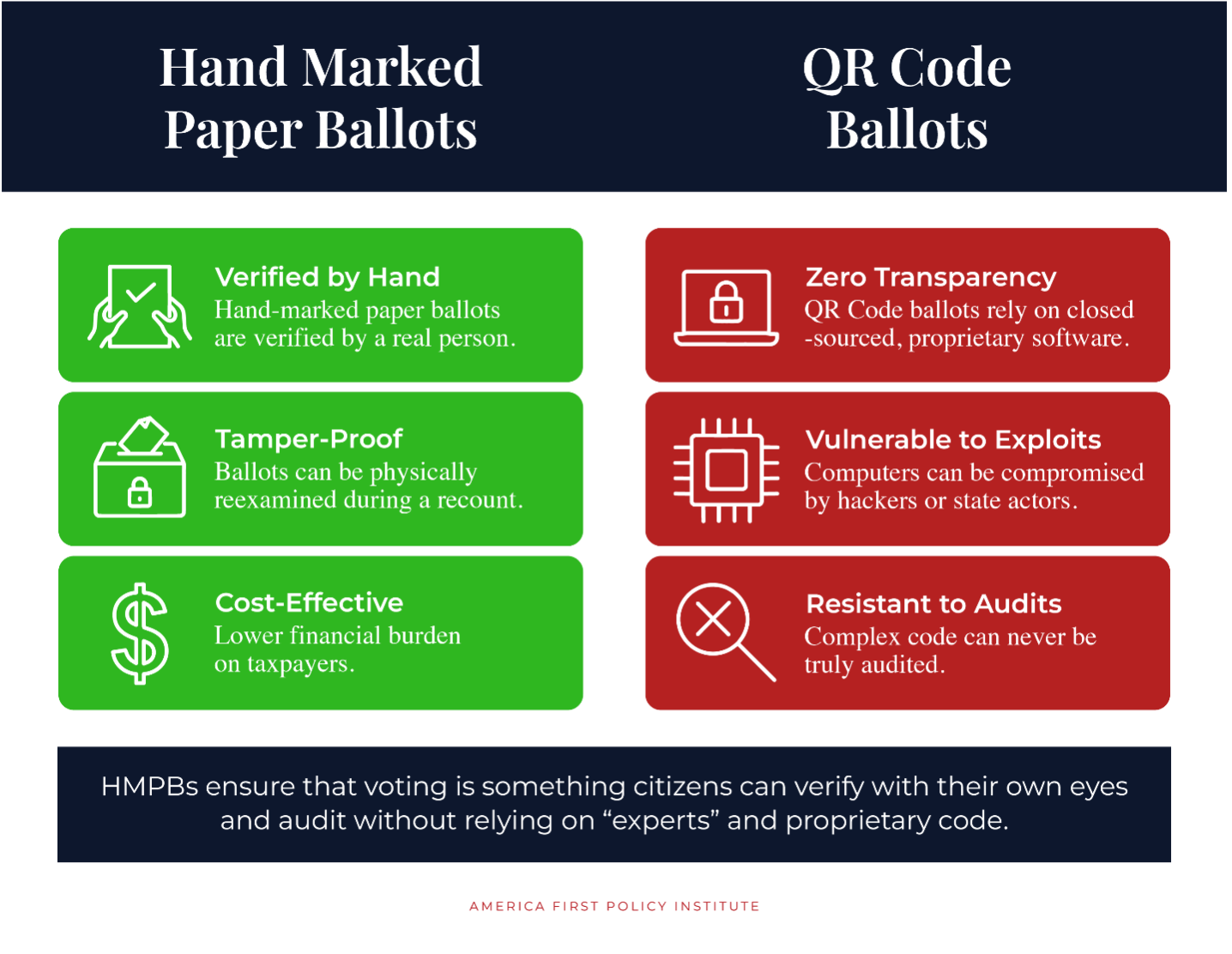
Unlike hand-marked paper ballots (HMPBs), which are read and tabulated based on human-readable marks that voters, auditors, and election officials can all visibly verify, QR-code based ballot-marking devices (BMDs) create uncertainty between what a voter can see and what the machine actually counts. When comparing HMPBs and BMDs, there are significant differences in security standards, auditability, cost, administrative burden, and voter experience.
SECURITY STANDARDS
A strong and secure voting system should be software-independent, contestable, and defensible—three fundamental criteria identified by cybersecurity and election security researchers from Princeton, Georgia Tech, and UC Berkeley.
- Software Independence: Errors must be detectable and correctable without relying on the same software that may have failed. HMPBs meet this standard because their marks are independent of software and cannot be changed by it, serving as physical proof of voter intent.
- Contestability: Voters and auditors must show that votes were recorded incorrectly when necessary. HMPBs meet this standard because their human-readable marks make it possible to demonstrate discrepancies, while QR codes limit this ability because they depend on software.
- Defensibility: Election officials must be able to show that the reported winners really won. HMPBs meet this standard because physical records can be audited to confirm results, while QR codes cannot be independently verified.
AUDIT ACCURACY
- Post-election audits are one of the most important tools available to confirm that tabulation matched the voter intent. If the record is human-readable, auditors can compare the paper ballots to the reported outcomes and confirm whether the scanners counted correctly.
- When the system depends on unreadable QR codes or barcodes, auditors may be able to confirm that the scanner read the code consistently, but that is not the same as confirming that the code accurately reflected the voter’s intent in the first place.
COST-EFFECTIVENESS AND ADMINISTRATIVE BURDEN
- QR code systems with BMDs can cost twice as much to implement and maintain as HMPBs.
- HMPBs reduce administrative burden by requiring only a few scanners compared to fleets of touchscreens.
VOTER VERIFICATION AND USABILITY
- Studies show that voters using touchscreen BMDs fail to recognize over 93% of errors deliberately introduced on printed ballots.
- Federal usability research finds that voting time on BMDs is comparable to HMPBs, refuting claims that touchscreens improve speed or accuracy.
STATUS QUO AND NATIONAL DIRECTION SHIFT
- Nearly 70% of U.S. voters live in jurisdictions already using HMPBs as their primary voting method.
- States like Georgia and major jurisdictions in Texas are phasing out QR code systems in favor of HMPBs over security and cost concerns, consistent with Trump’s Executive Order 14248 in 2025.
- Federal authorities, such as the Federal Bureau of Investigation (FBI), have alerted the public as recently as July 2025 to the risks of scanning QR codes, warning that encoded data can disguise malware and fraud not visible to the human eye—making these systems unsuitable for voting.