August 10, 2026
South Dakota: The Great American Comeback
This report was prepared with the support of OFRA AI tools. Data as of July 30, 2026.
$1,731
Average Working Families Tax Cuts for South Dakota joint filers with 2+ children (tax year 2025)
81%
of South Dakota’s electricity from homegrown renewable resources in 2024—the Nation’s second-highest share
4th
state in the Nation to opt in to the OBBB’s federal school choice tax credit
807
deportations processed by South Dakota National Guard soldiers in partnership with ICE
The Economy: The Nation’s Lowest Unemployment Meets the Working Families Tax Cuts
South Dakota shows what pro-growth policy delivers: no state income tax, the Nation’s lowest unemployment rate, an economy that just topped $80 billion for the first time—and now the largest federal tax relief for working families in a generation under the Working Families Tax Cuts (WFTC), enacted as the One Big Beautiful Bill (OBBB) and signed July 4, 2025.
- South Dakota’s unemployment rate fell to 2.0% in June 2026—the lowest in the Nation and roughly half the U.S. rate of 4.2% (Bureau of Labor Statistics [BLS], 2026a). More of its people are on the job: Labor force participation stood at 67.0% in June, about five points above the national rate (BLS, 2026b, 2026c).
- The state economy topped $80 billion for the first time in 2025 and stood at an $82.5 billion annual rate, in current dollars, in the first quarter of 2026 (Bureau of Economic Analysis [BEA], 2026a)—and in the third quarter of 2025, South Dakota posted the second-largest real GDP increase of any state, led by agriculture (BEA, 2026b).
- South Dakota’s tax climate is nearly unbeatable: one of only two states with no individual income tax, no corporate income tax, and no gross receipts tax, it ranks #2 overall on the Tax Foundation’s 2026 State Tax Competitiveness Index—with perfect #1 rankings on both the individual and corporate income tax components, perfect scores because it levies neither tax (Tax Foundation, 2026a).
- Federal reform: The WFTC delivers no tax on tips (up to $25,000), no tax on overtime (up to $12,500/$25,000 joint), a $2,200 Child Tax Credit (Internal Revenue Service [IRS], 2026a), a new $6,000 senior deduction, and a deduction of up to $10,000 in car-loan interest on U.S.-assembled vehicles (IRS, 2025). Counting the full bill—including permanence of the 2017 tax cuts and business provisions—the Tax Foundation estimates the average South Dakota filer saves $3,638 in 2026 (Tax Foundation, 2026b)—and the relief looms larger still as a share of taxes owed: by a separate Heritage Foundation estimate, the average filer in the median state keeps about 15.8% of what they would otherwise pay (Brashers, 2025).
- AFPI has modeled the WFTC state by state: the new worker-focused provisions alone—one slice of the broader $3,638 full-bill relief—save the average South Dakota filer $867 for tax year 2025, rising to $1,164 for families with children, $1,731 for joint filers with two or more children, and $1,357 for seniors. A South Dakota single mother working as a home health aide keeps an estimated $696—more than double the $295 the same worker keeps in high-tax Illinois on nearly the same wage (America First Policy Institute [AFPI], Office for Fiscal and Regulatory Analysis, 2026a, 2026b).
- The OBBB is built for farm and ranch country: it makes the 20% small-business deduction permanent, locks in a $15 million death tax exemption—indexed for inflation—so family farms and ranches pass to the next generation, makes 100% immediate expensing permanent, and pours $62 billion into the farm safety net and crop insurance. All told, AFPI estimates the bill cuts taxes for farmers by more than $10 billion (AFPI, 2025b)—and finds the bill’s manufacturing investment incentives, led by permanent full expensing, are expected to add 1.2% to long-run GDP (AFPI, 2025c).
- Paychecks stretch further in South Dakota: Overall prices ran about 11% below the national average in 2024—with rents about 32% lower (BEA, 2026c; BEA, 2026d; BEA, 2026e)—and, as of April 2026, South Dakotans pay about 23% less for electricity (U.S. Energy Information Administration [EIA], 2026a).
Energy: Reliable, Affordable Power from South Dakota’s Rivers and Corn Fields
President Trump’s Executive Orders 14154 (Unleashing American Energy) and 14156 (Declaring a National Energy Emergency) put reliable, affordable energy back at the center of federal policy (Exec. Order No. 14154, 2025; Exec. Order No. 14156, 2025)—and the orders’ definition of energy expressly covers hydropower and biofuels, two of South Dakota’s signature strengths: the Missouri River’s dams anchor the state’s grid, and its corn crop makes it the Nation’s fourth-largest ethanol producer by capacity (EIA, 2025a; EIA, 2025b).
Note: Shares are rounded and may not sum to 100%; renewable resources, including other renewables, supplied 81% of 2024 generation.
- The Missouri River is the dispatchable backbone of the state’s power supply: Four of the six major Missouri River hydroelectric dams sit in South Dakota—including Oahe Dam near Pierre, whose 231-mile lake is the fourth-largest man-made reservoir in the country—and hydropower supplied 21% of in-state generation in 2024 (EIA, 2025a).
- Power is affordable: Residential electricity averaged 14.52 cents per kilowatt-hour in April 2026—about 23% below the national average of 18.83 cents (EIA, 2026a).
- Corn becomes fuel: South Dakota is the Nation’s fourth-largest fuel ethanol producer by capacity, with 16 plants able to produce about 1.5 billion gallons a year (EIA, 2025b)—homegrown fuel squarely within the executive orders’ energy agenda.
- Wind rounds out the homegrown mix: Wind farms—25 of them, with 3,450 megawatts of capacity as of mid-2025—supplied 59% of in-state generation in 2024, the second-largest share in the Nation, behind only Iowa. Together, water and wind supplied nearly all of the 81% of the state’s generation that came from renewable resources in 2024—a share second only to Vermont’s (EIA, 2025a).
- Federal reform: The national energy agenda is delivering: U.S. crude oil production set another all-time record of 13.6 million barrels per day in 2025 (EIA, 2026b), the Interior Department disbursed $14.61 billion in fiscal year 2025 federal energy revenues (U.S. Department of the Interior, 2025), and AFPI’s analysis details the OBBB’s wins for American energy dominance (AFPI, 2025a).
Education: South Dakota Families Are First in Line for Federal School Choice
The OBBB created the first-ever federal school choice program—a $1,700 federal tax credit for donations to scholarship-granting organizations (IRS, 2026b), a program that starts in 2027 (South Dakota Searchlight, 2025)—and South Dakota did not wait, becoming the fourth state in the Nation to opt in. Combined with one of the country’s freest homeschool traditions and students who outperform the Nation on the report card that matters most, parental empowerment is gaining ground in South Dakota.
- On November 14, 2025, at St. Joseph Academy in Sioux Falls, Gov. Rhoden announced South Dakota would join the OBBB’s federal scholarship tax credit—the fourth state in the Nation to commit. South Dakotans will be able to redirect up to $1,700 of their federal tax bill to scholarship organizations serving public, private, and homeschool students (South Dakota Searchlight, 2025); by July 2026, 30 states had signed up (IRS, 2026b, 2026c).
- The federal dollars will multiply the state’s existing program: The Partners in Education Tax Credit Program provided scholarships to 1,771 students at 48 participating schools in 2024–25, but its $5 million annual cap limits it to about 1% of South Dakota’s K–12 students (EdChoice, 2026)—the new federal credit adds capacity without costing the state budget a dime.
- Homeschool freedom runs deep: South Dakota legalized “alternative instruction” in 1939, imposes no instruction-time, parent-qualification, or testing mandates, and guarantees homeschooled students part-time access to public school courses and activities—and participation has roughly tripled since 2000, to about 6% of the state’s K–12 students (Johns Hopkins University Institute for Education Policy, 2026).
- The results hold up: South Dakota students beat the national average on three of the four core tests on the 2024 Nation’s Report Card—including 4th-grade math, where 42% scored at or above proficient versus 39% nationally (National Center for Education Statistics, 2025), an improvement over 2022—and matched the Nation on the fourth (South Dakota Department of Education, 2025).
- AFPI helped build the school choice wave: beginning in early 2022, AFPI’s Center for Education Opportunity produced more than 20 research reports, state-specific fact sheets, and model ESA legislation as universal school choice swept the states (AFPI, 2023).
- Federal reform: Workforce Pell Grants took effect July 1, 2026, opening federal aid for short-term skills credentials (U.S. Department of Education, 2026), and Executive Orders 14190, 14191, and 14242 expand education freedom and return authority over education to the states (Exec. Order No. 14190, 2025; Exec. Order No. 14191, 2025; Exec. Order No. 14242, 2025).
Safer Communities: Operation Prairie Thunder Is Taking Criminals Off South Dakota’s Streets
South Dakota’s communities are getting safer on two fronts: Overdose deaths are falling, and the state’s Operation Prairie Thunder puts state troopers, corrections officers, and National Guard soldiers to work alongside U.S. Immigration and Customs Enforcement (ICE)—including under five 287(g) agreements signed by state and county agencies (KOTA Territory News, 2025; South Dakota Searchlight, 2026a). South Dakota helped write the playbook: then-Gov. Kristi Noem sent the South Dakota National Guard to the Texas border five times (KOTA Territory News, 2024) before going on to serve as President Trump’s secretary of homeland security (KOTA Territory News, 2025)—and the Trump Administration’s historic securing of the border is reinforcing the gains at home.
- The drug tide is receding: South Dakota overdose deaths fell to 83 in 2025 (provisional)—down from 94 in 2024 and a peak of 104 in 2021—with methamphetamine-related deaths cut in half in a single year—even as opioid-related deaths, the only category to increase, ticked up from 39 to 41 (South Dakota Searchlight, 2026b). Nationally, overdose deaths fell almost 14% in 2025, a third straight annual decline (Centers for Disease Control and Prevention, 2026).
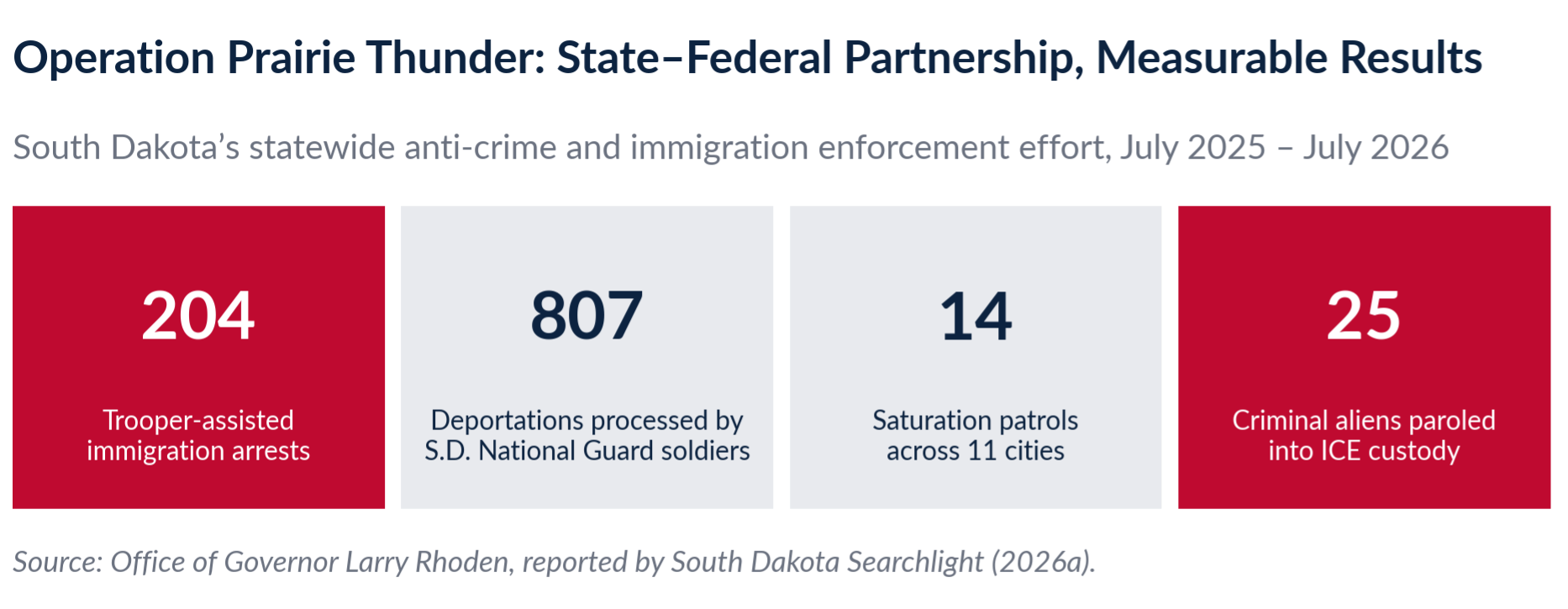
- Operation Prairie Thunder is delivering: Since July 2025, the Highway Patrol has run 14 saturation patrols across 11 cities, beginning in Sioux Falls; troopers have assisted in more than 204 immigration-related arrests; and Guard soldiers stationed in Sioux Falls and Rapid City have processed 807 deportations for ICE. The state has also paroled 25 criminal aliens directly into ICE custody—saving taxpayers an average of $34,000 per inmate each year, according to the Governor’s Office—and the Trump Administration is reimbursing the state’s costs, delivering $150,418 in July 2026 (South Dakota Searchlight, 2026a).
- Individual cases tell the story: DHS reports that in Sioux Falls, ICE arrested Herberth Orellana-Ventura, an illegal alien from El Salvador convicted of aggravated assault with a dangerous weapon (U.S. Department of Homeland Security [DHS], 2026b), and James Ayur Garang, an illegal alien from Sudan convicted of conspiracy to distribute a controlled substance—a conviction federal prosecutors announced in 2020 (DHS, 2026c; Tulsa Today, 2026; U.S. Department of Justice, 2020). A May 2025 worksite operation in Madison arrested eight illegal aliens at two manufacturers (U.S. Immigration and Customs Enforcement, 2025).
- A 2023 national study by the Federation for American Immigration Reform (FAIR) tallies the net fiscal burden of illegal immigration at $150.7 billion a year—by FAIR’s estimate, costs that fall heavily on state and local taxpayers for schooling, healthcare, and law enforcement—burdens South Dakota’s enforcement partnership with federal authorities is working to reduce (Federation for American Immigration Reform, 2023).
- The cartel pipeline that carried fentanyl and methamphetamine into South Dakota is being squeezed at both ends: In June 2026, federal prosecutors announced the dismantling of four major drug trafficking organizations connected to the Mexican cartels flooding the state with methamphetamine and fentanyl (Drug Enforcement Administration, 2026)—and at the source, Southwest border apprehensions in FY2025 totaled 237,538—the lowest level since 1970—versus roughly 1.6 million in FY2021 (House Committee on Homeland Security, 2025). In June 2026, monthly apprehensions (9,848) were 94% below the prior administration’s monthly average, and DHS reports 14 consecutive months of zero releases into U.S. communities (DHS, 2026d); DHS reports more than 675,000 removals in the Administration’s first year, plus an estimated 2.2 million self-deportations (DHS, 2026a).
Conclusion: South Dakota’s Formula, Federal Fuel
The Great American Comeback is compounding what South Dakota already does best. Federal tax relief worth $3,638 to the average filer lands in a state with no income tax and the Nation’s lowest unemployment rate; Washington’s reliable, affordable energy agenda backs a state whose rivers and corn fields already deliver 81% renewable generation and fourth-place ethanol capacity; the first-ever federal school choice dollars will flow to families in a state that raced to be fourth in line; and the state-federal enforcement partnership South Dakota helped pioneer—five National Guard deployments to the border, then Operation Prairie Thunder—is taking criminals off its streets while overdose deaths fall. South Dakota took the federal reforms and put them to work—and its families are collecting the dividend.
References