August 3, 2026
MICHIGAN: THE GREAT AMERICAN COMEBACK
A profile of Michigan’s 7th Congressional District | August 2026 | This report was prepared with the support of Office for Fiscal and Regulatory Analysis AI tools.
$2,162
Average Working Families Tax Cuts for joint filers with 2+ children in Michigan’s 7th District
1st
Restart of a commercial nuclear reactor in decommissioning—underway at Michigan’s Palisades
$1,700
New federal scholarship tax credit Michigan families can claim if the state opts in
48
Opioid-related overdose deaths among Ingham County residents in 2024—down from 98 in 2023, cut in half in a single year
The Economy: The Working Families Tax Cuts Land Where America Builds Its Cars
The Working Families Tax Cuts (WFTC)—enacted as the One Big Beautiful Bill (OBBB) and signed July 4, 2025—deliver what supporters call the largest federal tax relief for working families in a generation, and their provisions matter most in auto states: permanent 100% expensing for factories and equipment, plus a new deduction for interest on loans for U.S.-assembled vehicles—the vehicles the Lansing region builds. The America First Policy Institute’s (AFPI) Office for Fiscal and Regulatory Analysis (OFRA) estimates the law’s new worker-focused provisions alone save mid-Michigan’s biggest beneficiaries—joint filers with two or more children—an average of $2,162 for tax year 2025 (AFPI, OFRA, 2026b).
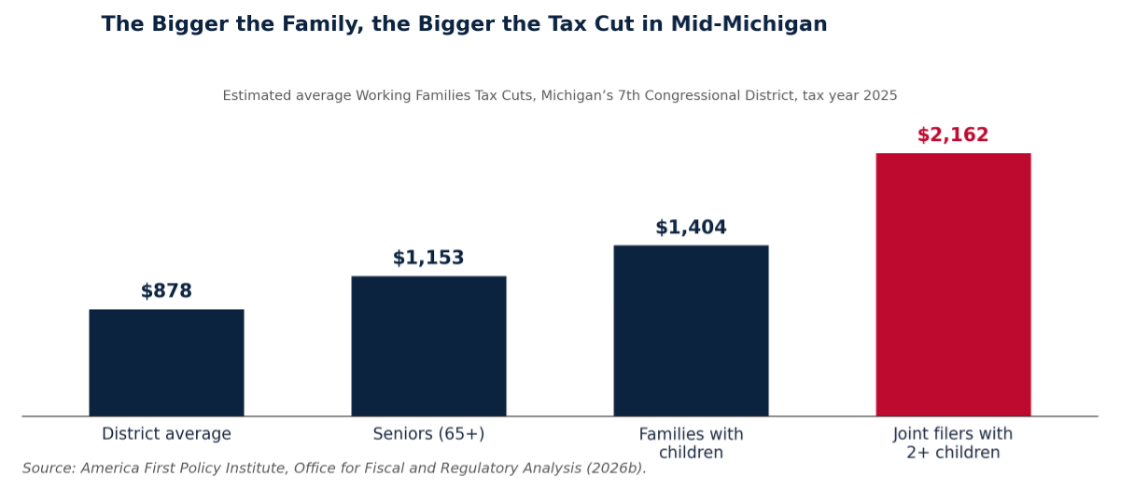
Figure 1. Estimated Average Working Families Tax Cuts Savings by Household Type, Michigan’s 7th Congressional District, Tax Year 2025. Source: AFPI, OFRA (2026b).
- Cadillac is committed to Lansing: In October 2025, General Motors (GM) confirmed the next-generation Cadillac CT5—a gas-powered sedan—will be built at Lansing Grand River Assembly, and said it is moving ahead with the $1.25 billion investment it first committed in 2023, funding a state-of-the-art paint shop transformation, new conveyors, and upgraded welding and control systems (GM Authority, 2025; WKZO, 2025). Lansing Grand River and GM’s Lansing Delta Township plant in Eaton County anchor the district’s manufacturing base.
- More gas-powered vehicles are coming back to Michigan: GM said in June 2025 it is investing about $4 billion in its U.S. plants—including Orion Assembly in nearby Oakland County, which will begin building gas-powered full-size SUVs and light-duty pickups in early 2027 (General Motors, 2025).
- Federal reform: The WFTC delivers no tax on tips (up to $25,000), no tax on overtime (up to $12,500/$25,000 joint), a $2,200 Child Tax Credit, a new $6,000 senior deduction, and a deduction of up to $10,000 in car-loan interest on U.S.-assembled vehicles (Internal Revenue Service [IRS], 2025, 2026a). The Tax Foundation estimates the average Michigan filer saves $3,131 in 2026 (Tax Foundation, 2026)—and the relief looms even larger as a share of taxes owed: the average filer in the median state keeps about 15.8% of what they would otherwise pay (Brashers & O’Quinn, 2025).
- AFPI has modeled the WFTC district by district: The new worker-focused provisions alone—one slice of the broader $3,131 full-bill average, which also counts permanence of the 2017 tax cuts and business provisions—save the average 7th District filer $878 for tax year 2025, more than the $765 statewide average, rising to $1,404 for families with children, $2,162 for joint filers with two or more children, and $1,153 for seniors. A Lansing-area nurse who works overtime keeps an estimated $2,159—about 76% more than the $1,227 a similar nurse saves in Illinois at a nearly identical wage (AFPI, OFRA, 2026a, 2026b, 2026c).
- Incomes are rising—and the job market needs the OBBB’s factory boost: Per capita personal income reached $66,556 in 2025, up 4.1% before inflation (Bureau of Economic Analysis [BEA], 2026a). Michigan’s unemployment rate stood at 5.0% in June 2026—a slight monthly downtick that came as the state’s labor force shrank—but it still runs above the U.S. rate of 4.2%—roughly the same gap as at the close of the Biden Administration, when Michigan stood at 5.0% against a national 4.1% in December 2024 (Michigan Department of Technology, Management & Budget [DTMB], 2025, 2026; Michigan Public, 2026a; U.S. Bureau of Labor Statistics, 2026). Closing that gap is exactly what the OBBB’s permanent 100% expensing for factories, equipment, and research is for—AFPI’s analysis finds it adds an expected 1.2% to long-run GDP (AFPI, 2025b).
- Paychecks stretch further in Michigan: Overall prices run about 3.8% below the national average—with rents about 17.7% lower (2024 data) (BEA, 2026b, 2026c). Stack thousands of dollars in federal tax relief on below-average prices, and affordability becomes a mid-Michigan advantage.
Energy: America’s First Nuclear Plant Restart Is Happening in Michigan
President Trump’s Executive Orders 14154 (Unleashing American Energy) and 14156 (Declaring a National Energy Emergency) put reliable, affordable energy back at the center of federal policy, and Executive Order 14302 (Reinvigorating the Nuclear Industrial Base) directs an American nuclear renaissance (Exec. Order No. 14154, 2025; Exec. Order No. 14156, 2025; Exec. Order No. 14302, 2025). Michigan hosts that renaissance’s signature project—the federally backed restart of the Palisades nuclear plant on Lake Michigan—on top of the Nation’s largest natural gas storage network.
- History is being made at Palisades: Holtec International’s 800-megawatt (MW) Palisades plant in Covert Township is, in the U.S. Department of Energy’s (DOE) words, “America’s first restart of a commercial nuclear reactor in decommissioning.” DOE has disbursed nearly half a billion dollars of a federal loan guarantee of up to $1.52 billion, and the Nuclear Regulatory Commission (NRC) has approved the licensing actions returning the plant from decommissioning status to operations (DOE, 2025). In July 2026, Holtec closed out the last major restart projects and shifted to final testing and readiness work ahead of fuel load—and although no firm restart date has been announced, the plant’s power is under contract by March 2027 (Holtec International, 2026; American Nuclear Society, 2026b).
- The next wave is already filed: Holtec plans two of its SMR-300 small modular reactors at the Palisades site, submitting the first part of a construction permit application on December 31, 2025; the NRC accepted it for review in February 2026 (American Nuclear Society, 2026a; NucNet, 2026).
- Michigan is America’s natural gas storehouse: The state’s underground storage fields can hold about 688 billion cubic feet of working natural gas—the largest such capacity of any state and about one-seventh of the Lower 48 total—letting Michigan buy natural gas cheaply in summer and deliver it through Great Lakes winters (U.S. Energy Information Administration [EIA], 2026a, 2026b).
- The Line 5 tunnel is finally moving: Under the national energy emergency, the U.S. Army Corps of Engineers granted the Great Lakes Tunnel Project emergency processing in April 2025 (Oil & Gas Journal, 2025), and in July 2026 Michigan’s environmental agencies issued key state permits for the tunnel that will encase Line 5 beneath the Straits of Mackinac—a project supporters say protects the propane and fuel supplies Michigan households depend on, with additional state permitting and the Army Corps’ final sign-off still ahead (Michigan Public, 2026c).
- The district powers itself: Lansing’s municipally owned Board of Water & Light generates local power at the $500 million, 250-MW Delta Energy Park natural gas plant in Delta Township (American Public Power Association, 2022).
- Federal reform: Executive Order 14302 sets the goal of 10 new large reactors under construction by 2030 (Exec. Order No. 14302, 2025), and AFPI’s OBBB analysis notes the bill “maintains support to produce reliable nuclear energy through tax relief” (AFPI, 2025a). Nationally, U.S. crude oil production set another all-time record of 13.6 million barrels per day in 2025 (EIA, 2026c).
Education: Michigan Families Are Choosing—and $1,700 Federal Scholarships Are One Decision Away
Michigan parents already vote with their feet: About one in 10 students attends a charter public school, and the state’s homeschool law is among the freest in the country. Now the OBBB has created the first-ever federal tax-credit scholarship—a tax credit worth up to $1,700 for donations to scholarship-granting organizations (SGOs), effective January 1, 2027—and the biggest step between Michigan families and those scholarships is the governor’s decision to opt the state in; a participating state must then submit its list of qualified SGOs to the IRS. Opponents point to Michigan’s constitutional ban on aid to nonpublic schools, while supporters note the credit turns on private donations, not state funds (IRS, 2026b, 2026c; Chalkbeat, 2026a).
- School choice is mainstream in Michigan: In 2022–23 (the most recent year analyzed), 373 charter public schools served 150,486 students—10.5% of all Michigan students—and in Detroit more children in grades 3–12 attended school outside the city district than in it in 2021–22 (Data Driven Detroit, 2024). In the district, Ingham County’s charter public schools serve about 3,700 students (Public School Review, 2026).
- Homeschool freedom is a Michigan hallmark: The Home School Legal Defense Association classifies Michigan as a “no notice, low regulation” state—most homeschooling families never file paperwork with anyone, and no state testing is required (Home School Legal Defense Association, n.d.).
- Results are moving in the right direction: Michigan’s four-year graduation rate reached a record high of just over 84% for the Class of 2025, up from 82.8% the year before—and the Lansing School District posted a 94% graduation rate, up from 62.1% just four years earlier—even as work remains on college readiness (Michigan Department of Education, 2026; Chalkbeat, 2026b).
- Federal reform: As of July 24, 2026, 30 states had signed up for the OBBB’s federal scholarship tax credit—neighboring Indiana and Ohio among them—but Michigan has not. The State Board of Education urged the governor to stay out on a 6–2 vote; the resolution is advisory, and the decision rests with the governor (IRS, 2026b; Chalkbeat, 2026a). Meanwhile, Workforce Pell Grants took effect July 1, 2026, opening federal aid for short-term skills credentials (U.S. Department of Education, 2026), and Executive Orders 14190, 14191, and 14242 expand education freedom and return authority over education to the states (Exec. Order No. 14190, 2025; Exec. Order No. 14191, 2025; Exec. Order No. 14242, 2025).
- AFPI helped build this wave: Beginning in early 2022, AFPI’s Center for Education Opportunity produced more than 20 research reports, state fact sheets, and model education savings account legislation as universal school choice swept eight states (AFPI, 2023)—momentum Michigan families can now join through the federal scholarship program the moment the state opts in.
Safer Communities: Michigan’s Recovery Is Being Locked In—From Lansing to the Northern Border
Fentanyl reached every corner of Michigan—and mid-Michigan paid the price. Now the recovery is taking hold where families live: overdose deaths and violent crime are falling across Michigan, from Detroit to Lansing. Under the Trump Administration, federal enforcement—at Michigan’s own northern border crossings and across the state’s interior—has surged, which supporters say is reinforcing and locking in those hard-won gains.
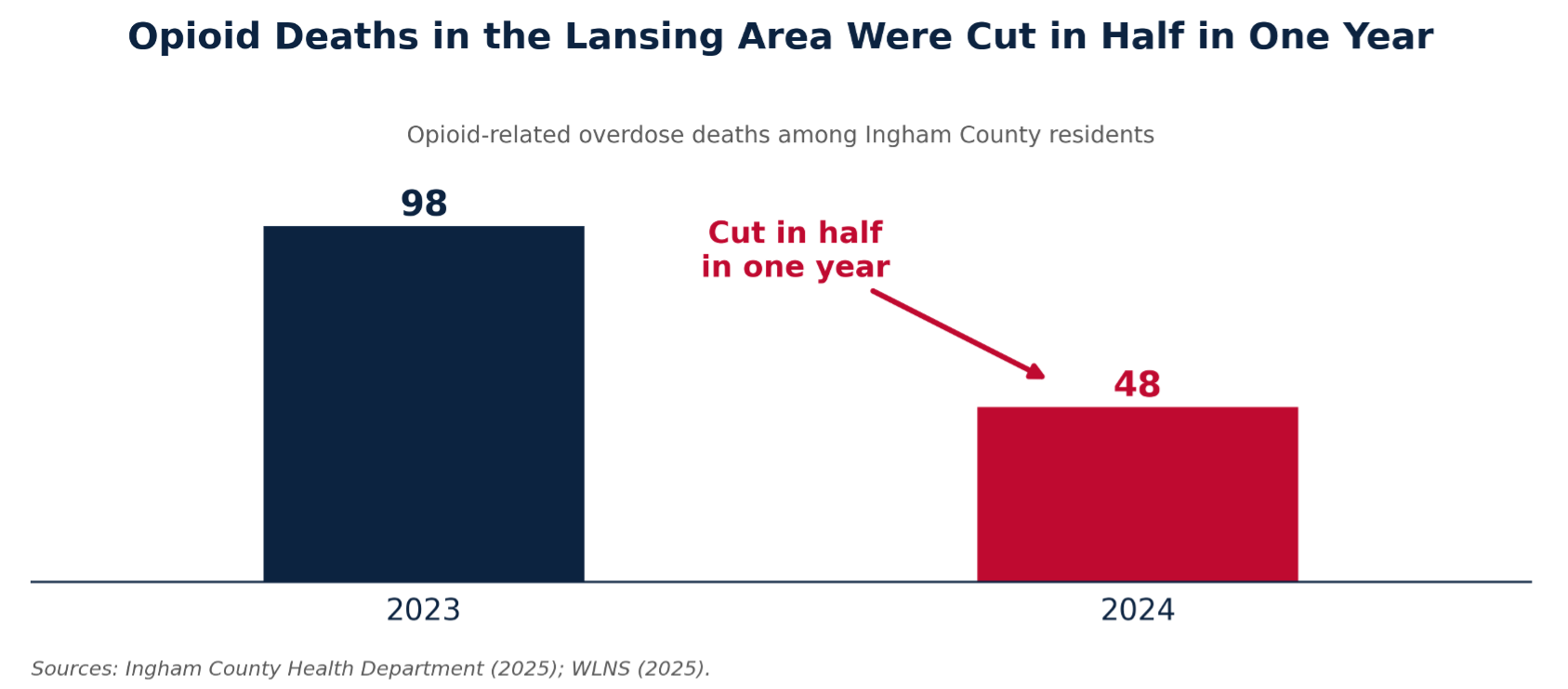
Figure 2. Opioid-Related Overdose Deaths Among Ingham County Residents. Sources: Ingham County Health Department (2025); WLNS (2025).
- The fentanyl tide is receding in mid-Michigan: Opioid-related deaths among Ingham County residents fell from 98 in 2023 to 48 in 2024—cut in half in a single year—and Lansing Fire Department naloxone runs fell for the second straight year (Ingham County Health Department, 2025; WLNS, 2025).
- Statewide progress: The overdose death rate has fallen 47% since 2021 (Michigan Department of Health and Human Services, 2026), with preliminary data projecting fewer than 2,000 deaths in 2024, down from nearly 3,000 annually at the height of the crisis (9&10 News, 2026). Nationally, overdose deaths fell almost 14% in 2025—a third straight annual decline (Centers for Disease Control and Prevention, 2026).
- Communities are safer: Detroit closed 2025 with 165 criminal homicides—down 19% in one year and 35% from 2023, and by city data the fewest since 1965—with nonfatal shootings down 26% and carjackings down 46% (Michigan Public, 2026b; City of Detroit, 2026; Kelly, 2026). In Lansing, homicides fell to seven in 2025, down from 26 at the city’s 2021 peak (Lansing State Journal, 2026).
- Michigan’s own border is producing results: U.S. Border Patrol’s Detroit Sector—covering 863 maritime miles of the northern border across Michigan and Ohio—recorded 681 narcotics seizures from fiscal year (FY) 2019 through March 2026, the most of any northern border sector, according to a Government Accountability Office review (Homeland Security Today, 2026). At the ports of entry, U.S. Customs and Border Protection (CBP) officers had seized more than 1,300 pounds of cocaine at Michigan crossings midway through FY2025, including a 116-pound load in an outbound commercial vehicle at the Ambassador Bridge (Guthrie, 2025), and in June 2026 pulled another 133 pounds—55 shrink-wrapped bricks hidden in a Canada-bound commercial truck—near the Blue Water Bridge in Port Huron, with the driver facing federal charges (Sherman, 2026).
- Interior enforcement is delivering in Michigan: U.S. Immigration and Customs Enforcement (ICE) arrests in the state nearly tripled—2,349 from January through October 2025, almost three times the same period in 2024—and deportations from Michigan nearly tripled last year (Bridge Michigan, 2026). The Federation for American Immigration Reform (FAIR), an immigration-reduction advocacy group, estimates illegal immigration costs Michigan taxpayers about $1.1 billion a year—including $955 million for education (FAIR, 2023). AFPI documented these costs in its Michigan immigration fact sheet (AFPI, n.d.).
- The national picture reinforces those gains: Southwest border apprehensions in FY2025 totaled 237,538—the lowest level since 1970 (House Committee on Homeland Security, 2025)—with the U.S. Department of Homeland Security (DHS) reporting 14 consecutive months of zero releases at the border (DHS, 2026; Athrappully, 2026)—a squeeze on the national fentanyl pipeline that supporters say is helping lock in Michigan’s gains.
Conclusion: The Comeback Is Accelerating in Mid-Michigan
The Great American Comeback is reaching the place where America builds its cars. Federal tax relief worth $3,131 to the average Michigan filer—and $2,162 to the district’s joint filers with two or more children—stacks on top of GM’s $1.25 billion bet on Lansing Grand River. America’s first restart of a commercial nuclear reactor in decommissioning is underway at Palisades while the Nation’s largest natural gas storage network sits under Michigan soil. New $1,700 federal scholarship tax credits await the state’s opt-in. And as enforcement surges—at Michigan’s own northern border crossings, across the state’s interior, and at the national border—the recovery is accelerating: Opioid deaths in Ingham County have been cut in half and Detroit murders have fallen to their lowest level since 1965. The federal reforms are on the table—mid-Michigan’s families are already collecting the returns.
References